We are in a bear market. The name of our game is to lose as little money as possible. That means:
1. No common stocks.
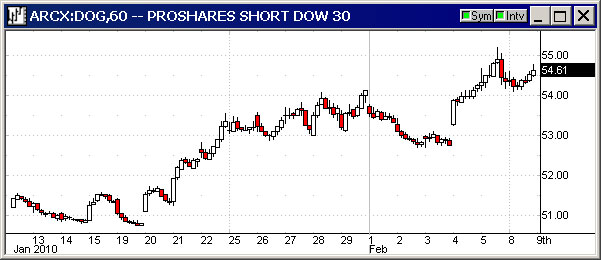
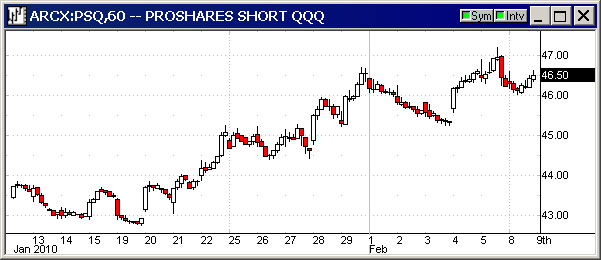
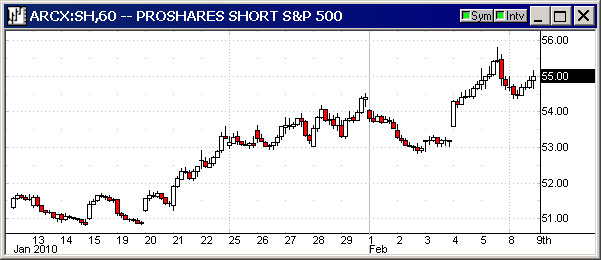
2. Shorts, if you wish. My favorites are the simplest– DOG (short the Dow), PSQ (short the Nasdaq QQQ), and SH (short the S&P 500). See below.
3. Cash is king.
4. Keep an eye out for something cheap locally — perhaps a foreclosed apartment or office building.
Maps of short EFTs recently:
High-yield savings from American Express: You can earn the giant return of 1.5% a year with American Express. There are restrictions, but remarkably few. Think old-time savings accounts at your local bank., though sadly no toasters.
Click here.
Ultra long-term predictions have few charms, but … Extended ultra-low interest rates do create boom and busts. We’ve lived through several in the last few years. Once again, we have ultra-low interest rates and a Fed that cares (as usual) naught for pricking bubbles. So what’s the next boom and bust? It’s not technology. It’s not commodities. It’s not real estate (housing and offices).
Here’s a guess from someone called Simon Hunt, who according to John Mauldin is an authority on copper and the Long Wave theory of cycles. Here are Hunt’s latest predictions.
+ Growth will slow in the first half of this year. It should recover late this year with a modest recovery likely in 2011.
+ The seeds of the next credit crisis have been sown by soaring government debt and monetary largesse. It may well be the need for a huge issuance of government loans that will cause the next credit crisis, starting around 2012 and reaching its apex in 2013.
+ A new global recession, part of the ongoing depression, will begin that year and last at least two years.
+ The world is unlikely to begin a new period of sustainable growth until 2018 at the earliest.
+ Until then, markets will remain volatile and should be traded rather than now making long-term investments.
Disgusted (again) with Wall Street. Shades of auction rate preferreds. From the New York Times.
State Street Gave Some of Its Clients Better Data
BOSTON — The State Street Corporation told some preferred investors in 2007 that one of its bond funds was almost entirely invested in subprime mortgage securities, allowing them to get out. Others were kept in the dark, costing them millions of dollars.
State Street’s selective disclosure came to light on Thursday (Feb 5) when it agreed to pay more than $310 million in penalties and restitution to settle accusations by the Securities and Exchange Commission and Massachusetts officials that it misled investors about risk associated with the bond fund and other funds that invested in it.
“State Street gave preferential treatment to some investors over others, leaving many investors — including dozens of Massachusetts charities and retirement funds — completely unaware of key facts about the funds,” the attorney general, Martha Coakley, said in a statement.
According to a complaint filed by the S.E.C., State Street set up the Limited Duration Bond Fund in 2002 and marketed it as an alternative to a money market fund. By 2007, however, the fund was almost entirely invested in subprime securities. State Street misled many investors about the fund’s exposure, the S.E.C. said, but provided particular investors with more complete information.
Those investors included clients of State Street’s internal advisory groups, which advised some investors in the fund. The advisory groups recommended that their clients, including State Street’s own pension plan, redeem their investments. State Street sold the most liquid holdings to meet these redemptions, the S.E.C. said, leaving the remaining investors with largely illiquid holdings.
The funds, which were managed by State Street Global Advisors, accounted for about $13 billion of State Street’s funds under management in 2007.
The settlement will be allocated among about 270 investors who lost money. It includes a $50 million fine and $8 million in forfeited advisory fees and interest. The payment is in addition to $350 million the bank will pay to settle private claims, the S.E.C. said. The bank will pay an additional $20 million to settle with Massachusetts authorities. …
Commodities continue to suck. If I had held my commodities fund, I’d be down by 9.30% so far this year to February 5. It seems to me that this commodities game is too difficult for ordinary people like you and me. There are four reasons we’re not smart enough:
1. The Chinese are messing with commodities. We know they stockpiled copper last year. They probably stockpiled other stuff also. I figure they see
2. The factories ran down their inventories for much of last year and then built them up in the last quarter, thus accounting for the alleged near-6% GDP growth in the fourth quarter. so, right now, the factories are selling out.
3. Despite the Great Recession and the closure of many mines, there’s still an overcapacity in many minerals, like copper, zinc, bauxite, etc.
4. Finally, I don’t think it’s possible to compete with hedge funds, who are in and out of commodities from one moment to the next.
Mercedes dumbs further down. Mercedes advertises superior engineering. Yup. Here’s a sample: When you change a tire on many Mercedes cars you can not use the lug nuts that you just removed. You have to root around your trunk and find a little plastic baggie of five shorter (but same diameter) nuts and use those. If you use the ones that you just took off they will stick out and destroy your brake. The repair will cost you $1,500+.
Every time I write about my awful experiences with Mercedes cars, readers inundate me with their horrible experiences. You are warned.
My computer just crashed. It’s not a major issue.
Computerworld. Feb 8, 2010: Some Windows 7 users have reported that their PCs started to freeze or randomly display the infamous “Blue screen of death” after applying a January update Microsoft billed as “a stability and reliability fix.”
Microsoft today said it doesn’t consider the problem a “major issue,” but acknowledged it’s investigating.
Computer Repair Hot Line:
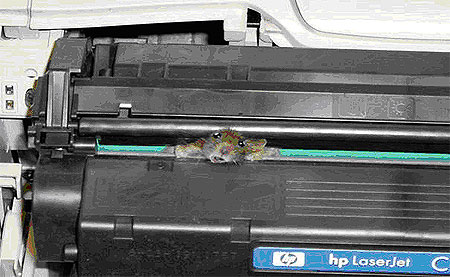
Caller: Hi, our printer is not working.
Customer Service: What is wrong with it?
Caller: Mouse is jammed.
Customer Service: Mouse? Printers don’t have a mouse you fool!
Caller: Mmmmm??.. Oh really?… I will send a picture.
Need a day off? From somewhere in Kansas comes this priceless story:
I urgently needed a day off work, but I knew the Boss would not allow me to take leave. I thought if maybe I acted ‘crazy’ he would tell me to take off a few days. So, I hung upside down on the ceiling making funny noises.
My co-worker (who is blonde) asked me what I was doing. I told her that I was pretending to be a light bulb, so that the Boss might think I was ‘crazy’ and give me a few days off.
A few minutes later the Boss came into the office and asked, “What in the name of God are you doing?”
I told him I was a light bulb.
He said, “You are clearly stressed out. Go home and recuperate for a couple of days.” I jumped down and walked out of the office.
When my co-worker (the blonde) followed me out the door, the Boss asked her, “…And where do you think you’re going?”
She said, “I’m going home. I can’t work in the dark..”

Harry Newton, ever fearful of Wall Street, adores the few shekels he gets each month from a couple of apartments he owns.

While I loved the Telecom Dictionary, this is even more of a lift as I work in a home office by myself. I don't know how you keep coming up with it. Wow. Much reverence!