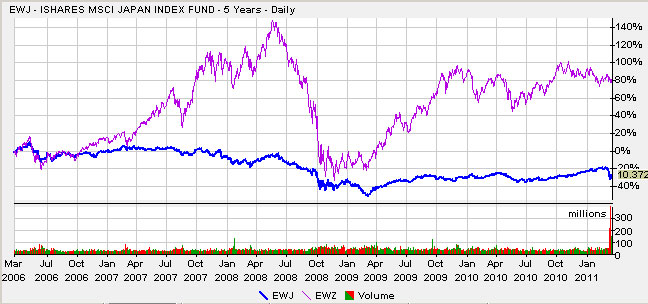
I’m not betting for, or against Japan. It’s too complex. There are too many unknowns. It’s too sad. And there are better places to gamble on. Here’s Japan (EWJ) compared to Brazil (EWZ) over the past five years.
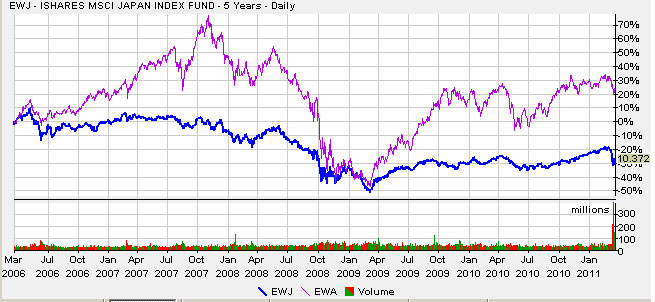
Here’s Japan compared to Australia (EWA):
The Wall Street Journal has a piece on investing in Japan. It mentions ultrashort funds. I have written extensively on ultrashort ETFs. Conclusion: These things do not work. Never buy an ultrashort ETF — unless it’s for a one day trade. End of story. Here’s the Wall Street Journal.
Some Investors Are Betting That Japan Will Rise Again
By JASON ZWEIG
Anyone with a heart has been transfixed by the catastrophe in Japan. But, for as long as there have been markets, investors have traded on tragedy, and this one is no exception.
Almost $1.2 billion in new money flowed from Tuesday through Thursday this week into exchange-traded funds that buy Japanese stocks, according to TrimTabs Investment Research. These buyers are betting that the selloff in Japanese stocks was an emotional over-reaction.
Others are betting against Japan, at least in the short run. The ProShares UltraShort MSCI Japan fund took in $45 million of new money from Tuesday through Thursday, nearly quintupling in size in three days, according to TrimTabs. This fund aims to go up twice as much as the Japanese market goes down on a given day.
Your conscience alone may keep you from investing in Japan, lest you feel you are exploiting other people’s suffering in a still-unfolding disaster. Many other factors might give you pause, including an aging population, massive deficit spending by the government, an overvalued currency and the lingering memory of what 20 years ago was one of the most overpriced stock markets ever seen.
But now the market is among the world’s most beaten-down. “In 1989, Japan was half of total world-stock market value, trading around 60 times earnings, and everyone loved it,” says David Herro, manager of the $7.7 billion Oakmark International fund. “Now it’s lost 80%, it’s trading at 16 times earnings, and everyone hates it.”
Mr. Herro has 23.5% of his fund in Japan—three times its weight in the Morgan Stanley All Country World Index. As he points out, stocks in the rest of the world trade at around 10 times the cash they generate. Japanese stocks are valued at around six. World-wide, companies are priced at roughly twice their book value (the surplus of what they own over what they owe). Japanese stocks are trading right around book value. By these measures, Japan is at about half the valuation of the rest of the world.
Japan hasn’t been quite as bad a place to invest as many Americans reflexively assume. While it is easy to cherry-pick periods over which to measure performance, MSCI’s Japan index had outperformed its U.S. index over the previous decade as of the end of February, growing at an annual average of 0.82% versus 0.74%.
The panic selling of this week—the Nikkei 225 stock index lost nearly 18% in three trading sessions before recovering a bit—has presented more bargains. Businesses such as Nissan and Nintendo aren’t worth 18% less than they were before the quake. If their ability to generate long-term profits has fallen at all, it has declined much less than their stock prices.
The best Japanese companies will survive and ultimately thrive. “It’s all about time horizon,” says Mr. Herro. “A few weeks or months of negative earnings will not mean much to the value of these businesses in the long run.”
Among his favorite Japanese stocks are Toyota Motor, Canon Inc., semiconductor producer Rohm Co. and Olympus Corp. All trade in the U.S. as American depositary receipts or U.S.-listed shares; the iShares MSCI Japan Index Fund also owns them all. Most derive at least half their sales and earnings outside Japan and years ago moved many of their factories overseas, too.
“Japanese companies are getting much better with capital allocation,” says Mr. Herro. Rohm, for example, repurchased about $120 million of its own stock last month and another $39 million or so in the first week of March, a smart move when shares are cheap. Olympus—which derives most of its revenues not from cameras but from medical equipment that it sells in the U.S., Europe and Asia—increased its dividend 50% between 2009 and 2010.
Many U.S. investors may have even less money in Japan than they realize. The Japanese and British stock markets are about the same size and stand behind only the U.S. as the world’s largest. Yet mutual funds and exchange-traded funds that invest in stocks have about 25% less of their assets in Japan than in the U.K., according to Morningstar.
If the next 20 years in Japan look like the last 20, that small position would be plenty. But Japan is a resilient nation that has reconstructed before; from 1950 to 1960, in the heyday of the “economic miracle” that followed World War II, Japanese stocks returned an annual average of 27% after inflation. The recovery from this disaster is likely to be much less robust. But some very smart investors think good stocks rarely get this cheap.
Much has been written about Japan’s stricken nuclear power plants. We know two things about them. First, nothing generates more fear (and nonsense) as a busted nuclear power plant. Second, the number of deaths caused by the pollution emitted by coal plants has been way underestimated. I read, watched a listened to reports of Japan’s nuclear plants. This piece from Australia made much sense.
Until the dust settles we will not know sufficient to determine the extent of the damage; but some facts are known.
Japan has 54 nuclear reactors providing around 30% of the country’s electricity. (More here.) Two more are under construction and another twelve are in the advanced planning stage. As a result of Japan’s largest earthquake in history all reactors shut down automatically as they were designed to do but cooling systems associated with two sites had been damaged.
Three reactor sites are adjacent to the earthquake epicentre and two were in the direct path of the tsunami. the Fukushima-Daiichi number 1 plant belonging to Tokyo Electric Power Company was particularly hard hit. It lost all grid connections, providing electricity, and its backup power plant was seriously damaged. But unlike a great deal of other infrastructure in the area, the reactors and their containment survived the destructive force of a wave that was significantly larger than the design expectations.
Cooling pumps were totally knocked out and alternative cooling methods have resulted in the production of hydrogen released from the reaction of water on hot metals. This has subsequently exploded on several occasions destroying parts of the outer containment building. There has been some success in pumping in water to cool the shutdown reactors and spent fuel rods but there are now exposed radioactive elements within the plant and steam may contain some radioactive isotopes.
This older-style plant dates from 1966. Reactor 1 began production in 1970 and is the smallest and oldest while reactor 3 has recently undergone an upgrade to change its fuel type. Both units have an older-style containment structure consisting of a rectangular steel-reinforced concrete building with an additional layer of steel-reinforced concrete surrounding; a steel-lined cylindrical drywell; and a steel-lined pressure suppression torus below.
There are four other reactors on site and nearby including number 6, a much larger more modern reactor with more modern containment and two more under construction. All were hit by the tsunami. The newer plant has not failed.
There were less critical cooling problems at Tokai nuclear power station, 120km from Tokyo, where one of two cooling systems, on one reactor, stopped working.
In addition, briefly elevated radiation levels led to a low-level emergency being declared at a Tohoku Electric nuclear plant, in Onagawa. But all three reactors there are functioning properly and it is thought that the spike in the radiation sensors may even have originated from the release of steam to atmosphere during emergency cooling at the Fukushima reactor 1 (above). This plant is located 114km to the South of Fukushima across Ishinomaki Bay.
Compared to other damage, that to nuclear plants seems to have been minimal. They are designed for such events but this one was certainly a ‘worst case’.
For a very good summary of the present situation go here:
For a balanced editorial on the issues go to New Scientist at this link:
Elsewhere in the same region at least 15,000 people have lost their lives. Oil storages have been swept away with the oil covering large areas; a refinery exploded; and there have been numerous fires and deaths resulting. Homes, factories, communications infrastructure, roads, rail lines and bridges have been destroyed.
At the present time no one, not directly involved, has suffered any more additional radiation than they would get from an X-Ray.
As a precaution an exclusion zone of 20 kilometres has been set up but there remain significant numbers of people within this radius. Children have been given iodine against the possibility of radioactive iodine accumulation. This was the most significant health risk from Chernobyl the World’s worst nuclear accident. There, 203, mainly emergency and plant workers, were hospitalised with acute radiation sickness, 31 people died; and up to 6,000 people are believed to have been seriously injured by a higher than normal cancer risk. There are many more lower level impacts.
The present incident is a far less significant than Chernobyl. Yet the media, and elements in our Government, are encouraging Australians to leave Japan because of the nuclear risk; that obviously looms large in the collective imagination.
It is very likely that oil, gas and coal (and possibly even wind turbines) will prove to be responsible for far more environmental damage and death than will Japan’s damaged nuclear reactors. Drowning and physical trauma; entrapment and location of victims; disease due to lack of fresh water and food; and cold due to lack of energy; should be of far more concern than leaked radiation.
Time will tell.
You can read the entire piece here.
Profoundly negative for AT&T, But ebulliently positive for Verizon. That’s my simple conclusion if AT&T does actually take over T-Mobile. AT&T will destroy T-Mobile and drive its customers to Verizon. AT&T is the worst cell phone provider in the U.S.. Verizon is the best. T-Mobile is the cheapest. My son Michael emailed me.
This is what I got, from NYTimes data:
33,700,000.00 Subscribers
$39,000,000,000.00 Sale Price
$1,157.27 Price per subscriber
$105.00 MN’s average monthly bill (unlimited everything)
11.02 Number of months of service for MN
For this money, they could have bought Twitter, Skype and a bunch of others things and remade themselves.
My son doesn’t understand the mentality of phone companies. That mentality is profoundly insular. More phones are better — despite the huge duplication of plant (and government regulatory woes) that T-Mobile will bring to AT&T. The Germans are dancing in the street. The shares of Deutsche Telekom which owns T-Mobile are skyrocketing. Big victory in ridding themselves of T-Mobile.
The racket that is bankruptcy receivership. Ever wonder why receiverships take so long? Item: A friend is trying to buy assets out of receivership. But the receiver delays and delays the court with frivolous nonsense. And wouldn’t you? The receiver is “earning” $600 an hour. His attorney and his various crony consultants have taken $1.5 million in the past year.
There’s a rule in the divorce business. The attorneys for the husband and the wife finally settle the case when their fees have sucked the estate dry of all its assets.

Harry Newton who had a wonderful time watching the matches and photographing the sights at the Indian Wells Tennis:
Lots of bling among the fans, most of whom were rich, drove Mercedes, Lexus, Porsches and Bentleys and were between 70 and death.

Protection from the sun took all forms.

Not everyone had the audacity to “dress” like this.
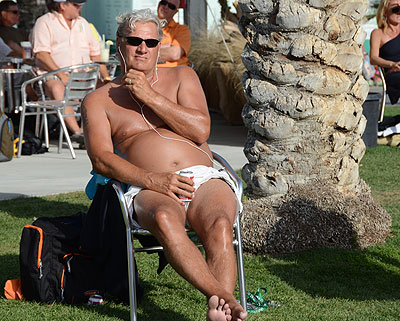
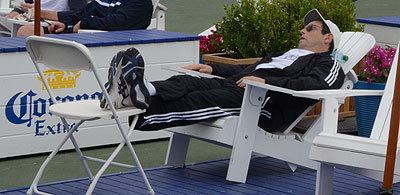
Some found the excitement (or the Corona) a bit much for their delicate constitutions.
I felt sorry for Rafa. He fell apart in the last set of the final as Novak Djokovic dominated with force and mastery.


Profoundly negative for ATT??? They get another big carrier, consolidate operations , have larger customer base(called economies of scale) , etc. You make a broad statement like that with nothing to back it up.
When I got the news this morning that ATT is buying T-Mobile, I was so saddened. I am an ATT, T-Mobile, and Verizon customer.
T-Mobile gives me unlimited wireless broadband for $39 a month. It works beautifully. I actually don't know how good their customer service is, because I've never had to use it.
ATT gives me decent cellphone service, but if you go roaming, they don't tell you about the outrageous charges you're amassing as you roam (nor do they warn you you are roaming, whereas T-Mobile on my cellular Zoom modem WILL warn me). So you don't know that your 3 weeks of normal business activity, conducted while in a new location, cost you literally thousands of dollars, until ATT issues the monthly bill. They do not reveal these charges online as they are piling up (I know because I checked almost every day, just in case). What a racket.
I'm not the only one who has suffered this nasty roaming fate. I'm assuming it's one of the main ways that ATT makes money these days (since Skype and its ilk have sucked the normal phone business out of the normal phone companies).
So this is a sad day for those of us who have come to rely on T-Mobile. Their website makes it easiest to pay, whereas ATT and Verizon both make it difficult. I'm about to post an article on my blog about how difficult Verizon makes it to pay, probably in a couple of days. (http://www.RevenueJournal.com).
Always enjoy your posts, Harry.
kz