I can quantify how stupid I am.
Figure A couple of million. That’s how much I “lost” by panicking by the tariff “negotiations,” selling out and coming back in far too late. In other words, I tried to time the market.
It cost me.
There are two saving graces:
First, it could have been a lot worse. I could have gone to cash at the very bottom. And then only bought when it rose.
Second, I could have done what many freaked hedge funds did — convinced the world was coming to an end — they went 100% short and got really burned (aka annihilated) when the market came roaring back.
Josh Brown is one of my favorite CNBC commentators — Tuesdays and Thursday middle of the day. He wrote this wonderful column, which I’ve excerpted:
Mammas don’t let your babies grow up to time markets.
It’s a tough way to earn a living. Now more so than ever.
It has never been harder to know what to do than it is right now. You wouldn’t want anyone you love and care about to be in a situation where they had to get it right.
Like, their career depends on it. Never before, at least during my career, has the stock market’s price action so unequivocally defied the economic situation we face.
I’m going to see Willie Nelson play at Jones Beach later this summer for the tenth anniversary of his traveling Outlaw Music Festival this August. Willie is the same age as the recently retired Warren Buffett. He’s bringing out Bob Dylan and Wilco at our stop – two of my faves – and I can’t imagine this not being one of the most epic shows I’ll ever see. Has to be, right?
The song Mamma’s Don’t Let Your Babies Grow Up To Be Cowboys was originally written and recorded by Ed Bruce in 1975. Three years later, Willie and Waylon Jennings released it on their joint album and made it their own. It’s now a staple in the Willie Nelson catalog and you’ll hear it pretty much anytime he plays a show. In 1979, a year later, Nelson released a cover of a Sharon Vaughn song, My Heroes Have Always Been Cowboys, and that became a number one hit on the country charts. There’s a little bit of cognitive dissonance there – don’t raise a cowboy but the world does need heroes so somebody’s got to do it.
For most of us, market-timing heroics are unnecessary in the context of directing our retirement assets. Leave that to the cowboys.
In my first career on The Street, as a retail stockbroker, I was trained to cowboy up. I was expected to have a strong view on the market’s near-term direction paired with a highly informed idea about what types of stocks should work given that view. It was nonsense on stilts of course, but when you’re in your early twenties and a mentee of slightly older cowboys, you do what they tell you and convince yourself to believe what you must in order to carry on.
So I told clients what I thought was about to happen, with all the conviction I could muster, and then I told them which trades in the stock market would make sense under the scenario I laid out.
Unfortunately for anyone in my orbit during those days, I was really good at it. Not only was I able to convince my own clients and prospects that tech stocks should rally or oil stocks were due for a run, the brokers around me would hear the conviction in my voice and begin writing down what I was saying. Before long, there was an entire boardroom full of brokers, frothing at the mouth, pounding my market opinions into the ears of their clients through the telephone.
The senior brokers at the firm handed me the morning meetings. In my early twenties, I would stand in the front of the room, motivating the troops and educating them on my pitch. Chief Cowboy. In that position, there was no room for even the slightest hint of doubt. I convinced myself and then set the direction for everyone around me.
The weirdest thing, as I think on it now, is how easily the other salesmen would just start rowing in the direction I had set. “Josh likes Jabil Circuit and Flextronics, so do I.” There were guys in that room who had been at it ten years longer than I had. Surely they had read and seen enough to have known that I couldn’t have possibly be a reliable shotcaller on the stock market. I guess not. If I wrote up the pitch on Natus Medical or Imax or Six Flags or Focus Media, they’d gladly deliver that pitch to anyone they could get to listen. It turns out, salespeople sometimes just want to sell something that people are willing to buy. A well-executed script with a convincing story was good enough.
My cowboy days ended in the aftermath of the 2008 crash. As I’ve written in my books, that stretch of time between the end of 2007 and 2010 was the moment I realized that I wasn’t any good at market timing and that no one else was consistently good enough at it either.
It wasn’t long before I dropped my Series 7 license and hung up my spurs. This epiphany forced a career change on me. I wasn’t the going to be the guy who sold his ability to call the next twist and turn in the markets anymore. I was 31 years old when I learned the truth about how impossible cowboying was in the real world. It’s embarrassing that I took me that long. But I know 51 year old men who still haven’t figured this out.
Thankfully, around that time the ideas of Barry Ritholtz and Nick Murray and Jack Bogle entered my life and the rest is history. I have tons of ideas about stocks, market fluctuations and investing themes. I always did. And nothing delights me more than sharing them with readers and viewers while debating them with my peers in the industry. What’s different now versus then is I have a process. Here’s what happens if I’m wrong.
More importantly, now I have humility. I think such and such could happen but I know I don’t know for sure. Deep down, everybody understands this. Lots of people – especially professionals – have to bury this obviously rational way of thinking for the purpose of getting through the day or earning their living.
The portfolios my firm manages are not predicated on the idea that there is one highly likely outcome and all we have to do is invest as though it’s going to come true. Durability under a range of potential outcomes is the goal. Not making predictions and praying they come true. We take assets from the cowboys when those cowboys inevitably fall from the horse. We dust their clients off and pull them up onto the wagon. We teach people to allocate assets as though there’s an entire range of possible futures and that, come what may, we’d better be prepared for it. …
Moodys vs Stocks
It has never been harder to be a stock market cowboy. We’ve just witnessed one of the greatest one-month stock market rallies in history. This past week, the S&P 500 went up five days in a row, rallying right into the Friday close. And then, a half hour later, the nation’s largest credit ratings agency, Moodys, delivered a downgrade of the US Treasury.
For anyone who is unsure about the importance of the Treasury bond market on a global basis, I’ll phrase it thusly: The US Treasury bond is like the sun. Every other asset class is like a planet orbiting that sun, deriving light and heat from it and maintaining its own place in the firmament accordingly. Every risk is priced relative to the risk-free rate of return emanating from what one could earn simply parking money in a Treasury instrument – be it a bill, a bond or a note.
The Treasury is the center of the galaxy. The price and relative attractiveness of anything you could put money into (stocks, real estate, corporate or municipal debt, venture capital, private equity, Bitcoin, gold, collectibles, etc) keys off of what one could earn by taking no risk at all via holding cash in US dollars or Treasury bonds.
As such, having the ratings agency of record call into question the creditworthiness of the US Treasury as a bond issuer is like a lightning bolt of uncertainty striking the ground right in front of you. S&P futures immediately lost one percent in the aftermarket yesterday, but the real tell will be the how international stocks react overnight on Sunday and then our own market open on Monday. Maybe this will be yet another negative the market decides to “look through” as it charges back toward the February highs. And maybe it won’t.
As my colleague Callie Cox points out, rival ratings agency Fitch downgraded the US Treasury in 2023 and it was greeted with a yawn. In 2011, Standard & Poor’s downgraded the US Treasury and it mattered a lot, contributing to generational volatility across all asset classes until the moment passed.
Here’s how the New York Times explains what just happened:
The credit rating of the United States received a potentially costly downgrade on Friday, as the ratings firm Moody’s determined that the government’s rising debt levels stood to grow further if Republicans enact a package of new tax cuts.
The downgrade, to one notch below the highest triple-A rating, amounted to a repudiation of Washington, where President Trump only hours earlier had pushed his party to adopt a legislative package that might add trillions of dollars to the nation’s fiscal imbalance.
The downgrade from Moody’s means that each of the three major credit rating agencies no longer gives the United States its best rating. Fitch downgraded the United States in 2023, citing fiscal concerns, and Standard & Poor’s downgraded the country in 2011.
The new rating decrease could send ripple effects throughout the economy if it prompts investors to demand higher payments on bonds, which in turn could raise consumers’ borrowing costs. So far, though, past downgrades have proved largely symbolic, as the American government’s debt remains the bedrock of the global financial system.
Here’s the FT with an illustration of these three consecutive downgrades over the last fifteen years:
The Trump White House wasted no time in repudiated the decision by Moodys to downgrade. Steve Cheung is the President’s Communications Director:
The usual combative, personalized attack. Fine. Expected.
Now what? Because the stock market has been acting as though none of the issues around debt, deficits or the effects of the trade war are going to matter going forward. …
This downgrade comes after a 25% rally in the Nasdaq 100 and an 18% run for the S&P 500. Not just an ordinary rally, but an explosive one. With mass participation from virtually every corner of the stock market save for healthcare. …
So now you have a stock market that’s gained back nearly everything its lost this spring in convincing fashion versus a fresh downgrade of the US Treasury from the ratings agency triumvirate. Whom do you listen to? Which matters more, price action or economic realities? I can’t remember a time where it’s been harder to know. …
Harry’s Reaction
I’m 60% back in the market but with a much broader array of holdings. Still technology, still the Magnificent Seven, and still (but much less) Nvidia, which reports tomorrow night.
I have always liked themes. I like AI. But instead of betting the house on Nvidia, I’m eyeing the power needs of all those pricey data centers being erected. Hence, OKLO, GEV, CRWV, and VST. I’ve also been lucky with NFLX. See below..
I list my entire portfolio in the right hand column of my blog’s website. Click here.
I am 82. I want to live to 100
So do zillions of other people from Peter Thiel to Jeff Bezos who are spending big to live longer.
In Eric Topol’s latest hefty (464 pages) “Super Agers” book, he quotes Venki Ramakrishnan
“When they were young they wanted to be rich, and now they’re rich they want to be young.”
Boy, is he right.
29% of my Harvard Business School ’69 classmates have died. That’s awful.
Hence I just spent the entire Saturday on Eric Topol’s new Super-Agers book on the strong recommendation from Jim Cramer who clearly must be having the same mortality thoughts. He’s 70, a spring chicken.
Two books have hit the best seller list and my bedside table.
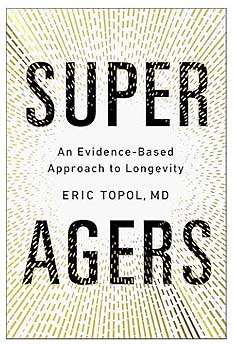
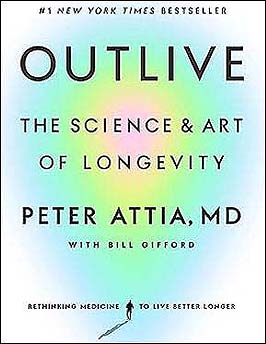
Here are the two BIG conclusions:
+ There’s no evidence yet for safely and effectively slowing the aging process in human beings.
+ The only free lunch is exercise. There’s two types — aerobic (running, tennis) and strength training (lifting weights).
There are the usual conclusions: Get your vaccines. Stay social. No salt. No sugar (Stevia maybe a good substitute), No alcohol. No red meat. No smoking. No processed foods.
In short, if you like eating, you’re destined to live a miserable life. Except that GLP-1 may be the miracle drug everyone has been waiting for — if you can afford it. About $12,000 a year.
There are hundreds of anti-ageing clinics. They do oodles of screening and testing. Sometimes they catch things. Sometimes they don’t. I’ve found blood testing and CT scans to be useful. Colonoscopies for younger people are critical.
I study my health more than my doctors. Second and third opinions can save your life. They have mine. I take three pills a day — a statin, Lisinopril (reduces blood pressure) and Prilosec (cuts stomach aid). I play tennis aggressively every day.
Ironically, coffee may actually be good for you. But obesity isn’t. My friend Chuck lost 30 lbs in the last 12 months by eating less. Literally. No pills. No drugs. Just eating less. He looks great.
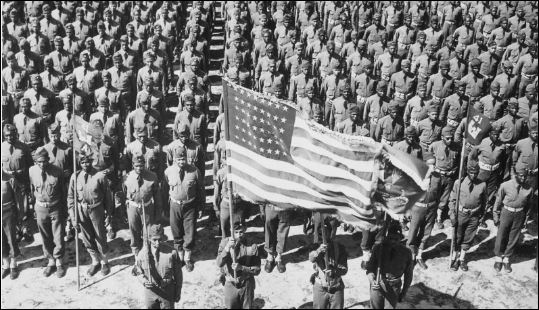
There was a time when we all ate less and all of us were thinner. Here are American soldiers in World War II.
Auto-pay dumps your money down the toilet.
Auto-pay is a license to steal your money. You don’t see what they’re billing you for. So they slowly bill you more and more each month.
Auto-pay is annoying when you’re paying for for drekky service, like Verizon’s cell phone service.
Auto-pay is worst when you’re not using what you’re paying for. Like the two landlines I still have (and have forgotten about) in New York.
There’s been a huge revolution in everything Auto-Pay.
Satellite TV is replaced by streaming. Dump cable and satellite, get YouTubeTV.
Netflix is a bargain.
Wireless is replaced by low-cost wireless resellers, like Mint Mobile.
Landlines have been replaced by wireless. You used to need wireless for security monitoring. But these days SimpleSafe (and others) use the Internet.
I figure the typical reader of this blog should be able to save $400 to $500 a month with these Auto-Pay Tips.
Thank You Harry.
Want to know how to do anything?
Like fix your dishwasher or do the perfect tennis serve, ask Google and/or YouTube. Or watch Instagram.
Soon there’ll be zillions of personal robots. We’ll each have one.
How will they learn how to do our everyday tasks?
Simple: Watch YouTube videos. Like we do. Neat?
All I know about tires
They develop holes at the worst times.
+ Run-flat tires are an expensive rip-off. They were designed to replace the space tire and thus give the car companies something extra to sell you — like a third row of seats. Fix-a-Flat will destroy run-flats.
+ This Airmoto Smart Pump works:
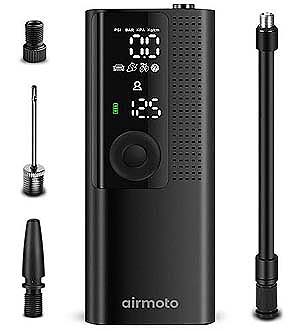
Buy it here.
Shower fixer
They put these things into shower heads to save on water. But they cut your shower to a miserable trickle.

Solution: Unscrew your shower head and remove this.
In the old days, you had a real job
Now there are influencers, TikTok, YouTube and Instagram stars who make a living from tips on cars, washing machines and humor. Why send your kids to college when they can make a handsome giving beauty tips or telling jokes? This one is my favorite. She is a hoot.
Apologies for this long blog.
I’ve been reading/researching a lot. It takes a while to synthesize all that reading into simple concepts. I feel much more confident that my broad portfolio of 42 stocks and ETFs makes sense in today’s weird market. Fifty percent of economists think we’ll be in recession by the end of the year.
The Europeans, Chinese, the Japanese — in fact the rest of the world — are bamboozled by the unpredictable soul running the world’s largest economy — which sadly, they can’t ignore.
From where I sit, I see shoots of heady optimism; technology powered by AI and the insatiable demand for electricity are producing serious breakthroughs. GLP-1 is most certainly a wonder drug. And then there’s this:
The French Tennis Open has started. It’s called Roland Garros. Grandson Peter is becoming a concert pianist. He’s really good.
Life is wonderful. — Harry Newton
