Your best investment today: A $40 subscription to The Verge and then read this brilliant article:
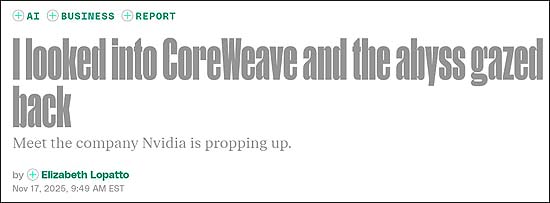
The article begins:
Hello, my friends. Have you been feeling too sane lately?
Have I got something for you! It is a company called
CoreWeave.
Since I read the article a couple of days ago, my short on CoreWeave is up about $5,200.
The second article you should read is How to spot a bubble bursting in the Economist. Click here.
It points out that picking when bubbles burst (like the AI one we’ve been in) is very difficult and it says
It is nevertheless disconcerting that Google searches for “AI stocks” have since fallen so dramatically in recent months, just as the stocks themselves are having a wobble. The share price of Nvidia, the world’s most valuable firm and most important chipmaker, has fallen by 15% from its peak.
The Economist’s article concludes:
That leads to another non-traditional measure. In the five years to March 2000, the NASDAQ suffered corrections of over 10% on at least 12 occasions, each time recovering and eventually rising nearly 12-fold. Even at the bottom of its subsequent plunge, the index was still twice as high as it had been at the start of 1995. Those who simply ignored both mania and crash, and held on throughout, were richly rewarded. The professionals who correctly called the bubble, meanwhile, often were not. Their experience was epitomised by Julian Robertson, another famed investor who over the two decades from 1980 handed his clients average returns of 25% a year, and in 1998 was overseeing $21bn. By March 30th 2000, withdrawals had forced him to close his fund, which had determinedly avoided the dotcom mania. As it turned out, the bubble had burst two days earlier.
Those trying to time the top of the present-day cycle should therefore look out for buzzkill types with big names going out of business. Such as, say, Michael Burry, who memorably bet against American mortgage-backed securities before they plummeted in value and set off the global financial crisis of 2007-09. This year Mr Burry has been busy shorting AI stocks, including those of Palantir and Nvidia. In late October, he wrote to investors to tell them he was closing his fund. ■
I did a little chart this morning. Two technology ETFs this year. AIQ versus VGT.
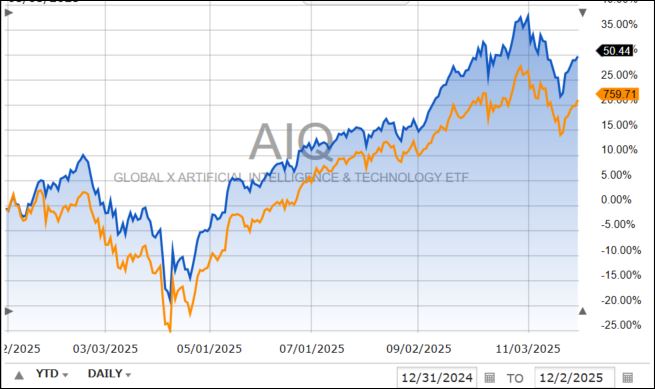
Here are my thoughts:
+ AI bubble is waning. People are losing interest. And worse, my friends, who run businesses, still haven’t figured AI’s benefits and hence have not committed the huge amounts of money that the AI providers are going to need to justify their immense, pricey data center build outs.
+ Too much debt. Too much leverage. That’s caused all the busts.
Now for something beautiful:
Ice formation above and below the waterline, Admiralty Inlet, Northern Baffin Island, Canada:

That’s it for now. I’m off to play tennis. I had to wait until they plowed the roads. We had six inches last night. Very pretty.
See you soon — Harry Newton
