Nvidia continues to amaze me with its expansive visions of where and how to apply computer power to producing endless ways to improve our world. For an overview of the latest Nvidia Visions, today:
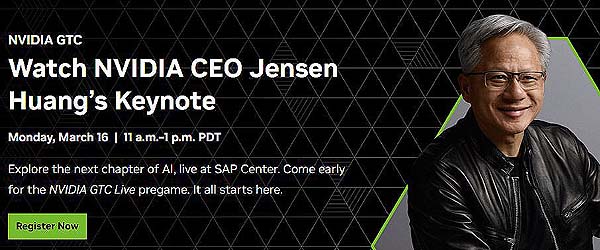
You can watch it on your laptop. It’s free. Register here.
Nvidia has been on an acquisition, investment and expansion phase — faster and more exhausting than any company I’ve ever had the privilege of following. At its core, it’s about mammoth speed increases its chips produce. And these speed increases in turn drive innovation (and new products and creation of new services).
From chips to run Windows PCs, from chips to run self-driving cars, to chips to run robots, from chips to design factories to chips it calls language processing units, or LPUs, that are designed for inferencing, running AI models. Nvidia says its processors can run large language and other AI models up to 10 times more efficiently than its GPUs, which started out in gaming.
What has always impressed me about Nvidia is its comprehensiveness. Intel made chips, but needed Microsoft to make Windows. Nvidia has chips and a whole software milieu that millions use to program them and make useful products and services. GTC will have 30,000+ attendees from over 190 countries and another half a million watching it on their laptops — including me.
Wired magazine says Nvidia could debut its own platform for AI agents, called NemoClaw, which would allow companies to deploy agents across their systems. Maybe empower Delta’s airline booking site to be as useful to its customers as Amazon’s.
The market for Nvidia has been quizzical in recent months. Look at this chart of the the last six months. It looks like it’s clawing for a reason to break out.
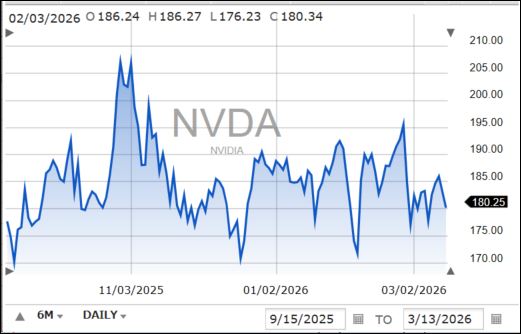
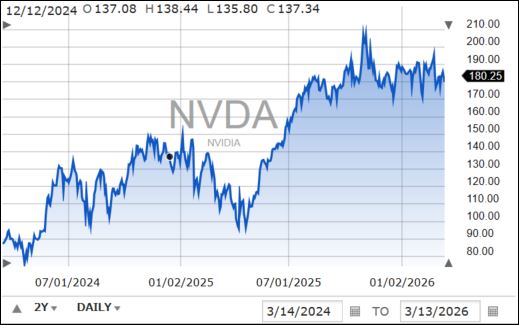
To break out and resume its ride of the last two years.
The Fog of War
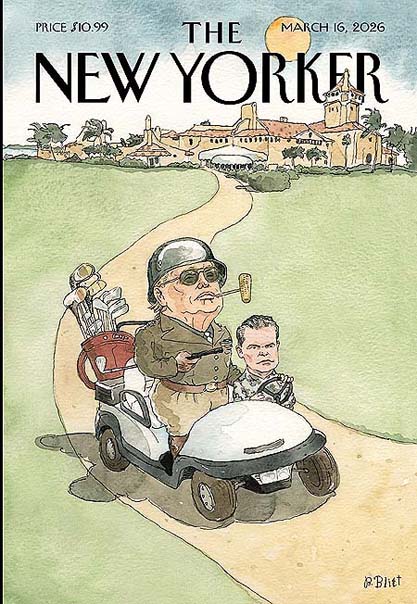
This was has not been good for our stocks. I really wanted to present some brilliant thoughts based on the stuff I’ve read. Then the New Yorker and the Economist came out with brilliant covers and summed my thoughts:
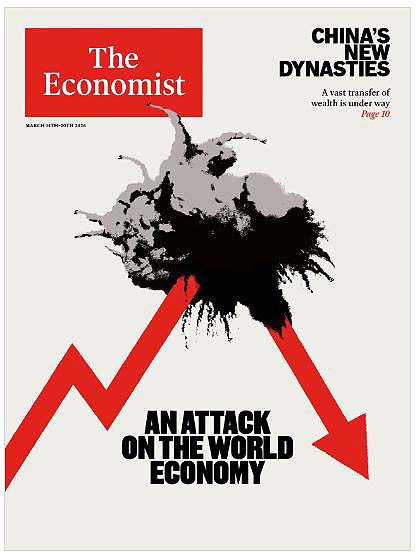
Then I discovered a wonderful article called Technomyopia in this week’s Economist. Here’s how it begins”
STOCKMARKETS ARE, in a literal sense, fortune-tellers: their job is to foresee which businesses will make money in the future and which won’t. When things are not changing much, this is a matter of simple extrapolation. When change happens, it gets harder. This is obviously true in times of acute change, such as the fog of war currently enveloping the world. Yet it is also true of slower-moving but more profound disruption, like that being wrought by artificial intelligence.
Confusion over AI is everywhere. Goldman Sachs has created a share-price index of firms at most risk of disruption (see chart 1). Over the past year this has fallen by more than 20%. The bank’s mirror index of “long-term AI beneficiaries”, whose earnings stand to get the biggest boost from higher AI-fuelled productivity, is down by about 5%, even though many stockmarkets are near record highs. Often investors cannot even decide whether a firm is an AI winner or loser. From May 2024 to May 2025 the share price of Duolingo, a language-educator, doubled. Since then it has fallen by 80%. Not long ago Google was apparently toast because of AI. In the past year the share price of its parent company, Alphabet, has risen by 85%.
The article ends:
Fans of efficient markets may be maddened by this inability to peer accurately into the future. But markets reflect only the collective wisdom of today’s investors. For as long as conversations between two Silicon Valley technologists produce three answers about AI’s impact on the world, no one will be the wiser. ■
You can read the rest of this brilliant piece here.
In case you’re wondering whether the Strait of Hormuz is, here’s a great map from the front page of a recent New York Times:
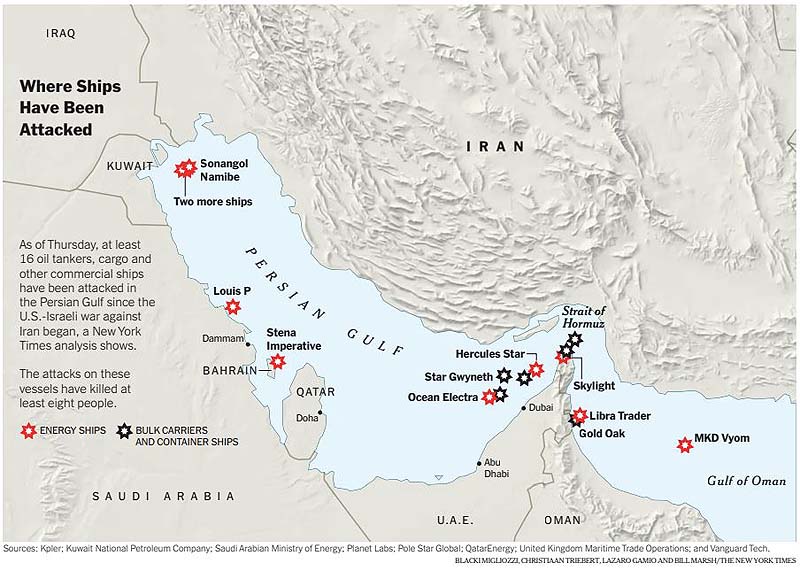
At its narrowest, the Strait is 24 miles — real easy to close with naval mines, shore-based anti-ship cruise missiles, and fast-attack craft with swarm drones. About 20% of the world’s oil flows through the Strait. Without those flows the world’s economy is hurting. Factories are closing. Heating is off. Fertilizer can’t get through. Food production is dropping.
The new Supreme Leader’s first act was to close the Strait. He played his trump card.
It’s hard to see how this can be solved with bombs.
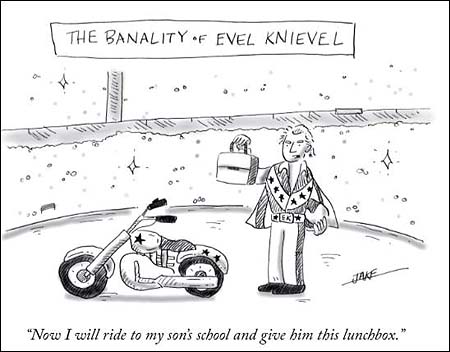
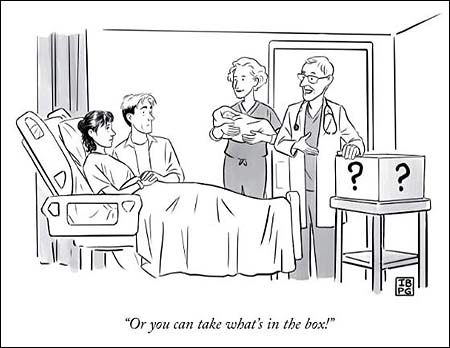
Best recent New Yorker cartoons
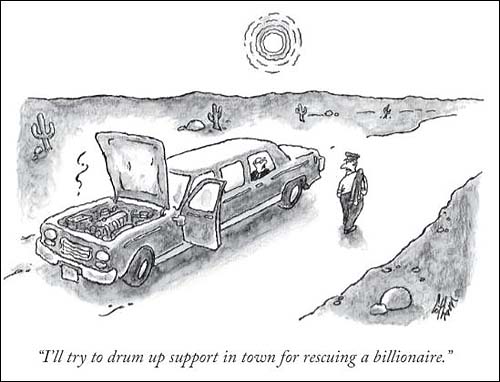
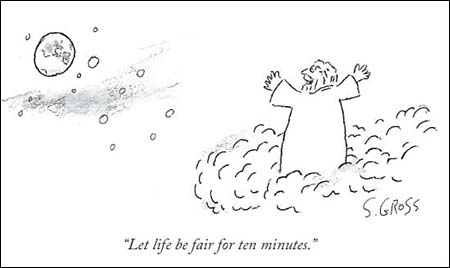
I’m back from my calf injury and playing gentle tennis. The body does repair itself. I used RICE. Rest. Ice. A little Compression. And some Elevation.
I was heavy on the Rest and gentle exercise, like walking.
I’m out of META and MSFT. Not impressed where they were doing. I’m sticking with what I have, knowing that long-term stocks are up. And AI makes huge sense. I use it daily. It’s most useful. And I know it’s impossible to time this market, even with AI.
See you very soon. — Harry Newton
