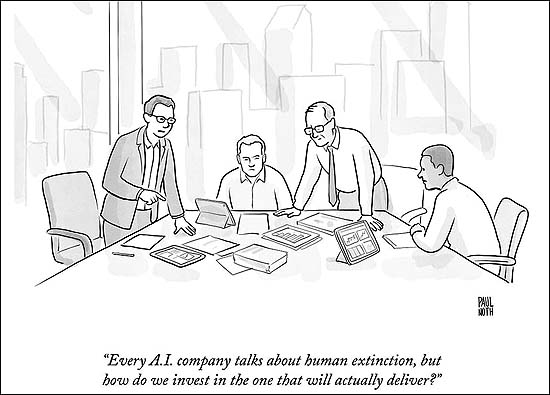
Finally a reason for writing a blog, courtesy The Borowitz Report
My son, Michael, 44, has a stroke
He’s OK. Seems to have fully recovered. He got to the hospital fast, within the hour. Fewer than 5% of stroke patients do.
He encourages us all to
+ Learn the symptoms. Check out www.Stroke.org
+ Never hesitate to get emergency help if you’re having them.
+ Keep active. Keep healthy.
AI has kept me busy
First, will AI kill us? No.
+ No CEO puts out products that kill people. There are laws and consequences.
Will any AI company “pause” their AI R&D? No.
+ No CEO will delay his product development. Especially when the market is so big.
I can give you 500-pages of reason why those two points. You’d be bored.
I start with my “job.” It’s finding companies whose stocks I can invest in, which will go up. I don’t have a company to manage day-to-day anymore. I sold it. I live on my portfolio and write about it (in this blog) as a hobby. I don’t get paid a piece of your action nor do you pay a subscription fee for receiving this blog. My hope is that some of you may send me an idea or two. But I don’t rely on your ideas, which, incidentally, have been few.
There are as many theories on picking investments as there are investments.
Here’s mine. Follow my logic:
First, there are companies that make things. Shoes. Pots and Pans. Cars. To make money, and more money (called growth), you have to make and sell more shoes, pots and pans and cars. Usually that involves building a factory. Big up front investment.
Second, there are companies that make software. Once they needed a factory to package their goods and mail it out. Then suddenly, they could deliver their software to a thousand people this week and then ten thousand the following week — using the Internet (instead of UPS or retail stores) and using someone else’s factory, called Amazon AWS or Microsoft Azure, etc.
But there was an upper limit. You can only use one Office 365. Two would confuse your laptop, driving you and it crazy.
Now there’s AI. That’s a seriously different product. One we’ve never seen before.
We know AI is useful. We know you can use three versions of “Office 365” AI on your laptop, your phone, your watch, your glasses, personal robot, and your car. Not just three. Maybe 20.
I already use half a dozen AI services. Last night I signed for another one – Meta’s Muse. It’s already proving useful. Soon I’ll be paying for it. The same path I’ve followed with Perplexity and Gemini.
I like buying shoes. These ghastly insanities (says my wife) cost me $15.30 (on Temu). Though they’re really comfortable, I don’t pay a “per wear” subscription.

AI needs a factory. It’s called a data center. They’re building them like crazy because there’s so much demand for their products. Dare I say “infinite” demand?
I can now report that every one of my businessperson friends is using AI. And this week they’re using more than they used last week. And next week, they’ll use even more.
Are they getting a good ROI? Better than if they had invested in a hotel in Houston, or an apartment building in Amsterdam?
They have no idea. They’re learning AI is addictive, and expensive, like all addictions.
I’d like to invest in Antropic and Open AI. They’re the leaders. It’s all their business.
For now, I’ll stick with Google, Amazon, Meta. I can’t own Perplexity because Jensen Huang, Jeff Bezos and Stanley Druckenmiller beat me.
I also invest in the “picks and shovels” of the data center business – from Nvidia to Micron. I’ve written about my favorites. You can see what I own in the right hand column of my web site.
Facebook’s Muse appeals bigtime
Today’s New York Times has a reporter telling us his experiences with Muse. Here are four paragraphs from his article:
Muse is the first consumer A.I. agent from a major tech company that has become publicly available. The tech industry sees agents as the next frontier, far more capable than chatbots. Agents can roam the internet, sign in to websites, fill out spreadsheets and make phone calls on behalf of people – and that’s just the start.
To test Muse, I experimented with it nonstop for two weeks, giving over many aspects of my life to it. I had to trust Muse with my most personal data, which included connecting it to my bank accounts and email. Then I had it perform dozens of day-to-day tasks, including ordering my groceries, scheduling my meetings and setting my fantasy football lineups.
Two weeks in, I found Muse to be the most useful A.I. app I had ever used. One clarifying moment came after I connected my credit cards to Muse and asked it to track my spending in Google Sheets. I watched as it spun up tabs with hundreds of rows of data each in minutes, then flagged two duplicate subscriptions, which it canceled for me. Then Muse used my email to request a refund for a free newspaper trial that had expired, saving me $44.99.
Very quickly, I found that Wren (his name for Muse) could efficiently fill out online forms, a tedious part of using the internet. I could take a photo of a parking ticket, and Wren would pay it for me, asking for approval before making the payment. While the agent worked, I watched its movements through a tiny browser window, where it navigated websites like a human with a mouse and cursor.
Many of my business friends
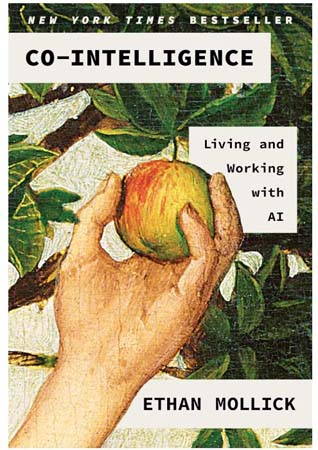
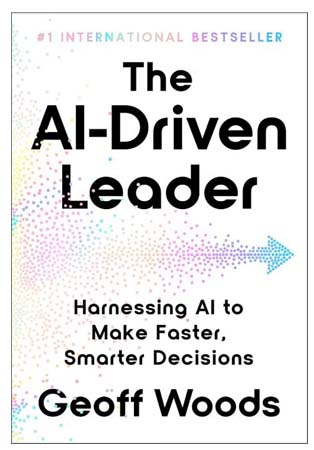
want to know what they should read on using AI in their businesses. Here are two book suggestions:
Tucker Carlson was once a big fan
This recent video is devastating.

Sorry to hear about your son’s situation and wish him a full recovery.
Thanks for all of your past blogs. You are my favorite writer and value your opinions, but do not always agree with them.
Government is a necessary evil. The evil is a never satisfied desire for power and control. To me this translates to socialism and communism, which in turn translates as verified by past history, to a dead end road of poverty for the society.
Is the Iranian war a war about religion, Islam v. Christian/Jews? This war is never written about in this context by the press. Why not?
And morals are forgotten. Morals are the guide, the compass, for human behavior. The ten commandments are my guide including #10, thou shall not covet. And then there is the cry to tax the rich.
In closing, welcome your thoughts and investment ideas on the coming digitized financial system.
Stay well by internet friend.
Keep your eye on the ball and move your feet.
Paul Livingston
Harry, hope your son is doing well-pretty scary!
Harry:
Are you interested in any quantum computing or fusion energy equities?