Now I know why call it Black Friday. We had a big storm last night. We lost power. The backup Generac emergency generator didn’t come on. All the locals who fix things are busy fixing other people’s things. More important people. Nobody knows when they might honor me with their presence. Some time before the sun sets. They told me that. They need the sun to fix an emergency generator. Go figure.
Meantime, my assortment of tiny travel batteries is juicing my phone and laptop. But, not my fridge or the boiler. Or my toilet. Susan has declined to go where the bears go. So we’re coping. Back to the 18th century and night soil, I suspect.
All this would be funny, if it weren’t. I’m now thinking we need a second Generac — one to backup the backup. How many backups does one man need? That’s sort of like asking how much money does Trump actually need? See below.
There’s an old saying “Follow the money.” It should be modified to “It’s only the money.“
Economists, learned writers and talking TV heads debate the “logic” of the latest tariffs. They’re allegedly to penalize countries with excess manufacturing capacity. That’s unadulterated nonsense, of course. When factories are making things, they’re making things. When they’re not, they have “excess capacity.” Our local Sunoco plastics factory has capacity on Sundays, when it’s closed.
Economists make theories up to please their bosses, just as appraisers are programmed to choose the value of your property – based on whether you, the owner, want to sell, buy, or lower your real estate taxes. Money buys opinions.
So tariffs? We raise them. That will hurt your business. “Your” being the importer. Bitching doesn’t work. But money does. Today there’s a whole new industry that takes your money and pays someone to reduce the tariffs hurting you. You can get pardons this way. Get out of jail cards, etc.
It’s the modernized indulgence industry. I asked Perplexity and learned:
“Most indulgences were earned through prayer, fasting, pilgrimage, or crusade. Over time, though, donations became a common route. Buyers received a written letter of indulgence as a receipt. Indulgences could also be obtained for the dead, to shorten a loved one’s time in purgatory. (That’s one for me. Are my kids listening?)
“Officially, the buyer still had to confess and be truly contrite. By Luther’s day, paying was often treated as enough. That abuse helped spark his 95 Theses. The Church later reformed the practice, and Catholic teaching today stresses that indulgences are not purchased forgiveness.”
Except in Washington. Jensen gave $25 million to Trump’s modest new ballroom. And course Trump, Lutnick and their families own mega-dollars of Nvidia stock, which is not up today.
I can’t get a good read on the market today, because of my no-real power and painfully slow Internet (achieved through my iPhone’s Personal Hotspot). But it reinforces my obvious conclusion: No one knows. No one can predict the future. You pick a few good themes and you go with the best.
Before we get to my themes, I was reading a learned piece in The Financial Times (the pink paper) on bubbles. That’s become a hot topic. Writers research all the bubbles of the last couple hundred years and see if they can divine where we’re are going with the AI Bubble in the next little while.
The overwhelming answer is “We have no freaking idea.” Let me try and explain: Most bubbles occur because of three things:
+ There’s a hot new area that will change the world – railroads, the Internet, AI, etc. Hotness makes prices rise, no matter the illogicals. The classic hotness was tulip bulbs. Ask ChatGPT for the tulip idiocy of the early 17th century.
+ Everyone wants in on the action but everyone doesn’t have the cash. So we invent borrowing, often with fancy names like “margin.” Borrowing comes with conditions which often don’t accommodate the gyrations in price that happen in bubbles. People who lend money — like bankers — like to get their money (and interest) back. There’s a real disconnect between bankers and the bubble people they lend money to. (Personally I have never borrowed on margin to buy stocks. It’s all too common for there to be a bad day (e.g. last Friday in Nvidia) only to be followed by a real good day (the following day Monday). You’d feel really stupid if you got sold out on Friday, only to see the next day’s trading — Monday’s Jensen Return Day.
+ A plethora of “Can It Last?” stories appear. Common people object to railroads or data centers in the backyards. Where is all the people and the AI demand going to come from?
I’m 50% in cash in my “equities” portfolio which you can see in the right hand column of my website, here.
Here are a few paragraphs from The Financial Times piece called “What happens when bubbles burst?”
Some of this has already happened if you look at the bloodbath in semiconductor companies and some big tech stocks. AI computing cloud outfit CoreWeave was down by 70 per cent from its 12-month peaks on Friday, Intel 61 per cent, Oracle 56 per cent, Micron 50 per cent. Even Alphabet and Meta are down 32 and 26 per cent respectively.
However, the evidence of the past 50 years suggests the potential for further weakness. After the bursting of the six major bubbles of the past 50 years, equity prices of the companies driving them have suffered median absolute losses of 67 per cent (with 54 per cent the smallest decline and 84 per cent the largest).
For broad equity markets, some have suggested they might fall 25 per cent in a bubble-bursting scenario. This may be optimistic. Despite AI tech stocks accounting for roughly 30 per cent of US market cap, simply applying an arithmetic loss in this sector underestimates the shock and awe that occurs when bubbles burst, as risk aversion spreads across markets and financial conditions tighten. Typically, the median decline when bubbles have burst in the last 50 years has been closer to 40 per cent.
No one knows for sure whether the AI bubble is currently bursting. Maybe the maturity of the earnings base of market heavyweights such as Microsoft, Apple and Alphabet will provide greater support this time. Maybe capital expenditure will be curtailed quickly enough or demand for AI services will support the current sector ambitions. However, back in 2000 even the eventual “digital winners” like Microsoft, Apple and Amazon saw their stock prices fall 65, 80 and 94 per cent respectively when that bubble burst.
Investors with large AI exposures should also recognise that typically a bubble asset gives back nearly all of the relative gains seen in the bubble period over the next five to 10 years. The investor scars that those losses create can keep the asset class out of favour for many years.
Harry’s themes
I am investing in basically three themes — selective healthcare, selective energy and very selective AI. I am not proud of my results. (Please email me your ideas.) Frankly, I’d be doing much better if I had dumped all my money into VGT a long time ago, and retired to a nice tennis venue with a great tennis coach, who could work on my down-the-line backhand.
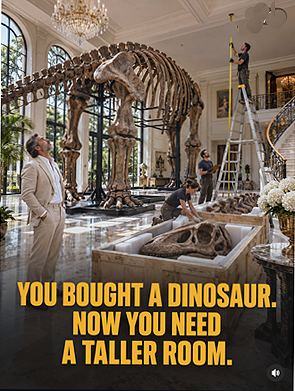
I love Instagram
You can waste endless amounts of precious time on its nonsense feeds that “thinkers” are creating to earn a few shekels.
These clips come from a Money Can’t Buy Eveything series. Someone spent the time and money to put this stuff together. You have to admire them.





Lessons for 2027
+ Learn to say NO more often. Watch out for steps and bathrooms. The array of recent Fall Breaks I’ve seen — from shoulders to femurs or calves — is truly mindblowing. Make two trips down the stairs. Don’t carry everything at once.
+ Buy backups. Keep gas in your cars, propane in your tanks, spare batteries for your phones and laptops. Extra food in your pantry. NYSEG tells me they have 24,085 customers (one of whom is me) without power.
+ Eat when you’re hungry. Sleep when you’re tired. Keep moving.
+ Learn Claude. Read the Economist and the New York Times.
+ Learn to have fun. I had fun writing this column in the dark.
I’ll be back. — Harry Newton
