He starts work at 8:00 AM Paris time. He reads, researches and phones. He begins trading at 3:30 PM when New York opens and often continues until 10:00 PM when New York closes. It’s a long day.
He’s a stock trader living in Paris, trading in the U.S. via an online-broker. For him the critical time is the first 20 minutes and the last 40 minutes of the day. He closes all positions at the end of day, when he’s 100% in cash. “This market is too volatile to hold stocks (long or short) overnight.”
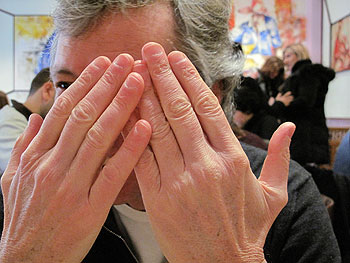
My secretive Paris trader.
He believes that traders and investors require information that is not known on the web. “Everyone uses the information on the web. You need something more.” He gets his from talking to companies’ competitors. They usually know more about their competition than what the competition will reveal — for obvious reasons. But he’ll use charts and economic statistics. The key is to figure the mood of the market that day.
He follows 35 stocks closely. Add in their competitors, you get a universe of three or four times that. He might buy in the morning. But if the price moves against him, he might sell twice — sell out of his position and go short the size of his erstwhile long position.
Today, he says, “there’s so much money out there. The people want to put their money to work. They put pressure on their hedge funds. Huge money out there is what’s driving markets at present — not economic or earnings fundamentals, which don’t look that good.”
Lessons he’s learned:
1. “There’s not enough handshake.” We don’t talk to real people enough. Networking is the most important thing.
2. Too many people think the future will be like the past. It’s not. Even the indexes have different companies.
3. Don’t feel you have to trade all day. That’s too much pressure.
4. Don’t rely only on charting. Get as many angles as you can. See lesson 1.
5. Don’t believe the TV. Journalists want viewers to watch, so they act positive. They want the market to do well.
6. Too many stockmarket traders are too U.S. centric. They ignore the money in Europe and China.
European prices are high and low. If the Euro were a dollar, prices would be fine. But it’s not. It’s 40% more expensive. There are lots of sales of last year’s “collections.” I found great shoes and a great sports jacket. But I was too big.
I was lucky to find this Vertu phone called a Cameleon at a place called Boucheron near Hermes and other ritzy stores on the rue du Faubourg Saint-Honore.
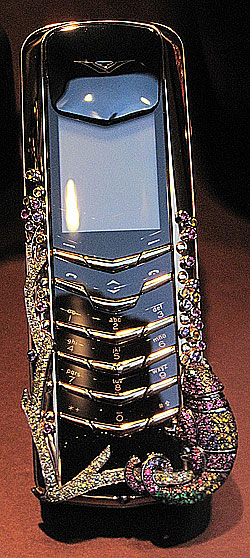
The price? Only 140,000 euros — or $191,800. If you leave the country with it, you get 20% back.
The European bargain. Europe’s income taxes are high – 55% is common. But the “benefits” are good — schooling (even university) and health care. Because of laws, it’s hard to fire anyone or to be fired. But there are ways around. You can hire someone for a year, then for a second year. Then you fire them and hire someone else for a year. It’s impossible to close a business down from one day to the next, as you can here.
But there are huge number of vibrant small businesses in Europe. I saw statistics that showed those European small businesses accounted for more of their GDP than they do here. Their problem is the same as here; banks won’t lend them.
The Story of Greece: It faked up its numbers to get on the Euro. Then it borrowed hugely and went on a spending binge. Now it’s broke. Its debts and its economy will have to be restructured before anyone — e.g. Germany — bail it out. It’s got 30 days.
Greece is the only European country with fake numbers. Spain is in trouble because of a European holiday home boom (and now) in warm Spain. Think Florida.
Getting around. Paris streets are a maze. Printed maps — such as those in guidebooks and foldouts — often omit many streets. Google maps and Microsoft’s Bing are the best. For Paris, Bing is more detailed and better. I carried a GARMIN GPS — the one that fits our car. You can use it for walking. But it has one “quirk.” It won’t direct you the wrong way on a one-way street. But it will get you there — which is better than 90% of Parisiens who are clueless about their city’s wonderful streets. Buses, subways and taxis work well.
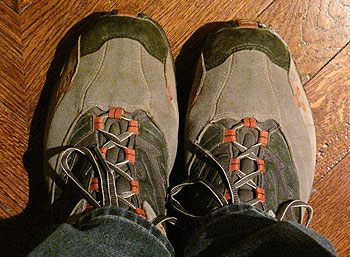
The best of Paris. Museums. Walking. Food. Window shopping. You want to walk in comfortable shoes like these ones I schlepped from the U.S.
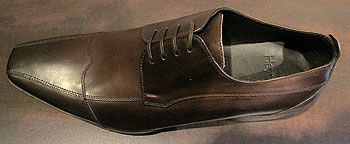
Or you could buy yourself a pair of French shoes:

Harry Newton, who’s wondering what’s gone wrong with his computer this morning. Updating the web site has become painfully slow.

Greece is the first European country to face default because of fake numbers.
There, I fixed it for you.