The big million put on SLV is rubbish. I’m getting back in this morning.
A reader points out the chart on GLD or SGOL looks much better than PRPFX’s chart.
I’m also putting a little more emphasis on my muni bond portfolio — stress testing it for quality and reducing its duration.
Curiously, neither I nor my outside equity money managers have managed to earn anywhere near on their equities in the last year what I have effectively earned with my muni bonds.
I know that interest rates will rise in coming years and therefore the value of my bonds will drop. BUT — and this is the big BUT — I plan on keeping most of my bonds to maturity. Hence my yield — my annual return in cash — is known. It’s fixed. When my bonds mature (they’re laddered and short-term), I’ll be able, hopefully, to buy bonds with a higher yield. For now, I can rely on them for income and for living. Remember, I don’t have a day job. This column is NOT a day job. It’s a hobby. It’s satisfying. It’s amusing (at least to me). But it doesn’t pay anything — despite all those Google ads on the left.
James Chanos of hedge fund fame has shorted FSLR. On CNBC this morning he said solar energy was three times more expensive, didn’t provide “baseband” power and many of First Solar’s execs had dumped their shares in recent months. He and other hedgies are heavily short alternative energy stocks.
To bulb or not to bulb? Next year my friend’s light sockets will go empty. So yesterday he spent $823 buying lightbulbs he’s convinced he won’t be able to buy next year — because Congress has passed legislation outlawing incandescent light bulbs as of 2012.
I spoke with Bryan Trainor, VP Marketing of Bulbs.com. The upshot: You will be able to buy bulbs to fit all your present fittings. Some will be incandescent, for example the light in your refrigerator for which there’s no alternative. Some won’t be incandescent. Some may be CFL or LED or some other new technology.
The legislation’s thrust is to push manufacturers to improve lightbulb efficiency. For example, today’s 100 WATT incandescent is horribly wasteful of energy. You can presently get the same light output (as measured in lumens) from a CFL using only 23-25 WATTS. That’s an 75% energy savings.
Try this: A 100 WATT incandescent from Bulbs.com costs 49 cents to $1 (depending on the maker). A CFL costs $1.50 to $3.00 but you’ll get 10,000 hours of life versus about 1,000 for an incandescent.
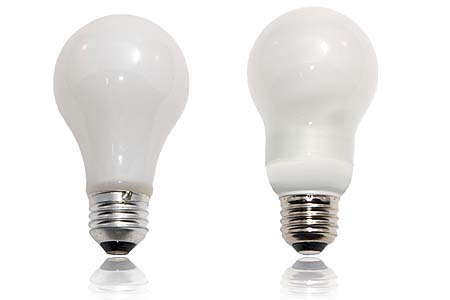
On the left is an incandescent 100 WATT. On the right is a CFL of equivalent light output. The CFL is slightly taller than the incandescent. Photo courtesty Bulbs.com
Many people, including my wife, believe CFL light is awful. But it’s been getting a lot better and now comes in various “flavors.” Our building switched hall lights to the curly CFLs and the apartment owners went ballistic. They argued the building was going “low class.” Then we switched the hall lights to the newer CFL curlies encased in glass — so they look like normal incandescents. No one complained. We’re now saving about $400 a month.
I replaced a couple of incandescent top hat overhead bulbs with CFLs in my country palace. Then I asked my friends to identify the CFLs and the incandescents. No one got it right. They were all impressed when I pointed out which was which.
Trainor says the legislation is “very complex.” It’s not about banning bulbs. It’s about making manufacturers hit improved thresholds of efficiency. Says Trainor, “The country will save a lot of energy if it could simply replace the millions and millions of 100 WATT incandescents with more efficient bulbs.”
Bulbs.com has an Energy Savings Calculator on its web site. The savings switching to CFL are striking. Click here.
P.S. I do buy all my lightbulbs from Bulbs.com. I buy the no-name “brands” since they’re cheaper and work as well. I’m not stocking up extensively, since technology is improving so fast and prices are coming down so fast. There are now dimmable CFLs.
Sugar is toxic. It’s not good for you. It’s a serious factor in diabetes and cancer. Give it up. Or at least reduce your consumption. The best article on sugar and research on it in the medical community was in yesterday’s New York Times. Please read it. Send it to your children.
Buying stuff. Harry’s quick takes: There are no so many alternatives in technology, you need to understand your needs — before you buy.
+ Cameras: there are three types: cellphones, pocket cameras and digital SLRs (single lens reflexes).The BIG difference is shutter lag — the time it takes from pushing the button to actually taking the photo. DSLRs are instantaneous. Everything else takes enough time to lose the smile.
– Cellphones are great. The iPhone 4 is the best cellphone for pictures. It’s also the fastest to email a photo.
– Pocket cameras are semi-useless these days. They all have shutter lag. They will produce a better photo than the iPhone. Usually you won’t tell the difference.
– Digital SLRs produce the best videos and photos. The new ones can make high-definition movies in 1080p. Directors are shooting ads for TV and movies on them. Compared to traditional movie cameras, they’re light and cheap. Compared to cellphones and pocket cameras for taking still shots, they’re heavy and expensive. I love my new Nikon D7000 with its ultra-sensitive chip. It’s the best camera for weddings, children and YouTube — shot in normal or low-light.
+ Laptops and iPads. There are basically four types:
– iPads. absolutely fine for email, surfing the Internet, reading books and watching movies. Great battery life. Great portability. Susan took mine and loves it. She rarely uses her laptop any longer.
– Ultra-portable, high-speed laptops, e.g. the ThinkPad X series. I use the X201 because I need its processing ability. I could write this column on an iPad, but it would be very difficult to pick up the photos and stock charts, scissors and paste them in Photoshop and then drop them into the column. My X201 has a bigger screen than the iPad, but is three times heavier and has only three hours of battery life, versus the iPad’s 10+ hours.
– Bigger laptops. My X201 has only a 12 inch screen (though I run three external 22″ screens with it). That screen is bigger than the iPad. You can get giant laptops — with screen ranging from 13″ to 17″ inches. The most powerful ones can cost over $4,000. They have super graphics and are used for gaming and animation.
– Apple’s laptops don’t have the variety that Windows machines have. But they’re less virus-prone and Apple’s operating system is far less buggy then Windows. There are two reasons I don’t use Apple laptops to write this column. First, I don’t like Apple’s keyboards. I can simply type faster on a Lenovo ThinkPad, which was originally designed by IBM. Second, I’m used to my Windows machine. To write this column, I use at least five different software programs each day. I don’t even know if all those programs are available for the Mac. In fact, I know of one that isn’t. And it happens to be key.
Rebuke my wife and daughter. That’s what one reader suggested yesterday because my wife and daughter hadn’t grabbed the Tarp monies as mentioned in Matt Taibbi’s article. See yesterday’s column. If you didn’t read it, you must.
My friend, a very successful, now retired Wall Street executive and ultra-strong Republican emailed me, “Even I find this outrageous.“
He also wrote:
Because Wall Street is much smarter than Government and can find opportunity in even the most mundane programs. I’m sure the company set up to purchase these assets was the brainchild of some smart young financial engineers at one of the major firms and peddled to Mack and his wife. It has happened many times over the past 40 years as smart HBS MBAs and mathematicians flocked to the Street. Almost every program created by the idiot Congress to intervene in free markets has brought with it these finds of opportunities.
Privately he told me that Wall Street finds these opportunities regularly and typically shows them to the executives of large companies it’s trying to sell investment banking services to.
Next week is Passover. I have some great Passover and Easter jokes.

Harry Newton who wonders at the wonders of Spring. The Cherry Blossoms are out on Roosevelt Island. This is one of the cherry Blossom trees below the 59th Street Bridge (from the famous Simon And Garfinkel song). You can also see the new Roosevelt Island Tram, rehabilitated by a French company called Poma at a cost of $25 million.

If you ever play tourist in New York, a ride on the tram is a lot of fun. Takes about four minutes each way. Pick a sunny day, like today. Not the day I photographed this.

I would like to make a comment about incandescent lightbulbs. They are 100% efficient if you use them for heat, which I do, and which I will have to go buy 20 years of stock because congress has to control what people should do.
Out of pure curiosity, how do you use them for heat?
I use the lightbulbs as a heat source at my second home, to keep the water from freezing in the winter (mainly in my pump house). Two 60 watt bulbs put out enough heat to keep the temperature above freezing. And it is much safer than running any electrical heater.
Also, go to pet stores (baby birds) and farms, bulbs are used quite frequently as a local heat sources.
I do use energy efficient bulbs in the rest of the house where heat is not required.
Harry, I would respectfully disagree on CFLs. The issue with cfls are that the life of the bulbs is nowhere near the life claimed and the cheaper the bulb(think: CHINA), the worse the life. Our local utility offered to switch out all of the incandescents in our house(more than 50) with CFLs at .50-$1 each. It was not a good deal even at that price. In one year about a third are already gone and I have replaced most with incandesents or hallogens. Like most fluorescents, cycling them on and off shortens their life. I have discovered that some of the expensive European and US made CFLs have held up to cycling far better. Another example of cheap Chinese junk not being cost effective.
I've heard the same thing. TCP is the only manufacturer making CFLs in the U.S. 90% of CFLs come from China. Some are better. Some are worse. I gather bulbs.com has some knowledge of which are good and which are crap.
Installed CFL Flood Light Bulbs in 2 Fixtures “ceiling can type” over the kitchen sink. No joke, it takes 5-10 minutes for them to warm up to adequate brightness.
They start out at about what candles would illuminate at. I don't know how I'm going to replace all the “can” fixtures in my house with CFL, with this type of poor performance.
CFLs definitely take 5-10 minutes to warm up. I wouldn't use them in lights you turn on, then off — like bathroom or a toilet. But for lights you leave on — like outdoor lights or hall lights — they make sense.
Here is a nice article on laddering of munis–he has some good points against it.
http://www.fmsbonds.com/News/b…
Harry —
First, thanks for your “hobby”. I think I recommended “a bully pulpit” to you many years ago. I enjoy your column along with many of my friends.
Second, on CFLs. Run cooler? Yes! A great benefit here in Florida. The quality of light getting better, “Yes!” … one hint… use a bigger bulb than what their equivalent ratings say. The lumen ratings don't take into consideration different light radiation patterns for the CFL and the fixtures you are using. BUT… LONG LIFE? … um, not so much.
The fantastic life spans of CFLs are rated based on a test of 3-hours on and 20-minutes off. That's the ideal life cycle. But, you and I were trained to turn off lights when we leave a room. We might turn a bulb on and off ten or twenty times a day. The incandescent bulb makers built supports in the filament structure to take the stress of heating and cooling. But the surge hitting the CFL is something quite different.
This all has to do with the type of ballast, the starting voltage applied between the cathodes, the type of pre-heat starting circuit, and other nifty engineering stuff. Bottom line, in our worlds, long-life CFL = Bullshit.
Because of these engineering bits and pieces, the brand of CFL you buy does make a difference. And yes, the conundrum of balancing initial bulb cost versus lifespan versus energy cost versus convenience is multi-variant equation we are both too old to worry about.
Harry, Proponents of CFL's never seem to mention that they lose their light output over time. I have about 30 in a row in a strip mall (overhead canopy lighting) and when one burns out, and I install a new one, the difference between even two month old CFL and the new one is quite noticeable.
I would say, over a couple of years (I leave them on 100% of the time) the lights will be about 1/2 as bright as when new. Incandescent bulbs seem to keep the same intensity over their entire lifespan…
Here's the answer from a person who knows:
I don't want to get too technical here…but here is the short (well…long) answer.
Incandescent bulbs lose part of their light output as well over time as the tungsten particles from the filament start to coat the inside of the glass and reduce light output. By 1000 hours it loses about 5% of its light output.
Like any other fluorescent bulb, CFL's do lose light output over time. However, they last 10 times longer than a fluorescent. They will lose (it depends on quality of product) about 40-50% of their light output after 10,000 hrs. The light output loss is more toward end of life than evenly over time.
As for the comment about 2 mo old CFL vs new being very different. Sounds to me like he is using two different bulbs, same bulb with different color temperature (2700 vs 300 vs 4200 Kelvin) or a lower quality bulb. That really is not the norm with like CFLs.
Keep in mind too…yes amount of light will diminish over time, but having longer lasting, more energy-efficient bulbs not only reduce energy but maintenance costs for business who use lighting service companies or special equipment to replace burnt out bulbs. Additionally, since CFLs give off considerably less heat, it will also reduce your HVAC costs b/c incandescent bulbs use 90% of the energy they consume to generate heat (only 10% is converted to light).
Hope this helps.
Most areas in which CFL's are used can actually reduce their operational lives to something less than incandescent bulbs, see: http://donjunior.com/images/Th…
Well, I use the same bulbs and get them from Luma Lamps:
http://www.e-conolight.com/lam…
Also, from a cosmetic point of view, unless I replaced all bulbs at the same time when you look at a row of lights and one is significantly dimmer than another it’s rather unsightly. I just don't like it…
I used to own a fabrication shop with all fluorescent lighting. We would have to replace 'All' the bulbs on a regular basis to keep the areas lit properly. It was amazing the difference.
In most home applications the individual does not notice the slow decay of light output over the lifespan of the bulb but I think it is important for the consumer to be aware of this.