Should we worry about the S&P downgrading of U.S. debt? In a word, NO.
This is not to deny to that Washington is grossly mismanaging its finances. It is.
We care about investing. Our key remains good stocks, gold, silver and overseas exposure in sound countries, such as Canada and Australia.
End of story. (There is a whole discussion on the downgrading on the New York Times web site.)
We care about corporate earnings. And they’re doing OK. Hence good stocks look good.
The first week of earnings season is in the book. This chart from UBS breaks it down by sector.
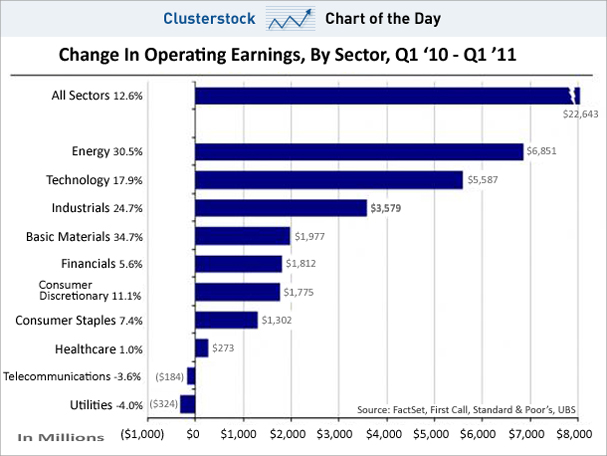
So far, total operating earnings are up 12.6%, and not surprisingly, the fastest-growing sectors are basic materials and energy.
Only telecom and utilities have seen a decline in operating earnings. The is from Clusterstock.
The Internet continues to offer huge riches.
Ask your kids about Internet apps they like, smartphone apps (iPhone, iPad, Android, etc.) they love and apps they’d like to see. There’s seriously big money out there. Today’s Wall Street Journal:
In Silicon Valley, Investors Are Jockeying Like It’s 1999
MENLO PARK, Calif.—Travis Kalanick is the founder of a start-up that lets people order up a car service from a cellphone. Recently, the 34-year-old found himself in the driver’s seat.
Travis Kalanick founded Uber, which lets users summon luxury taxis. Several major venture-capital firms were vying to fund Uber, his fledgling company. While presenting his business plan at the offices of Benchmark Capital, Mr. Kalanick briefly excused himself to phone three other potential investors. His message: They needed to move fast.
One Benchmark partner, Bill Gurley, wouldn’t have it. “No need to talk to those guys,” he told Mr. Kalanick. “Let’s get the deal done here.” After two days of wooing, Benchmark provided nearly $12 million in capital for a 20% stake in Uber, pegging its valuation at $60 million.
That is just one scene in the latest gold rush to sweep Silicon Valley, where prospectors are now fighting over buzzy start-ups and companies are getting their pick of deep-pocketed backers. The momentum is driving a wave of deal envy and trash talking—complete with power plays, personal feuds and turf wars among Wall Street bankers, billionaire speculators and venture-capital veterans.
“Suddenly everyone wants to invest in Silicon Valley,” says Mr. Gurley. “It’s game-on all the time.”
In 2010, venture capital investments rose for the first time in three years, to $21.8 billion from a 12-year low of $18.3 billion in 2009, according to the National Venture Capital Association. During the first quarter of 2011, says the association, U.S. venture capital funds raised more than $7 billion—a 76% increase over the first quarter of 2010.
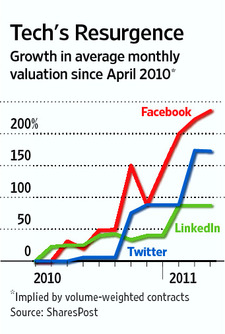
Demand for tech-company private shares is also surging. In a 90-day period a year ago, SharesPost Inc., an active secondary marketplace, handled roughly 20 transactions for five companies, according to founder and president Greg Brogger. In the past 90 days, the firm has overseen more than 300 transactions in about 40 companies.
With the secondary market so strong, tech investors are increasingly holding onto their stakes longer instead of prodding company founders to go to market in an initial public offering.
Rather than wait for the IPO stage to make money, Wall Street bankers are now piling in. Goldman Sachs Group Inc. scored a coup in January, when its funding deal with Facebook set the private firm’s valuation at $50 billion. A month later, J.P. Morgan Chase & Co. launched its Digital Growth Fund to invest exclusively in the high-tech sector.
To some investors, the mood is reminiscent of 1995, when the initial public offering of Netscape set off the dot-com craze, leading to a technology bubble. That bubble popped in 2000, littering the tech field with failed companies and red ink.
Others believe today’s boom is more sustainable. “There are a bunch of rich people and firms subsidizing tech entrepreneurs, but this time the entrepreneurs are better,” says David Lee, managing partner of SV Angel, which provides seed money for tech start-ups. “These companies have millions of engaged users or actual profits. It’s not just sloppy money coming to the table.”
Twitter, whose suitors helped double its valuation in a matter of months, is an emblem of the new frenzy. Venture capital firm Kleiner Perkins Caufield Byers handed the social-networking service about $200 million in December after agreeing to a $3.7 billion valuation. Two months later, J.P. Morgan’s tech fund jumped in and bought 10% of Twitter from other shareholders at a $4.5 billion valuation.
The cash is still swirling around Twitter—even though the company says it isn’t looking to raise additional money at the moment and has seen some recent management turmoil. Shares traded on the secondary market in recent weeks indicate that buyers are valuing the company at $7.7 billion.
“These numbers don’t seem real to me,” says Twitter co-founder Isaac “Biz” Stone. “People beyond the usual suspects are trying to get in.”
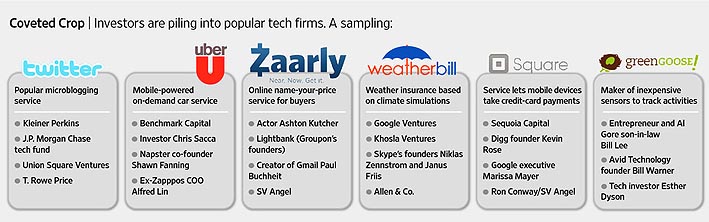
Investors are piling into popular tech firms. A sampling:
The frothy market is creating a velvet-rope effect. AngelList, a web site where entrepreneurs and investors match up, says it has turned away 3,000 potential investors in the past year.
“We don’t let in brand-new ‘angels’ who aren’t trusted members of the community,” says director Naval Ravikant. He argues that such exclusivity helps shield entrepreneurs from pushy investors seeking a quick return.
Last month, a venture capital firm named Y Combinator irked some investors after it set a new bar for potential backers. The company, which provides seed money for start-ups, held a “demonstration day” for its most promising nascent businesses. But only past investors were allowed to attend the early presentations—a rule that angered the rest of the money crowd.
“Investors are swarming for the next cool thing,” says Y Combinator’s head, Paul Graham. And it’s “not simply out of benevolence.”
Unlike banks, seasoned Silicon Valley investors can offer both money and advice—a combination that often leads to a board seat. Those coveted appointments typically pave the way to additional information and shares.
“Not all investors are equal,” says Shawn Fanning, co-founder of Napster, who is raising money for a new start-up. “We also want investors with expertise and connections who can be our partners, giving longtime players here an advantage.”
With signs of a new class system for investors emerging, some backers are worried about being shut out of the action.
Shortly after J.P. Morgan made its splashy entry into the high-tech realm, private-equity head Larry Unrein received several calls from people he dubs “elite VCs” angry that Wall Street was encroaching on their territory, according to a person familiar with the situation.
At a private gathering last fall, several venture capitalists, including David McClure, an early executive at eBay’s PayPal unit, complained that billionaire investors and Wall Street firms were beginning to price them out of hot new tech companies, according to three attendees.
Ron Conway, a veteran “angel,” emailed an angry letter to attendees. “The world of start-ups would be a better place if you spent less time complaining about deal structures, terms, vc’s, and valuations etc and the cars you drive, and just helped entrepenuers [sic] build their companies,” wrote Mr. Conway, an early investor in Google, Twitter and Facebook. He said the group’s meeting was “despicable and embarrassing for the tech community.”
Mr. McClure tweeted in response: “Ron is throwing us under the bus.”
But a few months later, Mr. Conway ignited another drama when he quietly negotiated what some investors considered to be a sweetheart deal.
In February, he teamed up with Russian tech billionaire Yuri Milner. Mr. Milner, a one-time nuclear physicist, has scooped up shares in Facebook, among other companies. The two men signed a deal with Y Combinator in which they paid $6.5 million to gain first access to roughly 40 promising entrepreneurs selected by the elite incubator.
Soon afterward, an investor blog heated up as some posters raged on about how they perceived the Y Combinator deal to be unfair or misguided.
Fred Wilson, managing partner of New York-based Union Square Ventures, said that the move by Messrs. Milner and Conway to secure first dibs on a new crop of companies amounted to “elitism at its very core.”
Mr. Conway declined to comment. Mr. Graham, of Y Combinator, said the start-up firms are “free to take money from anyone they want at any time.”
While investor interest is focused on buzzy social-networking and mobile application software companies, the competition for deals is also boosting companies in other tech niches.
GreenGoose is a maker of lightweight sensors that can track various activities such as exercising and taking medicine. Back in February, the company had applied to be a presenter at a San Francisco investors’ conference but was rejected.
Founder Brian Krejarek was relegated far from the main action to open space on the convention center floor—a cacophony of start-ups pitching to anyone who walked by.
But one conference speaker saw potential for the sensors to be in stores such as Wal-Mart and added Mr. Krejarek as a last-minute substitution on the stage. By week’s end, says Mr. Krejarek, GreenGoose was in demand—and secured a total of $500,000 from investors.
Such overnight success stories are becoming more common. At a Los Angeles “Startup Weekend” in February, Bo Fishback pitched his young company for all of one minute. Its product is Zaarly, a mobile application that asks users to name what they need quickly (from a personal assistant to a dog-walker), then brokers the transaction based on what users are willing to pay.
After the brief presentation, actress Demi Moore tweeted about the company. She noted that “everything has a price!”—a reference to her role in the film “Indecent Proposal,” about a man’s $1 million offer to borrow a stranger’s wife for a night. Within 48 hours, Zaarly raised its first seed round of $1 million. Among those piling into the deal, according to Mr. Fishback: Ms. Moore’s husband, the actor Ashton Kutcher, and Lightbank, a venture fund created by the founders of online-coupon giant Groupon.
The largesse is also spreading to companies in middle and later stages. Traditional venture capital firms, such as Andreessen Horowitz, are amassing $1 billion funds in hopes of buying pieces of these slightly more mature tech companies.
WeatherBill, a company that provides weather insurance for farmers who receive climate simulations on their properties, says it recently received four written offers from venture firms.
The interest was so great that WeatherBill’s founder, David Friedberg, had the upper hand. He says he told bidders specifically what their offers need “to look like in order for you to participate.” On the closing date, two bidders offered amounts that increased WeatherBill’s valuation by 50%, he says.
Mr. Friedberg selected two firms: Google Ventures and Khosla Ventures, based on a valuation of $42 million for the five-year-old company.
One particularly hot start-up, Square, had the pick of venture-capital firms in a recent $27.5 million funding round. “Every investor is already asking when we are doing the next raise,” says co-founder and chief executive Jack Dorsey, who is also a founder and the chairman of Twitter.
With a valuation now pegged at $240 million, Square—which allows individuals or businesses to accept credit-card payments on mobile devices—chose Sequoia Capital, a Silicon Valley powerhouse, as its lead investor. Partner Roelof Botha, an ex-PayPal executive, will join Square’s board.
In this hyper-charged market, even companies untested in the U.S. can fetch billion-dollar valuations. Russian firm DST, led by Mr. Milner, is set to buy a 5% stake in European music-sharing service Spotify for $50 million, based on a $1 billion valuation.
Not everyone is moved by all the excitement.
“I haven’t done any deals” in this year’s first quarter, “because it’s crazy out there,” says Mike Maples, an early Twitter investor. “It’s a true California Gold Rush.”
The full article is in today’s Wall Street Journal.
The secret to getting things fixed:
1. Hold the button down for 20 seconds. See what happens.
2. Hold all the buttons down for 20 seconds. See what happens.
3. Go to the manufacturer’s web site. With luck they’ll have an instruction manual. Pray you can understand it. Always get your installer to explain how it works before you pay him. Take notes.
The Texas bar
A woman went into a bar in Texas and saw a cowboy with his feet propped up on a table. He had the biggest boots she’d ever seen.
She asked the cowboy if it’s true what they say about men with big feet being well endowed.
The cowboy grinned and said, ‘Shore is, little lady. Why don’t you come on out to the bunkhouse and let me prove it to you?’
She wanted to find out for herself, so she spent the night with him. The next morning she handed him a $100 bill.
Blushing, he said, ‘Well, thankya, ma’am. Ah’m real flattered. Ain’t nobody ever paid me fer mah services before.’
‘Don’t be flattered… take the money and buy yourself some boots that fit.’
Two Ladies Talking in the Afterlife:
1st woman: Hi! Wanda.
2nd woman: Hi! Sylvia. How’d you die?
1st woman: I froze to death.
2nd woman: How horrible!
1st woman: It wasn’t so bad. After I quit shaking from the cold, I began to get warm & sleepy, and finally died a peaceful death. What about you?
2nd woman: I died of a massive heart attack. I suspected that my husband was cheating, so I came home early to catch him in the act. But instead, I found him all by himself in the den watching TV.
1st woman: So, what happened?
2nd woman: I was so sure there was another woman there somewhere that I started running all over the house looking. I ran up into the attic and searched, and down into the basement. Then I went through every closet and checked under all the beds. I kept this up until I had looked everywhere, and finally I became so exhausted that I just keeled over with a heart attack and died.
1st woman: Too bad you didn’t look in the freezer—we’d both still be alive.

Harry Newton who wonders why he paid more tax to Uncle Sam for 2010 than GE did. But then, I’m betting so did everyone reading this column. The following came from Jacob Sullum, a senior editor at a magazine called Reason:
The federal tax code, which in 1913 could be published as a single 400-page book, today occupies some 72,000 pages. In the last 10 years alone, reports National Taxpayer Advocate Nina Olson (your designated friend at the IRS), “there have been approximately 4,428 changes to the tax code.” The instructions for filling out Form 1040, which took up two pages 75 years ago, are 179 pages long this year.
No wonder that nine out of 10 taxpayers use software or professional preparers to do their taxes. Olson estimates that the process consumes 6.1 billion hours and costs $163 billion a year. “If tax compliance were an industry,” she writes, “it would be one of the largest in the United States.”
And what do we get for all this effort? Well, the federal government gets about $1.5 trillion in revenue (meaning that Americans pay 11 cents in compliance costs for every dollar they surrender). At the same time, according to the Joint Committee on Taxation, the government forgoes $1.1 trillion in credits, deductions, and exemptions that reduce people’s tax bills.
Last month, the New York Times revealed that GE, one of our largest companies, earned 46% of its revenue in the U.S. over the last three years but booked less than one-fifth of its profits there, shifting most of its booked profits to low-tax countries. In 2010, taking advantage of loopholes in U.S. tax laws (for which the firm had lobbied Washington lawmakers), GE paid negative taxes: despite $5.1 billion in declared pre-tax U.S. profits, the firm received a $3.2 billion tax credit.

The US tried to downgrade S&P, so now S&P is returning the favor.
Harry,
Thanks for the GE article. Just one of the 1,000s of good reasons to learn more about and then support the FairTax bill.
A 133 page bill HR 25/S13 that replaces some 70,000 pages of tax code and now has the support of 67 politicians in the 112th Congress.
All public policy favors some and disfavors others. The FairTax is good for tax payers, business, the economy and the U.S.A. It is not good for politicians and lobbyists. Lean more at http://www.fairtax.org
Paul,
Thanks for the comments on the “Fair Tax” it's something I've strongly believed in for many years. Let's hope that those that support the “Flat Tax” are beginning to understand that it won't reduce the tax cheating underground economy. The elimination of all estate, capital gains and fed/state income taxes with the implementation of the Fair Tax is the key to future US fiscal policy. Absolutely no doubt about it!!!……..Imagine a country were everyone is paying taxes, including plumbers, electricians, carpenters, roofers, stone masons, painters, gardeners, landscapers, pizza restaurant owners and I could go on and on and on……….Well, I guess the Fair Tax would hurt the motorcycle and boat/jet-ski dealerships for a while anyway.