All bubbles burst.
When is a price rise a bubble?
When the price rise is parabolic. Like silver.
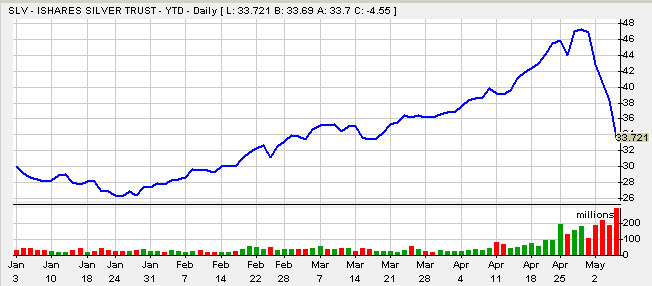
That’s a 30% drop to last night. Note the huge selling volume — in red.
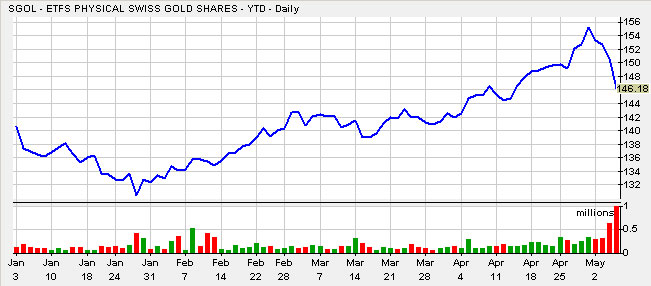
That’s a 6% drop. Much less severe, because the run-up was much less mad.
Today’s market movements are no longer dominated by “normal” investors — you and I (retail investors) and mutual funds.
Markets are dominated by hedge funds and fast-trading machines.
Hedge funds can buy on margin and sell short. Mutual funds can’t. This means hedge funds exacerbate price fluctuations. Hedge funds have a much shorter time horizon.
Fast-trading machine can do whatever they want, but most particularly accentuate a short-term trend — like pummel silver lower.
There are lessons here:
+ You and I are not fast enough. Some of my friends shorted oil, silver and gold when the turn came a few days ago. I didn’t. I should have. I did get out relatively quickly. So I was able to bank some of my gains.
+ Never buy anything on margin. Borrowing forces you to sell at the very wrong time. Borrowing wipes you out. Some hedge funds will announce liquidation in the next few days. We may also see some short-covering in the next few days (perhaps even today) and the price of oil, silver and gold may well bounce. I’ve still got a small holding in gold. I remain positive on it.
+ Oil, silver and gold weren’t the only commodities that collapsed in price in the last few days. That price reduction in commodities (especially oil) will be good for the earnings of industrial America.
+ In short, it’s fun to play “momentum” moves. It’s a good idea to take some profits home — before the inevitable bubble bursts. Names like KO, CAT, DHR, COST and DD are good companies with nice rising earnings. Today they’re a little cheaper.
Favorite recent column:
For the entire wonderful column, click here.
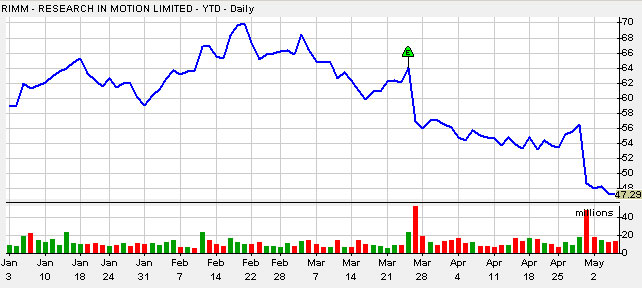
Sell BlackBerry short? Tech stocks are very volatile. I haven’t liked RIMM for a while. I’ve never shorted it. But, I should have recently.
Don’t catch a falling knife. Several New York investment bankers found the bargain of a lifetime — cheap apartments in Las Vegas. They paid $1 million for one that’s now worth $400,000, maybe. To help pay the mortgages, they’re trying to rent them out — with limited success. They offered my friend an apartment for $3,500 a month. He countered with $2,500. They accepted. If my math is correct, the rent won’t meet the interest on the mortgage, let alone any principal repayment. They now need to dump more money in each month, or let the banks have the apartments back. I wonder if they’re on the hook with a personal guarantee. I hope, for their sake, they aren’t.
In Vegas, the house always wins (?). Bad pun.
Verizon’s Thunderbolt’s one big negative. Lousy battery life. Much less than a day. I’ve asked Verizon for a solution. Meantime, hold off.
Bob Cringely on Sony. Cringely is one of my favorite writers. This is his latest piece.
…after the recent earthquake and tsunami in Japan, those stories about wallets filled with money being found and turned-in to the authorities, still stuffed with cash? That’s one positive aspect of Japanese culture, but does it also make them too trusting? Sony’s loss of first 77 million customer records and now another 24.6 million suggests that may be the case. A society with low crime rates and comic book criminals screams of unsophistication, which was confirmed for me this week when I heard from a reader who is a payment system auditor. He looks inside Japanese institutions and often doesn’t like what he sees.
“For whatever reason (low crime rate, maybe?),” my reader says, “the Japanese cannot seem to get their heads around the fact that unencrypted cardholder data sitting on servers in unsecured areas and being transmitted across public networks is a bit of a risk. Every other country in Asia has grasped this easy concept, but not Japan. I have tried many times to explain why this is bad but am usually met with blank looks and checking of watches.
“I could remote desktop right now to a Windows 2000 server in a facility in Japan with a public IP (user-name Administrator, no password) which contains hundreds of thousands of .csv files with full PAN, CSV, name, address etc. I notified the facility in question about this two years ago, by the way, and they have never done anything about it.”
This is Bob again. From my own experience with Windows systems I can’t imagine such exposed servers having not been repeatedly explored by bad guys over the past two years. That information isn’t just vulnerable, it is gone.
But it isn’t just the Japanese who are at fault. A short survey of some of my U.S. admin friends showed there are plenty of unsecured or under-secured payment servers running in this country, too, though none I know of without passwords. I don’t want to name too many names, but if your organization is handling funds on old unsupported Windows 2000 servers you are probably in trouble.
Now back to Sony. With now over 100 million accounts exposed, Sony finally sent lame duck exec Kaz Hirai out to take one for the team and apologize. Hirai offered — just as I predicted — a month of free service. What now? Lawyers will sue, Sony will fix their systems, and gamers once again will game. But while Sony may escape large economic losses from the current problems plaguing its various networks, there is one group that will continue to be rightly upset with the electronics giant — credit card companies like MasterCard and Visa.
The credit card companies have published standards for the management of customer data. These standards are a good combination of requirements and best practices. Anyone who does a significant amount of credit card-based business is required to meet these standards, which Sony appears to have ignored. Independent audits are required. To enforce the credit card company rules there are fines and the death penalty — being cut off.
Since Sony processes credit card transactions — and even offers its own credit cards as you’d know if, like me, you obsessively watch Jeopardy — they are going to be under a very uncomfortable microscope very soon.
The auditors are coming. Worst case they might tell Sony to buzz-off — to refuse Sony’s credit card charges for those 100+ million accounts. Then something really interesting stuff might happen.
Sony might not care.
If Sony is busted by Visa or Mastercard, Discover or American Express, all that probably means is they’ll have to hire a middle man — usually a big bank — to do the credit card transactions for them. Different servers in a different data center would handle the money and all would once again be right with the world, though at the cost of an extra service charge to Sony.
But what if Sony chose a different path? What if Sony cut a payment deal with, say PayPal, instead?
It’s a tempting gambit. PayPal would like nothing more than to pick up those 100 million accounts. They’d pay Sony for them, turning a loss into a gain and a loss of face into an industry transition.
PayPal has been looking for a chance to kick the credit card companies down a peg, grabbing some business.
I can almost hear the phones ringing in Tokyo….
On this day, May 6. Louis XIV of France moves his court to the Palace of Versailles on this day in 1682. The Sun King’s rich personality left no room for modesty as Louis once proclaimed: “Has God forgotten all I have done for Him?”
Should I buy a new ThinkPad X220? My Wednesday interview with ThinkPad X220’s product manager:
+ The graphics are twice as fast as my comparable X201. The processor is about 20% faster. The faster graphics are important to you if you need them. I probably don’t.
+ The big improvement is in battery life. There are now four options — ranging from 4 hours life to 23 hours life, which includes a “battery slice” (and some extra weight). I get big battery life with my X201 by simply carrying more batteries.
+ The docking station is new. It’s not the same as my X201’s. But the X and T series now share a common docking station. That was done because IT managers wanted it.
+ There’s one USB 3.0 port on the X220. That’s much faster than the present common USB 2.0. There’s not much out there that supports 3.0, as yet.
+ There’s now a displayport, but not a DVI port. But you can buy a displayport to a DVI cable. Displayport is big plus because all big monitors are now digital and look better when fed with a digital signal — not a RGB analog signal, which the X220 also supplies.
+ You can’t buy it yet with a downgrade to Windows XP, but it does come with Windows 7 running in XP virtual mode. I’m guessing it works but slow. Maybe I’ll learn to love Windows 7.
Intel has deliberately screwed up its naming of the processors its customers (like HP, Lenovo, Dell, etc.) use to power the laptops they make. Right now Intel makes three processors called — the i3, i5 and i7. The higher numbers are faster. But there’s a big gotcha. The processors come in two varieties — the slow, cheap, ultra-low volt and the fast, more pricey, standard volt.
Personally I would not want a laptop powered by an ultra-low processor. The laptop would be cheap and slow. I want something with power — like the X220 which uses standard, fast processors.
That said, Harry (that’s me) probably won’t upgrade to the X220 because his X201 machines are running so nicely. “If it works, don’t mess for it.”
However, if I were looking for a new laptop, the X220 is what I’d buy today — perfect combination of speed and super-great keyboard (the major reason I don’t use a Mac every day).
Yesterday’s May 5 celebration.
Most people don’t know that back in 1912, Hellmann’s mayonnaise was made in England. In fact, the Titanic was carrying 12,000 jars of the condiment scheduled for delivery in Vera Cruz, Mexico, which was to be the next port of call for the great ship after its stop in New York.This would have been the largest single shipment of mayonnaise ever delivered to Mexico. The great ship did not make it to New York. The ship hit an iceberg and sank, and the cargo was forever lost.The people of Mexico, who were crazy about mayonnaise, and were eagerly awaiting its delivery, were disconsolate at their loss. Their anguish was so great, that they declared a National Day of Mourning, which they still observe. The National Day of Mourning occurs each year on May 5th and is known, of course, as Sinko de Mayo.
Sorry about that.

Harry Newton who wonders why several readers are getting so any angry that I’m taking a little time to answer their concerns about my “too good to be true” recommendations on NLY, AGNC and ANH. As I pointed out, I do have other things to do. One reader brilliantly gets the message, “I suggest reading Harry’s column for fun and ideas but do your own research.“
Amen, do your own research. I give pointers to stocks and ETFs I like (or don’t like). But acting on that advice is your responsibility. Get comfortable with your own research before you act. Everyone has a different appetite for risk, a different portfolio allocation. My generic column (like this one) can not address everyone’s situation. I’m 68. You might think, from my column, that I’m a huge speculator in hot stocks and ETFs. In fact, around 70% of my portfolio is in bonds and cash. If I were 30, and in the throes of building a business or a career, I’d have 100% of my funds in equities. I’d also have fewer of them than I do now.
I remain optimistic. But I’m not buying anything — ever — on margin. And I never have. Amen.

I have a MacBook Pro for work, procured only for the 4GB RAM/500GB HD. Im counting the days until I can get a refresh and get rid of it. This thing blows. I suggested sending 10Mil of them to the
Fukushima power plant to rid act as a chernobyl concrete enclosure.
Thats all theyre fit for.
The ThinkPad team should give you a new ThinkPad, for all the free advertising you give them in your column!
Harry I had a Thinkpad T60 notebook for over four years
running Windows XP Pro and it had the great keyboard you write about but when
it came time to upgrade last year I switched, after much research &
hesitation to the new 13” MacBook Air. Moving to the super fast booting, light
and long batter life of the MacBook Air is great. I even sold my iPad (version
1) on eBay since I was using the MacBook Air instead of the iPad and I still do
not see a reason to get the iPad2. For the few Windows only programs like
Fidelity Active Trader Pro, I run them under Parallels Desktop 6 for Mac. You won’t
need or miss the docking station and trust me, you will get used to the
keyboard, I did. It looks awful compared to the Thinkpads but you get used to
it. While the current MacBook Air models run the older Core 2 Duo processors,
Apple is supposedly coming out with an upgraded MacBook Air sometime this year.
Even with the Core 2 Duo the speed is impressive with its Flash storage.
Harry,
Engadget had a paragraph on new Lenovo X1. From their site:
” We've already seen it pictured and detailed, but Chinese website Mydrivers.com has now scored what appear to be the very first in-the-wild shots of Lenovo's new super-slim ThinkPad X1. As you can see above and in a few more shots at the source link below, the laptop is indeed pretty thin — 21.5mm, or 0.85 inches thick, apparently — but Lenovo still found room to squeeze in a backlit keyboard (check it out after the break), not to mention the ThinkPad's trademark pointing stick. Unfortunately, Lenovo has yet to officially say anything about it itself, so we still only have that rumored May 20th launch date to go on for the time being.”
http://www.engadget.com/2011/0…
the risks with the mortgage reits are a flattening of the curve precipitated by rising of the short end. so when kocherlakota says the short end needs to rise, that would increase MREIT funding costs and tend to, without a corresponding increase in leverage, lower the dividends to single digit territory. to the degree QE2 rolls off but there is no change in fed funds, you may actually see further steepening, and continued high dividends in 2H11. One other note – these companies are run as funds and are generally compensated in an egregious manner, encouraging share sales whenever they trade over tangible book.
Harry, the second best thing I did after switching to a MacBook, was switching to FireFox!
You did good.
Harry,
Silver is still in a great bull market, looking at a long-term chart. When it failed to pierce its’ old high of $49.85, a pullback was in the cards, and it fed off itself with all the ‘hot money’ going to silver lately. The market punishes late arrivals, always has, always will. Silver could fall to the low $20’s and still be in a primary bull market. In my opinion, it will roar back this summer to explode thru $50, and within a year be at $80. There is simply no alternative, given the printing press mentality in Washington. The historic gold/silver ratio is 16/1, and we could well see that within 18 months. For anyone who owns no silver, CEF represents the best play now, as it is trading at a discount to NAV of 8.5%.