The sterling is tanking. The Euro sucks. But the dollar is hanging in, despite our mess. The good news is that our mess is comparatively better than their mess. Hence, I’m positive. I also like Asia and Australia. I have one Asian fund — MAPTX — and am eyeing others. I am also earning 6% on a CD with Westpac, Australia’s leading bank. The Aussie dollar is now over 90 cents. Wow!
I’m on my way to the California desert (La Quinta) for a month of decent weather. Predictably New York this morning is gorgeous. Not a cloud in the sky. Every time I leave town, I bring good weather. I could sell this skill?
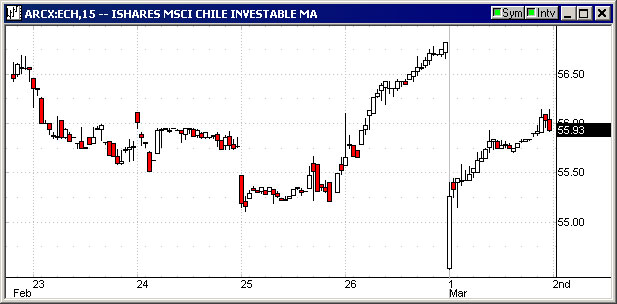
The Chile idea — buy on disaster — worked out well. I dumbly tried to buy on “limit” and kept chasing it up. Still, I managed to get in much below where it closed. I could have sold it for a nice profit yesterday afternoon — had I not played tennis.
I hate traveling. Ever since they invented the Internet, the “service” industry of airlines, car rentals and hotels has dumped all their paperwork on me. Endless hours of on-line B.S. over the weekend taught me:
1. Every assumption about traveling is wrong. Used to be you got great deals through Kayak, Expedia, Orbitz, etc. The airlines, the car and the hotels have woken up. Their own sites are often the cheapest. For example, Hertz has a “Pay Now” option that’s really cheap.
2. Not all online sites work with what you have. Hertz won’t work with Internet Explorer 8 (the latest version). Some will not work with Apple computers. If you’re having problems, switch. No one gives error messages. They just hang.
3. Not all online sites tell the truth. If your credit card bounces, many won’t tell you to try another credit card. Their sites will keep going around in circles.
4. Recognizing who you are is a roblem for some sites. Expedia sends me an email, but won’t recognize my email adddress on their site.
5. It pays to keep trying. One time Hertz wanted $7,000 plus for a California 5-week rental. An hour or so later, they wanted $1,368. Go figure.
6. Remarkably, real live people can be useful. The best are hotel people. They’ll negotiate rates. They’ll tell you of scams. For example, one clerk told me she couldn’t waive the $18 a day Internet charge. But if I complained that it didn’t work well, they’d remove the charge on checkout.
A bizarre, but wonderful play.
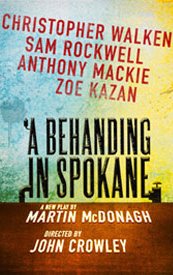
I won’t tell you the plot. Suffice, you’ll enjoy it.
Buffett is wonderful. Here’s today’s story that Anrew Ross Sorkin wrote in today’s New York Times. Sorkin wrote the much-acclaimed recent book, “Too Big To Fail.”
Buffett Casts a Wary Eye on Bankers
“Don’t ask the barber whether you need a haircut.”
That little nugget was buried in Warren E. Buffett’s annual letter to Berkshire Hathaway shareholders published over the weekend. It was his thinly veiled dig at Wall Street bankers and the perverse incentive system for corporate “advice” on mergers and acquisitions – namely that bankers are paid only if a deal is completed. (Bankers typically earn nothing if a deal is abandoned or collapses, giving them little reason to recommend against pursuing a transaction.)
It was a timely note from Mr. Buffett – Monday ushered in more than $50 billion worth of merger announcements – and it resurrected an age-old debate on Wall Street about how bankers are compensated for their counsel to corporate boards.
And it’s an issue that resonates far beyond Wall Street. Just think of all the other parts of life where people offer only encouraging words – “You should do this!” – because that’s the only way they get paid (real estate agents, stock brokers, the list goes on).
And Mr. Buffett has trained his sociologist’s eye on this phenomenon more broadly, too. In his 1989 letter to shareholders, he famously wrote about the “institutional imperative,” which describes, among other things, how an entire organization can rise up to help a boss justify some deal he’s inclined to do, regardless of its merit.
It’s nice to think some things can change, but the deal incentive for bankers probably isn’t one of them.
“You shouldn’t earn a lot less by keeping your client from doing something stupid, but that’s the way it is,” Felix Rohatyn, the financier and elder statesman of Wall Street, told me. “The majority of fees are conditional.”
Mr. Buffett’s letter made a bold suggestion that isn’t sitting well with the establishment.
“When stock is the currency being contemplated in an acquisition and when directors are hearing from an advisor, it appears to me that there is only one way to get a rational and balanced discussion,” he wrote. “Directors should hire a second advisor to make the case against the proposed acquisition, with its fee contingent on the deal not going through.”
Of course, acquirers often hire more than one banker to advise a board, to act as a check on the other. But all too often, both banks are given the incentive to recommend the deal.
Since 2008 in the United States, in 131 of the 230 deals that were worth over $1 billion, the acquirer hired more than one bank, and in some cases more than five. Those banks were paid an estimated $3.3 billion for advisory services, according to Thomson Reuters and Freeman Consulting.
The problem, as Mr. Buffett explained when I called him on Monday, is that the system is skewed. Companies are willing to pay advisers a supersize fee when they do a deal because then it is merely a rounding error, a tip on a lavish, celebratory meal.
It would be hard to justify a big payment if there were no deal, so the system has evolved into an all-or-nothing game. Banks are willing to play it, because the rewards are so high, and they are not shy about offering attaboys and go-get-em’s to help make it happen.
When Berkshire recently acquired Burlington Northern, Goldman Sachs and Evercore Partners – which advised Burlington – were paid almost $50 million for what equated to only a couple of weeks of work.
Mr. Buffett, of course, did not use an investment banker.
“If we need advice for a deal, we probably shouldn’t be doing it,” he said with his trademark chuckle. He told a story about how First Boston (now Credit Suisse) tried to gin up interest in the mid-1980s for Scott Fetzer, a hodgepodge of small businesses based in Cleveland. It called on 30 firms to help make a sale, but failed to find a buyer.
Mr. Buffett then called Scott Fetzer’s chief executive himself and negotiated the deal face to face. Just as they were about to sign the deal, a banker for First Boston said that the bank was still entitled to a $2 million fee. The banker asked Mr. Buffett’s partner, Charlie Munger, whether he’d like to read the firm’s analysis of Scott Fetzer. Mr. Munger replied, “I’ll pay $2 million not to read it.”
That’s not to say that Mr. Buffett won’t ever pay investment bankers. “If someone brings me a deal, I’m more than willing to pay them,” he said, referring to his favorite banker, Byron Trott, a former managing director at Goldman Sachs, who helped broker deals including Berkshire’s investment in the $23 billion Mars-Wrigley merger and its acquisition of Marmon Holdings. However, Mr. Buffett insists that typically, “I don’t think we’ve ever paid for advice.”
Mr. Buffett’s biggest gripe is not just that bankers are given improper incentives, but he thinks their advice is suspect, especially when valuing stock-for-stock deals.
He had some experience this past year with such deals when Berkshire bought Burlington (he issued 80,932 Class A shares and 20 million B shares). He was also uncharacteristically vocal with his criticism of Kraft for paying $19.6 billion for Cadbury, much of it in stock (he’s a big Kraft shareholder).
He thinks that too much attention is paid to the value of the company that may be acquired, and not enough attention is focused on the value of the stock that the acquirer is shelling out.
“In more than 50 years of board memberships, however, never have I heard the investment bankers (or management!) discuss the true value of what is being given,” he wrote in his letter.
“Charlie and I enjoy issuing Berkshire stock about as much as we relish prepping for a colonoscopy. The reason for our distaste is simple. If we wouldn’t dream of selling Berkshire in its entirety at the current market price, why in the world should we `sell’ a significant part of the company at that same inadequate price by issuing our stock in a merger?” …
Totally off-color. I am sorry this is off-color. But it is hysterical. It’s called the Irish Virginity Test Kit.
Paddy is planning to marry, he is, and asks his family doctor how he could tell if his bride-to-be is still a virgin.
His doctor says, “Aye, Paddy, all Irish use three things for what we call a Do-It-Yourself…. Virginity Test Kit…. a small can of red paint, a small can of blue paint and a shovel.”
Paddy asks, “Aye, and what do I do with these things, doctor?”
The doctor replies, “Before ye climb into bed on your wedding night, you paint one of your balls red and the other ball blue . If she says, “That’s the strangest pair of balls I ever did see…”…… you hit her over the head with the shovel.’ !!!

Harry Newton, who posted today’s column via Verizon’s wonderful MiFi broadband service, while sitting on the American Airlines plane on the tarmac. Amazing technology.

Re: Every time I leave town, I bring good weather
Not so fast Harry.
Last year this is what you left in your wake when you bugged out of NY for CA:
http://www.nbcnewyork.com/weather/stories/Tri-S…
Your plane may truly have been the last to leave before the great white out.
Enjoy CA.
P