Louis Navellier is O.K. at stock picking, but much better at self-promotion. His latest “Don’t Buy” list makes amazing sense:

His latest “Five A-Rated Stocks” to buy now also make sense:
1: Intel’s Worst Nightmare [ARMH]
If you’re looking for our next big doubler, look no further. This A-rated stock, ARM Holdings (ARMH) is a British chip designer that licenses chip design technologies to more than 200 major chipmakers around the globe, including Samsung, Texas Instruments and Toshiba.
But that’s just the beginning.
If you’ve ever used a BlackBerry or an iPad, you’ve seen firsthand what this chip company brings to the technology table. That’s because this company has a stronghold on the hottest trend in technology today: Mobile devices.
In fact, it currently controls an estimated 95% of the tablet market and 90% of the e-reader market (think Kindles and Nooks).
Thanks to the fact that their chips deliver better performance and use less power than the competition, the company shipped 1.1 billion energy-efficient chips in the fourth quarter (and posted a 40% earnings surprise!).
So it’s not surprising that the company followed that quarter up with another robust earnings report in the first quarter: Sales jumped 26%, while earnings surged 34%-and 1.15 billion chips were shipped.
And the big companies like Intel are falling behind and won’t be able to catch our chip designer’s stunning lead in chip de-velopment. That’s what makes this company such a compelling buy right now and why I’m expecting a long-term, market-trouncing run from this position. Shares are already up 20% in just 8 weeks.
2: Brazil’s Electricity King [CPL]
Our next company is at the heart of the strongest growth center in South America. Brazil’s economy has been growing at rapid 7.5% clip annually, and it takes a lot of electricity to keep that growth engine running.
That’s because in emerging markets, electricity consumption rises rapidly due to more construction and infrastructure development. It also doesn’t hurt that individuals now have more money to buy and use products that require more electricity.
Enter a major Brazilian electricity provider.
This company distributes electricity to more than 6.4 million customers in 570 communities; primarily in the states of Sao Paulo and Rio Grande do Sul. So its operations are in Brazil’s most developed regions, where electricity consumption grows the fastest.
Although the company already provides 13% of Brazil’s electricity needs, the company is not sitting on its laurels. Management is investing serious amounts of cash to build capacity in the next 4 years—about $2.9 billion—to keep up with demands.
I don’t know about you, but my palms are itching for this stock!
And I haven’t even told you the best part: The company pays a whopping 6.6% dividend yield.
With its growing customer base, in-demand services and high dividend yield, this Brazilian electricity provider is a great long-term investment.
3: A Global Warehouse [TDC]
If you’ve ever run a business, then you know how important it is to have access to good data about your customers and your operations. That way you always know where you’re spending too much or not enough, and how you can better serve your clients since you better understand their needs.
And that’s where our next company comes in: It’s a leading global provider of business data management and consulting. It designs and implements data warehousing systems.
Considering its booming global presence with operations in North America, Latin America, Europe, the Middle East, Africa, the Asia Pacific and Japan, it’s no wonder the company has a large client list. It has customers in businesses from virtually all sectors, including entertainment, financial services, government and telecommunications.
In fact, it has strong partnership with many industry leaders: CS Solutions, CoreLogic, EMC, Symantec, Microsoft, Accenture, IBM, Cognizant and Oracle—just to name a few!
So it’s no surprise the company is having a great 2011 so far: Revenues grew 18% in the first quarter, while operating income increased 6% (or 27% on a non-GAAP basis). And given global businesses’ increased dependence on secure, effective technology solutions, I’m betting this is just the beginning.
Our third A-rated stock’s versatile business strategy and service will continue to prosper and gain more business around the world—making investors a boatload of money.
4. A Leading Producer of Insulin [NVO]
If you’re going to buy just one stock this summer, it should be this one. This Denmark pharmaceutical company is the world’s largest producer of insulin, a hormone used to treat diabetes.
ACT NOWIts products are growing more and more in demand, as developing nations grow more prosperous and middle class citizens develop more Western-style tastes. This is leading to higher rates of diabetes in these nations—and boosting sales of our pharmaceutical company’s insulin products.
The numbers make the story even clearer: It announced a 23% earnings increase in the most recent quarter, with sales of its blockbuster insulin drug soaring 191%! And with the company launching this drug in China in the second half of the year, I’m expecting these strong results and stellar earnings to continue.
5: A Texan Oil Explorer [MRO]
Our final A-rated stock may surprise you given that the oil industry is extremely volatile right now and the fact that many oil service companies remain at depressed valuations.
But, I have actually found a fundamentally sound oil company that won’t be impacted by the troubles in the oil sector, including deep-water drilling issues in the Gulf of Mexico and high inventory of crude in the U.S.
Marathon Oil (MRO) is a Texas-based company that explores for, produces and distributes oil and gas products throughout several countries, including the U.S., Canada, Norway and Libya. It currently operates seven refineries with a total capacity of 1.2 million barrels of crude oil per day.
In the most recent quarter, MRO revealed that earnings more than doubled, revenues jumped 26% and earnings beat analysts’ estimates by 14%. The company also upped its production estimate for the year.
You can read his entire report/promotion here.
Grasping for Any Way to Prevent Alzheimer’s is a New York Times piece this week, which begins:
Is there a way to prevent Alzheimer’s disease? Last week, a study presented at the Alzheimer’s Association International Conference in Paris suggested there might be, something that would give hope to millions who worry that one day they may be struggling with dementia.
The new study, by researchers at the University of California, San Francisco, estimated how many Alzheimer’s cases might be attributable to certain behaviors or conditions: physical inactivity, smoking, depression, low education, hypertension, obesity and diabetes.
The authors used a mathematical model to surmise that these behaviors and conditions, all of which can be modified, are responsible for about half of the roughly 5.3 million Alzheimer’s cases in the United States and 34 million cases worldwide.
And they calculated that if people addressed these risks — by exercising, quitting smoking, increasing their education or losing weight, for example — a significant number of Alzheimer’s cases could be prevented. Reducing the prevalence of these risk factors by 10 percent, the researchers estimated, could prevent 1.1 million cases worldwide; reducing these risk factors by 25 percent could prevent more than three million cases.
I’ve had recent experience with a relative with Alzheimers. It’s a truly ghastly disease — for which there is no treatment and no recovery. The full article is here.
The definitive article on the nation’s debt ceiling. From the latest New Yorker:
Smash the Ceiling
by James Surowiecki August 1, 2011
In the past few years, the U.S. economy has been beset by the subprime meltdown, skyrocketing oil prices, the Eurozone debt crisis, and even the Tohoku earthquake. Now it’s staring at a new problem—a failure to raise the debt ceiling, which would almost certainly throw the economy back into recession. Unlike those other problems, however, this one would be wholly of our own making. If the economy suffers as a result, it’ll be what a soccer fan might call the biggest own goal in history.
The truth is that the United States doesn’t need, and shouldn’t have, a debt ceiling. Every other democratic country, with the exception of Denmark, does fine without one. There’s no debt limit in the Constitution. And, if Congress really wants to hold down government debt, it already has a way to do so that doesn’t risk economic chaos—namely, the annual budgeting process. The only reason we need to lift the debt ceiling, after all, is to pay for spending that Congress has already authorized. If the debt ceiling isn’t raised, we’ll face an absurd scenario in which Congress will have ordered the President to execute two laws that are flatly at odds with each other. If he obeys the debt ceiling, he cannot spend the money that Congress has told him to spend, which is why most government functions will be shut down. Yet if he spends the money as Congress has authorized him to he’ll end up violating the debt ceiling.
As it happens, the debt ceiling, which was adopted in 1917, did have a purpose once—it was a way for Congress to keep the President accountable. Congress used to exercise only loose control over the government budget, and the President was able to borrow money and spend money with little legislative oversight. But this hasn’t been the case since 1974; Congress now passes comprehensive budget resolutions that detail exactly how the government will tax and spend, and the Treasury Department borrows only the money that Congress allows it to. (It’s why TARP, for instance, required Congress to pass a law authorizing the Treasury to act.) This makes the debt ceiling an anachronism. These days, the debt limit actually makes the President less accountable to Congress, not more: if the ceiling isn’t raised, it’s President Obama who will be deciding which bills get paid and which don’t, with no say from Congress.
One argument you hear for having a debt ceiling is that it’s useful as what the political theorist Jon Elster calls a “precommitment device”—a way of keeping ourselves from acting recklessly in the future, like Ulysses protecting himself from the Sirens by having himself bound to the mast. As precommitment devices go, however, the debt limit is both too weak and too strong. It’s too weak because Congress can simply vote to lift it, as it has done more than seventy times in the past fifty years. But it’s too strong because its negative consequences (default, higher interest rates, financial turmoil) are disastrously out of proportion to the behavior it’s trying to regulate. For the U.S. to default now, when investors are happily lending it money at exceedingly reasonable rates, would be akin to shooting yourself in the head for failing to follow your diet.
Advocates of the ceiling like the way it turns the national debt into front-page news, focussing the minds of voters and politicians; they think it fosters accountability, straight talk, transparency. In reality, debt-ceiling votes merely perpetuate the illusion that balancing the budget is easy. That’s why politicians like the debt ceiling: it allows them to rail against borrowing more money (which voters hate) without having to vote to cut any specific programs or raise taxes (which voters also hate).
You might think that there are benefits to putting negotiators under the gun. But, as the Dutch psychologist Carsten de Dreu has shown, time pressure tends to close minds, not open them. Under time pressure, negotiators tend to rely more on stereotypes and cognitive shortcuts. They don’t consider as wide a range of alternatives, and are more likely to jump to conclusions based on scanty evidence. Time pressure also reduces the chances that an agreement will be what psychologists call “integrative”—taking everyone’s interests and values into account.
In fact, by turning dealmaking into a game of chicken, the debt ceiling favors fanaticism. As the economist Thomas Schelling showed many years ago, “It does not always help to be, or to be believed to be, fully rational, coolheaded, and in control of oneself” when it comes to brinksmanship. It doesn’t, in short, help to be President Obama. That may be why all the deals that have been taken seriously this season rely much more heavily on spending cuts than on tax increases: the deals represent Republican priorities, because the Republicans seem to be more willing than the Democrats to let the country default. It’s not pure craziness that’s rewarded—when some congressional Tea Partiers said that they wouldn’t vote to raise the ceiling under any circumstances, they became irrelevant to the conversation, since no compromise would make them happy. But recklessness does equal power: that’s why Eric Cantor, the House Majority Leader, and John Boehner, the Speaker of the House, have implied that they’re willing to go over the cliff (in part by suggesting that their fellow party members will force them to) but also that they can be persuaded to do the right thing.
We may nonetheless end up with a halfway sensible budget deal. But that would be the result of luck, not design. Instead of figuring out ways to raise the debt ceiling, we should simply go ahead and abolish it. The U.S. economy has plenty of real problems to deal with. We shouldn’t have to wrestle with ones we’ve created for ourselves. ♦
So, what’s the implications for investors of all the debt ceiling debate in Washington? Right now, the market is getting less upset about it than the national press — disasters aparently sell newsapapers and drive TV viewership. I asked my friend Ed Sonderling, private investor, investment advisor and former investment banker, for his opinions. His conclusion: Buy treasuries. His logic:
Democrats Give in to All Demands; Republicans Reject Surrender! Buy Bonds!
The democrats have dropped their demand for increased revenues. Their new proposal (from Reid) is about $2.7 trillion of cuts. It’s all cuts and cuts only. No new taxes on the rich, just cuts for the poor. No economic stimulus. This was the original republican ultimatum back in the spring. So there it is: Total surrender! The democrats’ only holdout positions now are 1) please let us have a big enough increase in the ceiling to get through the 2012 election without need for another debt ceiling increase, and 2) please hold off for now on cuts to Medicare, Medicaid, and Social Security. Please, sir.
The republicans have dug in. Their new plan is all cuts, including Medicare, Medicaid, and Social Security. Their wishlist is topped by a fantastical balanced budget amendment. Their fallback plan is a short term increase in the ceiling so they can at least torture the President and whack the economy a few more times before the election.
The line of scrimmage has once again shifted well over to the right. The republicans just won their biggest point. No new revenues. No new taxes, neither individual nor corporate. No loopholes closed. All cuts. No stimulus. In fact, enough cuts to equal the increase in the ceiling. Rather than agreeing to accept everything they asked for, the republicans have wisely moved the ball forward. They are pouncing on democrat capitulation, taking the hand and going for the arm. Their new pre-condition for a deal: entitlement cuts. This will provide political cover for the much despised Ryan bill to end and replace Medicare that every republican senator and house member voted for.
Key takeaways:
Republicans are trouncing democrats on substance. They’ve won all their demands and continue to add more. Why not. The only question is whether they will ultimately take the total victory being handed to them. This is a very real question. At least 100 House members will vote against any increase in the debt ceiling under any conditions. At least three Senators plan to filibuster any increase. Their desire to make the president fail may be the single strongest force in the government. This consuming political motivation is poorly understood and under-estimated by Wall Street and businessmen in general. Consensus expectations of a deal before the August 2nd deadline are still much too high. There is a very good chance that there will be no deal. Best guess: One out of Three. Market expectations: One out of Twenty.
Democrats are still winning on messaging. All the polls show the same thing. The perception is growing that republicans have been intransigent and unfair. However, by the time the 2012 election comes any political advantage won in this battle will be swamped by new events. By contrast, the cuts and concessions won by the republicans will be long lasting. Both sides seem to have lost sight of the much larger strategic political victory won by the republicans. Namely, that the soon-to-be-determined spending cuts and the absence of any stimulus or jobs program guarantees a weak economy and significantly damages the president’s re-election prospects.
Economic / Market forecast:
Buy Bonds! There will be no default under any conditions and under no possible scenario. Treasuries are rock solid. Here’s the one / two:
1) In the event no deal is made and the debt ceiling is not increased: There will be no default. The US will service its debt first before and ahead of all other spending, and they will declare this on the morning of August 3rd. All other spending will be prioritized and in the aggregate cut by about one third. US Govt Bonds will skyrocket in price! The flight to safety will be the largest in history and US Treasuries will continue to be the ultimate safe haven. All other debt will be suspect, especially municipal debt. There will be an immediate shock to the system: i.e. an immediate cessation of 12–25% of all economic activity. This would be considerably more severe than Lehman Bros, 9/11, or the Crash of ’29. The deflationary impact would be extreme. US Bonds would soar in price. Gold would soar, but industrial commodities would tank. The effect on global economies would also be severe. Expect a run on banks and money market funds. The FDIC could expand its coverage (a la 2008) to try to stop a bank / money market fund panic but the public may find such federal insurance implausible without an increase in the debt ceiling. Despite avoiding default, US Govt Bonds will be downgraded but the deflationary impact of the crash would swamp the meaning of the downgrade. A downgrade to AAA-, or AA+, or even AA will not impact the direction of interest rates in a major way. The simple lack of AAA alternatives will keep nearly all treasury money in treasuries.
2) In the event a deal is struck, i.e. an increase in the debt ceiling and trillions in spending cuts – It will be contractionary, maybe severely recessionary. All possible deals under consideration entail substantial spending cuts, job cuts, program eliminations, and general austerity. The deal will constitute a bold economic experiment. The exact opposite of a pro-growth Keynesian policy will be tried . . . with predictable results: slower or negative economic growth. Bonds rally! The bigger the deal, the more negative the impact and the more bullish for bonds. A deal that is too small will lead to an S&P downgrade sometime in the next few months. But pressure to restore the rating by applying more austerity will certainly slow the economy. Bonds rally!
Under all outcomes, bonds rally! An actual downgrade, which has a pretty good chance of happening whether there is a deal or not, is mostly discounted in the market already. It may cause a brief pullback in bonds. But even then, deflationary fiscal forces will win out, at least until 2013. After the election the whole process will re-set.
Finally, from Andy Borowitz, a solution:
WASHINGTON: With less than one week until the President and Congress run out of time to make a deal, most experts agree that the debt ceiling crisis is like Y2K all over again, only with assholes instead of computers.
This grim assessment comes on the heels of a new poll showing that a majority of congressmen can no longer remember which debt deal they like.
As the August 2 deadline approaches, several nightmare scenarios loom, including one in which the United States would officially become a province of China and would be renamed Panda Gardens 2.
The Chinese government proposed that name to avoid confusion with Panda Gardens, a popular Shanghai noodle shop.
In another possibility being openly discussed, the United States would cease to exist as an actual country but would continue in an online-only version.
In this scenario, Rep. John Boehner (R-OH) would no longer be Speaker of the House but would instead become an angry little orange avatar.
As for President Obama, he would step down and be replaced by Roger Goodell, commissioner of the National Football League.
“What can I say?” a resigned Mr. Obama told reporters today. “At least Roger got a deal done.”
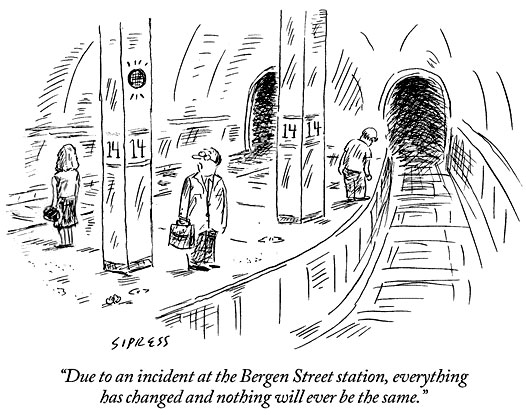
The final comment on the debt ceiling “debate” From the New Yorker:

Harry Newton who is pleased that AGNC (American Capital Agency) 2Q earnings beat expectations. Here’s today’s report from Deutsche Bank Equity Research:
American Capital Agency {Ticker: AGNC.OQ, Closing Price: 28.96 USD, Target Price: 32.00 USD, Recommendation: Hold}
Increasing estimates and target, but maintaining Hold rating
AGNC reported strong 2Q results, with operating earnings of $1.41 per share beating our estimate by $0.08 per share. We expect the attractive operating environment of a steep yield curve, low financing costs, and slow prepayments to continue in 2H11; however, we are maintaining our Hold rating given uncertainty around the U.S. debt ceiling debate. We are increasing our target to $32 per share.
2Q operating earnings of $1.41 per share beat estimate; Book value increases
Operating earnings increased sequentially from $1.30 per share and beat our estimate of $1.33 per share. The upside to our estimate was driven by larger-than-expected average portfolio size, which more than offset the lower net interest spread (246 bps vs. our est. of 255 bps). 2Q GAAP earnings were $1.36, which include unrealized and realized gains/losses. Leverage at 2Q end remained flat sequentially at 7.5x, while the 2Q average leverage excluding the June equity offering was at 8.3x. AGNC’s book value was $26.76 per share, up from $25.96 per share. 2Q taxable income was $1.56 per share while the company had $0.44 per share of undistributed taxable income at quarter end.
Increasing price target to $32 per share from $31 per share
Given the increase in book value, we are increasing our target to $32 per share. Our target remains based on applying a 20% premium to AGNC’s book value. We believe that a 20% premium is warranted given our portfolio return estimates. Historically, agency mortgage REITs have traded in a range of 0.6x to 2.0x book value.
AGNC manages interest rate and prepayment risk
Interest rate volatility may result in significant changes in book value. Downside risks: Increases in interest rates or increases in prepayment speeds could reduce AGNC’s net interest spread through increased premium amortization expenses. Declines in the value of agency RMBS may force securities sales in poor market conditions. Upside: Higher-than-expected leverage or spreads may result in higher-than-expected net interest income.
The following link will be available for 90 days. Click for the full PDF.

One big item ignored in the write-ups above was the power, until removed by Congress, of the president's ability to use a line item veto. At least that was a helpful tool for presidents that wanted to reduce the spending: this one doesn't.
The article by Surowiecki showed idealistic thinking. In fact, the administrative and legislative branches together can't produce ANY budget, let lone one that “fosters accountability, straight talk, and transparency.” The politicians in the Federal Government have proven that they need a belt, suspenders, training bra, and diapers. A balanced budget amendment is at least the suspenders. As for his quote from a Dutch psychologist that time pressure tends to close minds (boo hoo) I prefer the quote, “Hanging at dawn tends to focus the mind.”
On the other hand, the article by Sonderling was great. More please! Now I understand why my “Income Funds” that are heavily invested in government bonds just keep climbing every day. Seems like Mr. Sonderling isn't the only one willing to bet on that logic!
The problem with the smash the ceiling article is that the govt has no capacity to restrain spending, which is what reasonable and moral people do. Since Congress nor the President are reasonable or moral, I for one am grateful for it.
Its lunacy to think we dont need it especially since the govt hasnt balanced its budget since the early 70s. Id say, if a balanced budget amendment were ratified, without any exceptions except in time of real war(direct attack against the US soil), then a debt ceiling is not needed. the balanced budget would required balancing revenues and expenditures, and if too much spending, would require tax increases, and those that put those increases in place would be voted out of office.
Those moronic arguements of Keynesian fluffer Krugman are shear stupidity. But then, the Nobel committee gives an douche an award, including the President.
Well said, Sir. Speaking of the Nobel Peace Prize winner, how's that War in Libya going? Let's see… ABC World news March 18: “President Obama told a bipartisan group of members of Congress today that he expects the U.S. would be actively involved in any military action against Libya for “days, not weeks,”