The US borrows 40 cents of every dollar it spends.
If you and I did this, they’d lock us in debtor’s prison. And throw away the key.
Richard Russell writes “One item that astounds me is how a nation that borrows to survive can allocate billions of dollars to other favored nations. You borrow the money, and then give it away?. Amazing and sort of crazy in this mad, mad world of ours.”
And, by the way, we’re also running five wars. Count them — Iraq, Afghanistan, Yemen, Somalia and Libya.
Apparently I was wrong yesterday about our boots on the ground in Libya. It’s more like 115 (not 10,000) of our military personnel giving free advice. Still, it’s more than one. And our beloved President swore black and blue that he wasn’t going to put troops on the ground in Libya. he lies. But then so does everyone else in Washington.
Washington makes me sick.
John F. Kennedy (or someone) once said that Washington was eight square miles surrounded by reality.
What happens if they do downgrade the credit rating on the U.S. bonds? Nothing much, according to MoneyGame:
Our AAA rating is toast. But it means exactly the opposite of what you think:
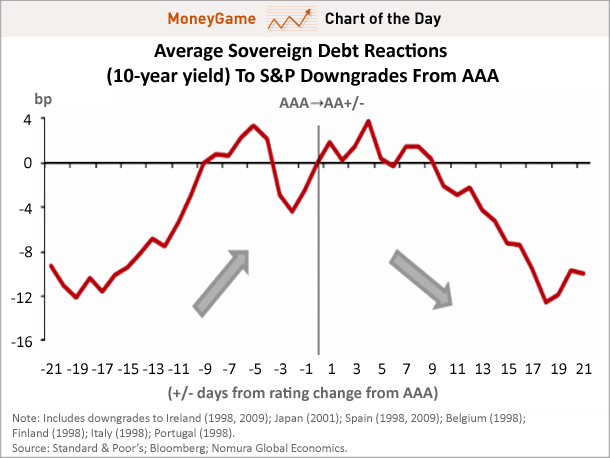
MoneyGame explains this chart:
Why S&P Should Be Ashamed Of Its Ratings
Yesterday we posted what we thought was the #1 reason not to fear a ratings downgrade in the US, namely:
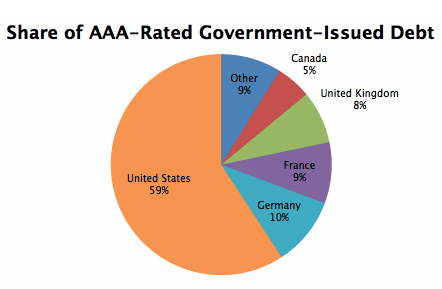
If you eliminate France and Germany — which can’t POSSIBLY be that safe, given that they’re not sovereign currency issuers and are exposed massively to their peers — the US share of the AAA-rated pie grows even larger, which means that a downgrade of the US AAA rating, would really just require everyone to grade on a curve. There’s just nowhere to fly to in a flight to quality.
There could be issues, but by the sheer dint of its size, US debt has a lot going for it.
The truth is, there just isn’t that much other AAA-rated material out there for people to jump into.
But this is even better.
Over at Stone Street Advisors, posts this great chart from Nomura (the big one above) showing the average impact on 10-year yields from the entire history of sovereign AAA downgrades by S&P.
Guess what: Historically yields go lower after such an event.
As he puts it: “from the look of things every historical precedent seems to prove that an S&P AAA downgrade is the bell rung for govvie buyers to re-enter the market.”
David Leonhardt’s last column sums it all up.
Lessons From the Malaise
When I began covering the American economy 11 years ago, it was the envy of the world.
The last 11 years have not been kind to it. First came the dot-com bust. Then there was the weakest economic expansion in decades, followed by the worst financial crisis and deepest recession in decades. Now we’re suffering through a painfully slow recovery, which Washington may soon make worse.
The malaise obviously has several causes, some of which are beyond our control. One major cause, however, is entirely our doing. We do not spend enough time focusing on our actual economic problems.
We are too often occupied with distractions, rather than trying to answer a simple question: What works? What economic policies have succeeded before and are most likely to lead to the best life for the largest number of people? Instead, we’ve effectively decided that because the United States is the richest, most successful country in the world, it is guaranteed to remain so.
Today’s column is my last in this space. I will continue to write in my next job, as Washington bureau chief, but not every week and not this column. So I want to take a step back today and look at what we know about the American economy and, almost as important, what we do not.
One of the tricky things about the subject is that almost nothing is certain in the way that, say, two plus two equals four. Economics — which is at root a study of human behavior — tends to be messier. Because it’s messier, it can be tempting to think that all uncertainty is equal and that we don’t really know anything.
But we do. It’s just that the knowledge tends to come with caveats and nuances. Economic truths may not rise to the level of two plus two equals four, but they are not so different from the knowledge that the earth is round or that smoking causes cancer.
The earth is not perfectly round, of course. Some smokers will never get cancer, while most cancer is not caused by smoking. Yet in the ways that matter most, the earth is still round, and smoking does cause cancer. Both of these facts are illustrative in another way, too: seemingly smart people spent decades denying them.
When it comes to economics, we know that a market economy with a significant government role is the only proven model of success. The United States has outgrown Europe partly because of our greater comfort with market forces. China and India boomed after allowing more of a market economy. On the other hand, unencumbered market forces often lead to disaster, as 1929 and 2008 made clear.
We also know that ever-rising levels of education are crucial to a country’s success. Not only is the evidence all around us — the college wage premium has been higher than ever lately — but careful studies have found that, on the margin, education itself tends to make people wealthier, healthier and happier. The next time you hear naysayers poormouth college, ask them if they plan to send their own children.
We know that the federal government has promised more benefits than it can currently afford. The only way out of this problem involves some combination of tax increases and cuts to Medicare, Social Security and the military. Anyone who won’t get specific about which ones they favor is not a fiscal conservative.
We know this country spends vastly more on health care than any other country — about 75 percent more per person than other rich countries — without getting vastly better results. The waste in our medical system offers the best chance to reduce the deficit without harming our living standards.
We know the planet is getting hotter. Last year tied for the warmest on record, and the 10 hottest have all occurred since 1998. The resulting risks, economic and otherwise, may be even more serious than the risks from the deficit, but receive far less attention in Washington. (And climate worriers do not need to be so skittish about making the connection between heat waves and the larger trend. The thing about global warming is that it warms the globe.)
We know that Wall Street, having bounced back from the crisis, remains a historically large part of the economy. Not coincidentally, we know that income inequality remains sharply higher than it used to be.
The most common income statistics can exaggerate the stagnation of middle-class pay, partly because they exclude health benefits. The American middle class is not disappearing. But it’s not doing well, and has not been for some time.
The bottom 50 percent of households, based on pretax income, make less combined than the top 1 percent. Only three decades ago, the bottom half made more than twice as much. The middle class has also received a much smaller tax cut in recent decades than the affluent.
This list is obviously a partial one. You could add the fact that the United States has benefited enormously from immigration, especially high-skill immigration, or the fact that discrimination, while hardly vanquished, is greatly reduced. But I think the issues here cover most of the high points.
The place where economic knowledge gets murkier is how to best deal with many of our biggest problems.
We cannot know, for example, what would happen if the government raised taxes to cut the deficit. A moderate increase seems unlikely to do much damage to economic growth, given that the increases by George H. W. Bush and Bill Clinton did not prevent the 1990s boom — and that George W. Bush’s tax cuts were followed by mediocre growth. All things equal, though, tax increases do not lift growth.
Likewise, we do not know precisely how to regulate Wall Street so that it will remain the global financial capital without also being a drain on our national resources. We do not know whether the most promising attack on climate change involves a carbon tax or more money for clean energy research. We don’t know how much medical costs would fall if people had to pay more out of pocket, as conservatives advocate, or how much costs would fall if Medicare tried to crack down on dubious care, as the Obama administration prefers.
The real problem with so many of these issues is that the political system is not even trying to find solutions.
Instead of a spirited, even partisan, debate over how health reform could be do a better job of controlling costs, lawyers are skirmishing over whether all Americans should have health insurance. Some of the world’s most talented people — students and would-be entrepreneurs who would like nothing more than to remain in this country — are told they are not welcome. Amazingly, Congress may be about to create a whole new economic problem by voluntarily defaulting on the national debt.
Democracy, not unlike economics, is often messy. And there are certainly some reasons for optimism, whether it’s the bipartisan push to improve schools or the simple fact that American society in 2011 is quite different from what many people could have imagined only a few decades ago. Much of that change has been for the good.
Perhaps the last refuge for optimists is Churchill’s reputed line: “In the long run, Americans will always do the right thing — after exploring all other alternatives.” The sentiment is nice. It would be comforting to have a little more reason to believe that history was going to repeat itself.
Dumb humor for today’s weird world.
A man got on the bus with both of his front pockets full of golf balls and sat down next to a beautiful blond.
The puzzled blond kept looking at him and his bulging pockets.
Finally, after many such glances from her, he said, “It’s golf balls.”
The blond continued to look at him for a very long time, deeply thinking about what he had said.
After several minutes, not being able to contain her curiosity any longer, she asked; “Does it hurt as much as tennis elbow?

Harry Newton who wonders how he can outsource Rosie’s grooming. Today she visits a groomer for the first time. Apparently, my scissors are not good enough. This is Rosie before grooming.

She poohed outside today. Not exactly a first, but a big accomplishment. I suspect we can train Rosie faster than Boehner can train his Republicans.
I’m not inclined to buy or sell anything in this market. It’s far too treacherous. Richard Russell, stockmarket newsletter doyen, writes, “Question– suppose the market weakness isn’t a result of Washington’s shenanigans — suppose the economy is actually fading as it did during the huge 1929-1930 rally?”
I hope not. “Hope” is not an efffective investment strategy. Need to mull on this.

Regarding “Boots” on the ground… the situation is much worse for the Nation than even you say. It is common knowledge that the State Dept is building a large army of mercenaries in Iraq (AKA “Contractors”) to “help” after the US (finally) gets the major forces out of country.
It is a very good bet that Obama veered from the spirit of “no boots on the ground” by using Mercenaries in Libya. They might not be DoD “boots” on the ground, but the people wearing them get their pay from the same place. Machiavelli warned against the use of mercenaries. In essence, the country that can not be defended by citizen soldiers is not worth defending. Obama, lacking any sense of honor, does as he likes.
Harry, what some of your readers–and Money Game–fail to realize when they say “nothing” would happen if US debt were downgraded is that every institutional fund whose charter states that a certain percentage of its assets must be composed of AAA-rated debt (and I mean state and municipal pension funds, private pension funds, and mutual funds, some of which require that ALL of their holdings are AAA-rated) would be forced immediately to sell. And since every other debt instrument in the country, namely municipals and corporates, trades at a spread off US sovereign debt, the bids on THAT debt would drop instantaneously. What do you think interests rates would do if suddenly a trillion-or-so dollars of bonds were for sale? “People” certainly wouldn't buy a TRILLION dollars of bonds, would you? Who would?
I pray institutions are not that stupid.
Haryy – you buying more of those “high yielders” yet? NLY and AGNC getting crushed- again! You are doing your readers a disservice when you continue to point out the ineptness in Wash DC , higher rates and downgrades that will follow while you recommend buying more of these high yielders. . NLY and AGNC will go lower as rates go higher (and rates will go higher) and ratings downgrade (and there will be downgrades) hurt the value of the portfolios they own. Stocks with high yields have a higher risk componenet. The risk for these names is higher rates and portfolio exposure. Well – what are you waiting for. Rates are going higher and downgrade is comming. Fire when you see the whites of their eyes. Dont you see the white?
I've been hearing the “higher rates” arguments for the last 5 years. ..So far, interest rates have gone lower. And with the economy not doing well, and the choices so limited… interest rates look like they'll stay low for a little while longer. We're on top of this one.
You have been hearing “higher rtes” argument for 5 years??? QE1 and QE2 were designed to keep rates low and that's what they did. I'm not sure what you are reading and who you are listening to but lower rates have been baked into this economy by the fed for years now. With QE2 over and the current debt ceiling resolution soon to kick in rates will go higher. Since the debt ceiling resolution does not really address the systemic budget deficit a liley down grade of US debt from AAA to AA cant be avoided. AA treasuries will still be the best game in town but rates will be higher. Higher rates are coming – NLY and AGNC are going lower.
David Leonhardt: what is he, a collector of platitudes? If that were a high school essay I'd grade it B minus.
I'll take Robert Reich, despite some of your readers who are stocking up on tea bags.
We don't need yawners who recycle tired bromides about SS and medical care. My favorite tortured sentence is “increases by George H. W. Bush and Bill Clinton did not prevent the
1990s boom — and that George W. Bush’s tax cuts were followed by
mediocre growth.” This is a deep thinker? As if the boom was coming anyway and completely separate from revenues, and as if GWB's tenure merely resulted in “mediocre growth” instead of what it was, an insult on the the health of the entire system that will take generations to undo, if ever.
It was OK as a short summary.
Gold and silver up while PM mining stocks getting crushed along with everything else. If PM mining stocks break with the overall market this sector could become quite interesting. The big money is watching closely and don't forget the big guy up in Canada has spoken. From what I understand all of the naked shorts up on Bay Street are skipping lunch today. Could the “Big Break” be headed our way? Probably not, but every time this battle is fought the miners learn something. Can mining stocks actually pay a dividend in gold or silver? Now wouldn't that be something. Mr. Sprott says they can, but not publicly…..yet.
Yea, you just can't train those stupid republicans. No, the stupid republicans are completely trained to give into the left, it's the Tea Party or otherwise known as conservatives who will not be swayed. I have stated before, what you are witnessing now is what happens when conservatives gain power, they are not swayed by the liberals in government or the media. So how we have liberals all across the land screaming because they are not getting their way. Get use to it.
Harry, if the Tea Party conservatives were in complete control of the house and senate and we had a Tea Party President do you honestly believe the U.S. would be headed for a bond downgrade?
Obama keeps saying how a rise in interest rates would make it much harder for Americans to borrow but he forgot to tell the people that save money that they might get a little bit of a return on their savings. Now wouldn't that be nice.
Harry, you got that golf balls joke from Dan Quayle (or from a blond?) didn't you. Blond still has no “e”.
Vince
Actually I looked it up. You can spell blond or blonde.
One is feminine and one is masculine. I was taught (many decades ago) that blonde/blond is the only English adjective with gender. Now, if you decide to use it as a noun… you are on your own as to gender!