New York, Friday, August 5, 2011: I wrote the column below early on the morning of Thursday August 5 — before the Dow plunged 512 points. I guess I was prescient about “Maybe a big one.”
I’m on a plane this morning to Hong Kong — so basically out of touch for 13 hours.
As to what to do now? I’m staying with the three recommendations I made yesterday — cash, high dividend-yielding mortgage REITs and gold.
I don’t believe now is “the great buying opportunity of the 21th century”. I don’t believe you should be in non-dividend paying stocks — like financials, technology, retailers, etc. — all those being hit by the global economic problems.
Even despite yesterday’s plunge, the market remains substantially higher than what it was in March 2009.This is the DOW over the past three years to last night’s gruesome close.
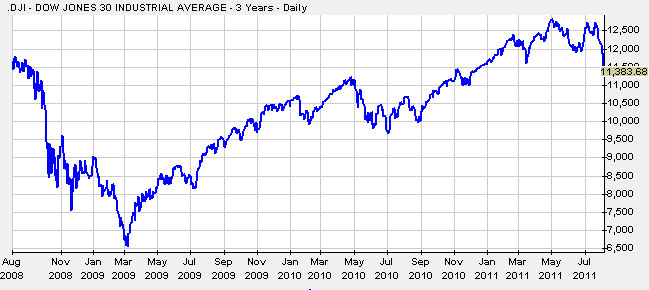
There is talk of a snap-back. But if it happens, we will all have plenty of time to jump back in. And cheap online brokerage rates give us the flexibility.
For now, my mantra is simple: Don’t try to catch a falling knife. Yesterday’s column — just below — continues to make sense, sadly.
+++++++++++++++++++++++++++++++++++++++++++++++++++++++++++++++++++++++++++++++++++++++++++++
New York, very early Thursday morning, August 4, 2011:
Things don’t look good for stockmarkets. To wit:
1. The technicals are breaking down. See charts below.
2. GDP “growth” is anemic.
3. Employment remains awful.
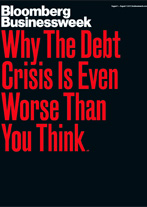
4. The debt crisis here and overseas is horrible, as reflected in BusinessWeek’s latest cover.
5. My take on retail sales shows some companies’ sales falling off a cliff (including Wal-Mart). Costco and Target are apparent exceptions.
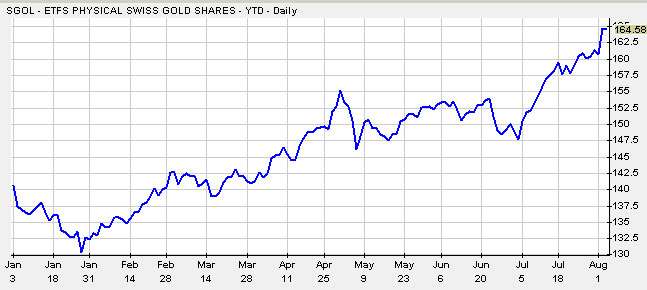
Cash, mortgage REITs and gold are king, viz:
Harry’s lesson in day trading. I freely admit to knowing nothing about day trading. But recently I’ve learned:
1. There are dumb investors out there, who do stupid things, like panic and dump shares wily-nily.
2. If I feel ultra-comfortable with the stock, I can pounce when some idiot dumps.
3. Buying with “limit” orders often doesn’t work, especially if the stock is bouncing back fast.
The first “panic” was with NLY and AGNC. Here the chart from the Wall Street Journal:
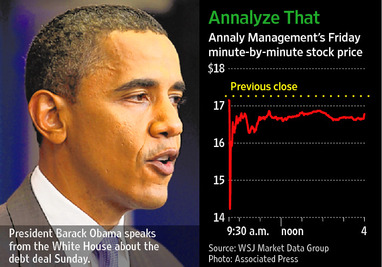
This is what the Journal wrote
At the height of the debt-ceiling uncertainty on Friday, a handful of mortgage real-estate investment trusts suffered a mini flash crash. Shares of Annaly Capital Management plummeted 19% in a few minutes in the morning, and American Capital Agency fell 22% before recovering the lost ground. The two REITs invest in government-backed mortgage securities using huge amounts of short-term debt.
The quick selloff was said to be induced by stop-loss orders that many investors place on these shares, which trigger a sale if the share price moves a certain amount. The big fear for the companies has always been a spike in interest rates. That could create a double whammy, hitting the value of the REITs’ long-dated mortgage securities, while also raising the cost of financing their short-term debt pile.
But the root of Friday’s panic actually came from a different source. Investors suddenly worried that REITs would lose access to the debt market they rely on for funding. Typically, REITs use repos, or repurchase agreements, getting leverage by pledging their government-mortgage securities as collateral. That amplifies returns, helping Annaly pay a hefty 16% dividend yield.
Yet, dependence on repos carries a big, if rarely pondered, risk. As of March 31, Annaly had $80 billion in repos. That included $11 billion due in one day and $22 billion due in two to 29 days. In contrast, 99% of Annaly’s $94 billion in mortgage-backed securities had maturities of more than one year. If Annaly couldn’t replace maturing repos, it could be forced to liquidate assets.
Fortunately, the repo market is unlikely to freeze up entirely. It functioned through the financial crisis, and the Federal Reserve would probably work hard to avoid any interruption, given its importance to the banking system.
And some tightening in the repo market is probably manageable. Steve DeLaney of JMP Securities says REITs can borrow against 95% to 97% of a government-backed mortgage security’s value in the repo market. That percentage fell during the crisis, but only to about 93%.
But the fact remains that Annaly is beholden to the repo market, as well as being heavily exposed to any shift in interest rates. As plenty of highly leveraged borrowers learned in the crisis, hefty short-term funding can change from a profit engine to a huge liability overnight.
In short, Annaly is fine. Its recent earnings are fine and the stock bounced back and has stayed back. I did buy a little on the drop but nowhere near $14, sadly.
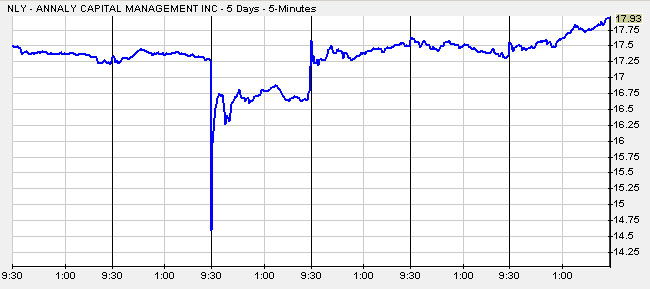
Here’s another mortgage REIT. This one came public just recently and raised $120 million, most of which it still probably has in cash. This is what happened yesterday:
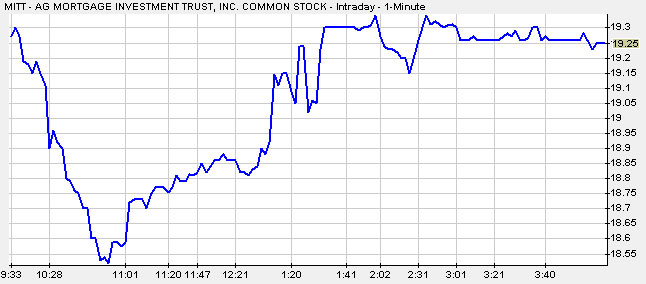
This time, I knew better and I bought a little as it was bouncing back. I bought at $18.56 and $18.77. I tried limit buys, but missed. I ended up buying on the market. Which is fine, since buying online through Fidelity is virtually instantaneous. In fact remarkably so.
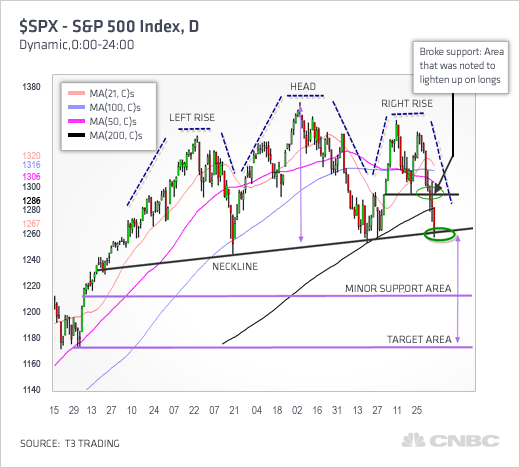
The broken neck bone that everyone is talking about. This is from CNBC:
This is what CNBC wrote:
The S&P 500 triggered a scary technical signal — a head and shoulders pattern in the chart — leaving investors to wonder if it’s the sign of more selling to come — or just a head fake.
The so-called head and shoulders pattern is formed when the chart pattern shows three rallies, with the middle rally peaking higher than the first and second, thus creating a head. If the market breaks the “neckline,” that is a trend reversal signal and can mean more selling ahead.
“What we’re having is a classical technical breakdown. When the S&P broke down through the 1248 to 1250 region, it violated the neckline on a head and shoulders formation, ” said Art Cashin, director of floor trading at UBS [UBS 15.76 0.05 (+0.32%) ].
“If it’s a valid head and shoulders then you begin a countdown to where it occurred. I think it counts down to 1120,” Cashin said. The market feels oversold and ready for a bounce, but the fact that the S&P is now negative for the year could weigh on sentiment, he added.
“You watch the rebounds. They should be restrained by the neckline at 1248 to 1252. A rally can only be a success if it punches above that,” he said.
The pattern doesn’t always trigger a break through the neckline and a selloff.
“There have been a few head fakes with this pattern since we came off the 2008 lows,” said Scott Redler of T3Live.com. He said the S&P started forming the pattern several times, but it was never triggered. “That’s why nobody trusts this pattern, but it feels different this time.”
In the chart below, the market first rallied, forming the top of the left shoulder in late February. It then rallied to a higher level, forming a head in May. It then dipped down to a neckline before rallying to form a right shoulder in July. Typically, the neckline is formed at an area of prior support. That would be the 1249 to 1280 zone, according to Redler.
“Today’s move down through 1249 was the bottom end of the neckline which traders have been watching,” said Redler. “What a head and shoulders tries to do is it tries to measure the potential move of a correction and the way you do that is from the top of the head to the neckline. The high was 1370. The neckline would be an average of 1270. That gives you a measured move for technicians to pick an area to buy. That takes you down to a zone of 1150 to 1180,” he said.
“That correlates to a pretty big support level from last year. That will be the level traders are watching,” he said.
Redler said another reason he was expecting this formation to be triggered was by the action in the industrial sector ETF, Industrial Select Sector SPDR Fund and the SPDR S&P Homebuilders ETF. Both showed head and shoulder patterns.
Redler, who watches the market’s short-term technicals, recommended raising macro cash in longer-term positions last Thursday when he saw the right shoulder start to get fully developed. It was also when the SPY, the ETF representing the S&P, broke its 50-day moving average at 1310.
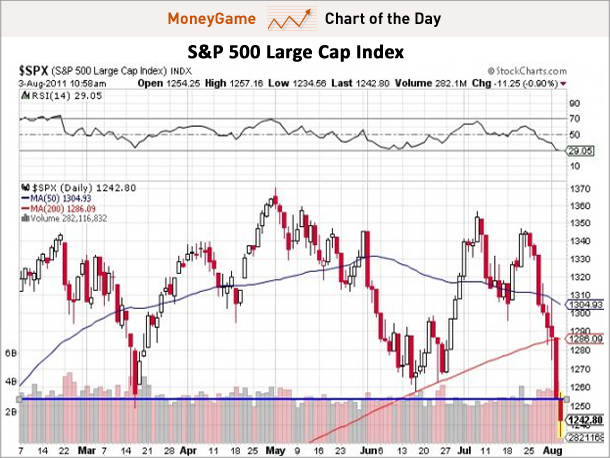
This is the chart from MoneyGame:
This is what MoneyGame wrote about the chart:
With stocks sliding again, and people desperate to look for an explanation of what’s caused the sudden panic, technical analysts are talking about a broken head and shoulders pattern.
As the chartists see it, you have that “head” for the May peak, surrounded by two “shoulders” in July and March.
The blue line… the neck bone that we just broke through.
Make of it what you will.
And this is what Richard Russell wrote the markets:
I’ll admit openly that I’m a bit confused by this market. I’m confused because the stock market and the economy may be doing exactly what I thought they might do. I did a careful study of the action of the great post-crash rally that occurred during late-1929 into early 1930. The rally was a beauty, stirring up more excitement and volume than did the advances in 1928 to the 1929 top.
Observers at that time were convinced that this was a “revival” of the great 1921-1929 bull market, and traders and investors piled into the advance, thinking that this was a golden opportunity to recoup some of their 1929 crash losses.
But the records show that the economy topped out in late-1928, and the economy faded throughout the 1929-30 advance. When in April, the D-J Averages turned decisively down, the Great Depression began. The losses in stocks following April, 1930, were disastrous. In March the Dow was 157. By the end of the year 1930 the Dow had crashed to 57.
I’m not saying that this is a repeat, but the truth is that I can’t get the comparisons out of my mind. True, the Dow and the S&P have given little since their highs, but nevertheless the trend (along with nine 90% panic declines) has been down. Today we have a little respite with the Dow and the Transports both up a bit.
Gold, as I write, is sceptical and is up 21 points to a new record high.
What’s gold worried about? For one thing, the Obama-Congress triumph doesn’t address the galloping costs of Medicare and Medicaid, which will explode as the US population expands. The new bill says not a word about the rising costs.
One way of paying for the added costs is the Fed’s way, which is known as printing money. On this count alone it is worth holding gold for the long pull. As other nation’s print their costs, money growth worldwide will accelerate,and the dollar will gravitate towards worthlessness. This is the fate of every fiat currency that ever existed, but at present the dollar is one of the weaker fiat currencies. The dollar is weak because almost every other fiat currency is stronger. Obviously, the world was not thrilled with the Obama-Congressional deal.
So you thought interest rates couldn’t go any lower?
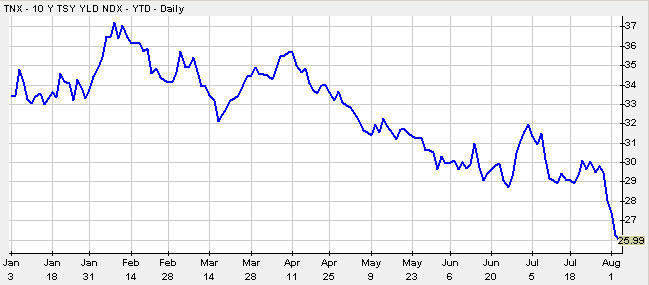
Buy American treasuries and you’ll benefit from the upcoming drop in the Euro and the Swiss France.
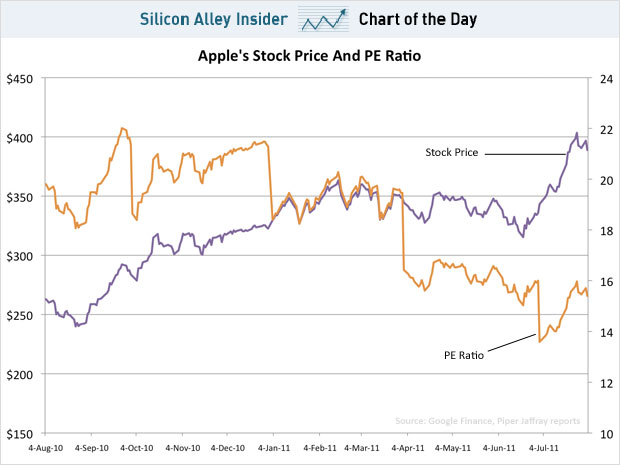
Apple is cheap. Words from Silicon Alley Insider:
After a rough start to the year, Apple’s stock has bounced back, even breaking $400 a share before pulling back.
While the stock has been on a tear, it’s still arguably very cheap when measured on a trailing price to earnings ratio. Apple’s PE is 15.3 right now, which is less than Google at 21.7, Amazon at 92.6, and Netflix at 66, to name three hot tech stocks. (It’s better than Microsoft, which is at 10.)
For some context, in the most recent quarter Amazon had 51% revenue growth on a year over year basis. Google had 32% revenue growth, and Netflix had 48% revenue growth. (Microsoft revenue was up 8%.)
Apple? It posted revenue growth of 82% on a year over year basis.
This is what Bloomberg BusinessWeek wrote in its latest issue about Apple:
Apple’s Earnings Power Befuddles Wall Street
The tech leader’s high-speed profit growth and share performance keep making analysts look bad
In rating shares of Apple (AAPL), analyst Brian J. White of Ticonderoga Securities could justifiably be unnerved by the example of Microsoft (MSFT) at the end of 1999 as the tech boom neared its peak. The software giant was then the world’s biggest technology outfit by market value: $607 billion, still the record for any company. Then came the tech crash. Since the turn of the decade, Microsoft has lost more than half its value.
These days, Apple is worth about $375 billion, with shares up about 25 percent, to $403, this year. If the stock gains an additional 12 percent, Apple will have the world’s largest market value, surpassing ExxonMobil (XOM). Yet White isn’t worried about Apple’s abruptly coming down to earth. If anything, he and a handful of other analysts think Apple watchers on Wall Street may be substantially underestimating the potential of the company, which still only has a single-digit market share in mobile phones and personal computers. “I don’t remember a company of this size growing at this pace,” says White, who recommends the stock and predicts it could be worth $617 billion within a year—the Street’s highest target. “We can’t even model out some of the possibilities: an Apple TV set, huge growth in China, businesses racing to buy Apple laptops. It’s like a religion. It sounds crazy, but it could still be early for Apple.”
Wall Street has had trouble getting a read on the prospects of the Cupertino (Calif.) tech wonder for some time. In fairness, Apple’s management is notorious for lowballing financial projections. Even so, Apple’s profit has topped analysts’ average forecasts for 25 straight quarters, according to Bloomberg data.
Throughout this period, while Apple shares have soared higher, they’ve become cheaper in relation to earnings. That’s because Apple’s profit, seemingly defying the law of large numbers, keeps growing faster than the share price. Apple hasn’t so much “beat the Street” as humiliated it. “There’s simply never been another large company growing at this rate,” says Eric M. Jackson, managing member of Ironfire Capital, a hedge fund in Naples, Fla., that owns Apple shares. “We look at today’s stocks through the lenses and biases of our past.”
Apple, he says, is unique. It is on pace to report revenue of more than $100 billion this year—roughly what Microsoft and Intel (INTC) take in combined. Profit is expected nearly to double, to $27 billion. The company is also throwing off greater amounts of cash—its $76 billion kitty could buy Hewlett-Packard (HPQ) or a combination of Netflix (NFLX) and EBay (EBAY). Jackson says that when Apple hit a $250 billion valuation, hedge fund managers and analysts warned him that this was the upper limit. A few months later, Apple was worth $300 billion, and now $375 billion. Jackson sees Steve Jobs & Co. expanding into mobile payments, perhaps by buying a credit-card company outright.
And so widens the disconnect: Apple just had its best quarter ever, posting sales of $28.57 billion, compared with Wall Street’s consensus view of $25 billion, with earnings per share of $7.79, fully a third higher than expectations. The 20 million iPhones the company sold topped predictions of 17 million.
Even as Apple’s stock jumped in reaction, adding $25 billion in market value, its price-earnings ratio didn’t. White, of New York-based Ticonderoga, calculates that Apple, excluding cash, changes hands for 10 times expected 2011 earnings, compared with the Standard & Poor’s 500-stock index’s p-e of 14 (even as Apple is boosting earnings at six times the rate of the broader market). At the same time, Apple sports a decade-low p-e on the next 12 months’ earnings.
Apple skeptics—yes, they exist—see challenges ahead. Apple’s revenue opportunity in China, with its projected 125 million high-end smartphone subscribers, could be worth $70 billion, says White. Right now it’s kicking in only about $4 billion a quarter. While Jackson and White believe that sum will multiply, Libin Lu, an analyst who covers Apple for Analysys International in Beijing, isn’t convinced. “The ecosystem of Apple is a highly closed one,” he says, contrasting it with Google (GOOG)‘s open Android mobile operating system, which now has the highest growth rate in the world and is gaining ground in China. “If they’re still the same way in two or three years from now in China, Apple will not win.”
Other investors protest Apple’s stinginess with its cash hoard, which works out to about $81 per share. The company has yet to return any of it to shareholders or use it to make a major acquisition. “I would not buy Apple for clients, but not because of market cap or valuation,” says Jenny Van Leeuwen Harrington, chief executive officer of Gilman Hill Asset Management in Westport, Conn. “They can and should be paying a dividend.”
Apple optimists remain undeterred. If Apple keeps it up, the company will soon have a shot at breaking Microsoft’s record tech company valuation. Then, says White, $1 trillion isn’t so absurd. “Why not?” he says. “Apple is an industry, not a company.”
The bottom line: Apple’s expected doubling of profit and its share performance have cast an unflattering light on Wall Street’s projections for the company.
Minor things I’ve learned recently:
1. Automatic magazine renewals are a ripoff. Thye typically charge you twice for a renewal what they charge for an initial subscription. And, if call the 800-number, they’ll give you a lot cheaper price.
2. Expensive cars — Mercedes, Volvos, Audis, etc. — are “money pits.” After 50,000 miles they fall apart and require gigantic repairs. Two solutions: Lease for three years. Or buy the longest warranty you can and sell just before the warranty expires.My trusted car repairman recommends the latest Surbarus, which are now larger, reliable and cheap to repair.
3. When your computer goes awry — my laptop wouldn’t unsleep — it needs a new, updated BIOS. You pick that up from the manufacturer’s web site.
4. The most effective way to speed up your laptop is with a solid state drive (SSD). Maximum PC magazine tested two new240 gigabyte SSDs — the OWC Mercury Extreme and OCZ Agility 3. The first costs $550 and the later $475. The magazine awarded the first “9 Kick Ass!” You can buy smaller cheaper ones that will speed your laptop significantly up. Frankly, I doubt you’d notice the difference. See the right hand column.
5. Everything takes five minutes — the second time.
6. Everybody will give you a discount, an upgrade or drop their shipping charges — if you’re with AAA, AARP, a frequent flyer program, or a member of The Dog of The Month Club. If none of those work, ask the operator which one does? They don’t care. They want you to have a deal. In short, call. Don’t book on online. The phone is always cheaper.
The Bomb That Didn’t Go Off. I read a lot of stuff that often has nothing to do with investing. I highlight the best articles I’ve read. This one is from Esquire. It’s called The Bomb That Didn’t Go Off. It talks of domestic terrorism.
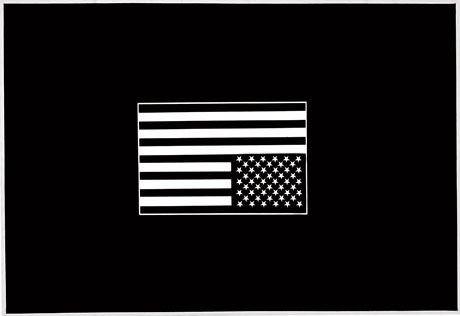
The article focused on a bomb found in 2009 in the city of Spokane, Washington, which fortunately did not explode. The article contains:
At the beginning of this year, not long after they’d found the bomb on the bench in Spokane, a journalist named David Neiwert put together a list of nearly thirty acts of right-wing political violence that had taken place, or had been foiled, in the United States since the summer of 2008 — or roughly since Barack Obama’s presidency began to be seen as a genuine possibility. The list began with Jim David Adkisson, who killed two people in a Unitarian church in Tennessee because he was angry at how “liberals” were “destroying America.” It included two episodes in April 2009, one in Pittsburgh and one in Florida, in which men who were sure that Barack Obama’s government was coming for their guns opened fire on law-enforcement officers who had come to investigate them on other matters.
Some of the crimes on the list were briefly sensational — Scott Roeder’s murder of Dr. George Tiller in Wichita, or Joseph Andrew Stack’s flying his small plane into a building in Austin in protest of the Internal Revenue Service, or the incoherent array of violent crimes committed by the “Sovereign Citizens Movement.” But most of them barely made the national radar at all. In December 2008, a woman in Belfast, Maine, named Amber Cummings shot to death her sleeping husband, James, who’d been savagely abusing her. Upon arriving at the Cummings home, investigators found Nazi paraphernalia and a stash of chemicals indicating that James Cummings was preparing to make a “dirty bomb” that he planned to detonate at Obama’s inauguration. Except in the local media, that aspect of the case disappeared completely. James Cummings and his bomb had nothing to do with Scott Roeder’s handgun or Joe Stack’s airplane.
It is a fertile time for such things. The country elected a black president with an exotic name. The economy, wrecked by a rigged game at the highest levels, continued to grind through a jobless recovery. The national dialogue grows coarser and wilder, and does so at a pace accelerated by technology. People sense the fragmentation — things are falling apart — even while they take refuge in those fragments of life that seem safest and most familiar.
But there is something about fragments that nobody talks about. It is a property first harnessed in 1784 by an officer of the artillery in the British army. He surmised that if you filled an artillery shell with fragments, you could wreak havoc far in excess of what would occur if the shell simply exploded. The destruction would breed upon itself. Propelled with sufficient force, the fragments would make new fragments of whatever they hit — a cart, a tree, a human femur — and, in turn, these new fragments would fly off to do their own damage. The officer’s name was Henry Shrapnel.
The bomb in the bag on the bench in Spokane was a shrapnel bomb, a direct descendant of Henry Shrapnel’s original brainchild. It was specifically designed and carefully placed to create an expanding killing zone, a sideways rain of lethal fragments. A child could have been killed by the blast itself, or by a piece of the bench, or by a chunk of the child’s own father. After all, shrapnel is nothing more than undifferentiated fragments with sufficient force applied.
That the bomb did not do what it was designed to do was a combination of luck and human agency. (It was a triumph for public employees, to put it in the context of our current political argument.) That the events of January 17 largely have faded from the news has nothing to do with luck at all. That is all human agency — how a fragmented country gathers the pieces of an event like this and tries to construct from them, not necessarily the truth of what happened, but a story that the country can live with, one more fragment among dozens of others that the country has remembered to forget.
Don’t talk, then, about the wildness in our rhetoric today, and its undeniable roots in that deep strain of political violence that runs through our national DNA, on a gene that is not always recessive. Don’t relate Centennial Park in Atlanta in 1996 to Oklahoma City to murdered doctors to Columbine, and then to Tucson and to the bag on the bench in Spokane. Ignore the patterns, deep and wide, that connect each event to the other like a slow-burning fuse to a charge. That there are among us rage-hardened, powerless people who resort to the gun and the bomb. That there are powerful people who deplore the gun and the bomb, but who do not hesitate to profit from their use. And when the gun goes off or the bomb explodes, the powerful will deplore the actions of the powerless, and they will reassure the rest of us that We are not like Them, who are violent and crazy and whose acts have no reason beyond unfathomable madness. But above all, they will say, Ignore the fact that there is still a horrible utility in political violence, the way there was during Reconstruction, or during the labor wars of the early twentieth century. If there were not, it wouldn’t be so hard to get an abortion in Kansas, and assault weapons would not have been accessories of choice at recent rallies purportedly held to discuss changes in the way the country organizes its health-care system.
And so Centennial Park gets stuck in amber, and Oklahoma City does, too. Just as did the actions of Andrew Kehoe, who blew up a school and killed forty-three people in Bath, Michigan, in 1927 because, he said, his property taxes were too high. Kehoe largely vanished from history for seventy-two years, until Dylan Klebold and Eric Harris shot up Columbine High School. Two fragments, similar to each other in lethality and in their choice of targets, but, of course, utterly unrelated. Except that, somewhere in the mix, there was politics — the politics of small-town government and the vicious personal politics of high school — that are common to who we are as a species, and therefore to who we are as a country, the political impulses that we share but that most of us do not act upon. In February 2010, Joseph Andrew Stack left behind a note that was a cri de coeur of someone whose world was being submerged by political and economic forces beyond his control and whose government seemed to have abandoned him to those forces to fend for himself.
“Here we have a system,” Stack wrote, “that is, by far, too complicated for the brightest of the master scholars to understand. Yet it mercilessly ‘holds accountable’ its victims, claiming they’re responsible for fully complying with laws not even the experts understand.”
And then he flew his airplane into a building.
The act was deemed an act of madness and shuffled out of the news. We are good and decent people who do not fly our airplanes into buildings. Nobody remembers his note, the sentiments of which would not have been out of place at any Tea Party rally. “The radical Right,” cautions Mark Potok of the Southern Poverty Law Center, “is a response to real things that are happening to real people in the real world.” A political act of madness is still a political act. We use the madness to separate the events so that we don’t have to recognize the politics they have in common. The madness of each individual act enables us to distance ourselves from the politics that burn under the polite society we’ve created like a fuse looking for tinder, like a bag in search of a bench.
What is left is a kind of mosaic, but a mosaic in reverse perspective, whereby the people who are closest to it see the entire picture most clearly. So tell the story in fragments, because it’s safer that way and the language is more soothing, but tell it in the voices of the people who have spent the time since January 17 discussing those properties of force and fragments that nobody likes to talk about. For what is a mosaic but disciplined fragments? What is a mosaic but domesticated shrapnel, waiting?
You can read the entire article here at Esquire.
Comments on our new, higher debt ceiling:

Harry Newton who is going to Australia tomorrow morning for the funeral of his wonderful father-in-law, who died last week at 95. He was the oldest surving Grand Prix winner in the world. He won the 1939 Australian Grand Prix in an MG he and his team souped up. He was a true gentleman who would appear at dinner in a white shirt, tie and a gorgeous sports jacket. He lived with us in the final years of his life at our house in mid-state, New York. He spent a lot of time tending flowers. He had a green thumb. This is Allan Tomlinson with some of his creations. He grew these in the middle of winter. You try that.
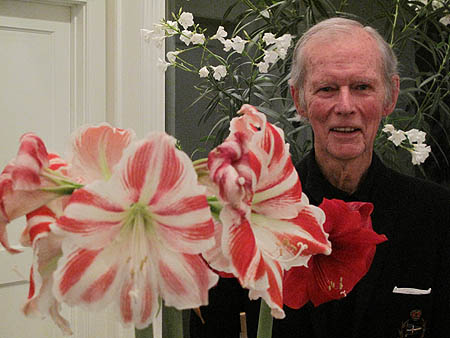
This is the Allan Tomlinson I remember — kind, serious, interested, happy. He was 94 when I took this photo.

My next posting will be next Friday, August 12 at 9:00 AM. It takes 24 hours of flying time to get to Perth, Australia where the funeral. Perth is the town that left the lights on for the astronauts and they saw them.

Condolences, Harry. The photo of your father-in-law at age 94 says it all – the embodiment of intelligence and perceptiveness. If a single photo can combine guidance and hope for us all, this one was it.
I lost my father-in-law this year at 76, after knowing him just 15 years. It's always too soon for those you love.
Incredible amaryllis, btw.
My condolences, Harry, on the loss of a good man and your father-in-law. May the memories live on forever and buoy up the family in its grief.
And don't forget to pick up some of those great knock-off suits in Hong Kong!
Hi Harry travel safe to AUS-I really appreciate you sharing your life's adventures with us. I know there are some folks who disagree with your recommendations but thats what make the world go round as long as we are all civil to each other. You make us aware of whats going on around the world and I look forward to your daily posting.
Thank you.
My condolences, Harry.
It seems I only get back to Perth under similar circumstances nowadays. If you have time, call in for a coffee at the blue duck cafe in Cottesloe – it's a simple experience most locals would recommend you to enjoy if you are there for a short period of time. Let me know if you're in Melbourne; I think you have my contact details from previous correspondence. Safe travels.
Thanks. We're staying Cottesloe. I'll check out the Blue Duck cafe. Thanks.
Harry, saw this on Longform and thought you'd enjoy it, @ tennis
http://www.esquire.com/feature…
Vincent
Lexus is the only way to go Harry…I have had 4 Mercedes over the years and will never buy another one…they nickle and dime you to death $500. at a time…I leased my Lexus IS250 for 4 years and then bought it a year and a half ago..no problems anywhere along the way other than normal maintenance which I no longer do at the dealer and save 75%. The body style of my 2006 is exactly the same as a 2011. Everyone thinks it is a new car. I liked a Suburu I had many years ago also.
Condolences on the loss of your father-in-law he must have been a real peach of a guy. Safe travels.
Lucky and Lorette
Harry you say the best way to speed up your laptop is with an SSD; but then you say that the difference won't be noticeable… contradictory?
Sorry. To make myself clear. The BIG difference is to replace your spinning drive with an SSD. You will notice an incredible difference.
But the difference between SSDs is not that significant.
Get an Kingston kit (see the right column). It's fabulous and works like a charm.
Harry – mark my words- you will crash and burn with NLY and AGNC. Your fall back position is that even if the stocks decline you are safe until they correct by the amount of the dividend. Here is what will happen in this current interest rate and economic environment. One day, after the market closes or before it opens, the company(s) will announce a significant earnings shortfall ( miss earnings estimates) and will simultaneously cut the dividend by 50%. The stock will then open down 25% or more . This type of earnings miss and stock blowup is a regular occurrence in the market. NLY and AGNC by virtue of their oversized and unrealistic dividends and by the fact that everyone knows that their earnings are directly linked to interest rates and spreads on their MBS portfolio. What other signs do you need? Economy and housing continues to slide. Rates are already at ZERO and can/will only go up. Take the money and run Harry. When the stocks blow up and give back 25%-50% in one day you wont look too smart. Lastly, when brokers start to upgrade that’s the sure sign of a top.
My God Harry for people that can afford a nice vehicle their are only two choices Lexus and Acura that's it period – case closed. But I will say that I'm warming up to Hyundai and I think that their Genesis Coupe is by far the best value for a “poor man's sport car” on the market today.
Condolences, Harry. You were the good son (in law) to Allan. Safe travels to you.
Thanks for sharing your father-in-law's pictures and a little bit about his life. The look in his eyes gives us all hope for the latest years of our lives. Hope you have a safe trip.
Kristin
Re: Esquire article…
Well, the author has been wrong before, for example when he predicted with great certainty that Scott Brown wouldn't win the 'Kennedy' Senate seat.
(http://en.wikipedia.org/wiki/C…
Wow.
However, here it seems as if he's attempting to make a link between 'acts of madness' and the Tea Party. But he's attempting to connect acts (fragments?) of madness *outside the system* with people who are working *inside the system*. Sad.
Esquire hasn't had anything in years that I've wanted (or needed) to read.
Well said, Mike. The author of that article is probably right on the facts he presents, but the innuendo he draws from the facts…. and the facts he conveniently ignores… (the “spin”) is so strong that it's insulting. Certainly not the best of balanced analysis. Esquire, and the NYT, are flailing as they slide down the chute. I'll have very mixed feelings over the demise of each.
I am starting to question if there is any place for the retail investor in the stock market. We have endured almost 5 long years of gut wrenching crashes followed by recoveries that never really get back to pre-crash levels.
Despite all of this, there is really no other place for the average Joe to put his money if he ever wants to retire!
Equity markets overall have gone nowhere in the past ten years. That's true. But some individual stocks have done well. The key is to pick those. If you had been 100% in gold and muni bonds, you would have done well. Really well. No one said this was easy.