This is a normal distribution (or bell) curve. We learned about it in college when we discussed the distribution of intelligence in the world. The peak is 100. There are just as many people below 100 (i.e. stupid) as there are above it, so the theory goes. Years ago I extended this theory to argue that because the person wore a suit or had a nice clean corner office didn’t mean anything about his/her IQ. It could still be below 100.

I humbly suggest that you print this chart and keep it on your desk. You’ll be impressed how useful (and soothing) it is — especially when you receive the next sales pitch on a new fund, a new structured investment or even a simple stock which “we’re loading up on.”
Organizing a queue for an outhouse. In Australia, they say of an incompetent “he couldn’t organize a queue for a shithouse.” Now think members of Congresss.
Their latest mess: They passed a law for the Mint to make dollar coins to honor all our past presidents, including the ones you can’t remember.
Well, it turns out nobody wants the coins, so the Mint makes them — they cost 32 cents a piece — and then stores them. Millions of dollars of coins nobody wants and millions of dollars of storage costs. And every day the Mint makes more of them and spends more to store them.
Watch this report from Diane Sawyer. It will make you sick. Click here.
Another story on Washington idiocy. This one is serious.
Corporate CEOs are up in arms over what the Naitonal Labor Relations Board is doing to Boeing. In a nutshell: Boeing is overwhelmed with demand for its planes. It builds a new plant in South Carolina so it can build the planes its customers want. The board argues what Boeing is doing is illegal. Of course, it’s not. But the brouhaha will keep a lot of lawyers employed for years and worse, cast a pall over American manufacturing, which, in turn, will affect stocks. Here’s the way the New York Times reported the story:
Boeing and the N.L.R.B.
It may be a difficult case to prove, but the complaint filed last month by the National Labor Relations Board against Boeing is a welcome effort to defend workers’ right to collective bargaining.
The N.L.R.B. is accusing the company of setting up a nonunion production line in South Carolina to retaliate against unionized workers in Washington State for striking. The board wants to force Boeing to make all of its new Dreamliner jets in Washington, rather than make 30 percent of them at the new line in Charleston.
The case hinges on proving Boeing’s intent. It is illegal to retaliate against workers for striking — there have been four strikes at the Washington facility since 1989 — or threaten workers in order to discourage strikes. But the company can decide to locate production in South Carolina because it makes business sense and may include “production stability” as a factor in its decision.
Boeing says it wants to diversify its assembly to make it less vulnerable to disruptions caused by potential future strikes. Further complicating the N.L.R.B.’s case, Boeing says opening the line in South Carolina will not lead to layoffs in Washington, where it is adding jobs, too.
The N.L.R.B.’s action lands squarely on an ambiguity in the nation’s labor protections — which enshrine the right to collective bargaining yet allow companies ways to avoid it by going to another state.
Today, 1 out of 13 private sector workers is in a union, down from about 1 in 4 in the early 1970s. Many forces are contributing to this erosion, including globalization and the decline of manufacturing. But one important force is the flight of companies to “right-to-work” states where workers cannot be required to join a union. Currently, unionized workers nationally make 19 percent more than nonunion workers, on average.
The N.L.R.B.’s case rests on statements by Boeing officials that, it believes, prove retaliation. One Boeing executive told The Seattle Times that the main reason to put the new line in South Carolina was “that we cannot afford to have a work stoppage, you know, every three years.”
A hearing before an administrative law judge is scheduled for June. The judge’s decision can be appealed to the full board, and the board’s decision can be appealed in federal court. If the N.L.R.B.’s position is upheld, this case could draw some clearer lines on what businesses can and cannot do to avoid dealing with unions. At the very least, this case will shed light on the business strategies employed by a powerful company to resist unionization.
Here’s the way the Wall Street Journal reported the story:
Boeing, NLRB Clash Over Non-Union Plant
SEATTLE—Lawyers for Boeing Co. and the National Labor Relations Board clashed Tuesday at a hearing on the board’s allegations that the aircraft maker illegally shifted work from union plants in Washington state to a new non-union factory in South Carolina.
BOEING
The hearing, which dealt mostly with procedural issues, marked the start of what could be a lengthy and politically charged legal battle, unless Boeing and the company’s machinists union, whose complaint sparked the board’s inquiry, settle their differences.
The administrative law judge hearing the case urged the parties Tuesday to work toward a settlement.
At stake is the future of a $1 billion factory Boeing recently opened to build its new 787 Dreamliner passenger jet. The NLRB alleges that Boeing built the plant in South Carolina, where unions are weak, to punish union workers in Washington state for their past strikes. As evidence, the NLRB cited public comments by Boeing executives.
Boeing asked the judge to dismiss the case as unfounded. “Frankly, we have a hard time understanding the elements” of the NLRB’s allegations, said William Kilberg, an outside counsel for the company.
Aside from instances in which Boeing executives were misquoted, Mr. Kilberg said, “We would argue that Boeing’s statements are truthful statements of economic realities. Customers don’t want production delays caused by strikes.”
“A company can certainly establish new facilities in other locations,” he added.
Boeing also has challenged NLRB Acting General Counsel Lafe Solomon, arguing that he lacked authority to bring the complaint. Boeing says a provision of the National Labor Relations Act specifies that an acting general counsel can serve for only 60 days before being formally appointed general counsel. Mr. Solomon has served longer than that on an acting basis.
The NLRB contends Mr. Solomon was appointed under a separate law that doesn’t make him subject to the 60-day rule.
Administrative Law Judge Clifford Anderson said he wanted to rule on that issue promptly, but didn’t give a timetable. He said he expected to see the parties back in the courtroom Wednesday morning.
NLRB lawyers, meanwhile, argued that the case was straightforward and that the International Association of Machinists and Aerospace Workers has evidence to support its claim that Boeing’s decision to locate its new facility in South Carolina was intended to retaliate against legal union activity.
With the nationwide unemployment rate topping 9%, Boeing and political leaders in South Carolina have portrayed the NLRB action against the company as an attack on job creation. “This case casts a shadow over Boeing,” Mr. Kilberg told the judge. “It makes life very difficult for Boeing.”
Judge Anderson stressed at the hearing that litigating the complaint could take years, especially if the battle went all the way to the Supreme Court. “I’ll be retired or dead,” he added.
If his decision in the case were to be appealed, the case would next go before the full NLRB, which currently has four members. That appeal alone would take one to three years, the judge said.
Machinists union General Counsel Chris Corson, who wasn’t at Tuesday’s hearing, has said he prefers to settle, and is open to creative ways to do so. The machinists have proposed dropping their complaint in return for assurances of more work for unionized Boeing employees.
Boeing has rejected that idea. Mr. Kilberg, who is representing the company, said in an interview that “Boeing is always open to a settlement,” but not any union proposals to guarantee future work at union facilities.
The case comes as Boeing is juggling a variety of issues that will affect its work force. It has built a temporary Dreamliner “surge line” at its huge factory in Everett, Wash., which it will use for final assembly of the 787 as it brings production at the new South Carolina factory up to speed. By late 2013 Boeing expects to build three Dreamliners a month in South Carolina and seven in Washington.
In the same Washington plant, union workers are also busy building the 777 wide-body jet and the massive 747-8, the latest version of the Boeing’s double-deck jumbo jet, which the company is selling in both a freighter and passenger version.
The company also has said it will boost the production of its best-selling 737 narrow-body aircraft to 38 a month by mid-2013 and is weighing a further increase to 42 a month, both record rates. The 737 fuselage is built by union workers at Spirit AeroSystems in Wichita, Kan., and final assembly is completed at Boeing’s factory in Renton, Wash., south of Seattle.
The company, which is weighing the future of the 737, could decide to build an all-new airplane while keeping the 737 production line going. The machinists union is concerned that Boeing will choose to move construction of any new plane to a less union-friendly state.
Boeing, meanwhile, is hiring union workers in Washington state to build the Air Force’s new aerial refueling tanker, which is based on the 767 commercial jet, long built in the Puget Sound area.
Among the procedural issues considered during Tuesday’s hearings were document exchanges and motions. The NLRB and the union have both subpoenaed documents from Boeing, and Boeing has done the same from them. There have already been clashes and objections over subpoenas, and there are expected to be more over which documents will be entered into the docket.
About an hour into the hearing, lawyers for the parties recessed at the judge’s suggestion to consider their respective document requests and try to resolve some of their difference over them. They returned briefly at 1 p.m. Pacific time, and the judge dismissed them again to continue as they had during the morning recess.
PCWorld reveals the 10 most ridiculous technology lawsuits:
1. Rosenberg v. Harwood. After being struck in 2009 by a car while walking in the dark on a busy highway in Park City, Utah, Lauren Rosenberg filed suit against the driver who hit her (Harwood) and against Google. Rosenberg blamed the walking directions given to her by Google Maps for landing her in the middle of dangerous traffic. Google carries a warning about the imperfect reliability of its directions. This summer, a judge threw the case out of court.
2. Mafia Wars (a computeer game) Breaks a Heart. Cheryl Gray of Michigan fell in love online–while playing Mafia Wars on Facebook. She says she began an online relationship with Wylie Iwan over the game. When she sent gifts and booked a flight to visit him in Washington, things apparently got a little too real, and the 35-year-old Applebee’s server broke it off. Gray is now looking for $8368.88 in damages from Iwan–the amount she estimates she “spent on the relationship.” There’s no word on whether she plans to go after Zynga for relationship racketeering.
3.Defamation by Google Suggest. The search giant has had a hard time convincing international courts that its autocomplete suggestions for search queries are harmless. Google lost two cases in France when Suggest added the French word for “scam” to a French organization’s name, and another when “rapist” and “Satanist” appeared next to the plaintiff’s name. Google lost similar cases in Italy and Argentina, and an filed by an Irish hotel owner has filed another claiming that a Google autocomplete option indicates that the establishment is in receivership.
4. The Case of the Pentium Allergy. A Dutch woman went after Intel and her government, claiming that exposure to a Pentium processor’s high-frequency radiation gave her hives. She apparently had no issues with 486-based processors. Last we heard, no court had been willing to take up the case.
5. ETrade v. Lohan. When Lindsay Lohan watched a Super Bowl commercial featuring cute babies hawking services for the online brokerage ETrade, she apparently saw a little too much of herself. The former child star filed a $100 million lawsuit alleging defamation because she believed that one of the babies was clearly referring to her when alluding to “that milkaholic, Lindsay” in the ad. Ridiculously enough, the parties actually reached a settlement in this case, meaning that Lohan probably walked away with some of ETrade’s cash.

6. Star Wars Fans v. Sony. Fans of the online MMOG Star Wars Galaxies were so bereaved when Sony announced plans to shutter it at the end of 2010 that they opted to take on the Japanese corporate Deathstar.
7. German Gold and the Flamed Florida Farmer. A Florida farmer sued a tiny startup that hosts message boards and chat rooms after discovering a negative post about himself by a message board user. The $800 million suit contended that the company was conspiring to influence the outcome of another court case involving 70-year-old German gold bonds.
8. Bonnen v. Horizon Group Management. When Amanda Bonnen complained about her moldy apartment on Twitter to all 20 of her then followers, rhe tweet prompted her landlord, a property management company, to file suit against her in 2009 for damaging its reputation. It also sought $50,000 from her in the process. The suit was dismissed because the judge felt that the tweet was too vague to be libelous.
9. Parents v. Wi-Fi. A Chicago area school district was considered pioneering when it installed Wi-Fi way back in 1995. But in 2003, parents sued the district, alleging that the routers were harming their children.
10. The Batman Bonus. In 2008, the mayor of the Turkish city of Batman reportedly considered suing Batman director Christopher Nolan and Warner Brothers for royalties from the blockbuster hit The Dark Knight.
The Eurozone. There are 17 countries who use the Euro. They are Austria, Belgium, Cyprus, Estonia, Finland, France, Germany, Greece, Ireland, Italy, Luxembourg, Malta, the Netherlands, Portugal, Slovakia, Slovenia, and Spain. With the exception of Germany and perhaps France, this is not an especially impressive bunch. Hence the business of saving the Euro falls squarely on Germany, whose people and prime minister clearly are not motivated to save the bond default problems of so many of its members. There is no simple solution. Europe’s bond problems will continue to hurt our stockmarket.
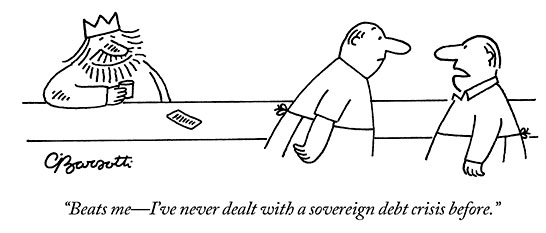
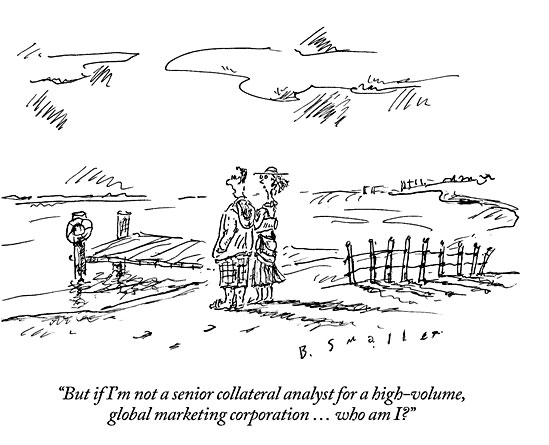
Favorite recent New Yorker cartoons.


Harry Newton who wonders why he’s so naive. These car dealers now have service reps suited and sitting at nice clean desks. They talk to me about my car, tell me what’s wrong with it and make recommendations. I just learned many service reps are on commission. They’re motivated to sell me every conceivable service and spare part I don’t need. Am I stupid or what? My, more intelligent, friends take their cars to independent mechanics who charge less per hour and are more honest. They can talk to them and the mechanic will show them what’s really wrong and discuss alternatives.

If euro zone is in trouble, how come the euro is still rising against dollar? Thanks.
I don't know. I shall try and find out.
Zhupeter80 and Harry—-it's not the euro raising against the dollar — it's the dollar falling against the euro…….Got Gold?
Dealership mechanics are typically paid by flat rate instead of hourly. Meaning that if the service advisor sells you something that is an 8 hour labor job, the mechanic gets paid 8 hours no matter how long it takes. It encourages the mechanics to take short cuts to accumulate as many billable hours as possible.
You just learned that service reps are on commission? Gee I knew that twenty years ago! They cannot get a paycheck let alone keep their job if they don”t “SELL” you.WAke up HARRY!
I'm now awake. Thank you.
Glad your awake and didn't mean to” snap” at you but I thought you would have known that. They try to sell you tires when you have 6,000 miles left .