Jim Cramer has a TV show that needs a rising market and/or his optimism to get viewers and advertisers. When the market is difficult — as it was in August — he resorts to homilies on investing, which he repeats endlessly. Most of his stuff is logical. But…
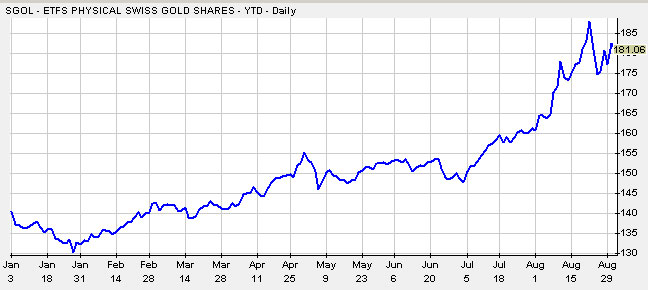
+ Diversification is his mantra against disaster. No more. When the market is down, most stocks go down –in all industries. Nobody ever got rich by diversifcation. They got rich because of one big bet — typically on their own business. Hence, his game “Am I diversified?” is pointless. That said, the “diversification” that has worked in recent months — is gold and high dividend paying mortgage REITs. Gold has tended to go up when big industrials go down:
Annaly (and other mortgage REITs don’t move very much. NLY is flat on the year. Which is exactly what you want. You bought them for the dividends, not the capital appreciation.
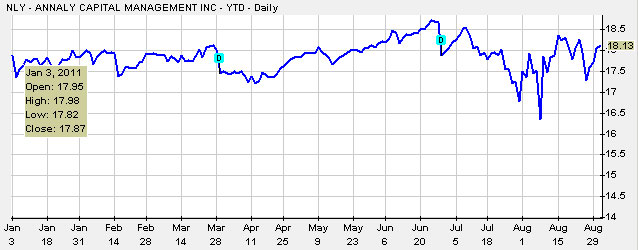
+ Don’t buy or sell at “market.” Use limit orders. That’s a theoretical protection against being hammered by the high frequency traders. But it’s a stupid worry. If I hit the Buy or Sell button on my Fidelity Active Trader Pro software, I’m done in seconds. If I lose a tenth of a penny to the high frequency guys, so be it. But I’m happy with my price. If I hang around with limit orders, I often miss the run-up or run-down… And heck what is my time worth? The big advantage of limit orders is putting in ultra-low buy orders and hoping I’ll snag a few of my favorite stock when it collapses momentarily (often because of the high frequency guys/computers). An example is early August wth NLY or late August with SGOL. In fact, I think this is the way to take advantage of the high frequency traders.
+ Don’t buy or sell all at once, says Cramer. Bullshit. If things have changed dramatically, get rid of all your holdings and fast, or buy all at once. If it’s on a tear up or down and the facts are totally evident (even to Blind Freddie), do your thing. Don’t hesitate.
+ Stop loss orders are inviolate. Yet I’ve never heard Cramer talk about them. He says sell when things have changed with the company. Which is right. But you should also sell when the thing falls 8% to 15% from its recent peak. I’ve always pushed 15%, but I’m now tending towards 8% — if only because it’s so much easier and cheaper to get out and in quickly. I pay Fidelity $7.95 for any size order. In the old days, you could pay $500. That’s huge difference.
+ Don’t buy mutual funds. I agree with him. If you can’t do better than your typical money manager, then buy yourself some bonds and clip coupons. They’ll definitely do better, especially in recent markets. Don’t forget that one stat. If you were in an S&P or Dow index fund in the the first decade of this century — i.e. from 2000 to 2010 — you lost money. Real cash money.
+ The older you get, the more you should be in bonds. This makes sense — but only on one condition, namely that you don’t want to devote the time necessary to pay attention to what you own and learn about this business of investing. Still, I like muni bonds and have lots of them. The family lives off them.
My favorite “house spectacularizer.” This is the spectacular switchplate in my bathroom at the gorgeous Allison Inn and Spa in Newberg, Oregon. You’ll notice the switchplate has no screwholes — like all the ugly switchplates in your (and my house).
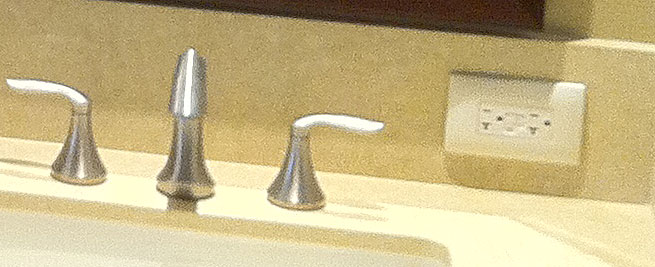
Want to specutacularize your home? Get these classy things.
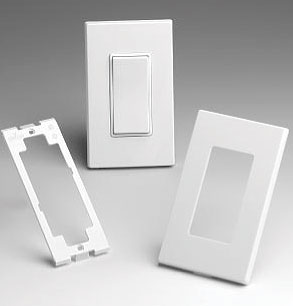
They’re called Decora-Plus Snap-On wallplates. I have no idea what they cost. I know they’re made by Leviton. They’re hard to find. To find them, I called the Allison’s wonderful concierge, who’s acutally called Allison. For Leviton’s brochure (which is where the second photo came from), click here.
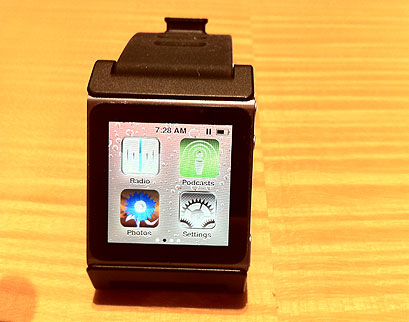
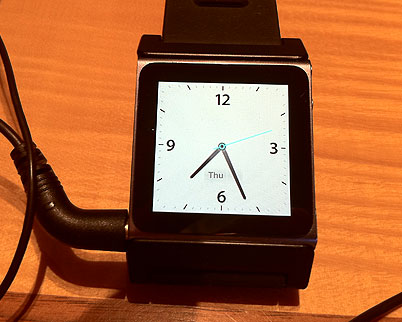
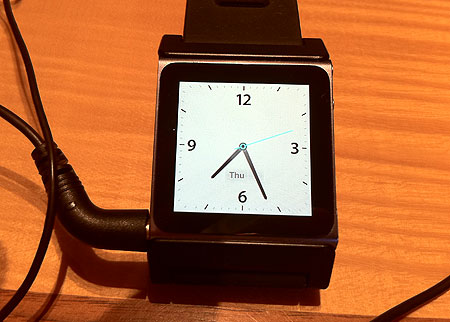
My new favorite watch. Some of my friends have $15,000 watches. I now have a $238.38 watch. Mine does some things their’s doesn’t — like play music, podcasts and FM radio. Mine also shows photos of my family and Rosie, our new dog. Mine also has a pedometer which tells me how many calories I burn (not enough). Of yes, it also tells the time in the dark (useful in theaters).
It’s called an Apple iPod Nano. The watch band is called a TikTok.
This is its little screen showing the FM radio, podcasts, photos and settings. There are other screens for my music, my pedometer and my audiobooks.
This is it showing the time, the day and the date (obscured by the big hand.
My favorite ComputerWorld magazine story:
The iPad wars: HP TouchPad sale burns Apple’s foes by Jonny Evans
In a triumph of madness over common sense, HP says it will manufacture one more batch of its loss-making TouchPad tablet “to meet unfulfilled demand,” but won’t say how many or when they will ship: no great surprise when you think about just how much cash HP has already lost competing with Apple [AAPL] and its iPad juggernaut.
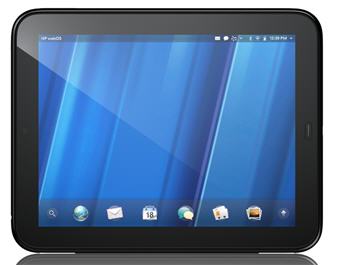
ABOVE: An HP TouchPad — the anti-iPad tablet killer.
Suicide is painless
It has to be as obvious as the world being round that HP is losing a huge amount of money selling TouchPads at just $99 per unit.
There’s no way you can even acquire the components used in these machines at prices as low as these. When you factor in manufacturing and shipping/distribution costs, all HP is doing is cutting its losses — while starving everyone else in the anti-iPad market of what little oxygen remains by offering a device with features and at a price competitors can’t conceivably match.
If Apple’s sobbing non-iPad tablet-making competitors thought things were bad already, HP’s low-cost giveaway move made things worse. There must be hundreds of thousands of unwanted tablets from sundry manufacturers filling up the distribution chain: making a Holiday season price war inevitable. In other words, HP’s decision to sell its tablets at a loss will eventually be emulated by all Apple’s other competitors.
Spend, spend, spend
These firms must be addicted to losing money in their battle with Apple — word out of Taiwan even claims some vendors are already planning new models for the Christmas market. Asustek, Acer, Dell, Lenovo and Amazon are all preparing to bring new tablet models to market. And of these only Amazon can offer a feast of available content to make its device an even slightly interesting proposition.
I’m expecting a bloody price war. Why? Apple has the hearts and minds of the consumer market with its iPad. Android tablets lack the rich, apps market Apple enjoys; devices from other makers strive to even equalize what’s available for Android devices, with Apple app availability just a distant dream. In other words, Apple has the device people want with a the vast array of available apps to help make each iPad unique to the person that owns it.
iPad competitors will be combating each other for the smallest slice of the market. HP’s recent move to sell $99 TouchPads means many consumers already have a device they can use for the next year or so. That reduces potential sales numbers, and creates an expectation that non-iPad tablets aren’t worth much money. All vendors will feel this pricing pressure.
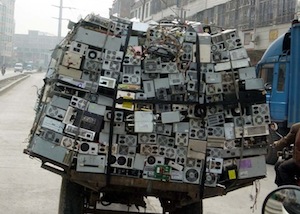
ABOVE: Unwanted PCs heading for landfill — at least all those non-iPad tablets will take less space. c/o: Greenpeace.
The drowners
The problem grows worse when Amazon will steam in using all the clout of its online marketing power. That company is expected to offer its own tablet at a price lower than that of Apple’s iPad.
You’ll see tablet makers struggling madly to sell devices at price points which only barely cover their costs. If pressed, Apple has the nuclear option of dropping iPad prices in order to further starve the market. Amazon will be seizing as much oxygen as it can, shunting devices from other makers and OS developers to the sidelines.
The end result will be that after a disappointing Christmas quarter executives in boardrooms outside of HP will also be asking if it is worth losing money in a market Apple owns. And Apple will be planning to raise its game again with the introduction of the iPad 3.
Phyllis Fredericks is my favorite. Phyllis is Jack’s wife. Jack is the best car mechanic in the entire world. When I asked Phyllis yesterday for an apoointment, “tomorrow, Friday,” she corrected me and said, “Tomorrow is Thursday. All day, too.”
I explained to to Phyllis that wives have this nasty habit of destroying their husband’s ego by always correcting them.
She explained what she typically responded to Jack, “Life s a bitch and then you’re married to one.”
God bless Phyllis.

Harry Newton who aplogizes to his readers for the piece on faceplates. When I first wrote about spectacularizing your home for sale (click here), I was inundated with suggestions from kind readers pumping all sorts of things like granite countertops and infinity pools. I’m tending towards “spectacular, but not ultra-pricey.” I’m making a list. I’m still looking for suggestions. I remain taken with screwless faceplates. I’ll buy a bunch next week.
Anyone been playing with MLPs? What’s your experience been?
Stop Press: The Wall Street Journal carries this important story this morning:
Goldman Takes a Dark View
A Private Note to Hedge-Fund Clients Gives a Strategist’s View; Ways to Gain From Global Pain
By SUSAN PULLIAM And LIZ RAPPAPORT
A top Goldman Sachs Group Inc. strategist has provided the firm’s hedge-fund clients with a particularly gloomy economic outlook and suggestions for how these traders can take advantage of the financial crisis in Europe.
In a 54-page report sent to hundreds of Goldman’s institutional clients dated Aug. 16, Alan Brazil—a Goldman strategist who sits on the firm’s trading desk—argued that as much as $1 trillion in capital may be needed to shore up European banks; that small businesses in the U.S., a past driver of job production, are still languishing; and that China’s growth may not be sustainable.
You can read the entire Wall Street Journal story.

Harry-Cramer is an entertainer first and foremost….secondly if he was any good at picking stocks and making $$ he wouldnt be on TV..he would be trading and running a hedge fund….he sells books now and acts crazy on TV…..take everything he says with a huge grain of salt…..
I agree with you Mutual Funds are a waste…..to restrictive and a great $$$ machine for the firms that own them…..best bet is to be your own portfolio mgr…own lots of safe Munis or treasuries and then take the rest and invest in high quality stocks.
OF course any period of time used as a scale for performance can be managed to make them look good or bad….its all marketing….if one is too lazy or busy to watch thier investments than you get what you pay for!
I love visiting this site – it's truly a contrarian indicator. You're wrong so often. Same reason I occasionally check out Roubini.
“Don't buy mutual funds” is particularly inane advice. Yeah, mutual funds went nowhere from 2000-2010 but what you – and all the doom and gloomers always omit – is that the 1990s were the biggest bull run ever. If you were in from 1988 -2010 you made a killing.
Goldman Sachs' best practice goes into the education sector, Education Management is owned 41% by GS:
http://www.nytimes.com/2011/08…
Goldman Sachs' “best practice” goes into the education sector: Education Management is owned 41% by GS
http://www.nytimes.com/2011/08…