Here’s the past 15 years in equities, as measured by the S&P 500 stocks. Pretty depressing?
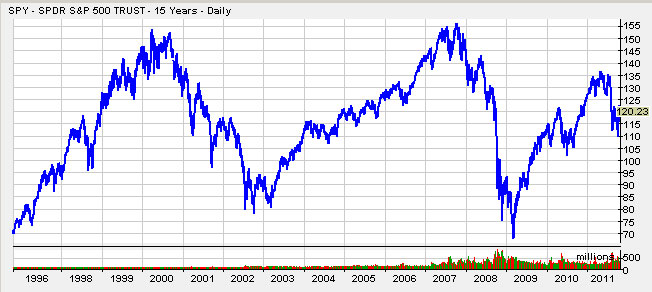
I went short the SPY. I was up a bit.But then the market rose. And I’m current down a bit. Here’s year to date:
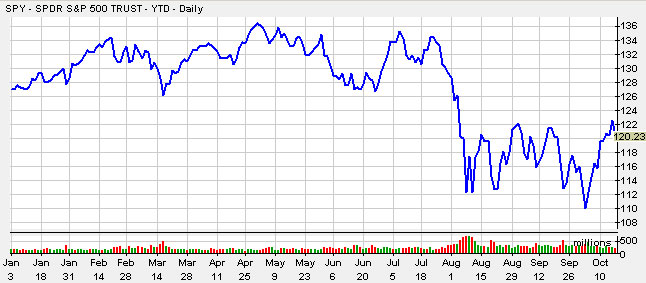
I don’t think it’s possible to make money in this ultra-volatile market — especially since August.
Gold is down. Equities are down. My mortgage REITs are down — but not as much as their yield.
It’s too hard. There are no clear trends. No clear signals.
Our motto is: When in doubt, stay well out.
IBM reported OK earnings numbers last night. But this morning it’s down 5 1/2%. It’s hard to please Mr. Market.
When things are too good to be true … This morning goldman Sachs reported a $428 million loss for the third quarter. This article appeared in today’s New York Times:
The Missed Red Flags on Groupon by Andrew Ross Sorkin (author, Too Big To Fail)
Andrew Mason, the founder of Groupon, said the I.P.O. would exceed expectations.Antoine Antoniol/Bloomberg NewsAndrew Mason, the founder of Groupon, said the I.P.O. would exceed expectations.
This summer, Lloyd Blankfein, the chief executive of Goldman Sachs, flew to Chicago to personally pitch his firm to underwrite what was supposed to be the hottest initial public offering of the year: Groupon, the fledgling online coupon company that was being valued at around $30 billion.
Mr. Blankfein’s pitch succeeded and Goldman was selected as one of three lead underwriters, including Morgan Stanley and Credit Suisse. As the summer progressed, some insiders whispered that the offering could value the company at even more. For Wall Street, the I.P.O. was the ultimate bragging right.
They probably aren’t bragging anymore.
Groupon’s triple-digit growth has slowed, slicing Groupon’s valuation in half – if not more. Analysts now suggest the valuation will be lucky to be more than $10 billion. A series of accounting and disclosure gaffes have brought the attention of the Securities and Exchange Commission, raising questions about the company’s credibility.
The history of Groupon’s chairman, Eric Lefkofsky, was also unearthed, showing a lawsuit-prone entrepreneur who flipped a dot-com company in 1999 only to have it lead to bankruptcy a year later for the firm he had sold it to. And Groupon’s filing shows that when the company privately raised $950 million in a pre-I.P.O. round in January, it paid out $810 million of that to its investors and employees, a red flag for any investor. (Mr. Lefkofsky and his wife took home about $319 million of the total.)
All of this raises an obvious question: How did so many Wall Street firms desperate to underwrite the Groupon I.P.O. miss these warning signs when pitching such a sky-high valuation? Or did they just turn a blind eye?
“Underwriters are supposed to be gatekeepers, not just a sales and marketing agent,” said Lynn E. Turner, a former chief accountant for the S.E.C. “Underwriters have gotten to the point of being cheerleaders. I question whether they are really fulfilling their obligation to investors.”
A cursory reading of the various versions of Groupon’s prospectus that the banks signed off on, as did the accounting firm Ernst & Young, would give virtually anyone a modicum of pause. And a deep dive into the numbers should have raised alarm bells at the outset about even talking about the possibility of a $30 billion valuation.
Here’s just one data point: Groupon has $225 million in the bank. The company lost $102.7 million in the last quarter on revenue of $878 million. If that were to continue at the same pace, it would need to find a new way to start making money quickly or raise new financing. That is why the I.P.O. could not come soon enough. (Groupon, it should be noted, says it does not intend to use the proceeds of the I.P.O. to finance operations in the next 12 months. But there is always next year.)
In total, as of last quarter, the company had $681 million in current liabilities but only $376 million in assets. Among its liabilities, it owed $392 million to vendors. That is because the company receives money from customers before it has to pay its vendors, called a working capital deficit.
In some cases, a working capital deficit is not a problem. Wal-Mart has a working capital deficit, too. But when there are questions about whether your business can continue to grow at the same rate, a working capital deficit can become a problem because it means you are relying on a steady stream of new revenue to pay off old liabilities.
The company also spent $432 million in the first six months of the year on marketing, an unsustainable model. Add in the fact that Groupon’s revenue slowed in August, up only 13 percent, compared with 96 percent in the first half of the year, according to Yipit Data, and the picture becomes a bit nerve-racking.
Groupon is in a quiet period ahead of its I.P.O., so the company, as well as its underwriters, is unable to comment publically.
But in a memorandum to employees last month, Groupon’s chief executive and founder, Andrew Mason, said he was not worried: “We’re almost on the other side, and the negativity leaves us well positioned to exceed expectations with an I.P.O. baby that, having seen the ultrasound, I can promise you is not one of those uglies.”
He also said that he planned to slow the company’s marketing expenditures. “Eventually, we’ll ramp down marketing just as fast as we ramped it up, reducing the customer acquisition part of our marketing expenses,” he wrote.
Of course, it is possible that Groupon could update its prospectus with new numbers before the I.P.O., showing that it has already begun to get its house in order. If it were to really slow its marketing spending, it is possible Groupon could turn a profit.
Even so, it does not fully explain how Groupon’s underwriters, whose endorsement of the company is supposed to be considered the Good Housekeeping Seal of Approval, originally came up with Groupon’s questionable $30 billion valuation.
Perhaps more troubling, those same banks allowed their client to publish one of its first filings with an accounting gimmick. It was a made up metric called Adjusted Consolidated Segment Operating Income that accounted for the company’s operating income but conveniently excluded several major expenses, including marketing and acquisition-related costs. That caught the eye of the S.E.C., and Groupon has since been forced to remove the accounting metric.
The cynical reason that the banks stood by Groupon and its accounting shenanigans is most likely the expected fees from the offering. Even if Groupon’s I.P.O. values the company at $10 billion instead of $30 billion, the banks will probably walk away with hundreds of millions of dollars.
“There’s a ton of money to be had,” Mr. Turner said. “That’s what’s driving this.”
Jim Rogers on financial tips for your kids. The tips make sense. Click for the video.
Prevention: Doubts on Women’s Use of Supplements. From last week’s New York Times:
Older women who used common dietary supplements died at slightly higher rates than women who did not rely on supplements, a large study has found.
Scientists followed 38,772 women, whose average age was 62 at the start of the study, over a period of 19 years, during which 15,594 of them died. Those using multivitamins or supplements of folic acid, iron, magnesium or zinc were more likely than women who did not to have died during that period, the researchers found.
Some supplements, like iron, were associated with a substantial increase in the risk of death, while others — vitamin A and vitamin D, for example — had no effect. Multivitamin use was linked to a 2.4 percent increase in the absolute risk of death, but calcium supplements appeared to decrease the risk.
The study, published on Monday in The Archives of Internal Medicine, was observational, and a variety of factors other than supplement use might have affected the outcome. The participants were older white women, and the findings may not be applicable to other populations, the authors warned.
“Other studies have not shown such dramatic results,” said the lead author, Jaakko Mursu, a postdoctoral fellow at the University of Minnesota. “I would say that women should reconsider whether it’s really necessary to use supplements. And I would advise paying more attention to a healthy diet.”
My Saigon traffic video. Now playing on YouTube. So easy to make videos with the new cameras — still or video. So easy to upload them to YouTube. So easy to have your friends watch them — give them the link. In fact, YouTube is really the only to share videos you make. Most email services barf at 20-25 meg file sizes. The Saigon Traffic video I uploaded is around 57 megs and it’s only a few seconds.
Exploding SMS use is killing us. the FCC struck a deal this week with the cellphone carriers that they will alert youwhen you run into pricey overtime. For now the best way to send SMS messages free from you computer is the web site TXTDrop.com. I tried a bunch of free SMS apps on the Apple AppStore this morning (including email2sms and Y! Messenger) and couldn’t find one that worked reliably. Maybe there is one?
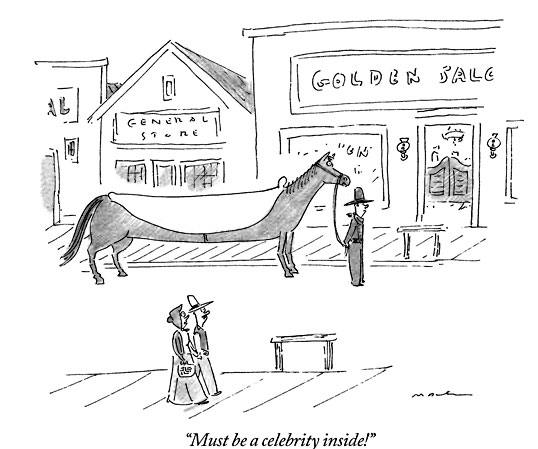
Favorite recent New Yorker cartoons. The third one is particularly appropriate in this ugly market.

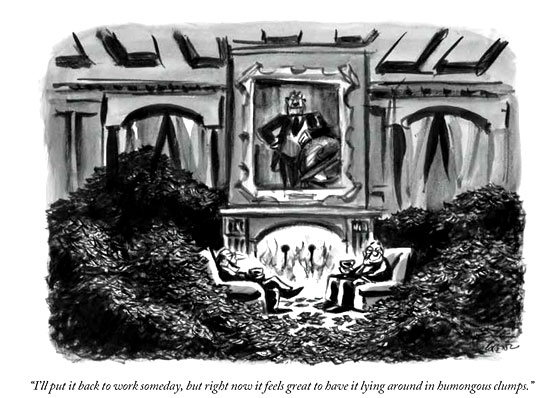
In case you can’t read it, the caption reads, “I’ll put it work someday, but right now it feels great to have it lying around in humongous clumps.“

Harry Newton who hates to trash firms. But the Post Office is now regularly losing packages (my personal experienjce) and mail (our building’s experience). Don’t use it for important stuff, any longer. Use UPS or FedEx. Second, AT&T cell phone service is worse than atrocious, at least in Manhattan where it’s not uncommon to have absolutely no reception, i.e. no bars.

the postal service is terrible & a lot of it is due to the people they hire!
i have a t & t land line & i have troulbe w/it & their billing. just made a complaint about them to my state public utility commission!
On that video, how did you get that black & white with only certain objects colorized? (i.e., was that an automated feature of your camera or did you use software to give that effect after recording?)
I suspect this was a function of the camera's inadequacies. it's only a little baby Canon G10. It's also probably two years old.
Try GoogleVoice for free texts. It works. There's an iPhone app for it.
It is good for SMS and voicemail, but it can't handle picture messages (MMS) if that's important to you.
Harry-in a few months you will probably see something on your local news about a mailman who was hoarding or stealing mail and not delivering it to its intended location..LOL…btw I have never had a problem with USPS delivering packages..but I also use the .70 cent delivery confirmation..that way big brother is watching……and you wonder why the USPS has so many problems
Harry, what's missing from your traffic video from when I was there was the White Mice on Harleys, Army jeeps and deuce and a half's, and the incredible thrill rides of the motorized Cyclo's. Mix them in and you have one heck of a mess to navigate.
Now it's more scooters and less bicycles with the drop-down engines on their front tires. The air looks much cleaner without all the two stroke engine smoke that used to abound from all modes of two and three wheel transport.
Re: “Some supplements, like iron, were associated with a substantial increase in the risk of death”
A post-menopausal woman( and most are at/after age 62) should not consume iron fortified food or supplements.
So this study simply underscored something educated women already knew.