Your own business, number one. Play in Main Street. Be ultra-wary of Wall Street. Stories:
Goldman Sachs Demands Derivatives Collateral It Won’t Dish Out. The story begins:
March 15 (Bloomberg) — Goldman Sachs Group Inc. and JPMorgan Chase & Co., two of the biggest traders of over-the- counter derivatives, are exploiting their growing clout in that market to secure cheap funding in addition to billions in revenue from the business.
Both New York-based banks are demanding unequal arrangements with hedge-fund firms, forcing them to post more cash collateral to offset risks on trades while putting up less on their own wagers. At the end of December this imbalance furnished Goldman Sachs with $110 billion, according to a filing. That’s money it can reinvest in higher-yielding assets.
You can read the rest of the story here.
How Lehman died. Let’s start with the cartoon:
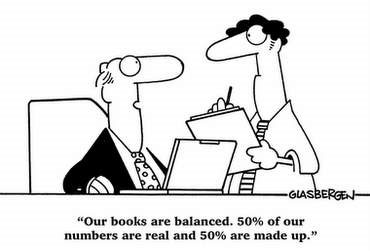
From the New York Times:
Report Details How Lehman Hid Its Woes
It is the Wall Street equivalent of a coroner’s report — a 2,200-page document that lays out, in new and startling detail, how Lehman Brothers used accounting sleight of hand to conceal the bad investments that led to its undoing.
The report, compiled by an examiner for the bank, now bankrupt, hit Wall Street with a thud late Thursday. The 158-year-old company, it concluded, died from multiple causes. Among them were bad mortgage holdings and, less directly, demands by rivals like JPMorgan Chase and Citigroup, that the foundering bank post collateral against loans it desperately needed.
But the examiner, Anton R. Valukas, also for the first time, laid out what the report characterized as “materially misleading” accounting gimmicks that Lehman used to mask the perilous state of its finances. The bank’s bankruptcy, the largest in American history, shook the financial world. Fears that other banks might topple in a cascade of failures eventually led Washington to arrange a sweeping rescue for the nation’s financial system.
According to the report, Lehman used what amounted to financial engineering to temporarily shuffle $50 billion of assets off its books in the months before its collapse in September 2008 to conceal its dependence on leverage, or borrowed money. Senior Lehman executives, as well as the bank’s accountants at Ernst & Young, were aware of the moves, according to Mr. Valukas, the chairman of the law firm Jenner & Block and a former federal prosecutor, who filed the report in connection with Lehman’s bankruptcy case.
Richard S. Fuld Jr., Lehman’s former chief executive, certified the misleading accounts, the report said.
“Unbeknownst to the investing public, rating agencies, government regulators, and Lehman’s board of directors, Lehman reverse engineered the firm’s net leverage ratio for public consumption,” Mr. Valukas wrote.
Mr. Fuld was “at least grossly negligent,” the report states, adding that Henry M. Paulson Jr., who was then the Treasury secretary, warned Mr. Fuld that Lehman might fail unless it stabilized its finances or found a buyer.
Lehman executives engaged in what the report characterized as “actionable balance sheet manipulation,” and “nonculpable errors of business judgment.”
The report draws no conclusions as to whether Lehman executives violated securities laws. But it does suggest that enough evidence exists for potential civil claims. Lehman executives are already defendants in civil suits, but have not been charged with any criminal wrongdoing.
A large portion of the nine-volume report centers on the accounting maneuvers, known inside Lehman as “Repo 105.”
First used in 2001, long before the crisis struck, Repo 105 involved transactions that secretly moved billions of dollars off Lehman’s books at a time when the bank was under heavy scrutiny.
According to Mr. Valukas, Mr. Fuld ordered Lehman executives to reduce the bank’s debt levels, and senior officials sought repeatedly to apply Repo 105 to dress up the firm’s results. Other executives named in the examiner’s report in connection with the use of the accounting tool include three former Lehman chief financial officers: Christopher O’Meara, Erin Callan and Ian Lowitt.
Here is how the report says the “Repo 105″ worked:
In an ordinary repo, Lehman raised cash by selling assets and then promising to buy them back several days later. Those moves were treated as financings and the assets remained on the balance sheet. But under its Repo 105 move – in which the assets were 105% or more of cash–accounting rules permitted the transaction to be treated as a sale so the assets could be removed from the balance sheet.
As a result, Lehman’s balance sheet appeared $50 billion smaller.
And using Repo 105, Lehman reported net leverage of 12.1 at the end of the second quarter 2008. Without 105, Lehman’s leverage would have been 13.9.
“Lehman’s own accounting personnel described Repo 105 transactions as an “accounting gimmick” and a “lazy way of managing the balance sheet as opposed to legitimately meeting balance sheet targets at quarter end.” Lehman used Repo 105 “to reduce balance sheet at the quarter end.” In 2008, Lehman knew that net leverage numbers were critical to the rating agencies and to counterparty confidence. Its ability to deleverage by selling assets was severely limited by the illiquidity and depressed prices of the assets it had accumulated.”
The full 2200 page report is available here.
Harry as the Kiss of Death. I had $100,000 in a one-year CD at the Park Avenue Bank in New York. The CD came due. I called about rolling it over for another year. They said I’d have to come to their offices. I said, ‘You got to be crazy. Every bank in the universe extends their CDs with a phone call.” They said, “No. That’s our policy.” I went over and took my money out.
On Friday, the Park Avenue Bank failed. Good riddance.
Never, ever upgrade your software. My rule is simple, “If it works, don’t mess with it.” The computer industry wants to upgrade you because it wants to upgrade its finances, not because it wants to upgrade your performance or enjoyment. Item:
Barnes & Noble “upgraded” my BN Reader, which is software I use to read books on my laptop. (I don’t own a Kindle since I don’t want yet another gadget.) The “upgraded” BN Reader comes with a text file that proudly announces a list of “retired features.” (Remember, I don’t make this stuff up.) My favorite “retired feature” is the two-page view. I have to read a book on a screen that’s now twice the width of a book. Dumb.
Don’t get me started on Windows 7 — another upgrade that appears to have zero benefits for me.
Don’t speed. Don’t go through stop signs. Don’t do nothing. From reader Stephen Gornick:
Got a chuckle from your discovery on how California is dealing with its budget problems by issuing fines. So true. I’ve been lucky so far, but nearly everyone I know has gotten zinged in the past year or so with a ticket for one reason or another.
-There’s a web site called “Financial Armageddon – Insights on debt, derivatives, government guarantees, the retirement system, and the coming economic unraveling.” It has a piece called “The Enforcement Tax,” which begins:
It’s no secret that municipal finances are imploding under the weight of falling income, sales, and property tax revenues. Unfortunately, with no real sign of a rebound in hiring or housing prices, and with consumers saving more and spending less, there’s little hope of a reversal of fortunes, at least in the short-term.
So, what’s a cash-strapped municipality to do?
Why, step up collection of the enforcement tax, of course.
In Virginia Hands Out 6996 Traffic Tickets In One Weekend In An Effort To Raise Revenue For The State Government,” ….
In other words, state and local governments across the U.S. are broke and so they need some suckers to prey on.
Not that it was ever a good idea to break the traffic laws. But now even a minor violation can put a massive hole in your wallet. For instance, driving as little as 15 miles an hour over the speed limit in Virginia can get you a reckless driving charge that can carry a fine of up to $2,500.
The reality is that you have to be very, very careful out there now because the nature of driving in America has fundamentally changed.
Whether it is rapidly increasing traffic fines or all of the toll roads going in everywhere, American drivers are increasingly being viewed as a big fat revenue source.
And as the current economic collapse gets even worse, drivers are going to be preyed upon even more by state and local governments.
If you have not already done so, now is the time to change the way that you drive. Don’t give state and local governments an excuse to take even more of your hard-earnedmoney from you than they are already.
By the way, it wasn’t me who got caught in La Quinta, California for doing 40 in a 25-mile zone. . It was my friend. (His fine was close to $1,000.) I don’t drive. My wife won’t let me. She thinks I’m a lousy driver. She’s right.
My wife now takes her BlackBerry to bed. From the New Yorker, an “Ah Ha” moment.
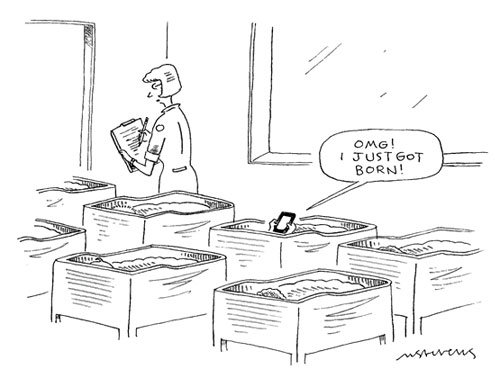
BlackBerry is holding its own against Apple’s iPhone, according to all the numbers I’ve seen lately. I added some more Favorite Toys on the right.

Harry Newton, who can’t believe his eyes. This meant to be a recession. And the Indian Wells Tennis Tournament was sold out yesterday with people paying $35-plus. I paid $35 “for a day pass” and got a bench without a back. Photos tomorrow. Meantime, the tennis is on The Tennis Channel.

I was a Reserve Police Officer in Costa Mesa, CA for five years. Regardless of the rummers spread here and pure Newton Bull, Police officers write citations only in response to traffic violations. They are not ordered to write more citations in bad economy. In fact they are never writing citations for political reasons. That is pure Newton Bull.
If you have real questions I suggest you contact the Costa Mesa police department traffic division and they will be glad to put these rumors to bed for you.
I don't think we know the real story. And i think it probably varies from jurisdiction to another. Fact is there's a lot of circumstantial evidence that suggests traffic violations are being more enthusiastically enforced.
I think it depends on the cop/department. I live in the L.A. area, and I know several police officers. Generally, regular police officers have their duties to perform (like fighting crime) and don't spend a lot of time writing tickets. However, the CHP and meter maids are pretty much just glorified tax collectors. I saved this link regarding the police in a small town.
http://www.myfoxmemphis.com/dpp/news/local/0828…
And while my friends in the LAPD say that there is no quota for tickets, if you are way under everyone else's numbers, your boss is going to wonder what the h— you're doing, so there is some pressure to write about the amount of tickets that everyone else does.
There's a swell article now about the 'reverse Grapes of Wrath' now going on – people exiting California and places like Oklahoma actually increasing in population.
http://trueslant.com/level/2010/03/11/californi…
Here in Texas, the economy's doing quite well, although the unemployment rate is rising a bit – still below national rate. Every day, I see a few more out-of-state plates: Michigan, Illinois, N.Carolina…
Harry you see that the Ex-president of Park Avenue Bank was charged with Fraud this am?
Sometimes the perfect investment is Luck(St Patty's Day soon)…of course you were covered by FDIC but the mess of trying to get your $$ back would have been a huge headache..glad you were able to get your $$ back before the failure