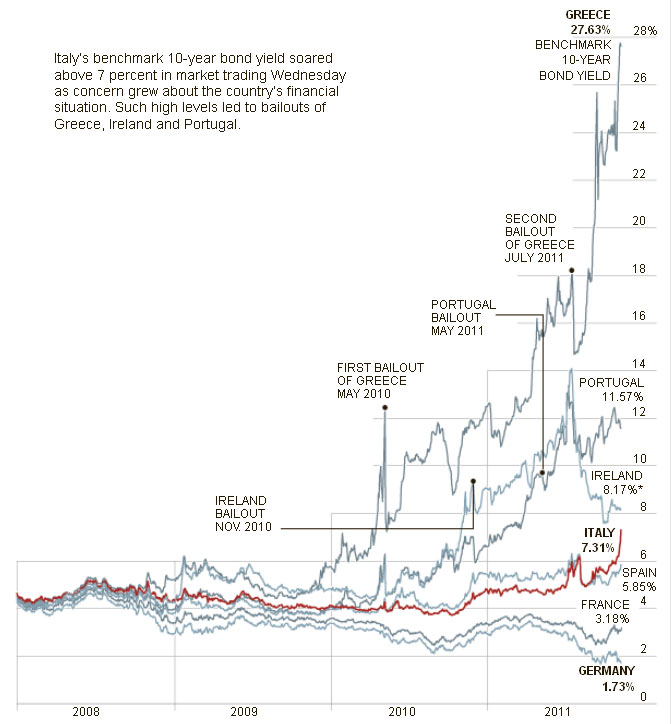
European governments are having to pay higher and higher interest to borrow money. Soon some governments won’t be able to borrow money, because the lenders will believe they’ll never get all their money back. But the governments need the borrowings to pay their day-to-day bills and the interest on previous year’s bonds. This will get worse. As you can see from this chart in today’s New York Times, it is getting progressively worse, as European governments have to pony up more and more interest. Since world financial markets are now so intertwined, this European problem affects us, too. Yesterday the Dow fell by 3+% and Hong Kong fell by over 5%.
Now is not a good time to be holding equities. Nor shorting them. It’s far too volatile out there. Far too difficult to predict. Here’s the chart of European bond yields. Look at Greece. Would I want to get paid 27.6% a year, knowing that I will never get all my money back?
MF Global Customer Assets brazenly stolen. The following comes from a blog on the Internet called Jesse’s Café Américain. Jesse refers to himself as “A simple, honorable man.”
What is emerging is a system heavily stacked against the normal investor — you and me. Be ultra-wary. When in doubt, stay out.
MF Global’s Customer Assets – STOLEN – And Nothing You Hold In This System Is Safe
As suspected, MF Global brazenly took liquid assets like Treasuries and warehouse receipts, but not cash which would have been more quickly missed, from customer accounts to post as illegal collateral for emergency funding with a lender who must have known that they were receiving stolen goods.
When things fell apart, the lender simply took the collateral and liquidated it, and kept the money.
And now they are refusing to even acknowledge this transaction, and apparently the management of MF Global is not yet talking. Why? Because it was an insider deal, and they don’t want to give back the stolen money.
When ‘non-consequential’ customers were requesting their funds, they were issued checks instead of wire transfers. The checks of course were not honored and bounced. But days later, and just hours before the bankruptcy filing, MF Global was paying BONUSES to its UK traders. Remarkable in light of how much dirty business the NY firms have been outsourcing to London. Follow the hush money.
This is a scandal of the first order, and a severe test for the Obama Justice Department, the regulatory agencies, and the exchanges. This is a great crime, undeniably premeditated, and possibly the tip of an iceberg that would shake the public confidence in a deeply corrupt financial system.
If a registered broker can simply take Treasuries and receipts for physical assets like gold and silver from customer accounts and give them to a complicit crony lender, and then look at the public with a straight face and say the money is missing and they do not know where it is, then no one’s accounts are safe, anywhere, at any bank or broker, in the US financial system.
This has every appearance of a legally sanctioned theft, pure and simple.
This is from today’s New York Times. I added the bolding:
Clients Question Oversight by MF Global’s Regulator by AZAM AHMED and BEN PROTESS
Futures trading, which caters to farmers as well as to hedge funds, was left largely untouched when lawmakers took on Wall Street after the financial crisis.
But a light regulatory hand is now being called into question after the collapse of MF Global, the brokerage firm run by Jon S. Corzine until last week.
As regulators hunt for $600 million in missing customer money at the firm, many clients are aiming their anger at one of MF Global’s primary regulators: the CME Group.
For decades, commodities and futures trading firms have been largely policed by the exchanges where they trade, setting up potential conflicts of interest. These profit-making exchanges, like the CME Group, oversee the very futures firms they rely on for business, a self-regulatory system unlike that overseeing the Wall Street banks, which contend with armies of federal regulators.
Some farmers that used MF Global to protect themselves from the price swings of their crops are losing faith. “You do business with these places and you just assume they are fine and reputable,” said Brian Eggebrecht, a third-generation grain farmer in Montana. “It’s a scary time for farmers. Who’s to say what is going on with the other clearinghouses?”
The CME says the missing money at MF Global is an isolated incident, and does not warrant an overhaul of the exchange’s regulatory powers. Other industry insiders said there had not been problems with group’s regulation in the past.
“The self-regulatory structure, since our founding, has been a hallmark of our safe and stable markets. It has served our market users well and continues to,” Anita Liskey, a CME spokeswoman, said in a statement. “No one has a higher interest in making sure the members don’t fail or cause a loss to the clearinghouse and other members of the clearinghouse than CME Group.”
Customers of MF Global who used the CME’s exchanges say it has done little to help its cause. Many are furious that they were frozen out of trading by the CME on the day MF Global filed for Chapter 11. Traders on the floor of the exchange scribbled down the prices for trades they felt they should have been able to clear, to keep records of their losses.
“Price and time are extraordinarily important, and the CME knows this,” said John L. Roe, a principal at the BTR Trading Group, which did business with MF Global. “I don’t even know if you can calculate the loss. The tentacles reach out into just about every type of commodity.”
Some have also raised questions about whether the CME should have noticed the missing money, since ensuring that customer accounts are segregated is its responsibility. The frozen funds mean some business owners, like Daniel Ward, may struggle.
“The loss of my actual money, $86,076.80 and $1,801.00, is seriously impeding the day-to-day operations of my family-owned business,” Mr. Ward, the owner of True Metals Group, said in a letter to the trustee overseeing the bankruptcy. “This is unfair to persons like me, small-business owners who depend on modest futures accounts to hedge risk.”
Federal regulators, including the Commodity Futures Trading Commission, are searching for the missing $600 million, and the CME is helping to sort through the process. It was charged with regulating the side of the business where the money was determined to be missing.
“We are cooperating with all authorities on their investigations of MF Global,” said Ms. Liskey, the CME spokeswoman.
On Nov. 2, the exchange issued a harshly worded statement that blamed MF Global, saying the firm might have transferred client money “in a manner that may have been designed to avoid detection,” a serious violation of Wall Street regulations. The exchange said it had conducted an audit of the firm a week earlier.
But the last large-scale audit the CME conducted was in January. The last-minute review it cited in the release was a “spot audit,” said a person close to the CME who did not want to be identified because the investigation was continuing.
The CME verified that customer money was in the right accounts at outside banks on Oct. 26, this person said. MF Global filed for bankruptcy on Oct. 31.
A number of customers say that the CME should cover the $600 million in missing funds that has gummed up the bankruptcy process. The exchange can then ensure that the accounts are properly transferred or unfrozen. At least $2.5 billion of MF Global’s $5.4 billion in client funds was with the CME at the time of the bankruptcy.
“It is time for the executive team at CME to save its business and do the right thing,” wrote Glenn Jackel, a managing member at Traxian Partners with about $1 million trapped at MF Global, in a letter to CME board members. “As it stands now, the MF Global debacle represents every single deep-seated underlying fear that commodity investors have, that their money will be lost or frozen in a commodity firm meltdown.”
Reached by phone, Mr. Jackel said it was not just the CME’s reputation that was at stake but the entire futures business.
“Think about what happens in this business if I don’t get my money back,” he said. “What are the chances of me putting any significant money into any commodities again?”
While traders and others can find new business or opt out of the markets, farmers may not have that luxury. For many, participating in the futures market is as necessary as tilling the land.
“You can’t gamble on your whole crop; that’s why we use these markets and that’s why they’re very important to us,” said Mr. Eggebrecht, the Montana farmer. “There is a lot of risk out there, and we are the end users of that risk and we end learning about it the hard way.”
Ten years ago, Mr. Eggebrecht, whose ancestors were homesteaders on the land he now farms, had scarcely used futures or options contracts. Now, much of his business depends on them.
The market allows him to lock in a price to deliver his winter wheat at a future date. He says these contracts protect him from volatile price swings that can batter the commodities markets.
The volatility has tracked the boom in the futures industry, which has grown exponentially over the last decade as electronic trading and newfangled financial products have crowded out simpler transactions. The futures and options market set a record of 22.4 billion contracts last year, a 650 percent jump from 2000 levels, according to the Futures Industry Association, a trade group.
The CME has been at the center of the growth. Founded in the mid-1800s, the exchange became the clearinghouse of choice for commodities. In 2002, it became the first United States exchange to go public, and quickly began buying up its largest competitors, including the Chicago Board of Trade and the New York Mercantile Exchange.
During that consolidation, some questioned whether it could be an effective regulator. “How many other public companies are self-regulators?” asked Jerod Leman, a trader and broker in Indiana. “Individuals aren’t the regulators on their taxes. You have the I.R.S. for that.”
“The last thing most people want is more regulation, but when something like this happens it definitely raises some flags,” he added.
The Commodity Futures Trading Commission, which oversees the CME Group, reviewed the arrangement at the time, but the industry fought back hard.
“CME has a long history and strong track record in self-regulation,” the exchange told the futures commission in a 2004 letter. “As one of the major exchanges in the world, we believe that our market surveillance and financial supervision regulatory capabilities are part of the brand identity that we have created.”
The commission backed off after winning a few concessions, including more independent board members at the exchanges. The chairman of the commission at the start of the debate, James Newsome, went on to join the CME Group board after leaving the agency. More recently, Mr. Newsome’s lobbying firm has represented MF Global.
Discounts galore in drawers. If you’re shopping, ask what Discount Coupons the cashier has in her drawer — the one under cash register. There you’ll find
+ Applications for store credit cards which give you an instant 15% to 25% discount.
+ Cards from various old and new promotions that may or may not apply, but can be applied with a modicum of begging and heavy flattery.
+ Temporary membership cards to all sorts of discount clubs.
+ All online shops will give you hefty discounts — especially on shipping — if you ask. Asking is the key.
I speak from experience, having enjoyed all four.
Two bad wonderful jokes.
Two Mexican detectives were investigating the murder of Juan Gonzalez.
‘How was he killed?’ asked one detective.
‘With a golf gun,’ the other detective replied.
‘A golf gun! What is a golf gun?’
‘I don’t know. But it sure made a hole in Juan.’
Joke #2.
A lady walks into a New York store displaying zillions of watches and clocks in its window.
“How much will it cost to fix my watch?” she asks.
“Sorry, Lady, I don’t fix vatches,” the proprietor says.
“What then do you do?”
“I’m a moyel.”
“So why do you have a clock in the window?”
“Lady, vut vuld you put in the vindow?”

Harry Newton who spent yesterday afternoon playing tennis and showing a friend from England the sights. It was far more pleasant than watching stock prices crash and wondering if I could ever time this. I’m largely out. These are not happy times in financial markets. Startups are more interesting. See yesterday’s column.

I think that's “sights.”
Alongside the MF Global article is an ad for Goldline, a company which currently faces 19 criminal counts in Los Angeles for fraud, theft, and grand larceny.
And let's not forget that Goldline was brazen enough to actually produce a commercial featuring Glen Beck. I'm surprised that it's only 19 criminal counts….
For those in dire need of a little truth, I suggest reading the latest article by Ann Coulter, “David Axelrod's Pattern of Sexual Misbehavior.” As usual Ann take out the big hammer and hit's the nail directly on the head.