The Eurozone is 17 countries. America is 50 states. Therein lies the difference. We can deal with crises. They can’t. Europe is getting worse and worse. It will affect us more and more.
Own a few stocks for fun and dividends. But cash and gold are king today. Muni bonds are the major part of my liquid portfolio. Good ones are still available. Pick carefully. I pay the rent with muni bond interest.
Miscellaneous European stuff:
+ European banks need to generate more than $800 billion each month to fund maturing institutional borrowings. This is, in Mr. Sarkozy’s words, unsustainable. And the markets are saying so. The CDS market for European banks is back at or above the peak levels seen during the 2008 financial crisis.
+ Italy is the world’s eighth largest economy and third largest bond market. This is triggering margin calls and leading banks to pull credit from the European market. This, in turn, is damaging the European economy, which is already being squeezed by the austerity programs adopted in every large euro-zone economy. A weakening economy will damage revenues, undermining efforts at fiscal consolidation, further driving away investors and potentially triggering more austerity. The cycle will continue until something breaks. Eventually, one economy or another will face a true bank run and severe capital flight and will be forced to adopt capital controls. At that point, it will effectively be out of the euro area. What happens next isn’t clear, but it’s unlikely to be pretty.
+ From today’s Wall Street Journal: Italy could deal insurers a lethal blow. Europe’s insurers own an estimated ?300 billion (about $408 billion) of Italian sovereign debt-equivalent to a large chunk of their ?450 billion shareholders’ equity, notes JP Morgan. While banks’ exposure has been much debated, an Italian default or euro exit could devastate insurers’ capital and in turn Europe’s savings.
Insurers’ holdings make up a sizeable chunk of Italy’s ?1.6 trillion government debt. Some insurers have cut exposure-Zurich Financial Services sold around ?2.3 billion in the last quarter-but many are reluctant to crystallize big losses when they hold assets to maturity and a default is still an outside scenario. Finding enough long-dated assets to replace them and back their huge liabilities is tricky.
+ From the Economist: I have been examining and re-examining the situation, trying to find the potential happy ending. It isn’t there. The euro zone is in a death spiral. Markets are abandoning the periphery, including Italy, which is the world’s eighth largest economy and third largest bond market. This is triggering margin calls and leading banks to pull credit from the European market. This, in turn, is damaging the European economy, which is already being squeezed by the austerity programmes adopted in every large euro-zone economy. A weakening economy will damage revenues, undermining efforts at fiscal consolidation, further driving away investors and potentially triggering more austerity. The cycle will continue until something breaks. Eventually, one economy or another will face a true bank run and severe capital flight and will be forced to adopt capital controls. At that point, it will effectively be out of the euro area. What happens next isn’t clear, but it’s unlikely to be pretty.
Can this cycle be interrupted? I think so. I think that an ECB guarantee to backstop sovereign debt, coupled with massive purchases to establish credibility and a substantial easing in monetary policy, could change the dynamic, particularly if quickly followed up with a major fiscal commitment from core economies to support bail-out efforts and invest in peripheral economies while peripheral economies focus on substantial labour market, public-sector, and tax reforms. How likely does all of that sound? Could the ECB even commit to the above bold actions without facing debilitating criticism, and perhaps intervention, from national governments?
I hate to get this pessimistic about the situation. It feels panicky and overwrought. I can’t believe that Europe would allow so damaging an outcome as a financial collapse and break-up to occur. And I still don’t understand why, if this is all as obvious as it seems to me, equities aren’t down 20% now, rather than 2% or 3%. But the window within which something could be done to prevent it is closing, and fast. I hope to be proven astoundingly wrong in my assessment, but I’m struggling to see alternative outcomes.
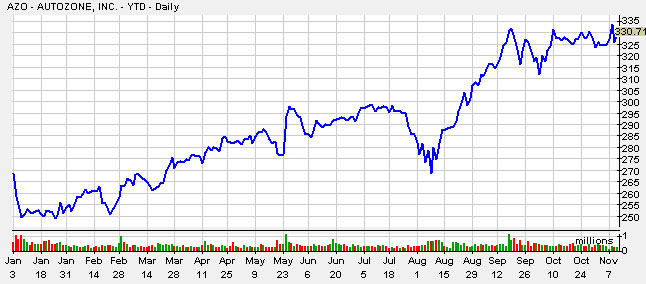
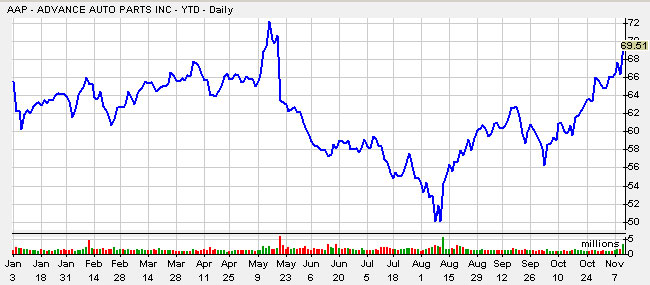
No one is buying new cars:
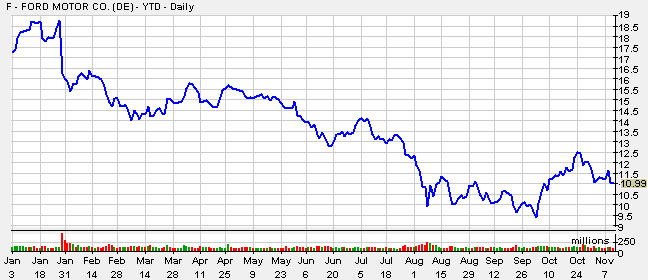
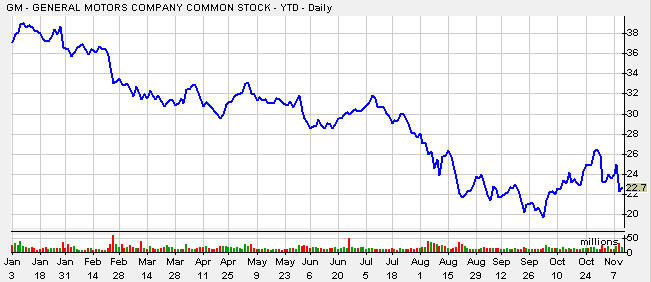
But everyone is fixing their old cars. It’s what you’d expect in an awful economy.
Aging Well Through Exercise By GRETCHEN REYNOLDS. This piece is from yesterday’s New York Times. It doesn’t tell us something we didnt know — namely exercise is good for you. But it’s got some neat new research and is worth reading:

Is physical frailty inevitable as we grow older? That question preoccupies scientists and the middle-aged, particularly when they become the same people. Until recently, the evidence was disheartening. A large number of studies in the past few years showed that after age 40, people typically lose 8 percent or more of their muscle mass each decade, a process that accelerates significantly after age 70. Less muscle mass generally means less strength, mobility and among the elderly, independence. It also has been linked with premature mortality.
But a growing body of newer science suggests that such decline may not be inexorable. Exercise, the thinking goes, and you might be able to rewrite the future for your muscles.
Consider the results of a stirring study published last month in the journal The Physician and Sportsmedicine. For it, researchers at the University of Pittsburgh recruited 40 competitive runners, cyclists and swimmers. They ranged in age from 40 to 81, with five men and five women representing each of four age groups: 40 to 49, 50 to 59, 60 to 69, and 70-plus. All were enviably fit, training four or five times a week and competing frequently. Several had won their age groups in recent races.
They completed questionnaires detailing their health and weekly physical activities. Then the researchers measured their muscle mass, leg strength and body composition, determining how much of their body and, more specifically, their muscle tissue was composed of fat. Other studies have found that as people age, they not only lose muscle, but the tissue that remains can become infiltrated with fat, degrading its quality and reducing its strength.
There was little evidence of deterioration in the older athletes’ musculature, however. The athletes in their 70s and 80s had almost as much thigh muscle mass as the athletes in their 40s, with minor if any fat infiltration. The athletes also remained strong. There was, as scientists noted, a drop-off in leg muscle strength around age 60 in both men and women. They weren’t as strong as the 50-year-olds, but the differential was not huge, and little additional decline followed. The 70- and 80-year-old athletes were about as strong as those in their 60s.
“We think these are very encouraging results,” said Dr. Vonda Wright, an orthopedic surgeon and founder of the Performance and Research Initiative for Masters Athletes at the University of Pittsburgh Medical Center, who oversaw the study. “They suggest strongly that people don’t have to lose muscle mass and function as they grow older. The changes that we’ve assumed were due to aging and therefore were unstoppable seem actually to be caused by inactivity. And that can be changed.”
Other recent studies have produced similar findings. Last year, researchers at the Canadian Centre for Activity and Aging, for instance, examined muscle tissue from older competitive runners, checking for the density of their motor units, a measure of muscle health. A motor unit is, essentially, the control mechanism of a functioning muscle, composed of a neuron and the particular muscle fibers that that neuron activates. The more motor units in a muscle, the stronger it generally is.
In multiple earlier studies, people over 50 have been found to possess far fewer muscle motor units than young adults. But that wasn’t true for the sexagenarian runners, whose leg muscles teemed with almost as many motor units as a separate group of active 25-year-olds. Running, the scientists wrote, seemed able to “mitigate the loss of motor units with aging well into the seventh decade of life.”
Of course, the volunteers in both Dr. Wright’s and the Canadian study were, for the most part, lifelong athletes. Whether similar benefits are attainable by people who take up exercise when they are middle-aged or older “isn’t yet clear,” Dr. Wright says, “although there’s no reason to think that you wouldn’t get similar results no matter when you start.”
In an encouraging animal study from last year, elderly rats that had been sedentary throughout their adult lives were put on a running program. After 13 weeks, their leg muscle tissues had filled with new satellite cells, a specialized type of stem cell that is known to build and repair muscle. Comparable experiments in older people have yet to be done, though.
Other questions about the impacts of exercise on aging muscle also remain unanswered. “We don’t know what kinds of exercise are best,” Dr. Wright says and, in particular, whether endurance exercise is necessary for muscle sparing or whether weight training might be as good or better. Scientists also haven’t determined just how much activity is required to maintain muscle mass, or how intense it needs to be.
“What we can say with certainty is that any activity is better than none,” Dr. Wright says, “and more is probably better than less. But the bigger message is that it looks as if how we age can be under our control. Through exercise, you can preserve muscle mass and strength and avoid the decline from vitality to frailty.”
Missed Jon Stewart last night on Rick Perry? It’s very very funny. I’ve seen it twice and I’m still laughing.

Click here.
Missed Jon Stewart on Corzine? It’s also very funny.

Click here.
The best voice mail message.
I dialed your phone and got the following recording:
“I am not available right now, but thank you for caring enough to call. I am making some changes in my life. Please leave a message after the Beep. If I do not return your call, you are one of the changes.”
The best little boy story.
While taking a bath, a three-year-old boy was examining his testicles.
“Mom” he asked, “are these my brains?”
“Not yet,” she replied.

Harry Newton who cautions his friends: It’s winter. There’s less humidity in the air. Unless you drink oodles of water, you will get oodles of cramps. Water cures cramps. Cramps comes from exercising or stretching in bed. End of story.
The family in all its glory — at Michael and Anne’s wedding. From left, Ted (Claire’s husband), Susan (choose me-who knows why), Michael (son), Anne (Michael’s gorgeous new wife), me and Claire (my ultra-brainy daughter):
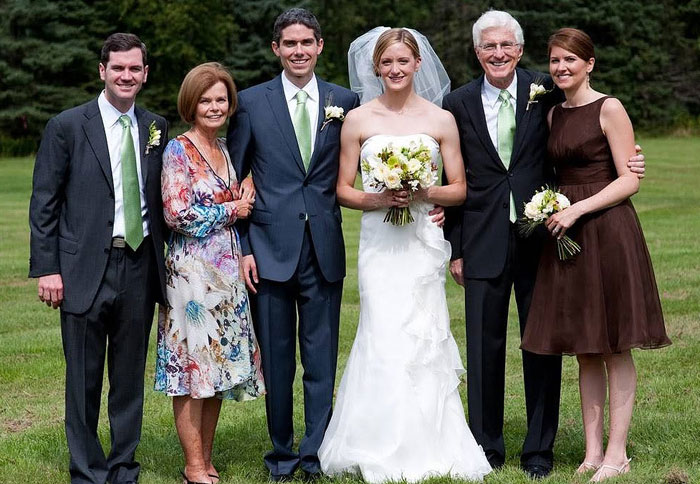
Michael and Anne are visiting today.

Harry-
A Happy Veteran's Day to all of your readers today from a long time reader of yours who happens to be a veteran himself.
Thanks to all the men and women and their families for serving our country and us by what they do everyday.
Steve