ON Monday Greece announces it is leaving the euro. It will replace Euros with drachma at the rate of one new drachma for one old Euro.
ON Tuesday the drachma drops 40% to 60 euro cents. The Greek government is happy. It’s much cheaper to repay its bonds. Tourists are visiting the country in droves, eager for cheap hotel rooms and goods (like booze) that cost a lot more in their country.
ON Wednesday, there’s a run on several large French banks, as depositors withdraw their money in a frenzy. The banks own too much Greek government debt and rumors abound that no other bank will deal with them any longer.
ON Thursday, three large French banks declare bankruptcy, closing their doors and turning off their ATM machines.
ON Friday, consumers in Italy, Spain and Portugal rush to remove Euros from their bank accounts and swap them into American dollars. Some are successful in wiring funds to their US and Swiss bank accounts. Some are successful in securing actual US printed dollars — greenbacks. But there’s not enough printed dollars to satisfy demand.
ON Saturday, every country in Europe announces new stringent currency regulations: No one is allowed to transfer more than $1,000 out of country.
ON Sunday Italy, Spain and Portugal announce they’re also leaving the Euro and reverting to the Lire, the Peseta and Centavo.
ON the Monday, several more banks in France and one in Germany declare bankruptcy.
You can fantasize the remaining consequences. German exports to Greece, Italy, Spain and Portugal slump. There are two reasons. First, Germany’s goods are suddenly twice as expensive. Second, German exporters don’t want to be paid in Drachma or Centavo. The PIGS don’t have enough dollars or Euros to pay for the goods. Many German exporters teeter on the brink of bankruptcy. But local German governments step in with short-term loans. Meanwhile many firms in the PIGS lay off workers because they can’t buy the spare parts from Germany to keep their factories humming.
German firms suddenly faced with demand for their products that has fallen off a cliff fire their workers. Street protests erupt throughout Europe. Elections are held and governments are toppled — following a pattern. In the last two years, eight European governments have already been toppled. Spain was the latest one, when, a week ago, its Socialist government was defeated in a landslide.
The US dollar is now much higher. The Euro is on par with the dollar. Gold is skyrocketing, already over $2,000 an ounce.
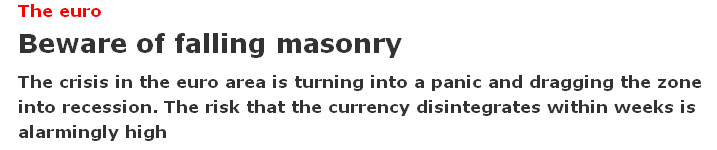
Last week the Economist ran this headline:
Over the weekend there were rumors of a “deal” to save the Euro. Today European stocks bounced up 3%.
Europe is not the U.S. nor even England. Both of our governments rushed money into our banking systems in 2008 and 2009 to shore up our banks and protect our credit system. Europe could print the money and pump it into their banks and governments. The resulting inflation would probably be massive — perhaps approaching what happened in the late 1920s, which led to the Great Depression.
Europe is obsessed with inflation and not letting this happen again. But, as their politicians dilly-dather around, the price of saving Europe goes higher and higher and the consequences more awful to contemplate.
We are not immune. US banks have a big exposure to European government bonds and European banks. Most large US corporations have European exposure — exports or factories, or both.
I spent a little of the weekend sitting under a palm tree reading European stuff. Conclusion: Nno one knows what will happen. But it all looks pretty grim. Most of my European friends have already moved their cash money into dollars and into US banks. No one seems to believe today’s politicians will solve the problem.
This piece from the New York Times is worth reading:
November 27, 2011
Time Runs Short for Europe to Resolve Debt Crisis by LANDON THOMAS Jr.
LONDON – Eighteen months into a sovereign debt crisis – and after many futile efforts to resolve it – the endgame appears to be fast approaching for Europe.
While its leaders may well hold to the current path of offering piecemeal solutions, nervous investors are fleeing European countries and banks.
Two main options exist: either the euro zone splits apart or it binds closer together.
Each of these paths – Greece, and possibly others, dropping the euro or the emergence of a deeper political union in which a federal Europe takes control of national budgets – would lead to serious political, legal and financial consequences.
But with financial panic now threatening to move beyond Italy and Spain to Belgium, France and Germany, the euro zone’s paymaster, the pressure to arrive at a solution is at a new level of intensity.
In Britain, even the satirical weekly Private Eye has weighed in, proposing last week that the answer was for Europe itself to leave the European Union.
Underlying these possible outcomes has been Europe’s persistent inability to address the central weakness of its common currency project: how to get money from the few countries that have it, mainly Germany and the Netherlands, to the many that need it – Greece, Italy, Spain, Portugal, Ireland and perhaps even France.
In recent days, euro zone leaders have been pursuing a deal that would institute strict new budget rules while avoiding the need to rewrite existing treaties.
The consequences of continued inaction are dire. Uncertainty and austerity have decimated the euro zone’s growth prospects, and analysts now expect the region’s economy to shrink 0.2 percent next year – a blow for the many American companies that export there.
American financial institutions are also at risk. According to the Institute of International Finance, they have $767 billion worth of exposure through bonds, credit derivatives and other guarantees to private and public sector borrowers in the euro zone’s weakest economies.
With the European Central Bank continuing to refuse to print money as its counterparts in the United States and Britain have done, investors now foresee a much greater likelihood of a broad market crash and a worldwide recession.
Such anxieties were on display last week when Vítor Constâncio, the vice president of the central bank, gave a speech to investors in London.
It was billed as an address on the international monetary system, but given the circumstances, there was little interest among investors in Mr. Constâncio’s views regarding fixed versus floating-exchange rates and quite a lot about what steps the central bank might take to address the crisis.
One somewhat frantic investment banker noted that beyond the Italians and the Spanish, even the Germans were having problems selling their bonds. What, he asked, was the European Central Bank going to do about it?
Mr. Constâncio mentioned the central bank’s bond buying program and making loans available to banks, but he was blunt in saying that unless countries like Greece and Italy followed treaty rules and reduced their budget deficits, there was not much the central bank could do.
“The countries must deliver,” said Mr. Constâncio, a former governor of the Portuguese central bank. “In the end, it is governments that are responsible for the euro area – it is not just the E.C.B.”
It is this eat-your-spinach policy approach, however, that many analysts now say is making the situation worse as countries throughout the euro area – including Germany, the region’s economic locomotive – cut spending and raise taxes to meet budget deficit targets.
In a recent paper, Simon Tilford, an economist at the Center for European Reform in London, argues that imposing additional rules rather than creating a federal framework to allow the euro zone to commonly transfer or borrow money – as can be done in the United States – will end in disaster.
“The solution to the problem has become the problem itself,” he said. “And investors see this: you cannot just keep cutting spending in the teeth of a recession.”
Bernard Connolly, a persistent critic of Europe, estimates it would cost Germany, as the main surplus-generating country in the euro area, about 7 percent of its annual gross domestic product over several years to transfer sufficient funds to bail out Europe’s debt-burdened countries, including France.
That amount, he has argued, would far surpass the huge reparations bill foisted upon Germany by the victorious powers after World War I, the final payment of which Germany made in 2010.
Analysts say it is the unbending attitude of Germany, Europe’s richest country, that it not become responsible for the debts of weaker economies that has so far stymied progress on the widely supported idea of a euro area able to issue its own bonds.
Lack of movement on a federal Europe has pushed investors to consider what would happen if a country like Greece exited the euro zone. Analysts predict dire consequences for the departing country, ranging from default to a collapse of its banking system.
A recent report by UBS estimated that in the first year, the citizens of the exiting nation would face costs of as much as 11,000 euros a person on top of the austerity-induced pain already incurred.
Such a move might be legally impossible: there is no provision in any European treaty for a country to leave or be expelled from the euro zone – a conscious choice by the framers of the project.
But if a country made such a decision, it would have to leave the 27-member European Union as well, thus entering a more profound state of exile.
A view is now taking hold among many European leaders that the ever-worsening crisis may result in Brussels being given direct control over the budgets of countries that continue to run excessive deficits – a proposal made recently by the euro’s most passionate advocate, Jean-Claude Trichet, former president of the European Central Bank.
“The will to make this thing work is stronger than you might think,” said Larry Hatheway, an economist at UBS and one of the authors of the report on the cost of one or more countries leaving the euro zone.
In this vein, several economists at Bruegel, a research institute in Brussels, are calling for a euro zone finance minister, elected by the European Parliament, who would have limited federal powers to raise revenue.
With time short, pressure is building on the European Central Bank to defy German objections and buy more distressed government bonds, but there is little indication the bank has decided to do so.
Last week, Mr. Constâncio actually appeared to boast about the bank’s restraint thus far, explaining to harried investors that the central bank’s bond-buying effort represented about 2 percent of euro area G.D.P. That compares with an intervention of 11 percent of G.D.P. by the Federal Reserve in the United States and 13 percent by the Bank of England.
“We are not financing the deficits of countries,” he said.
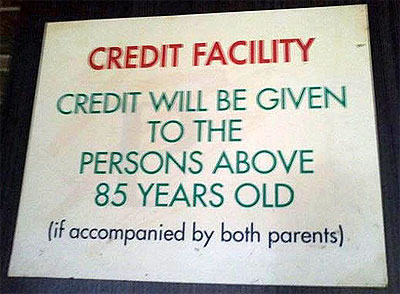
Only sensible credit policy:Too much debt. That’s the problem worldwide. I like this sensible sign.
Amazing charts. Even more amazing are the dozens of learned security analysis reports from brokerage firms in 2011 pounding the table for these dreadful stocks.
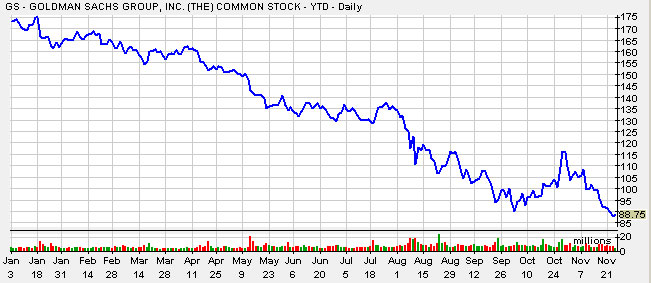
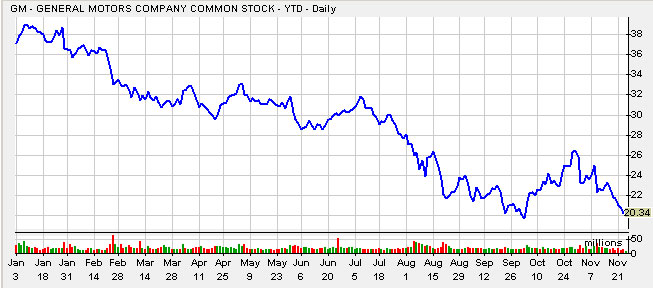
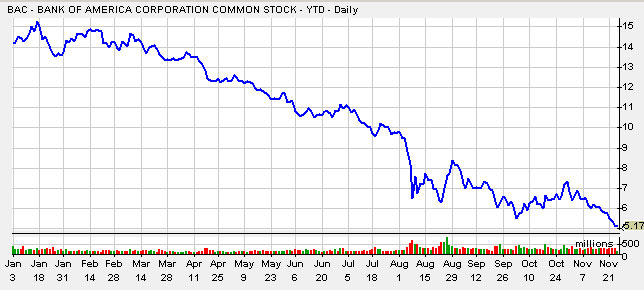
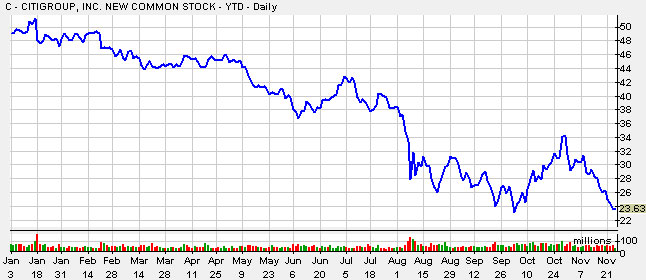
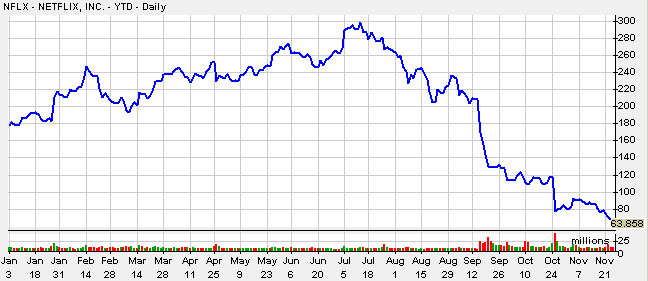
To me, these four charts are the perfect testimony to our inviolate Stop Loss Rule: Down 8% or 15% (at most) and you’re out. All of these have fallen a lot more than 15%, meaning you would have come out ahead if you were unfortunate enough to buy the stocks in the first place. Fortunately, I have been pounding the table against owning financials all year. And I never did like GM stock, its pension fund problems or its cars (though they are improving).
$4 billion for what? From the Wall Street Journal, Thanksgiving Day:
NEW YORK— AT&T Inc. signaled for the first time that its $39 billion acquisition of T-Mobile USA is more likely to fail than to succeed, saying it will set aside $4 billion in this year’s final quarter to cover the cost of breaking up the deal.
Margin Call — the most insightful Wall Street movie ever filmed. To read the full review from ProPublica, click here. To watch the movie on your PC for $6.99, click here. Or buy a Roku2 for $90 and watch it on your PC. Click here.
Latest travel tips:
1, Luxury hotel and resort hotels are reducing their prices because demand simply isn’t there. Call the hotel direct and offer a much lower price, e.g. $200 a night for an erstwhile $500 a night room. Bargain for included goodies, like breakfast, spa treatment, Internet, etc.
2. It’s hard to avoid airline baggage fees. Pack less. Carry your 22″ bags on. We spent an extra $100 to check two bags. $25 per bag times two bags times there and back.
Belgium, as travel destination.
Americans traveling by tour bus through Belgium stopped at a cheese farm. A young guide led them through the process of making cheese, explaining that goat’s milk was used. She also showed the group a lovely hillside where many goats were grazing.
‘These’ she explained, ‘Are the older goats put out to pasture when they no longer produce.’
She then asked, ‘What do you do in America with your old goats?’
A spry old gentleman answered, ‘They send us on bus tours to Belgium.
Great holiday game with the kids. Susan, Anne, Michael and myself played Monopoly on Michael’s iPad on Thanksgiving evening.

Enormous fun. Just like the real thing. The graphics are beautiful. Only 99 cents. Click here.

Harry Newton who wonders how there can be so many shopping centers, restaurants and bikers’ bars between Phoenix, Scottsdale and Carefree, where we stayed.
We had fun. Played tennis. Swum. Worked out. Enjoyed Arizona’s sun and cloudless blue skies. Stunning weather.
This is not your usual vacation picture. It’s Harry, Susan and Michael on our way to the pool. That’s Michael in his new Nike Air Max + 2011 sneaks. Despite their hideous color, every where he goes with them he gets rave comments. They’re very comfortable. I have a pair in metallic silver. You can get your very own pair. Click here.

That’s me in the local hotel robe. I’m trying to protect myself from the sun. Photo by Anne Newton, Michael’s wife, who had the foresight to stay out of this silly picture.

On Sunday November 27th Goldman Sacks has placed the last of their bets from their infinite number of anonymous worldwide tax haven accounts and are gleefully awaiting your scenarios to play out.