Europe has become a gigantic cockroach. Yesterday’s news:
The ratings of 15 euro-zone nations were placed on credit watch negative by Standard & Poor’s Rating Services, citing tightening credit conditions and disagreements among European policy makers on how to tackle the region’s immediate and long-term economic challenges.
The decision to put the countries on negative credit watch-which signals a downgrade within 90 days has 50-50 odds-affects six countries with the rating firm’s highest, triple-A rating: Germany, France, the Netherlands, Austria, Finland and Luxembourg.
My friend was quoted in today’s Wall Street Journal.
Recently, David (Dave) Rawlings, the guitarist who performs with American roots musician Gillian Welch—another client—called from Europe complaining about the still-strong euro. Unlike many top musicians, the duo drive from show to show, and found themselves shelling out four times as much on fuel, hotels and food as they do in America—something Mr. Burnstein jotted down. “They really have a ground-level view of what things cost” in Europe, he said. “That’s another thing that confirms for me that, because of the exchange rates, prices in Europe are much higher, and this isn’t a sustainable situation.”
But American markets? My friend, the stock guru, Pete Rawlings (and father of Dave Rawlings — it’s a small world) writes me this morning:
This market wants to go up. Remember next year is an election year. The QQQ’s are now above their 50and 200 dma. IBM is at a new high and getting ready to break out. It looks like CAT is ready to break out also. Check out WFC, XLY and FAS . They are now trading above their 50 dma. IMO(In My Opinion) this market isgoing to explode when it looks like the European problem is over. Bernanke is working on fixing that. Then it will be time to sell, not buy. Buy low Sell high.
I have two bank CDs in Australia. They’re with Westpac, Australia’s largest or second largest bank (depending on how you measure). The CDs pay over 6%. With the rise in the Australian dollar they’ve done handsomely. I continue to feel comfortable with my money in Australia, despite today’s Wall Street Journal story:
Australia’s Juggling Act
By CYNTHIA KOONS
With the capacity still to cut interest rates, the Reserve Bank of Australia (RBA) is the envy of central bankers in most of the developed world. As the globe heads into a potential downturn, however, the RBA’s task of juggling a two-tier economy is far from straightforward.
The resource sector boom has driven up the value of the Australian dollar, leaving other parts of the economy behind. Retail, tourism and manufacturing can’t compete with lower-cost options from other parts of the world. The number of small businesses declaring insolvency is set to increase by 80% off an already high base to 18,000 next year, according to the Council of Small Businesses of Australia.
House prices also are in trouble, having fallen 4% in the 10 months to the end of October on a seasonally adjusted basis, according to RP Data.
So far, the RBA is responding as expected, by cutting rates. On Tuesday, the central bank cut the cash rate 0.25 percentage point to 4.25% from 4.5%. In response, the Australian dollar barely budged against the U.S. dollar, ending the day just a few ticks below where it started. As long as the Australian dollar remains around parity with the greenback, prospects won’t improve for those industries that suffer from its strength.
Still, worse could follow.
Economists expect 2012 will see a slowdown in the economy of China, Australia’s biggest trading partner. China’s gross domestic product growth could slip to around 8% from more than 9% this year, which will lead to lower demand for commodities. Already, the Reserve Bank of Australia’s index of commodity prices—a weighted basket of Australia’s resource sector exports—has fallen sharply this year. The central bank says the economy’s resources-led surplus may have hit its peak and could decline “somewhat” from here.
While a global slowdown would help take the heat out of Australia’s resource-boosted dollar, it could also threaten the strongest sector in the Australian economy.
The central bank doesn’t meet again until February. By then, a clearer picture should have emerged on Europe’s debt crisis and the global economy. Australia’s central bank has room to maneuver. Signs of a further downturn would surely mean more rate cuts must come.
Australia’s dollar is $1.022, down from $1.07 a little while ago.
Has everyone noticed how the stories in the Wall Street Journal have become increasingly negative? And increasingly I take their negative stuff with a grain of salt.
I haven’t had a subscription to the print Journal for eons. I don’t miss it.
Some good stuff on Annaly:
NLY Named Top 10 REIT at Dividend Channel With 15.99% Yield
By Dividend Channel Staff, Tuesday, December 6, 7:55 AM ET
Annaly Capital Management Inc (NYSE:NLY) has been named as a Top 10 Real Estate Investment Trust (REIT), according to Dividend Channel, which published its most recent ”DividendRank” report. The report noted that among REITs, NLY shares displayed both attractive valuation metrics and strong profitability metrics. For example, the recent NLY share price of $16.27 represents a price-to-book ratio of 1.0 and an annual dividend yield of 15.99% — by comparison, the average stock in Dividend Channel’s coverage universe yields 4.4% and trades at a price-to-book ratio of 1.9. The report also cited the strong quarterly dividend history at Annaly Capital Management Inc, and favorable long-term multi-year growth rates in key fundamental data points.
You can read the rest here. I still own Annaly.
My Citi Visa got hacked. First, someone charged 34 cents on it. Then reversed the charge. Then they charged 80 cents and reversed it. That was to test the card worked. Then they charged three sets of $290 to a candle company.
By then Citibank had closed the account down. And my latest airline fare kept being blocked.
I called Citibank. What I learned:
+ Anyone and everyone can have their card stolen. Citi doesn’t know how they stole mine.
+ Make sure your credit card company has your cell phone number so they can contact you — by calling or testing. They didn’t have mine. They now do.
+ Citi knows all the companies which regularly charge my purchases to my card — e.g. electricity and FedEx. They have a database of companies they will automatically notify my new card number to. There were two they don’t have on their list that I’ll notify.
+ I won’t be charged for the fraudulent purchases.
I was impressed with the Citi’s diligence. They’re FedExing me a replacement card with a different number.
I get unusual requests for money:
XYZ Corporation is in the business of providing more efficient and cost-effective building and construction violation remediation and removal services for customers all five New York City boroughs. While other violation removal companies exist in the market, the Company’s unique competitive advantage is two-fold: First, the Company has developed a proprietary architectural database which minimizes costs and time needed to complete services; Secondly, the Company has integrated all violation removal activities into a seamless, in-house process. For customers, these two competitive advantages translate into lower costs and a more streamlined violation removal process.
The airlines (and Amtrak) go crazy on demand pricing.
I’m going to Vegas for the January Consumer Electronics show. I leave NYC with JetBlue on Monday, January 9 come back on Thursday. Cost $1309.40.
Had I gone the following week, traveling on the identical planes would cost me $508.40. That’s a 60% savings.
All tickets include a $55 surcharge a few miserable extra inches of legroom.
On a lazy Sunday morning.
One lazy Sunday morning the wife and I were quiet and thoughtful, sitting around the breakfast table when I said to her unexpectedly, “When I die, I want you to sell all my stuff, immediately.”
“Why would you want me to do something like that?” she asked.
“I figure a woman as fine as yourself would eventually remarry and I don’t want some other asshole using my stuff.”
She looked at me intently and said: “What makes you think I’d marry another asshole?”
What’s in the box? (This is stupid. But I can’t stop laughing.)
A little old lady went to the grocery store to buy cat food. She picked up four cans and took them to the check out counter.
The girl at the cash register said, “I’m sorry, but we cannot sell you cat food without proof that you have a cat. A lot of old people buy cat food to eat, and the management wants proof that you are buying the cat food for your cat.”
The little old lady went home, picked up her cat and brought it back to the store. They sold her the cat food. The next day, she tried to buy two cans of dog food. Again the cashier said “I’m sorry, but we cannot sell you dog food without proof that you have a dog. A lot of old people buy dog food to eat, but the management wants proof that you are buying the dog food for your dog.”
So she went home and brought in her dog. She then was able to buy the dog food.
The next day she brought in a box with a hole in the lid. The little old lady asked the cashier to stick her finger in the hole. The cashier said, “No, you might have a snake in there.”
The little old lady assured her that there was nothing in the box that would harm her. So the cashier put her finger into the box and quickly pulled it out. She said to the little old lady, “That smells like shit.”
The little old lady said, “It is. I want to buy three rolls of toilet paper.”

Harry Newton who wonders if bank stocks are really going to boom. If so, buy some XLF:
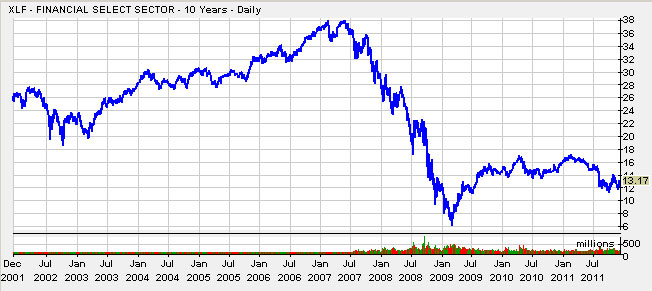
What got me thinking: Sunday’s front page story in the New York Times:
Modest Bonus Year on Wall St., but Stock Could Yield Fortunes
Buffeted by lackluster profits and turmoil in the global markets, Wall Street is bracing for one of the worst bonus seasons in recent memory. But in the alchemy of high finance, bankers are hoping to turn the slump to their advantage.
Financial firms are preparing to dole out huge amounts of stock at depressed prices, the value of which could rise substantially in a few years.
“This year is the perfect situation where they can say it is a modest bonus season, but in the end, it could end up making many of them zillionaires,” said Jonathan R. Macey, a professor of corporate law and finance at Yale. ”Not all banks may do well in the long run, but most will.”
Even by Wall Street’s lofty standards, the compensation outlook this year is pretty bleak. Financial firms like Goldman Sachs, Bank of America and Citigroup are culling their ranks, and the remaining employees are resigning themselves to smaller year-end checks, at least in terms of the dollar amount. By some estimates, bonuses could shrink by as much as 30 percent this year.
But a large portion of those payments will be in stock, rather than cash. Since the financial crisis, banks — which have faced withering criticism from lawmakers, investors and the public over their compensation practices — have been pushed by the government to hand out larger swaths of restricted stock and options, which allow an employee to buy shares down the road at a certain price.
Haraz N. Ghanbari/Associated PressBrian T. Moynihan, chief of Bank of America.
By linking personal compensation to long-term company performance, the hope is to curb the excessive risk-taking that brought the financial system to the brink a few years ago.
Top executives now receive the bulk of their bonuses in shares. In 2010, the chief executive of Goldman Sachs, Lloyd C. Blankfein, received 70 percent of his bonus in restricted stock, roughly $12.6 million. Bank of America awarded its head, Brian T. Moynihan, $9.05 million, entirely in equity.
This year, the pattern is expected to persist, and some bankers are even lobbying for more stock and less cash in the mix, say several senior Wall Street executives responsible for setting compensation but not authorized to speak on the record.
One senior bank executive says he comes in every day “praying” the stock price of his firm does not go up before bonuses are handed out early next year.
“It is all anyone is thinking about,” the executive said on the condition of anonymity because he was not authorized to speak to reporters.
With cash, employees receive a fixed amount. Stock, on the other hand, has the possibility of upside appreciation, albeit with downside risk.
So $1 million of stock today could be worth $1.25 million or more next year — or the shares could be essentially worthless. Equity payouts from 2010 are underwater, in many cases.
This year, bankers are predicting that the shares will rise significantly, or at least not fall much further. Bank stocks, on average, have dropped 40 percent since peaking in February, according to an index put together by the investment bank Keefe, Bruyette & Woods.
“Investors have been betting with their wallets of late and avoiding buying the big brokers,” said Glenn Schorr, an analyst at Nomura. “But if history is any guide, these companies will adapt, improve their profitability and the prices will go up.”
They have used the strategy in the past. With their shares in the doldrums at the depths of the financial crisis in 2008, several firms handed out unusually large amounts of stock to their employees.
In 2009, JPMorgan Chase gave out 131 million shares of restricted stock, with an average price of less than $20 each. As the stock rose the following year, the company paid out 80 million shares, with an average price of almost $43 a share. On Friday, it closed at $32.33.
Goldman granted 36 million options in December 2008, more than 10 times the amount the year before. Afterward, employee stock grants accumulated over time represented 20.3 percent of the total shares outstanding, up from 7.3 percent before the issuance, according to an analysis by Footnoted, a division of Morningstar that scrutinizes corporate disclosures.
It has the potential to be a windfall for Goldman employees. At the time of the grant, the stock was trading at nearly $79. When some of the options began to vest a year later, shares of Goldman had more than doubled in value. While the stock has since pulled back, it still stands at around $97, roughly $20 higher than three years ago. These stock grants can not be sold until 2014. Goldman declined to comment.
Stock grants are not always a boon. In December 2008, Morgan Stanley, which declined to comment, handed out 28 million shares, with an average value of $16.81. But those grants are not looking so good today, with the stock now trading at about $15.50.
Taking shares is still a gamble some bankers are willing to make.
While a bank’s stock could continue to languish amid the economic malaise and regulatory uncertainty, the odds are in the bankers’ favor.
Following periods of prolonged weakness, financial companies typically experience a large price spike the next year. After the recession ended in 2003, the Keefe, Bruyette & Woods index of bank stocks rose more than 40 percent.
“These stock grants have the potential to look a whole lot better three years from now than they do today,” said Mr. Schorr, of Nomura.

The levels of fraud are why credit card companies much charge merchants 2 to 3% of every sale plus charge the customers from 8% to 30%.
A competing service for making online purchases (and to a lesser degree, for in-person retail purchases) is Dwolla. Dwolla charges a flat-rate, $0.25 per transaction and even waives the fee for transactions under $10. The merchant can make it so the customer pays even.
Dwolla is a debit (cash) balance service, so there are no interest charges.
If the merchant wants to offer a lower price, the savings can be passed on in the form of a cash discount.
e.g. on your flight, JetBlue could have offered:
Pay with Visa/MC/AmEx: $1,309.49
Pay with Dwolla: $1,270.12
and netted the exact same amount regardless of which method you used for payment.
Which method would you use?
Harry…my credit card companies (even PayPal) send me an email immediately after every purchase is made so I know if they were mine or not…just sign-up for the service online.
I do not like American Express and have not held their card for years…I was just approved for a new one which I applied for while making my next reservation on Delta…We are taking 2 extended trips next year and by charging them on American Express we get an immediate $50. discount on each plus double miles and Priority Boarding. Maybe most important “Free” checked baggage which will save us quite a bit on the 2 round trips for stays over a month each. Fares to Maine for one trip was $200. cheaper than Jet Blue. We took a volunteer bump last year which returned us $800. (helps on the Hawaii fare) during which time we had a leisurely lunch on Delta and took the next flight, which got us home 30 minutes earlier than our original booking. Second year annual fee of $95. is high but may be worth it, I'll decide that when it kicks in.
Cheers.