Our markets are dominated by the mess in Europe. Without that being solved, we go nowhere — except up and down. This is from the Economist. It tells the story.
European leaders can still avoid the apocalypse, but only if they act boldly and quickly
THE end is nigh. Olli Rehn, the European economic commissioner, says the euro zone has ten days to save itself (so what exactly will happen on December 12th?). Radek Sikorski, Poland’s foreign minister, says he fears German paralysis more than German power (or Russian missiles). Barack Obama says the euro zone poses the greatest risk to America’s well-being. Having once spurned the IMF, euro-zone leaders beg for its help. In European chancelleries the talk is of who should be the elect ones. Will it be the 27 members of the EU, or just the 17 that are in the euro zone? Or, if even that is impossible, could the six AAA-rated members of the euro zone bind themselves together?
It is time, in short, to repent. But what is the original sin? For Germany, it is over-indebtedness. Although troubled countries can be helped, real salvation must come through individual actions to reduce deficits, repay debts and boost competitiveness. Germany also wants a new covenant: EU treaties must be changed so that national budgets are scrutinised by Brussels, with powers to impose “automatic” sanctions on countries that stray. This would be backed up by the European Court of Justice. The Germans think only a treaty commitment and the power of the judges will ensure that vows of discipline are honoured.
In this section
Nobody denies that they have a point. But most also think that the sinning is more widespread than that. Germany itself was one of the first to breach the stability pact’s ceilings in 2002-03. For every irresponsible borrower there is a reckless lender (often a German bank). Excessive deficits for some imply excessive surpluses in others. The euro’s design was flawed, without fiscal integration or a central bank to act as a lender of last resort. If so, what is needed is greater mutual support: joint Eurobonds to mutualise at least some of the debt, as suggested by the European Commission, and perhaps a change to the statute of the European Central Bank (ECB).
Such positions will be hard to reconcile ahead of next week’s summit. Germany and France usually try to present a common position but that looks less easy this time, with Angela Merkel, the German chancellor, and Nicolas Sarkozy, the French president, making separate speeches this week. Germany will not hear of throwing cash at the problem: no more for the euro-zone rescue fund, no Eurobonds and no open pressure on the ECB to buy more bonds. In Brussels this week euro-zone finance ministers muddled along. They approved the next tranche of loans for Greece to avoid a sudden default; they finalised plans to enhance their rescue fund through financial engineering, even though it may fall short of the original promise of €1 trillion; they pledged a new effort to increase the IMF’s funds. Where the money would come from was left vague; the IMF alone cannot save the euro. Perhaps, suggest some, it could borrow from the ECB.
It is being left to Herman Van Rompuy, president of the European Council, to find a compromise and avert a breakdown. He is known to be wary of opening up the treaties. But if amendments there must be, he is likely to try to balance Teutonic rigour with Latin solidarity. This might include a “road map” to Eurobonds. It might also involve toning down a previous deal that private creditors should be singled out if debtors cannot meet their obligations. But Mr Van Rompuy faces several conundrums.
First, Germany opposes any such grand bargain. Even though Mrs Merkel has crossed many earlier red lines, conversion to anything resembling Eurobonds or to unlimited ECB liquidity is unlikely in a few days, if ever. Second, Britain has an impossible list of demands if there is a new treaty. These include repatriation of social policy, special protection of the City of London and safeguards to stop the 17 “ins” ganging up against the ten “outs”. Third, France’s overt campaign for a smaller, more exclusive inner core is stoking the fears of Britain and some others. “I think there is not enough economic integration in the euro zone, the 17, and too much integration in the EU at 27,” Mr Sarkozy declared in October. French EU diplomats recently stunned colleagues by arguing that, when the commission’s proposals for new budget rules are debated in the European Parliament, only MEPs from euro-zone countries should be able to vote.
It has fallen to Poland, a non-euro country, to speak truth to the EU’s bigger members. In a powerful speech in Berlin this week, Mr Sikorski said Germany was Europe’s “indispensable nation” and had to provide leadership. With an eye on France, he declared: “To those who would like to divide Europe, I say: how about a natural division into growth-Europe and non-growth Europe?” And he told Britain: “We would prefer you in, but if you can’t join, please allow us to forge ahead.”
Europe needs an all-encompassing deal to save itself. The crisis is now about the survival of the euro, so it requires a big response; nobody will be spared if the euro collapses. A sensible compromise would be to impose greater discipline now, in exchange for the eventual introduction of conditional Eurobonds. A paper by the Brussels-based think-tank Bruegel adds the need for a euro-zone finance ministry, with power to raise its own taxes and to oversee the banking system.
With time running short, an all-encompassing deal might take too long to negotiate. That said, a limited German-style treaty would also take time. A balanced deal is more likely to be accepted by voters, in both creditor and debtor states, and to assuage markets. It may need to be done in phases. In the short term, it must be enough to free the ECB to intervene without limit, by assuaging fears of moral hazard. In the long term it needs to signal to investors that the euro’s problems are being fixed for good. Only then might the apocalypse be cheated.
Stocking stuffers — Part 1. I’ll continue this series as I think of more goodies. For now:
+ Buy your grandkids one share of Apple (AAPL), Amazon (AMZN), Electronic Arts (ERTS), Intel (INTC), Google (GOOG), Nintendo (NTDOY), Disney (DIS), Glu Mobile (GLUU), the New York Times (NYT) and Microsoft (MSFT — for the Xbox).
+ The iPad2 is the number one desired stocking stuffer. The 16 gig version is sufficient.
+ A cheaper alternative is Amazon’s Kindle.
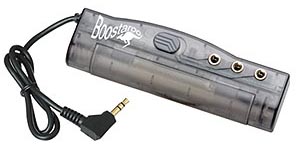
+ Susan and I occasionally snuggle in bed and watch a movie on a laptop. This $20 gadget (now on sale) has two benefits. It lets up to three people plug their headphones in and listen. But most importantly (at least for me) it boosts the volume of my movie or music. I’m not claiming to be deaf, though the family says I am. The Boosteroo uses two AA batteries. They’ll last for 20 or so hours.It weighs nothing.
Click here.
Swan Lake in China. Totally amazing. Entirely gripping. You’ve never seen a Swan Lake like this one.

Click here.
Watch out for print magazines. My New Yorker subscription expires in November, 2015. That’s four years from now. They just sent me a renewal invoice. That gives chutzpah a whole new meaning.
AT&T is more stupid than I ever imagined: I am a customer. I became one when they had the iPhone and Verizon didn’t. Now I want to upgrade to the iPhone 4S. They won’t offer me a “deal.” They’ll charge me the same price as if I were a new customer walking in off the street. But I can cancel out, pay them $165 and move to Verizon. I just might.
However… with major prodding (and too much time on the phone with them) I learn that they’ll buy my old iPhone 4 phone from me for $250 (so long as it’s not damaged, which it’s not).
Strange world. One of the computer magazines figured that AT&T’s 3G data service is much faster than Verizon’s! But AT&T is willing to pay $4 billion in takeover fee penalties because it can’t buy T-Mobile. Whoever told them the merger would be allowed? A bunch of lawyers with nothing to lose. Meanwhile Verizon buys $3.6 billion in new spectrum, which is so much more intelligent.
Here’s the last five years of AT&T. Pretty miserable.
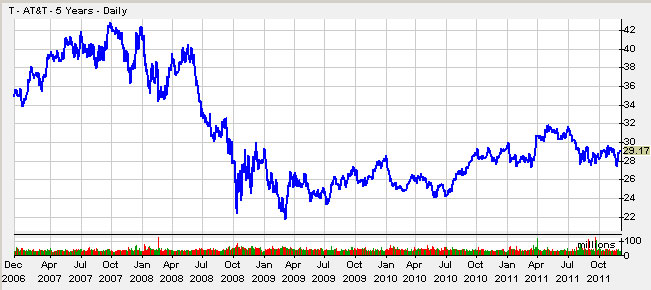
Go figure the cell phone business.
How to fix your TV. I have Verizon FiOS TV. This morning it wouldn’t show several channels, including BubbleVision.
Solution: Unplug its coax cable. Unplug its power cable. Count to twenty. Then plug back in. Pray. Bingo, it now works. Isn’t technology wonderful?
Favorite recent New Yorker cartoons.
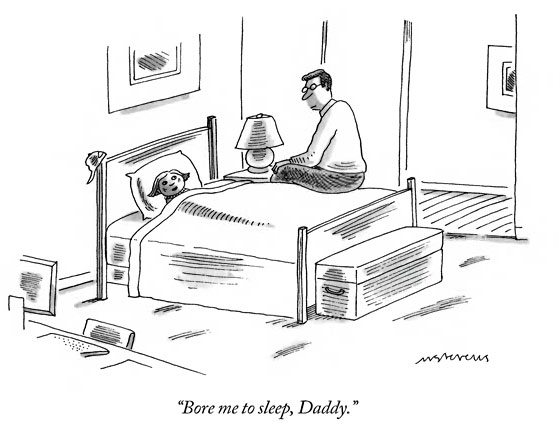
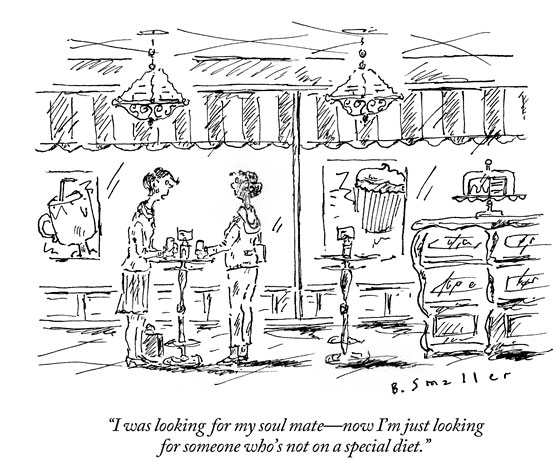


Harry Newton who says try this for logic. Yesterday in Afghanistan Sunnis killed 63 Shiites who were celebrating a peaceful religious holiday.
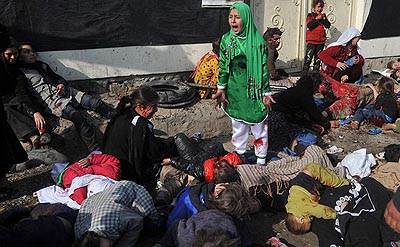
The deaths were the work of a Pakistan Sunni group. Saudi Arabia has spent billions building “schools” in Pakistan called madrassas. These schools teach a radical form of Islam, but no useful skills for today’s world. They produce suicide bombers and recruits for the Taliban. Indirectly, through our oil purchases, we finance this evil. And indirectly we are responsible for the deaths of these 63 people, which included one American. We should be aggressively reducing our OPEC oil purchases. Natural gas, anyone?

We as Americans have contributed nothing to their violence. That would happen regardless of our actions. These are a group of murders and their day of reckoning is coming. If you want to feel bad about something and do something, help the many starving Americans in this country and bring back out jobs.
clean water or natural gas, pick one, you cant have both. If you want invite halliburton to your back yard to frack your aquifer.
Two things, Harry.
One regarding AT&T, I am a customer whose contract expired on my old iPhone 3g more than a year ago. They would NOT give me a deal on a new iPhone 4S either and I did not have to pay a termination fee because of my expired contract. It would have cost me the same going to Verizon or Sprint to get the new iPhone. What made me stay was only one thing: their agreement to continue/”grandfather” my unlimited data plan which Verizon does not offer. With most people migrating more and more of their online activities to their smart phones, it will not be long before the data plans create a hole in our checkbooks. Will Verizon offer you unlimited data? Are you willing to put up with Sprint's service/coverage, or lack thereof? For me, the answers to those questions prompted me to reluctantly stay with AT&T and if your iPhone use is heavy on data, you may be wise to stay with AT&T and get used to dropped calls.
Second, as for Saudi Arabia, if 9/11 did not open America's leaders' eyes about the Saudis' position regarding their “friendship” to the US, will anything else do so? Or, is it that we are willing to pay a significant price for oil? The Saudis have always hated America and likely will always do so. Do we believe that it is just a coincidence that almost all of the terrorists on 9/11 were from Saudi? Why is it that we are a nation that advocates human rights for all and loudly criticize nations who abuse their own citizens but turn a blind eye towards the oil rich nations that we call our “allies”? We look at the price of oil on the market based on the prevailing price per barrel but always forget to factor in the lives that are sacrificed, in and out of uniform. Ironic, isn't it – that we are financing our own enemies' war against us?
The Swan Lake performance is amazing. And yet, Americans still say that the Asians aren't innovators……