I bought a little XLF, the financial ETF, a few days ago. My friend, the covered call writer emailed
I think that’s a good bet. i already own it. If you want to make sure that you make some money on it, just sell a Jan 13 Leap on it. I’m going to make 12 to 14% on mine next year. However, if it goes down, I’ll buy back the options for a quick gain and wait for it to go back up again and resell some more options on it. Remember market volatility is the call seller friend. If we are ever going to get out of this garbage, the banks have to go up.
He’s a VectorVest (VV) subscriber. He followed up today:
Historically using VV the time to BUY is when the VV MTI is down around .5 (5th step) and to SELL when it gets up around 1.5 (15th step). In this market cycle the MTI hit a low of .57 on 11/23 and today is at 1.3. Therefore, the time to start taking some profits will be when it’s around 1.5. Will I no! Instead I’ll sell call options, own some gold and Mreits (mortgage REITs) and try to out smart the Market like Jim Cramer.
One day interest rates will rise. That’s the prevailing wisdom. In fact, it’s been the prevailing wisdom for several years. Adherents to this belief have bought TBT — the classic bet on interest rates rising. Sadly they have watched TBT fall and fall.
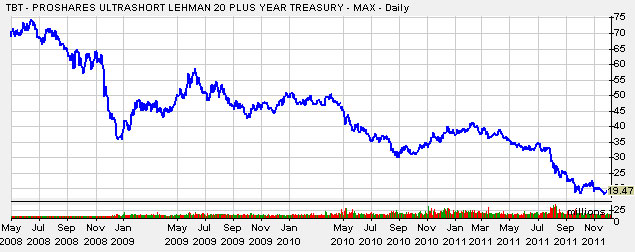
TBT has been a lousy “investment,” also called a gamble.
So, when will interest rates rise? The simple answer: Not any time soon. Items:
+ Today the European Central Bank cut by 25 basis points to 1% — its second cut in two months.
+ Earlier this week Australia cut interest rates for the second month in a row — this time by 25 basis points to 4.25 per cent — having cut in November for the first time since April 2009.
All the industrialized world’s central banks are obsessed with restraining inflation. Though you and I think prices are rising, the banks don’t. Moreover they think inflation is a function of employment. When it gets tight, they raise rates.
We’re a long way from tight employment. Perhaps five years.
The book of jobs. Joseph Stiglitz, the award-winning economist, argues we’re in for a long employment slump, and we’re making it even longer.” From his piece in the latest Vanity Fair:
It has now been almost five years since the bursting of the housing bubble, and four years since the onset of the recession. There are 6.6 million fewer jobs in the United States than there were four years ago. Some 23 million Americans who would like to work full-time cannot get a job. Almost half of those who are unemployed have been unemployed long-term. Wages are falling-the real income of a typical American household is now below the level it was in 1997.
Read the entire piece here.
The Central Banks are thinking the unthinkable. From The Wall Street Journal:
Some central banks in Europe have started weighing contingency plans to prepare for the possibility that countries leave the euro zone or the currency union breaks apart entirely, according to people familiar with the matter.
The first signs are surfacing that central banks are thinking about how to resuscitate currencies based on bank notes that haven’t been printed since the first euros went into circulation in January 2002.
The central banks’ planning is preliminary, according to the people familiar with the matter. It doesn’t represent an expectation that the euro zone is headed for dissolution.
What is this word “expectation.” Heh guys, they must be expecting it if they’re planning for it. The way to write this story is to talk about probabilities. What probability do they put on the Euro falling apart? That probability will determine the seriousness of their planning. I’m betting they think it’s pretty high, since the rescue package still hasn’t been finalized.
One nation under arms. That’s the title of a disturbing, but gripping story in this week’s Vanity Fair. It talks about the consequences of America as superpower — muscle-bound and shrouded in secrecy. Here’s an excerpt:
In his book Bomb Power, Garry Wills argues that from the moment Congress passed the Atomic Energy Act of 1946, giving the president of the United States sole authority over the use of nuclear weapons, the jig, in some crucial sense, was up. Every subsequent expansion of the vast web of secrecy that is now woven through the whole of our government-every line of the intelligence community’s “black budget,” every presidential finding that author- izes the targeted assassination of a terrorist enemy, every assertion of a “unitary executive” possessed of almost unlimited powers in “time of war,” however that concept may be defined-was created by this fateful act.
Even the colossal and documented executive deceptions of Vietnam and Watergate were not enough to check the ever accelerating cycle of secrecy and unscrutinized authority that are the hallmarks of the modern national-security state. The balance of power is so inverted that, in 1973, Congress sought to reclaim for itself just some of the authority that the Constitution had granted exclusively to the legislative branch: namely, the power to make war. And even that measure-the War Powers Act-has been honored largely in the breach in the years since its passage.
Today, roughly 4.2 million Americans hold security clearances, with some authority to decide what information should be withheld from the public. In 2006, historians using the National Archives noticed that documents relating to intelligence and national security that had been publicly available just a few years earlier had been quietly removed from the files; the archives conducted an audit and found that 24 percent of the documents withdrawn by various agencies should never have been removed, and that another 12 percent had been redefined as classified on questionable grounds.
The secret government agencies and scores of private contractors that do some sort of national-security or intelligence work are now so numerous that the officials theoretically in charge of them cannot keep track of their operations. A private company such as S.A.I.C., based in northern Virginia but with personnel worldwide, has its hands in so many secret operations that it is effectively an arm of the government, but without effective oversight. A lengthy investigation by The Washington Post last year found that some 1,300 government organizations and nearly 2,000 private corporations work on some aspect of counterterrorism, homeland security, or foreign intelligence. In the Washington, D.C., area alone, 33 new building complexes related to top-secret intelligence work have been completed since September 11, 2001, or are under construction. In the name of national security, bedrock protections of the American legal system have been eroded, whether through the Bush administration’s refusal to grant habeas corpus rights to suspected terrorist detainees (even if they were American citizens) or through the secret wiretapping by the National Security Agency of Americans and others inside this country without court-ordered warrants. Intrusive new bureaucracies-from the Transportation Security Administration to the Department of Homeland Security itself-have proliferated and expanded. ?Measures undertaken in the fevered climate that followed the 9/11 attacks are now permanent features of American life. No president-Republican or Democrat-willingly gives back new powers once they have been acquired. National security is a ratchet-it turns in one direction only.
Two Societies
A theme that runs through page after page of Kennan’s writings-from his astonishment at the leisure culture that thrived in Southern California during his first visits there, in the post-World War II period, to his mordant commentaries on the Reagan era-is a profound love of country tempered by deep disappointment at the ways in which the modern United States has so often been willing to settle for the wasteful, the trivial, the second-rate. In Box 286, one finds a speech to the National Defense University, in 1985, in which Kennan sounded just these themes as he reflected on the broader meaning of containment.
“There is much in our own life, here in this country,” Kennan said, “that needs early containment. It could in fact be said that the first thing we Americans need to learn to contain is, in some ways, ourselves: our own environmental destructiveness; our tendency to live beyond our means and to borrow ourselves into disaster; our apparent inability to reduce a devastating budgetary deficit.”
In fact, America’s six decades of all but unlimited attention to national security, narrowly defined, has resulted in correspondingly less attention to almost every other social, political, and economic challenge we face, from public education to the environment, from health care to energy-as if these were not themselves matters of national security. It is no accident that the singular domestic achievement of the Eisenhower administration-the interstate highway system-was undertaken in the name of national defense, to create swift routes of evacuation in the event of a wartime emergency, or that J.F.K.’s inspirational reach for the moon was conceived of as a way to beat the Soviets to the punch. It is hard to name a purely domestic effort on behalf of the American people as a whole that works better than it did 50 years ago, the near-bankrupt Postal Service being but the latest example.
Yet each diminution in national greatness-on the scale by which genuine greatness is properly measured-has resulted in a perverse increase in national chauvinism and bellicosity, as if chants of “U-S-A! U-S-A!” were proof of American exceptionalism rather than sounds of wishful thinking. An attitude has lodged in the soul. The huge video-game industry-in dollar terms, nearly equal to the movie business-is heavily dominated by military or quasi-military plotlines of increasing violence and xenophobia. Police departments everywhere-not just in big cities-have adopted military-style uniforms and upgraded their body armor and automatic weaponry. A swat team in Peoria today is a more fearsome sight than any unit the U.S. sent into battle in Korea or Vietnam. Our airports and train stations and highway rest areas, with some notable exceptions, are decrepit; the only 21st-century element is the visible presence of armed soldiers in cammies, German shepherds at their side.
Insidiously, the creation of an all-volunteer military-replacing universal conscription-has made the use of military power easier rather than harder, while at the same time adding a troubling new element into the country’s social makeup. The Nixon administration’s abolition of the draft was a deliberate effort to remove the great bulk of eligible young people from any threat of military service, thereby diminishing the incentive for their politically active mothers and fathers to object to acts of war. The all-volunteer military is, in many ways, a shining example of successful social organization, and it has been a prominent path to education and advancement for blacks and other minorities. Indeed, in an era of vanishing real jobs, it is often the only path to advancement. But it also represents something that the country didn’t have in the past-a large and permanent warrior caste.
Increasingly there exist two societies in America: a military class, strongly religious, politically conservative, drawn disproportionately from the South and from smaller towns and areas of limited economic opportunity, including the inner cities; and an untouched civilian class consisting of everyone else, who wouldn’t know a regiment from a firmament or an M16 from a 7-Eleven. The dynamic between the two societies will become only more unhealthy. The civilian class can deploy the warriors at will, knowing that most Americans will remain unaffected. In turn, the military class can demand what it wishes, knowing that the civilians have no standing to resist.
You can read the rest of the article here. There’s nothing you or I can do. Being aware is useful. We still have troops in Iraq and Afghanistan, and now, of all places, Australia.
Stocking stuffers — Part 2.
+ The best present you can give your wife is a wireless headphone for yourself. This allows her to watch TV at her preferred (lower) volume and you to watch at your preferred (higher) volume. This is is the Sennheiser RS120 along with its charging cradle. The headphones are very comfortable.

Amazon sells it for $55.95. Worth every penny. Click here.
+ This is the OXO Good Grips Soap Squirting Palm Brush. You put Palmolive in the containter and squeeze the top a bit when you need some green stuff. This thing is designed for washing dishes. But I use it for cleaning the soles of my shoes. When I walk Rosie to the park late at night (a husband’s work is never done), I come back with dirty shoes, which are not allowed in the apartment. Hence this brush.

Only $7.50 from (guess where?) Amazon. Click here. Actually, it ‘s cheaper at Bed, Bath and Beyond.
Once upon a time I was in telecom. This is funny. I made a great deal of money from what we called automatic call distributors. Those are the things that let you punch in 1 for Sales, 2 for Service, etc. Sadly, the whole idea took off. And we’re now stuck with today’s insanity. Which brings me to this delightful audio clip. You’ll need a kleenex. It’s very funny. Click here.
Blagojevich gets 14 years in prison.
CHICAGO (MarketWatch) — Former Illinois Gov. Rod Blagojevich was sentenced to a total of 14 years in prison by a federal judge Wednesday. Blagojevich was arrested in December 2008 by agents of the Federal Bureau of Investigation and charged with, among other things, conspiring to sell the U.S. Senate seat that had been vacated by President Barack Obama.
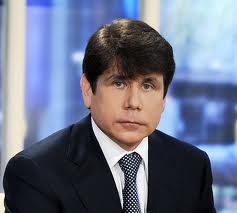
He was not charged with having a bad hairdro.
He was convicted in June of 10 counts of wire fraud and 10 other charges of extortion and bribery. Prosecutors had sought to put Blagojevich behind bars for 15 to 20 years. Under current guidelines, the Chicago Democrat will have to serve 85% of his sentence before being eligible for parole. There were three separate sentences, of 168 months, 60 months and 36 months, but Blagojevich will serve them concurrently.
OK. One conviction. How going after some of the bankers who committed fraud and securities violation during the subprime mortgage runup? such convictions would be far more important than going after poor, stupid Rod Blagojevich. What example does that set?
Boy, am I popular. This was the pile of catalogs I received last weekend:

The pile weighed 15.5 pounds and was five inches high — Coke can for reference. I felt sorry for all the trees who gave their lives for direct mail catalogs I didn’t buy anything from.
Many of the catalogs offer huge discounts, which I found strange so close to Christmas. I have one buying tip: If you will buy more than one of something, order only one. Wait till you get it. You’ll also receive a discount certificate, making your next purchases so much cheaper.
If you’re buying from a retail store (remember them?), ask about opening a store credit card. That will save you 15%. Ask about the coupons in the drawer under the cash register. They will save you another 20%. Don’t knock Harry’s Shopping Tips. Saving the money is almost as much as figuring all the ways to get the discounts. I got 35% off at Bloomies using these techniques.
AT&T rated worst cell phone carrier for second year in a row. This came from CNET News yesterday.
AT&T may be huge and generating boatloads of cash every quarter, but when it comes to service, the carrier has a lot of work to do.
For the second year in a row, AT&T was ranked last in Consumer Reports’ annual customer satisfaction survey. The company was hit especially hard by complaints over poor voice service and phone-based customer care. Even worse for AT&T, the company’s 2011 rating is slightly lower than last year’s.
Consumer Reports’ survey examines voice, data, and text-messaging service, as well as customer care. The specific ratings are available to subscribers.
So, who fared best? Believe it or not, it wasn’t a big carrier. Consumer Reports found that Consumer Cellular–an MVNO that uses AT&T’s network and focuses on senior citizens–topped the list this year. It was followed closely by regional carrier U.S. Cellular. Even Credo–an MVNO that uses Sprint’s network and donates to progressive nonprofits–beat out the big four.
“Our survey indicates that subscribers to prepaid and smaller standard-service providers are happiest overall with their cell-phone service,” Paul Reynolds, electronics editor for Consumer Reports, said in a statement. “However, these carriers aren’t for everyone. Some are only regional, and prepaid carriers tend to offer few or no smartphones.”
For major carriers, Verizon Wireless took the top spot in Consumer Reports’ study, earning high marks for texting and data service. Sprint and T-Mobile followed with slightly lower scores. Last year, Verizon also ended atop the Consumer Reports survey with Sprint and T-Mobile following closely behind. However, all three companies saw their scores drop this year, compared with last year’s figures.
AT&T’s customer service troubles aren’t solely a Consumer Reports finding. In July, the carrier earned the lowest score of 751 in a J.D. Power and Associates customer care study. Verizon Wireless took the top spot with a score of 770. …
DEAR ABBY:
I have always wanted to have my family history traced, but I can’t afford to spend a lot of money to do it. What should I do? — Sam in California.
DEAR SAM:
Register as a Republican or a Democrat, and run for public office. — Abby

Harry Newton who’s happy his vegan children are visiting this weekend. More delicious beans.


Wait, you gripe about all the junk mail and catalogs you get then suggest signing up to all kinds of promotions (e.g., store credit card) which will result in even more mail?
You obviously don't consider the value of your time in trying to cancel said credit card. Or in fielding their “surveys” and other solicitations on the phone.
You often mention that cash is king — but there's yet another reason why that is so: the anonymity it gives you.
I used the card once. I got a big discount. I paid the card off.I've received three catalogs,. No big deal to throw out. The card will expire by itself, especially if I don't use it.