Wall Street is a product machine. It creates what it can sell you. It has NO interest in the future of what it sold you.
Understanding this is fundamental to your dealings with Wall Street and protecting yourself and your few saved shekels.
Some of Wall Street’s new products succeed. Some crash and burn. Many destroy vast amounts of investors’ money. A few years ago, Wall Street invented something called an auction rate security (ARS). The pitch was that it was “as safe as a money market, but paying a little more interest.”
Brokers got paid a commission on the sale of ARSs, but didn’t get paid for putting their client’s money into money markets. Hence they had a real interest in pushing auction rate securities on their clients. It’s fair to say that none of the clients who bought the ARS nor the brokers who sold the ARS ever read the ARS prospectuses. The brokers simply believed what their bosses told them — safe as a money market.
The auction rate security market completely froze in February 2008. One day you could redeem your ARS for cash. The next day you couldn’t. You were stuck.
Some of us — I had some — got out of ARS and got our full money back. But many didn’t. And that’s the subject of yesterday’s piece by the Wall Street Journal’s Daisy Maxey:
For Many Auction-Rate Investors, the Freeze Goes On
By DAISY MAXEY, in the Wall Street Journal
Four years ago the market for auction-rate securities, an investment touted as safe and liquid, froze up. Four years later, despite various settlements and repayment efforts, many investors are still fighting for the return of their money.
All told, about $100 billion from individual and institutional investors remains outstanding in the former $330 billion market, according to SecondMarket, a broker-dealer and secondary market for illiquid assets. Auction-rate securities are debt instruments with interest rates that are meant to be reset periodically at auction.
As the uncertainty has lingered, investors have put off buying homes, expanding businesses or retiring. Others have stood by, their money on the sidelines, as financial markets made a tremendous recovery in the wake of the financial crisis and global recession.
Thomas Martin, president of Americas Watchdog, a private consumer group in Washington, said he has received phone calls from numerous investors still trapped. “Where’s the outrage?” he asked. “Here comes another spring and these poor people don’t know where their money is, what their retirement situation is; they’re forgotten. Where are the regulators?”
Municipalities, nonprofit hospitals, utilities, housing-finance agencies, student-loan finance authorities and universities were among the frequent issuers of auction-rate securities. Among the investors in the securities were corporations, charities and individual investors. Many purchased them on the advice of brokers, who touted them as a safe, liquid alternative to cash.
But in February 2008, the market froze amid the credit crunch. By the fall of 2010, dozens of big banks and brokerages that underwrote the offerings had repurchased billions of dollars of the securities in settlements with regulators. Since then, various brokerages have redeemed some securities in batches and some investors have won their money back via arbitration. But some banks and brokerages fell through the cracks or have been slow to cash out investors.
The situation is fraught for investors. Many of those who can afford attorneys have hired them because they faced a statute of limitations on filing arbitration claims. Others fear they’ll be placed at the end of the line in any redemption process should they speak out. Brokers who hold the securities in their own accounts fear losing their jobs if they discuss the issue.
The exit avenues aren’t appealing. Investors can sell the shares on the secondary market, but that generally means taking a sizeable loss. Investors may file an arbitration claim, and many have. But for those holding securities worth less than $1 million, it’s difficult to justify the costs, which can run to $100,000.
“It’s kind of a black hole now,” Mr. Martin said. “We’ve got retail investors, small-timers, then big commercial investors who are in these things for tens of millions of dollars, and we don’t know what’s happening to them all.”
Ed Dowling, the owner of a clothing maker in New York City, originally had about $2.6 million stuck in the securities and still has $1.175 million stranded, all of which were sold by Oppenheimer, a subsidiary of Oppenheimer Holdings Inc. “I think it’s absolutely foul and disgusting. I think the whole system is either broken or corrupt.”
For three big sellers of the auction-rate securities-Charles Schwab Corp., E*Trade Financial Corp. and BlackRock Inc.-accords were struck to unfreeze investors. While some securities remain outstanding at the firms, the terms of the wind-down have been set.
But investors who purchased shares from some firms, including Allianz SE ‘s Pacific Investment Management Co. or Oppenheimer, still have no explicit word on when or whether their investments will be redeemed.
Pimco and Nicholas-Applegate Capital Management-since rebranded Allianz Global Investors Capital-had $5.3 billion in auction-rate preferred shares outstanding in March 2008. About 44% of the shares issued by companies’ closed-end funds have since been redeemed. Pimco said it hasn’t made any redemptions since 2009.
Allianz told shareholders in a December letter that it’s evaluating market alternatives. It isn’t possible “to determine if and when a solution will be identified,” Allianz said at the time. Pimco had no further comment.
The issues at play are perhaps most acute at Oppenheimer, one of the largest sellers of auction-rate securities to individuals. It had about $377 million stranded in auction-rate securities as of Dec. 31, according to a regulatory filing by the company. That amount excludes securities owned by qualified institutional buyers and those transferred to the company, purchased by clients or transferred from the company to other securities firms after February 2008, it said.
Oppenheimer stands out among the major brokerages because its settlement with regulators didn’t result in a timely redemption for individual investors, said Todd Higgins, a managing partner at law firm Crosby & Higgins LLP in New York.
Oppenheimer reached settlements with the New York attorney general’s office-then led by current New York Gov. Andrew Cuomo-and the Massachusetts Secretary of the Commonwealth’s office in 2010, and purchased $69.3 million in auction-rate securities from clients. The settlement committed Oppenheimer to a financial review every six months to see if more funds are available buy additional auction-rate securities from holders. The company must report to the attorney general’s office on those reviews.
“That’s the only one that I’m aware of that’s ended up in a repurchase process that has the potential to drag on for many, many years,” said Mr. Higgins, who has represented about a dozen claims against Oppenheimer, five of which are pending.
Oppenheimer said it is purchasing the securities on a periodic basis in accordance with its settlements. The company noted that it is committed to purchase a total of $57.3 million in the securities from clients through 2016 and will pay about $2.5 million as a result of legal settlements with clients. Oppenheimer had no further comment.
Danny Kanner, a spokesman for New York State Attorney General Eric Schneiderman’s office, said, “This office is routinely scrutinizing the expenditures of the firm, which is conducting buybacks periodically throughout the year.”
Steve Cohen, former chief of staff to Mr. Cuomo, said, “The auction-rate-security settlements speak for themselves, putting billions of dollars back into the pockets of victims across the country who were misled into believing they were buying cash equivalent investments”
Investors say they fear Oppenheimer is waiting them out, hoping they will sell at a discount on the secondary market in desperation before any redemption comes their way.
Phillip Aidikoff, a partner in the law firm Aidikoff, Uhl & Bakhtiari, has represented investors in about 50 arbitration cases related to auction-rate securities since the market froze. Most have been resolved through regulatory settlements or settlements with broker-dealers, he said.
The settlement Oppenheimer reached with Mr. Cuomo’s office was “stunningly inept,” Mr. Aidikoff said. “It allows the broker-dealer to do whatever it wants to do.”
The market plunged 200 points yesterday. There were a thousand reasons — from war with Iran to slowdown in China. But no one knew definitely. And no one ever will. The key is to look at each of your stocks and ask two questions:
1. Are the trends right for owning this stock?
2. Does the chart look OK.
I’ve owned BHP for a while but lately there have been too many negative stories about the stock, and the chart looks awful:
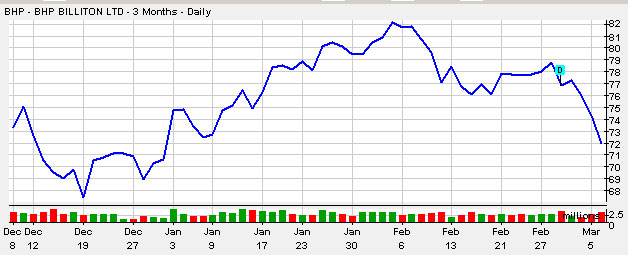
Hence I sold it.
I used to like 15% stop loss orders. Investors Business Daily likes 8%. I’m tending towards 5% to 6% today. This market remains squirrelly, though it has done well in recent months.My preference remains for dividend-paying stocks. The payments really add up.
Apple announces its newest iPad today. I’m guessing that will help the stock.
Preschoolers in Surgery for a Mouthful of Cavities. Send a copy of this disturbing article to all your friends with young children. This details what happens to young teeth when the parents neglect and indulge their kids. It’s frightening. Click here.

Harry Newton who doesn’t like to inject politics into this column, but is occasionally reminded of the fact that his parents fled the Nazis in 1939 and most of their friends and many of our relatives perished in the holocast that followed. This piece was originally published five years ago in March. It’s worth reading and perhaps passing on to your friends:
Why the Peaceful Majority is Irrelevant.
History lessons are often incredibly simple.
by Paul E. Marek, a second-generation Canadian, whose grandparents fled Czechoslovakia just prior to the Nazi takeover.
I used to know a man whose family were German aristocracy prior to World War II. They owned a number of large industries and estates. I asked him how many German people were true Nazis, and the answer he gave has stuck with me and guided my attitude toward fanaticism ever since.
“Very few people were true Nazis,” he said, “but many enjoyed the return of German pride, and many more were too busy to care. I was one of those who just thought the Nazis were a bunch of fools. So, the majority just sat back and let it all happen. Then, before we knew it, they owned us, and we had lost control, and the end of the world had come. My family lost everything. I ended up in a concentration camp and the Allies destroyed my factories.”
We are told again and again by experts and talking heads that Islam is the religion of peace, and that the vast majority of Muslims just want to live in peace. Although this unquantified assertion may be true, it is entirely irrelevant. It is meaningless fluff, meant to make us feel better, and meant to somehow diminish the specter of fanatics rampaging across the globe in the name of Islam.
The fact is that the fanatics rule Islam at this moment in history. It is the fanatics who march. It is the fanatics who wage any one of 50 shooting wars world wide. It is the fanatics who systematically slaughter Christian or tribal groups throughout Africa and are gradually taking over the entire continent in an Islamic wave. It is the fanatics who bomb, behead, murder, or execute honor killings. It is the fanatics who take over mosque after mosque. It is the fanatics who zealously spread the stoning and hanging of rape victims and homosexuals. The hard, quantifiable fact is that the “peaceful majority” is the “silent majority,” and it is cowed and extraneous.
Communist Russia was comprised of Russians who just wanted to live in peace, yet the Russian Communists were responsible for the murder of about 20 million people. The peaceful majority were irrelevant. China’s huge population was peaceful as well, but Chinese Communists managed to kill a staggering 70 million people. The average Japanese individual prior to World War II was not a war-mongering sadist. Yet, Japan murdered and slaughtered its way across Southeast Asia in an orgy of killing that included the systematic murder of 12 million Chinese civilians – most killed by sword, shovel and bayonet. And who can forget Rwanda, which collapsed into butchery? Could it not be said that the majority of Rwandans were “peace loving”?
History lessons are often incredibly simple and blunt; yet, for all our powers of reason, we often miss the most basic and uncomplicated of points. Peace-loving Muslims have been made irrelevant by the fanatics. Peace-loving Muslims have been made irrelevant by their silence. Peace-loving Muslims will become our enemy if they don’t speak up, because, like my friend from Germany, they will awaken one day and find that the fanatics own them, and the end of their world will have begun.
Peace-loving Germans, Japanese, Chinese, Russians, Rwandans, Bosnians, Afghanis, Iraqis, Palestinians, Somalis, Nigerians, Algerians and many others, have died because the peaceful majority did not speak up until it was too late. As for us, watching it all unfold, we must pay attention to the only group that counts: the fanatics who threaten our way of life.

It is very sad to see a significant increase in rampant caries among preschoolers, as confirmed in the NYTimes article today. One of the major problems is that parents give kids bottled water who contains no flouride. Snapple, juices and cola can cause cavities. I have seen so many kids consuming such drinks. Parents should bring their toddlers to the dentist or pediatric dentist as early as 18 months old! Parents with periodontal disease should have their kids on a regular recall to monitor any early stage of periodontal disease. It is very discouraging to see preschoolers undergoing general anesthesia for treatment of multiple tooth decay. Keep brushing and flossing!
What do you think about the new IPAD 3 coming out?
Dr Ekelman
Harry, thanks for the thought-provoking commentary today. As I emailed to you and just finishued blogging about myself, there is something seriously missing from your suggestion of “
It has NO interest in the future of what it sold you.” In particular, Wall Street wants to profit from your downside, either from shorting to bet against you (and their own products) or to wait for you to get antsy and dump your investments at a steep loss which presents Wall Street with an opportunity for more update. Make no mistake, Wall Street definitely “Has an interest in the future of what it sold you” — even if the broker or salesman or “sell-side” department that sold you the stuff is primarily interested in their own short-term commission stream.
Read more:
http://finaxyz.blogspot.com/20…
Keep up the good work.
— Jack Krupansky
P.S., As far as “the fanatics who threaten our way of life”, the real fanatics are those people who insist that you should distribute diatribes such as the one you distributed at the end of your post. They were the ones who were beating the war drums that took us into Iraq and Afghanistan and are desperately trying to drag us into Iran as we speak. I thought you were opposed to our involvement in Iraq and Afghanistan? If so, why aid and abet these people in their fear and warmongering?
Harry,
When I was about 10 I remember seeing when both parents had their teeth pulled at the age of about 30. I was told this was normal.
When in high school I remember going to school with crud on my teeth.
I was told it was normal for my gums to bleed when I (rarely) brushed my teeth.
My teeth were saved when I was drafted for Vietnam.
I'm now 66 with all but one of my regular teeth. (A molar cracked about 25 years ago.) And my gums don't bleed when I brush.
I grew up on a farm and we just didn't know about oral hygiene.
This story is very hard for even me to believe. But I know it's true. I wonder about the kids in your article.
Harry
I've followed your ongoing problems with ARSs with much interest and for a good reason. In 2008 I had power of attorney for my mother, and I had a portion of her assets in ARSs with TD Ameritrade. Unlike many investors I had actually read the prospectus on this type of paper and knew what would happen if it became impossible to roll the instruments over. I went ahead and purchased the ARSs anyway because such a freeze-up had only rarely and temporarily occurred, and I thought it an unlikely risk. And then one morning the Wall Street Journal ran a small story about Bristol Meyers. The company's treasurer had parked excess funds in ARSs to pick up a little extra return, and suddenly he wasn't able to get out of them. I immediately called the broker and instucted them not to roll over the ARSs in my mother's account. Fortunately all of this paper had a 7 day rollover, and my mother was out of them before the entire ARS market seized up 2 weeks later. Because I was a fiduciary for my mother, and had been warned by my lawyer friend to take this role very seriously, I was lucky enough to exit the ARSs without complications. Had these securities been in my own account, I'm afraid that my buy and hold mentality might have meant that I would still be stuck in them.Good luck to you and your readers who 4 years on still find themselves in just that situation.
Harry your last article on the silent majority sitting on the sidlines while fanatics “rule” is “right on”….history will repeat itself….Muslims and Hispanics will rule America…we have no authorities that want to keep America America….we have become feminized and nannified and far too “politically correct”…Our President could set the tone for our future for staying the America we came to love, but he chooses another course….
Careful, you sound like one of the hate mongering fanatics.
AMEN
Harry – I do not know what horrible and terrible experience(s) you have had with “Wall St” but your constant bashing and cynicism is boring already. You are absolutely INCORRECT when you say -“It creates what it can sell you. It has NO interest in the future of what it sold you.” That is rubbish. No business in the world can regularly and consistently burn its customers. If that happens customers move their business elsewhere. The engine of Wall St is capital formation. Corporations regularly come to Wall St to raise money thru stock and bond offerings. The money raised is to finance new plant and equipment, expand businesses, start new business, build roads, hospitals, water treatment facilities, etc. These stocks and bonds (other instruments as well) are sold to institutional investors (pension funds, mutual funds, money managers, hedge funds, insurance co's, banks) and sold to retail investors. If Wall St regularly “had no interest in what it sold” then they wouldn’t have a place to sell these securities and there would be no business. Wall St has a vested interest in making sure the instruments they market generally perform well so when they return to market they have a customer base ready to participate. If Wall St regularly burned investors they would have no success. Clearly the vast majority of instruments perform as designed and it is not the horrible scam you portray. Of course there are examples of deals gone bad but unlike your description, it is not a regular occurrence. Grow up and stop complaining. You became a rich man by working the very system you now bash.
And if you have such a problem with Goldman Sachs then close your accont and move your money – or stop compalining.
No question it's boring. And clearly Wall Street does occasional good work. And no question that my muni bonds have done really well recently. But we all need to be reminded regularly of the pitfalls. Let us not forget the Wall Street involvement with sub prime mortgages, their securitization, CDAs, and all the other stuff that nearly brought the entire house down in 2008. And let us not forget how much of our taxpayer money went to saving the very firms on Wall Street that caused it all — with the single exception of Lehman Bros.
But changing the subject, what are you investing in these days? Have you found something you're willing to talk about?
Investguy – what century do you live in? Wall St is good for Wall St and not much else. What you describe is what Wall St USED to do. Companies went to Wall St to raise capital in order to fund their growth and expansion thus creating jobs. Now, Wall St looks at those companies as nothing more than piggy banks. I am not saying that Wall St should not profit from what it does. However, I am saying that it's interests are now ONLY to profit from anything it peddles even when it knows it is peddling worthless crap. Remember the internet bubble? Who do you think pushed that to the public wrapped to look pretty to the public? Who profited and who lost? How do you peddle countless companies' stocks that represent ownership of nothing more than thin air packaged as a high growth online company that in some cases never sold a dollar's worth of anything? If you look around, it is actually true – Wall St never sells anything it loses money on. In the rare instance they are put in that position, they always have someone else cover their losses – be it the taxpayers or another shell creation of theirs that will pass on the loss to “believers” of Wall St.
And lets not forget that when pharmaceutical companies need to raise money for research and development to cure diseases they come to Wall St to float a bond, do a stock offering, or private capital raise. When an industrial company (steel, paper, chemical, railroad,) needs money to expand, modernize and renovate they come to Wall St to raise money thru stock and bond offerings. Apple computer, Intel, Microsoft, Cisco, and all the social networking companies that have transformed our society would not exist in their current state and could not have grown to have the positive impact had it not been for Wall St. Harry – you regularly extol the virtues of so much technology that you love. Those companies could never get to the mass production and mass marketing stages they currently enjoy without Wall St. So instead of focusing on the bad (credit default swaps, mortgage bonds, junk, etc) why not focus on the good. There is so much more good than bad that has improved things around the world. That is the century I live in. What about you “The Skeptic”. You communicated via your computer, using software, over the internet, on broad band. All of those functions required Wall St. Not so bad – huh.
Billtoomy – I stated that Wall St USED to do that. In fact, that was the “purpose” of Wall St's being – to help raise capital for businesses who needed it. However, it is an undeniable fact that raising capital for businesses is no longer the main focus of Wall St. That has been replaced by the focus on short term profits which does more damage than good to everyone except Wall st. It is that focus that has given rise to the Hedge Funds, arbitrage, and many others that simply exist to squeeze as much profit in the shortest time possible without adding much, if any, value to the market, businesses, or society in general. Understandably, when the IPO market died they had to figure out ways to create income. They have the resources to create, market, and sell the daylights out of just about anything new. As for the technological advances I use daily, I thank the entrepreneurs who created those companies not Wall St. If anything, they turned those wonderful companies into corporate entities purely focused on pleasing “the market” i.e. Wall St. so that their stock prices do not get hammered. Just do some research and find out what those company founders say about the choice of not going public – most, if not all, of them are glad they did NOT go to Wall St, with hat in hand as they are now FREE to create as they see fit with a focus on their customers, not next quarter's earnings report.
Investguy– I agree with Harry 100%. I have always had to watch brokers to keep from being walked into products with high fees. I was stuck in ARS's also even after much research before I bought them. Sold to me as safe as CD's just not backed by the US gov. They were backed 100 % by the brokerage firms. When Feb 2008 the ARS market shut dwn my broker called me & told me about it & not to worry. My money was still there but I just couldn' get it. One year later , after many calls, my broker said he didn't worry about things he had no control over & hung up on me. I drew all my money out & have never used a broker since.