I’m short — RSH, RIMM and DELL. They’re all down, but DELL is only down a little. I have faith. I heard Michael Dell intone on bubbleivsion (CNBC) “We regard ourselves as an end-to-end solutions provider.” I laughed. I noticed Dell just bought a security company. When the desperate can’t innovate, they buy other people’s innovations at vastly-inflated prices.
Apple is skyrocketing, as usual. When the new iPad was released, I wrote here that its features would appeal strongly to businesses — hence opening up a total new and potentially huge market for Apple. This morning I read on 24/7Wall Street Wire:
The new iPad from Apple Inc. (NASDAQ: AAPL) may not have a catchy new name, but it definitely has plenty of appeal. A recent survey by ChangeWave Research indicates that 22% of companies plan to buy tablet devices for employees during the second quarter of 2012. Of those buyers, a staggering 84% plan to buy an iPad, a gain of 7% since the last survey in November.
Those new buyers have to come from somewhere and, in this case, they are coming from potential buyers of tablets from other manufacturers. Samsung Electronics (OTC: SSNLF.PK) gets 8% of new buyers, Amazon.com (NASDAQ: AMZN) gets 6%, and Hewlett Packard Co. (NYSE: HPQ) gets 4%, all down 2% from the last survey. Other makers get even smaller shares.
Read the rest of the report — here.
We rented a Ford Edge from National. It’s a remarkably good car, oops SUV, oops crossover, oops whatever.
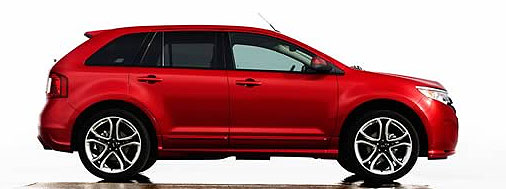
This photo is from Ford’s web site. It basically looks like every SUV/crossover thingee on the road. That’s not an indictment, just a fact.
What’s most impressed me about our Ford Edge:
+ Its ride. It doesn’t feel as though it’s going to tip over every time I turn a corner — unlike other SUVs I’ve driven in the old days.
+ Its logic. Someone has actually thought through what a car should contain — from a rear camera to Bluetooth for synching my iPhone, from a new touchscreen to a host of inputs for pumping my own music into the car’s sound system.
+ Decent fuel economy. I haven’t measured it but we seem to be able to go over 200 miles before we need to fill it up (with, mercifully, regular gas).
+ There’s plenty of room and the seats are comfortable. Even Rosie (our 13-lb spoiled Havanese dog) can sleep while I drive. That’s amazing, because Susan, my wife, is in perpetual terror.
+ The price is reasonable. I think we could buy the one we rented for around $30,000.
This is the first time in 30 years I’d really consider buying an American car. Something has changed. They’ve begun to make cars customers like.
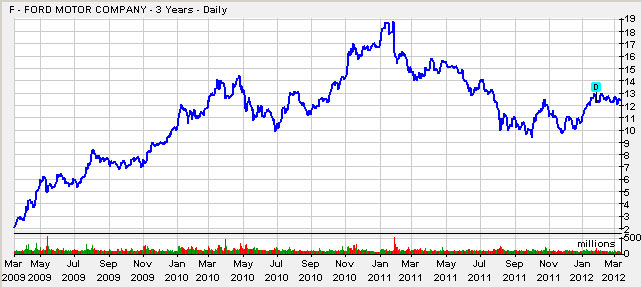
I’m even attracted to Ford’s stock, which could benefit by the pent-up demand for cars — (see James Surowiecki’s article below):
I love shopping: Susan says I don’t get out enough. Here’s my latest “discovery.”
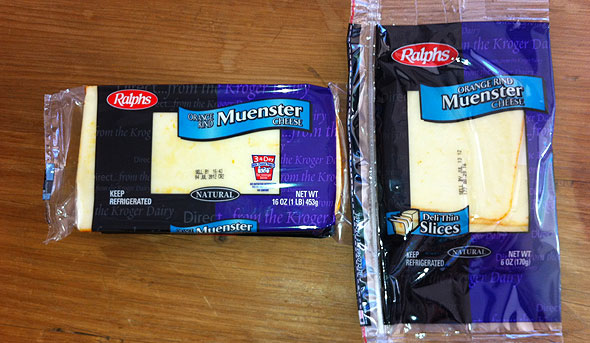
The left package is 16 ounces of hunk muenster cheese. The right is 6 ounces of sliced muenster cheese. Both cost the same in the local supermarket — $2.99 a packet. That means you get 2.7 times as much cheese in a hunk. Having them slice it is hideously expensive.
I research this because Rosie (our dog) and I love muenster.
Some Dos and Don’ts About Leverage, Simply Put. This piece by Paul Sullivan of the New York Times is about borrowing money. Personally, I don’t like borrowing money and only borrowed once on a mortgage and paid it off the following year. This article has me thinking that maybe I’m stupid. Here’s Sullivan’s piece:
I RECENTLY came across a report on the value of taking on some debt that was so simply worded and straightforward that I was startled. Those types of reports, typically, are anything but easy to understand. They’re also usually trying to sell something that is complicated.
But then, I wondered about the need for the report, “Leverage: A Thoughtful Approach,” part of a series from J. P. Morgan Private Bank called “Managing Wealth in a New World.” Have even the very rich become so averse to debt, or leverage as it’s called in financial jargon, that they need a primer?
The answer, it appears, is yes. And that is not necessarily a good thing. Debt, after all, allows you to keep cash on hand. On a more complex level, it can allow you to increase your investment returns without taking excessive risks.
When I called the writer of the report, Phil D. Conway, the United States head of capital advisory at J. P. Morgan Private Bank, he confirmed that his aim had been simple. “All we were trying to do with the paper was to get people to think rationally about debt and not irrationally,” Mr. Conway said. “There is a healthy way to think about leverage, and that’s what I wanted to do with the piece.”
He said he realized that most people had either a fight or flight mentality toward debt. “It’s sort of like being at an all-you-can-eat buffet,” he said. “People gorge themselves when times are hot and then they say they’re never eating again until they get hungry. Then guess what? They gorge themselves again.”
To continue the analogy, J. P. Morgan and other banks are not about to throw open the doors of the buffet to everyone, and they will make money from lending money to a group of people they are confident can pay it back.
But what interested me was finding the more rational ways that people are using debt. This is not an issue just because interest rates are at historic lows. Instead, there are costs to paying cash for everything and putting money in low-yielding bonds. Here are some of the advisers’ thoughts on debt that struck me.
EXTREME CAUTION For the average person, debt is a mortgage, car loan or credit card balance. For the wealthiest, debt can be money borrowed to increase investment returns, and it goes by the fancier name of leverage. The goal is to get a return higher than it costs to borrow the money.
John C. Bailey, the founder and chief executive of Spruce Private Investors, which manages $3.2 billion for a group of ultra-affluent families, said his clients were particularly cautious about any leverage today.
“There are two areas where clients have levered historically,” Mr. Bailey said. “Only one of them has worked out.”
That one way is borrowing to buy commercial real estate. His clients continue to do that, but they are putting more money down.
Borrowing has not worked out, he said, when people have used the money for illiquid investments like hedge funds that are already leveraged. “Leverage on leverage never ends well,” he said.
Leverage, after all, not only multiplies returns on the way up, it also quickly compounds losses on the way down.
As to household debt, the advisers said their shrewdest clients were paying that down to levels that were psychologically comforting, if not rational.
John M. Verfurth, managing director at VWG Wealth Management, a division of HighTower, said clients had paid down mortgages to less than $1.1 million, which is the limit of where mortgage interest can be deducted.
And that is true even among people of higher income levels, where the deduction gets phased out.
“Some people just brought it down to $1.1 million, even though they’re losing a part of the deduction once their income goes over $200,000,” Mr. Verfurth said. When the income stretches into the millions, as much as 80 percent of the deduction gets phased out.
THE BLINDNESS OF LENDERS At the same time, many more people are taking on more risk than they may realize.
The other side of borrowing money is lending it, and that is what the millions of people who have bought United States Treasuries have done. Being a lender to the federal government carries risks if inflation increases or the economy improves enough that people start selling their Treasury bonds to get higher yields elsewhere.
“What we’re telling our clients is it’s an incredibly dangerous time to be a lender, particularly to the U.S. government because rates are at historic lows,” said Joseph J. Duran, chief executive of United Capital Financial Partners. “If the economy picks up steam and we get any inflation, it will have a huge impact on returns.”
Mr. Duran said his firm had completed a study that showed that 1 percent increase in yields on 30-year Treasuries would result in an 18 percent loss in the value of the bond. He added that Treasuries were 3 percent below their historic average yields.
Of course, such advice, built on simple math, can go unheeded when investors remain scared about other options.
“I have clients who are 100 percent in fixed income and who still want to bury their money in the backyard,” said Seth J. Finkel, managing director at Neuberger Berman Wealth Management. “Often, I have to explain the risks of being a lender. You used to be able to get safety and income, but now you choose one or the other.”
GOOD BORROWING In the end, I found two areas where a little debt, judiciously applied, can be beneficial.
The first is a way to get slightly higher returns without taking on considerably more risk. Mr. Conway gave an example of borrowing 30 percent against $1 million in bonds with two- to three-year maturities so the investor had $1.3 million invested. “My yield could go from 7.5 percent to a little over 8 percent with a modest increase in volatility,” he said. “That’s a better way to get increased return than going down to buying junk.” That may not sounds like a big return but he argues that it is a safer way to increase yields than buying riskier investments.
The other use is for personal needs, and that is through a margin account. While no one is recommending you borrow $105,000 against your bond portfolio to buy a Mercedes SL500, borrowing against a securities portfolio can be an easy and low-cost alternative to taking out a bank loan for a mortgage or business investment.
“A bank may not want to lend $2 million on a $3 million house, but Schwab, who is our custodian, will lend $2 million on a $4 million account at 2 to 4 percent in a few hours,” said Marc Singer, founding partner of Singer Xenos Wealth Management. “It’s so cheap because the loan is 100 percent securitized and 100 percent liquid. A bank may not want to put that big of a loan on its books.”
If a portfolio is earning 5 to 6 percent and a bank will not lend to you, then borrowing against your own money at 3 percent is perfectly rational.
Of course, being a rational investor is not always easy. “You could say I’m comfortable with a stock like Apple, but I bet you could get less volatility in a leveraged bond portfolio,” Mr. Conway said.
And volatility, or how much any investment swings up or down, is probably going to determine whether you stick with it.
For the piece, click here.
The American economy is coming back. Here is the latest piece by my favorite New Yorker business writer.
Great Expectations
by James Surowiecki
The story of America’s recovery from the recession has been one of dashed hopes. In early 2010, and again early last year, the economy looked as if it might be starting to grow under its own power, only to slow markedly in the months that followed. So what should we make of the current signs of rebound? The employment report for February, which came out last week, was solid, meaning that businesses have created more than two hundred thousand jobs a month for three months in a row. Economic data show that the economy, and real incomes, grew at a fine clip at the end of 2011. And unemployment, while still painfully high, has fallen a full two points from its peak. Bitter experience might suggest that we regard these numbers with a jaundiced eye. But there are at least a couple of reasons to think that, this time, we aren’t looking at a false spring.
One good sign is that Americans are buying new cars again. That’s a major shift: annual new-car sales fell from a pre-recession peak of seventeen million to just 10.4 million in 2009, a thirty-year low. And, though the economy began to recover, auto sales didn’t. Credit was hard to come by, and even people with jobs were wary of making big purchases. So people bought used cars, or just repaired the vehicles they had. It’s no coincidence that the stock prices of auto-parts stores, like AutoZone, have risen in recent years. But the result of this is that the age of the average American car has kept going up, too; last year, the average car on the road was eleven years old-an all-time high. This means that there is a lot of pent-up demand for new cars, and there are signs that potential demand is starting to translate into active demand. New-car sales began to rebound over the winter, and last month they jumped sharply, up almost sixteen per cent from the previous year. Even if that figure was an outlier, at the current sales rate factories will soon be running at ninety per cent of capacity, which suggests that more demand will lead to more jobs. Indeed, in the past year automakers, and auto-parts makers, have added forty-five thousand workers. And, while Detroit is much smaller than it once was, the auto industry remains a huge business-many “foreign” cars sold in the U.S. are actually made here-so its return to health will have ripple effects across the economy.
There’s an even more important source of pent-up demand, though: all the young adult Americans who have spent the past few years living with their parents. Perhaps the most striking feature of this economic downturn is the way it changed the rate of household formation. Between 1947 (when the government first started collecting data on the subject) and 2007, the number of households in the U.S. rose every year, closely tracking population growth. This recession dramatically broke the trend. In 2008, 2010, and 2011, the number of households dropped, even as the population continued to grow. As Gary Painter, an economist at U.S.C., has argued, the decline in household formation was largely a response to the slow economy and soaring unemployment among the young.
The dwindling number of new households, which the economist Scott Sumner has called a “demographic depression,” isn’t just a result of the weak recovery; it has also been a major cause. We rely on new households to help drive economic activity, in part through the construction of new homes. But, this time around, construction, which normally leads the way out of recession, has been a drag on the economy. While overbuilding during the housing bubble bears some of the blame, so, too, does the lack of new households: when people are doubling up, there’s little demand for owning or renting. This hurts not only the construction industry but all the businesses that make the products that you put in new homes. Spending on durable goods-washing machines and the like-has been very weak over the past few years.
That’s the bad news. The good news is that when this trend reverses there will be a spike in demand, both for housing, especially rentals, and for all the stuff that you put in a house. Some pessimistic observers argue that this reversal will never happen, and that the U.S. will become more like European countries-Italy, say-where living at home until one is older is more common. But it’s easy, during a crisis, to mistake a cyclical change for a permanent one, and surveys show no evidence that young Americans are more interested in living with their parents now. Painter’s study of past recessions shows that, in the past forty years, household formation has slowed notably during downturns but has rebounded as the unemployment rate fell. It seems much more likely that the same will happen this time around than that American aspirations and social norms changed overnight in 2007.
Of course, there’s still a lot that can get in the way of recovery. High oil prices or rising rents could lead the Federal Reserve to overreact and tighten monetary policy prematurely. Europe’s troubles could spill over into the U.S. Political concerns could produce cuts in government spending. And the housing bust put the economy in such a big hole that we have a long way to go before the job market is healthy again. But if the recession was a vicious cycle-in which shrinking demand led to layoffs and wage freezes, which led to shrinking demand-we may finally be seeing the signs of a virtuous one.
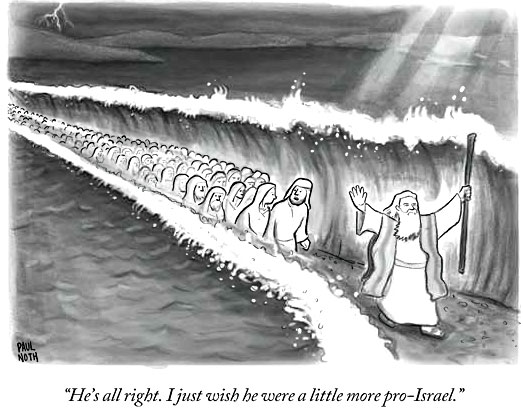
Favorite recent New Yorkers cartoons:



Harry Newton who’s watching the Indian Wells tournament on The Tennis Channel. Tennis is a mini-metaphor for life, and for investing. You can be down a set and several games — looking like it’s all over — then come roaring back with sheer determination, gutsiness and grit. Most of us are still scratching back from the devastation of 2007-2008. Clawing back. Not easy. But it can be done. Just like Caroline Wozniacki did last night.

She may win this tournament. Caroline’s got more determination than most others.

So, which is better a Subaru Outback or the Edge? I have been looking at both. However, the Ford Focus SEL hatchback has caught my eye since it would give me a little extra room and 38 MPG!
My Lexus IS-250 doesn't look like a crossover or a SUV and gets over 30 MPG…rides nice too!
Harry, I have made more money in real estate than I ever did working and every bit of it was on Bank Money. I love interest free credit cards and spent several years (days gone by) borrowing money at zero per cent and lending it out at 12%. I just bought an AZ condo on my credit card, 13 months zero interest (4% fee which is like 4% flat interest) of course I have the income plus funds to back it up.
Excellent. My compliments. As the article points out, intelligent use of borrowing (as you have done) can be more profitable.
My Honda Crosstour doesn't look “like every SUV/crossover thingee on the road.”