I wish I owned more Apple.
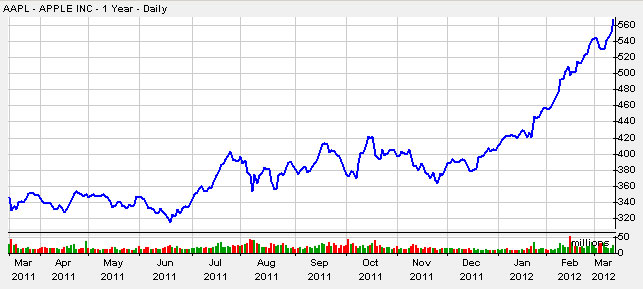
Actually, thinking on that, I think I’ll buy some more today. Apple’s P/E is still only 16.18.
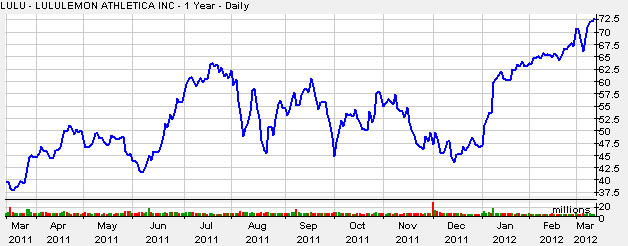
As an absurd comparison, which would you rather have Apple at 16.18 or Lululemon with a P/E of 68.12?
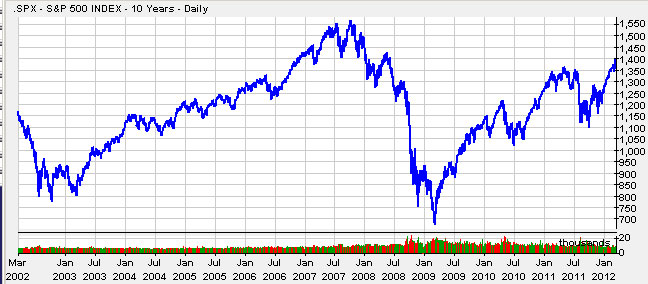
I don’t know how long this present little stockmarket boomlet will continue, but it’s worth noting that we’re not back to the peak of October, 2007. And fortunately, we’re not facing the financials winds at that point.
To mark SmartMoney’s 20th anniversary, the magazine looked at the 10 best performers in the stock market since the magazine was founded in April 1992. They are:
#10: Astronics, This commercial aerospace supplier makes things like the TV screens that fit on the back of airplane seats, or the power outlets that let travelers plug in their electronics in flight.
Total return since April 1992: 6,004%
#9: Celgene Corporation. This biotech firm’s success is mostly due to the drugs it makes for treating a type of blood cancer called multiple myeloma.
Total return since April 1992: 6,244%
#8: Biogen Idec. The growth of this biotech stock hasn’t been quite as steady as Celgene’s, but shares have doubled since 2010. The company is best known for its multiple sclerosis drugs, Avonex and the newer treatment Tysabri. The recent run-up in the shares is largely due to unexpectedly good clinical data on a new pill (instead of an injectable treatment) for MS,
Total return since April 1992: 6,334%
#7: Diodes. Twenty years ago, this company simply distributed semiconductors. In the late 1990s, they became the exclusive U.S. distributor for a manufacturer called Lite-On, and then used the cash from that business to expand into manufacturing their own semiconductors,
Total return since April 1992: 8,601%
#6 Oracle. Back in March 2000, a Morningstar analyst wrote: “While Oracle’s (ORCL: 30.13, 0.42, 1.41%) long-term positioning in the enterprise software market is second to none, its share price already reflects unbridled optimism.” Sure enough, the company’s stock actually peaked in 2000, rising to about $45 a share. It’s recovered steadily since the dot-com bust, but at nearly $30 a share, it’s still not all the way back. CEO and co-founder Larry Ellison has been with the firm since 1977, and he’s led the firm to develop what Morningstar analysts call a “wide moat” — a sustainable competitive advantage. In recent years, the firm has been growing through acquisition, including scooping up some software-as-a-service firms.
Total return since April 1992: 8,571%
#5 Qualcomm. This chipmaker also peaked in 2000, at roughly $75 a share, although it’s since climbed back to about $62 a share today. “Qualcomm has done exceptionally well,” says Vijay Rakesh, an equity analyst at Sterne, Agee & Leach. The company developed a technology called “code division multiple access,” or CDMA, a key part of wireless networks. The many patents it holds on this technology allow it to collect royalties from almost every mobile handset maker. Qualcomm (QCOM: 64.85, 1.00, 1.57%) also supplies chips for many mobile phones, including the iPhone, and the more-complicated chips it makes allow it to command higher profit margins than a company like Diodes. “Everything is going to a mobile, always-on kind of environment,” and Qualcomm has been and should continue to be a major beneficiary of this trend, Rakesh says.
Total return since April 1992: 9,232%
#4 EMC Corporation. Another tech firm that fell hard after the dot-com bust, EMC Corporation’s shares were actually worth more than three times their current price of $28 in 2000. But this data-storage firm has been able to maintain a strong competitive position in a rapidly changing industry. Back in 1999, a Morningstar analyst noted that “the Internet is fueling a huge increase in the demand for data storage, since every mouse click on the Web creates a nugget of data that companies want to be able to store and analyze.” EMC Corporation (EMC: 29.62, 0.59, 2.03%) took an early lead in this growing market, and Morningstar analysts are still crediting the firm’s “desire and ability to remain at the forefront of the technology curve.”
Total return since April 1992: 9,624%
#3 II-VI. “Two-Six” primarily sells components for lasers called “optics.” Optics are like razor blades — a key part of the overall equipment that regularly needs to be replaced, says Mark Douglass, a senior equity analyst with Longbow Research. The use of lasers in industrial manufacturing has grown multiple times faster than GDP since the 1990s, so “they were basically riding the wave,” Douglass says. II-VI (IIVI: 23.79, 0.65, 2.81%) is also well-regarded within the industry, command roughly 50% of the market, and have historically had high margins, he says. “Investors love those kinds of stories, where you have a high degree of replacement demand, where you have strong growth, obviously, and you have a defensible market position, so you can get high margins,” Douglass says.
Total return since April 1992: 10,423%
#2 Middleby. Most of this commercial cooking equipment manufacturer’s growth has been concentrated in the past decade. Middleby (MIDD: 99.42, 1.56, 1.59%) makes ovens and other equipments for restaurants, but “it’s probably more of a technology company than an industrial or equipment company,” says Anton Brenner, an equity analyst with Roth Capital Partners, LLC. “It’s the most innovative company in the industry,” Brenner says. They regularly add new labor-saving features to their equipment, he says. They’ve also grown through M&A: The stock really took off after Middleby merged with Blodgett, a division of Maytag that also made commercial cooking equipment. They’ve also acquired several other smaller companies since then, and recently they’ve been growing their international business, Brenner notes.
Total return since April 1992: 14,330%
#1 Kansas City Southern. Aside from falling along with the rest of the market in 2008 and 2009, this stock has been climbing steadily since the late 1990s. But back then it looked a little different. “It was a conglomerate, and it was a weird conglomerate: It was a railroad and a money management firm,” explains Morningstar’s Larson. In 2000, the money management firm was spun out into a separate entity, now trading as Janus Capital Group (JNS: 9.16, 0.41, 4.69%) . “At the point of the spinoff, it was the money-management firm where the value was, not the railroad,” Larson says. But Janus’s stock has fallen 78% since the spinoff, while Kansas City Southern (KSU: 71.38, 2.65, 3.86%) has climbed another 1,051%. Back then, Kansas City Southern’s profit margins were lower than the railroad industry average, but its tracks run into Mexico, so it’s benefitted from NAFTA-fueled cross-border trade. Profit margins are now closer to industry norms. Clearly, that turnaround story has already rewarded patient investors, but Morningstar analysts believe that its best days are still to come.
Total return since April 1992: 19,030%
If you own a credit card you should read this: This is Matt Taibbi’s latest blog post:
In a story that should be getting lots of attention, American Banker has released an excellent and disturbing exposé of J.P. Morgan Chase’s credit card services division, relying on multiple current and former Chase employees. One of them, Linda Almonte, is a whistleblower whom I’ve known since last September; I’m working on a recount of her story for my next book.
One of the things we were promised by the lawmakers who passed the Dodd-Frank reform bill a few years back is that this would be a new era for whistleblowers who come forward to tell the world about problems in our financial infrastructure. This story now looms as a test case for that proposition. American Banker reporter Jeff Horwitz did an outstanding job in this story detailing the sweeping irregularities in-house at Chase, but his very thoroughness means the news may have ramifications for Linda, which is why I’m urging people to pay attention to this story in the upcoming weeks.
The Cliff’s Notes version of the story goes something like this: Late in 2009, Chase’s credit card services division sold a parcel of nearly $200 million worth of credit card judgments to a debt collector at a discount. This common practice in the credit-card industry is a little like a bookie selling the outstanding debts of his delinquent gamblers to a leg-breaker for 25 cents on the dollar. If the leg-breaker gets half the delinquents to pay, the deal works out for both sides — the bookie gets 25 percent of money he wasn’t going to collect, and the leg-breaker makes a 100 percent profit.
In the case of credit cards, of course, you’re selling the debts to collection agents, not leg-breakers, but aside from that unpleasantly minor distinction the process is the same. The most valuable kinds of sales in this world are sales of credit card judgments, in other words accounts in which the debtor has already been successfully brought to court. That, ostensibly, is what this bloc of accounts Chase sold in 2009 involved.
Almonte came to Chase in the summer of 2009 as a mid-level executive in the credit card services division’s offices in San Antonio, and was quickly put in charge of preparing the documentation for this enormous sale of credit card judgments. When Chase regional offices from places like southern California and Illinois began sending in the papers for these “judgments,” Almonte very soon found out that something was seriously wrong. From Horwitz’s piece:
Nearly half of the files [Linda’s] team sampled were missing proofs of judgment or other essential information, she wrote to colleagues. Even more worrisome, she alleged in her wrongful-termination suit, nearly a quarter of the files misstated how much the borrower owed.
In the “vast majority” of those instances, the actual debt was “lower that what Chase was representing,” her suit stated.
Linda subsequently found an enormous range of errors. Some judgments, she told me, were not judgments at all. In some cases, she said, Chase actually owed the customer money.
When she brought these concerns to her superiors, what do you think their response was? They told her and others to shut up and just sell the stuff anyway. Her boss, Jason Lazinbat, allegedly told her “she had better go along with the plan to sell the misrepresented asset.”
Think of the consequences of this: because Chase was so anxious to make money off this debt sale, countless credit card borrowers would now have collection agents chasing them for money they did not owe. The debt-buyer, too, was victimized by being sold accounts it could not collect on. It is almost impossible to estimate how many man-hours of pointless court proceedings would be lost because of this decision.
Anyway, when Linda refused to go along with the sale, she was fired. This was in November of 2009. She then went through a post-firing odyssey that is an epic tale in itself: her many attempts to get any of the major bank regulators interested in this case were disturbingly fruitless for a long time (although the Office of the Comptroller of the Currency is apparently looking into it now), and she struggled to find work in the industry.
She has been repeatedly harassed and has gone through all sorts of personal hardship as a result of this incident. She filed a whistleblower claim with the SEC as part of the new whistleblower program created by Dodd-Frank, but so far there’s been no progress there.
When I met Linda last year, my first reaction to her story was that I was skeptical. The tale she told went far beyond the bank knowingly selling millions of dollars worth of errors into the financial system. She also recounted, firsthand, the bank’s elaborate robosigning operation, which Horvitz, talking to other Chase employees, also discussed:
“We did not verify a single one” of the affidavits attesting to the amounts Chase was seeking to collect, says Howard Hardin, who oversaw a team handling tens of thousands of Chase debt files in San Antonio. “We were told [by superiors] ‘We’re in a hurry. Go ahead and sign them.'”
And there were other stories…suffice to say that the picture Linda painted of life inside Chase reminded me a little of Upton Sinclair’s The Jungle: they were putting just about everything into those sausages. When I was writing it all up for my book I went through a period where I was waking up nights, seized with the urge to close every credit account I had – her story makes you think that most credit card companies are essentially indistinguishable from giant identity theft operations.
Again, though, when I first heard the story, I was skeptical – until I found other people in the company who verified Almonte’s account, all the way down the line. Horvitz, too, found numerous employees in Chase’s credit card services division who confirmed the story of the company knowingly selling a mountain of errors into the market, and manufacturing robo-signed documents to the tune of thousands per week.
The financial crash wouldn’t have happened if even a slim plurality of financial executives had done what Linda Almonte did, i.e. simply refuse to sign off on a bogus transaction. If companies had merely upheld their own stated policies and stayed within the ballpark of the law, none of these messes could have accumulated: fraudulent mortgages wouldn’t have been sold, families wouldn’t have been foreclosed upon based on robo-signed documentation, investors wouldn’t have been duped into buying huge packets of “misrepresented assets.“
But most executives didn’t refuse to go along, precisely because powerful companies make it so hard on people who come forward. Almonte, after being fired, entered into a modest settlement with Chase that prohibited her from coming forward publicly. At the time she entered into the settlement she was in an extremely desperate state, and she made a bad decision, taking a very bad deal.
Still, like Jeffery Wygand, the tobacco scientist from the movie The Insider, she was sitting on top of a story that, morally speaking, should not ever be protected by a confidentiality agreement — and the subsequent lack of regulatory action eventually moved her to speak out to people like Horvitz and me. Of course, now that her story is out there in public, the concern is that the bank will move swiftly to take her to court.
This person does not have any money, so an action by Chase at this point would be purely punitive, to send a message to future whistleblowers. They’ll be more likely to do it if they think no one is paying attention. I’ll keep you posted on that score.
In the meantime, please check out Horvitz’s piece. It should give everyone who has a credit card pause.
To read the American Banker article, click here.
Why I Am Leaving Goldman Sachs By GREG SMITH
TODAY is my last day at Goldman Sachs. After almost 12 years at the firm – first as a summer intern while at Stanford, then in New York for 10 years, and now in London – I believe I have worked here long enough to understand the trajectory of its culture, its people and its identity. And I can honestly say that the environment now is as toxic and destructive as I have ever seen it.
To put the problem in the simplest terms, the interests of the client continue to be sidelined in the way the firm operates and thinks about making money. Goldman Sachs is one of the world’s largest and most important investment banks and it is too integral to global finance to continue to act this way. The firm has veered so far from the place I joined right out of college that I can no longer in good conscience say that I identify with what it stands for.
t might sound surprising to a skeptical public, but culture was always a vital part of Goldman Sachs’s success. It revolved around teamwork, integrity, a spirit of humility, and always doing right by our clients. The culture was the secret sauce that made this place great and allowed us to earn our clients’ trust for 143 years. It wasn’t just about making money; this alone will not sustain a firm for so long. It had something to do with pride and belief in the organization. I am sad to say that I look around today and see virtually no trace of the culture that made me love working for this firm for many years. I no longer have the pride, or the belief.
The full devastating article is in today’s New York Times. Click here.

Harry Newton who points all his readers to the excellent tennis from Indian Wells, California (where he is staying at present) now showing on the Tennis Channel.
I no longer eat much meat. But last night’s steak from Costco was truly delicious. Rosie loved it also.

Harry-gotta love the Smith comments on GoldmanSquid……isnt it great how some GS employees called their clients “Muppets”?…..most likely the institutional side of things but when they had HNW group I wonder if they called retail clients that too??…so the question has to be going around if you were a former or current GS client what Muppet would you be? and why?
After 12 years at Goldman Sachs it sounds like Greg Smith has decided that integrity does matter. He seems to believe that the culture at Goldman is derived from the top on down. Clearly he doesn't believe that things are or will get any better in the future. I thought this simple phrase he wrote was quite tilling…”it is eroding”…..but then again that depends on what the definition of “is” …is.