There a zillion people who write regular newsletters on the stockmarket. Some are daily. Some are monthly. Some are forever bullish. Some are forever bearish. None are right all the time. But most have their moment in the sun. Richard Russell of Dow Theory Letters writes in his letter yesterday:
Older subscribers remember my comments during when the VIX trended lower and remained there for an extended period. The comment was, “After the calm comes the storm. I last said that towards the end of the year 2008, when it seemed that the VIX was stuck in the low (“no worry”) area month after month. Then came the storm, from the low VIX area, the VIX exploded higher to over-80 as the stock market crashed.
Note on the longer-term chart below that the VIX has been declining since late-1968. The VIX is now down to that area from where the VIX started its upward surge from is mid-2008 low. At this point I want to issue this observation again. “After the calm comes the storm.”
The latest VIX reading is 16.82. The VIX has been descending steadily from its high of over 80 in late-1980. This suggests that investors see almost no need to protect themselves from any forthcoming trouble. Periods of extreme complacency tend to be dangerous periods for investors and traders. And once again I’ll repeat what I’ve said many times before — “From out of the calm, comes the storm.” I think a storm is coming. At this juncture, bullishness, boldness, and optimism are all running high. And just as important, investors are not positioned for any trouble. The low level of the VIX tells us that.
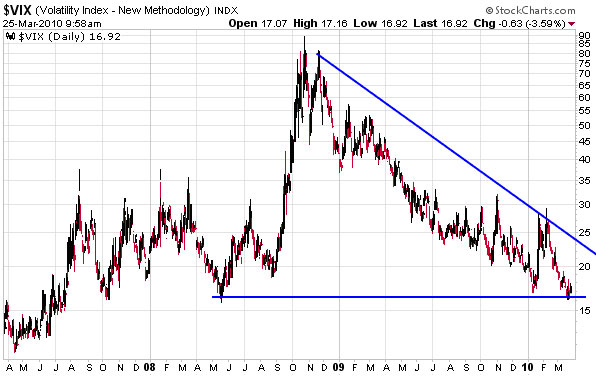
I did my own VIX chart (weekly).
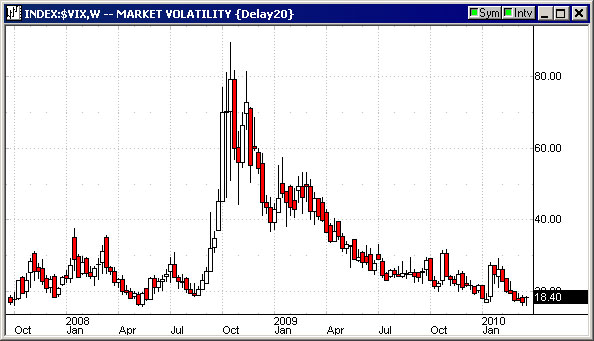
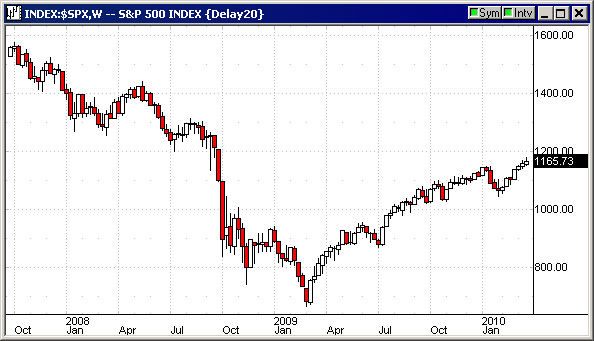
And I compared it to the S&P 500 Index. Is it a predictor or a reflector? Your guess is as good as mine or Russell’s — a traditional cautious bear.
Where housing prices have come and gone.
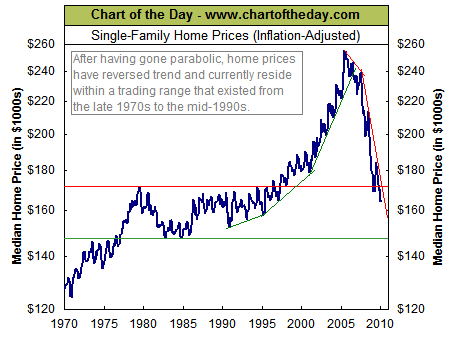
Here’s the comment from them:
For some perspective into the all-important US real estate market, today’s chart illustrates the US median price of a single-family home over the past 40 years. Not only did housing prices increase at a rapid rate from 1991 to 2005, the rate at which housing prices increased — increased. That brings us to today’s chart which illustrates how housing prices have dropped 35% from the 2005 peak. In fact, a home buyer who bought the median priced single-family home at the 1979 peak has actually seen that home lose value (4.3% loss). Not an impressive performance considering that over three decades have passed. It is worth noting that the median priced home has moved back to the top of a trading range that existed from the late 1970s into the mid-1990s.
Of course, you can’t bank “averages.” Real estate is a local phenomenon. We’re renting in La Quinta, California. Prices in our immediate community are down about 30% from their peak. However, next door at a Centex development called Legacy Villas, prices are down by 60%+, persuading an amazing number of homeowners to walk and forcing lots of properties into foreclosure.
Femtocells are the greatest gadgets in the history of the cell phone world. Verizon calls its a network extender. It’s a little $249 box which you plug into your home (or office) broadband connection. Presto, it becomes your very own mini-cell phone tower. When you’re home (or office) it recognizes your cell phone (and your family’s) and your calls go through it on your broadband connection. This has two benefits — a much stronger cell phone signal and louder, clearer calls.
With Verizon, calls — data or voice — that go through your broadband connection (i.e. through this device) don’t count as part of your Verizon wireless plan — so long as if you have their $69/month unlimited plan. The others do. Ditto for AT&T’s similar gadget.
This is the Verizon gadget. Samsung makes it. I like Samsung stuff.
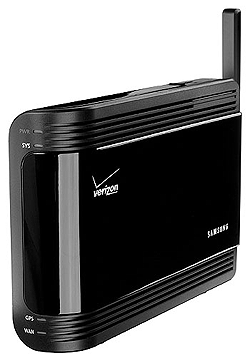
The best news is that you can live in a cave (i.e. have no normal through-the-air cell phone reception) and still use your Verizon cell phone. The gadget becomes your very own mini-cell phone tower. In short, if you have lousy or no cell phone reception at home (or office) you need one of these things.
P.S. You can also carry it around on trips. Only proviso: you must be in the Verizon “footprint,” which is basically everywhere — even at the Grand Canyon.
Two books to read this weekend. The best of the recent business books.
Reverse logic — the essence of great humor.
At a U2 concert in Ireland, Bono asks the audience for some quiet. Then in the silence, he starts to slowly clap his hands. Holding the audience in total silence, he says into the microphone…”Every time I clap my hands, A child in Africa dies.” The atmosphere is electric.
Finally a voice from the audience pierces the silence. “So, stop clapping your hands.”
============
Dad: I’m worried about your being at the bottom of the class.
Son: Don’t worry, Dad. They teach the same stuff at both ends.
============
A somewhat plump lady walks into the bakery and buys a cherry pie.
“Would you like it cut into four pieces or eight pieces? ” the salesgirl asked.
“Better make that four pieces,” was the reply. “I’m on a diet.”
============
Two people are walking in New York’s Central Park. A bird poohs on one.
“Shouldn’t you go for a kleenex?” the other asks.
“No. By the time I get back with the kleenex, the bird will be miles away.”
============
The farmer is holding the pig up to the tree while the pig eats acorns on the tree.
The city slicker passing by says “There’s a better way. A way to save time.” He shakes the tree and the acorns fall to the ground.
The farmer shrugs and replies “What’s time to a pig?”

Harry Newton, who loved having his son visit for three days. What makes kids run so fast? The kid runs faster than Nadal on the tennis court. His father (i.e. me) cannot keep up. I can’t figure if I should be happy (for him) or depressed (for me).

Allow me to add the following eye-opening read: CORNERED: THE NEW MONOPOLY CAPITALISM AND THE ECONOMICS OF DESTRUCTION, by Barry C. Lynn (Wiley). I'm not sure this is a general business book or a text; it serves as both. Anyone interested in pricing, antitrust, and the corrosive hand of the “trader” and the now-stunted hand of the “producer” in pricing and market expansion will, I hope, gain much insight from this read.
Speaking of Bono…
http://247wallst.com/2010/03/24/bono-becomes-th…
VIX musings: I thought the “storm” referred to by Russell would be here by now.
Recent Books: Just read “American Anarchy” by Jim Rath – scary.
Proud papa: Don't be depressed that your “kid” can run faster than you on the court – be proud! It's all in the genes!
However, next door at a Centex development called Legacy Villas, prices are down by 60%+, persuading an amazing number of the now-underwater homeowners to walk away.
There, I fixed it for you.
I fixed it up top, incorporating your remarks. Thanks.
harry, picked up the lewis book at costco last night – their price beat amazon and i don't have to wait for ups to deliver – and plan to read it over the weekend as well. one thing i stumbled across this morning was the yves smith critique of the book, but it's worth a read over at naked capitalism.
The whole business of book publishing is getting weird. Amazon will send overnight deliveries of books. Barnes and Noble takes a week. Some new books are available electronically — for the Kindle and/or for the Barnes and Noble reader (BN Reader). Some are not. Some are available in unabridged audio CD. Some are not. Amazon seems to prefer selling Audible downloadable versions (did Amazon buy Audible?). It's check, check, check.