The end of retailing? The Internet is killing store-based retailing. Shoppers visit Best Buy to choose, then buy from Amazon, where it’s cheaper. That’s the classic case. At one end of the continuum. At the other end are retailers like LuluLemon and Chipotle which sell only the the stuff they make themselves. That’s the key. Choose retailers with their own merchandise. Low price — a la Walmart — is not going to cut it. We need to think this through, make a list.
Why is Instagram worth $1 billion? The company has no revenue and no profits. Yet it’s “worth” $1 billion. Everyone has their theories. My friend who’s in the business theorizes:
1. It’s an inside job. It’s not necessarily how good your product is, it’s who you know. Marc Andreeson is both on the Facebook board and the Instagram board. Several of the VC’s that invested in Facebook also invested in Instagram. Seems no-one cares about a conflict of interest!
2. It’s other people’s money. The U.S. market has somehow become blasé to the number of zeros. I still can’t get why Facebook is supposedly worth $100 billion. Its also not “real” money in that most of it is Facebook stock that will be locked up for 2 years, so that also seems to make people more comfortable with the huge number.
3. Facebook needs more hype leading up to the IPO and they need a “hot new face” in their product portfolio.
4. I heard that Mark Zuckerberg has some kind of special class of shares that means he can go shopping and throw FB stock around and it doesn’t affect his control.
5. The world has gone mad.
Visit to Apple’s AppStore, you’ll find at least ten photo sharing apps. One that looks interesting is Path. What we’re seeing is a shift away from laptop/Internet apps to mobile apps played out on smartphones, like the iPhone. Tell your kids. The New York Times theorizes this morning on Facebook’s acquisition of Instagram for $1 billion:
Facebook Plays Offense and Defense in a Single Deal
SAN FRANCISCO – Is it crazy for Facebook, a start-up that has not yet even gone public, to be throwing $1 billion at Instagram, an even younger start-up?
To some, the rich price tag on the deal, announced Monday, was yet more evidence of a bubble in the technology industry, especially because Instagram, a mobile app that allows people to share their smartphone snapshots with friends, has not made any revenue.
But the history of Silicon Valley suggests that expensive purchases of start-ups by start-ups may not always be so crazy.
In 2002, the hot start-up turned juggernaut was eBay, then an online auction service. It bought a small online payments company, PayPal, for $1.5 billion. The PayPal division of eBay now brings in almost as much revenue as eBay’s merchandise.
In October 2006, a year after it went public, Google paid $1.65 billion for YouTube, a video uploading site that had no revenue and little prospect of profit. At the time, the price raised eyebrows. But YouTube dominated the competition and became a significant online advertising platform for Google.
Reid Hoffman, a co-founder of PayPal who went on to found LinkedIn, the social networking site, said in an interview on Tuesday that acquisitions were made partly to gain something valuable, but also to stave off the competition. “History shows they fail most of the time, but when they win it’s very valuable,” he said. “There’s always the blended question of opportunity and threat.”
Young hot technology companies are nothing if not aware of their mortality. Because so many started out by wounding an older tech giant, they know they can be killed, or at least severely injured, by that which lurks in the rented office space of Silicon Valley – an even hotter, younger technology company.
In part, that anxiety feeds the guiding logic here: eat the new start-up before it eats you, or before a competitor grabs it. And be sure to keep extending your reach if you want to stay relevant.
“Anything they can do they will do to keep customers coming back – that’s extremely valuable to these companies,” said Len Lodish, a marketing professor at the Wharton School at the University of Pennsylvania.
In this way, Facebook’s purchase of Instagram was an effort to push into a new area before its rivals. As YouTube and PayPal did for Google and eBay, Instagram offers something that Facebook desperately needs – a whole new audience that uses technology in a totally different way.
Never mind that Instagram has no immediate promise of making money. Facebook had to make another calculation before going public, which is expected to happen in the coming months, and confronting new pressures from impatient shareholders, said David Charron, who teaches entrepreneurship at the Haas Business School at the University of California, Berkeley.
That calculation was whether it was worth a billion dollars to be sure that Instagram would not lure away Facebook users.
But in the unpredictable world of Silicon Valley, sometimes buying the newcomer does not work.
In the spring of 2005, Yahoo, still a major player in search and online media, bought Flickr, a photo-uploading site. A Yahoo spokeswoman at the time described it as part of “the next generation of Web services.”
Yet Yahoo languished, and Flickr failed to innovate and keep pace with the shift to social networking, photo sharing and mobile devices. Today, Yahoo finds itself severely challenged by the next generation of Web services.
News Corporation, a traditional media company, spent over $580 million for MySpace in 2005, when it was the dominant social network. News Corporation sold MySpace last June, after its users had defected, chiefly to Facebook. The price: $35 million.
One challenge for Facebook will be to keep Instagram users happy. On Tuesday, some expressed fears that the app would be destroyed by its new owner.
A user named “monkm” wrote: “Congrats on the purchase … I must add however that most of us on IG are on here because it’s not FB.”
An especially vitriolic comment written by a user named “brianbrutal” said: “Stick to being overlord of Facebook. We don’t want you on Instagram.” The comment was deleted.
But several people welcomed Mark Zuckerberg, Facebook’s founder, back to the service after he shared a photo of his dog, Beast, giving the pet a moment of fame. It was only Mr. Zuckerberg’s fourth post on Instagram since he signed up for the service in October 2010. That is a lot of millions of dollars for each image.
Useful tips:
+ Always ask for a discount. Remember:
– Why did God invent Christians?
– Because someone has to pay retail.
By asking recently, I received discounts from TD Ameritrade, Banana Republic, Lenovo and Wisteria. And that’s only for the last four vendors I dealt with.
+ Don’t buy no-name packing tape. 3M’s works. The rest is crap, including the stuff from Staples.
+ Don’t go on “auto-pay” for magazine subscriptions. They charge you more, compared to paper renewals — many of which will give you two subscriptions for the price of one renewal.
+ Don’t forget to keep saving your work and backing it up elsewhere. To my brain, the most reliable backup is an external USB hard drive, like the ones Apricorn sells. See the right column.
The awful job salespeople do.
+ Asking, “How are you today?” (Actually I’m awful, but why should you care?)
+ Asking. “Is this a good time?” (Hint: it’s never a good time.)
+ Asking, “Why do you keep hanging up on me?” (Maybe because your last five recommendations all lost money, including Alcoa.)
+ You can’t manage someone’s money after one visit. You have have to earn that right.
+ Learn what vCards are and send them to your potential clients. Saves them hand typing your business card into their Outlook.
The CEO of Best Buy resigned. That’s sad. He was probably the only person who ever waited on a Best Buy customer. Now there’s no one left. I’m being extreme. But have you been into a Best Buy recently? Compare that experience with visiting an Apple store.
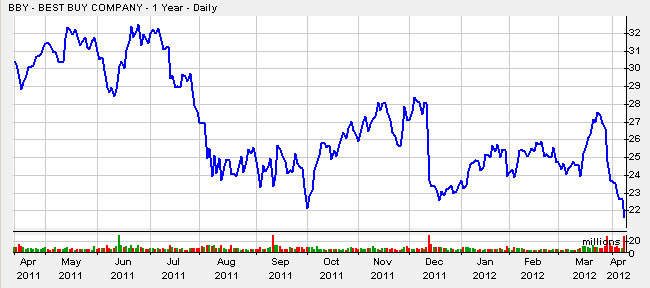
17.1% of Best Buy’s float is sold short. That’s high. I bet it will go lower.
Moses and the Red Sea. Passover continues.
Nine-year-old Joey was asked by his mother what he had learned in Sunday School.
“Well, Mom, our teacher told us how God sent Moses behind enemy lines on a rescue mission to lead the Israelites out of Egypt . When He got to the Red Sea , he had his army build a pontoon bridge and all the people walked across safely. Then, he radioed headquarters for reinforcements. They sent bombers to blow up the bridge and all the Israelites were saved.”
“Now, Joey, is that really what your teacher taught you?” his mother asked.
“Well, no, Mom. But, if I told it the way the teacher did, you’d never believe it!”

Harry Newton who marvels at the pollen in New York’s air. Coughing, sneezing and headaches. You’re not sick. You’re allergic. Turn on your airconditioner and wash your face and hair. Take Claritin. Move to California’s desert, Northern Alaska, or anywhere.

Would you please share your opinion on two topics?
1)augmented reality “project glass” at Google, any investment plays?
2)First Trust Cloud Computing ETF index, “SKYY”
Today it is just the two founders and their Silicon Valley-type circles that invested the million reaping all the rewards. But with crowdfunding it will be the early users who saw the potential and put in $25, or $200 towards the startup and got equity in return.
This will do two things. For one, the obvious — it will enable a larger number of ideas to get built. Less recognized is how it will move the miracle. When you had to be physically close to where the money was sourced, Silicon Valley, stayed on top. When you crowdsource your source of money is distributed across the nation and across the globe. The epicenter of the startup universe will no longer be Sand Hill Road.
My recent retail store story: I just started taking mandolin lessons at a place in Brooklyn called Jalopy (recently written up in the Times at:
http://www.nytimes.com/2012/03….
Mandolins are notoriously difficult to tune and keep tuned. My teacher recommended that I buy a tuner from the Jalopy store. After my lesson, I inquired as to the price, and was told it was $30. I decided to hold off. I went home, went online to Amazon, and saw the exact same tuner for $13!
As much as I would love to support our local Jalopy, I could not bring myself to pay more than double to do so! How will most retail survive? No idea.
Harry I don't see the Apricorn USB hard drive on the right
Thanks
Sonny
ooops. Go to the Apricorn web site. For travel, get their Padlock series.
Staples' own brand packing tape is fine (the thick stuff, not the thin). We've been shipping with it for years, and never have trouble.
Photo always looks good big screen PC/iMac, even better on HDTV. Photo on the phone? so small, and killnig your eyes? Where is the revenue for those things? This facebok thing is just like those .com and housing bubble. Someone will be crying down the road.
What's worst with Instagram is they force you to crop your ractangular photo to a square. But that means you can lose important detail. Be warned.
Harry
Like you say, many stores do not advertise their discounts…you must ask for them. Example…both Home Depot and Loews offer 10% discount (even on most sale items) to current or EX military. I long ago lost my 50 year old army ID. I reduced a copy of an old army school certificate I found, carry it in my wallet and have saved several hundreds of dollars, at both stores, while doing condo remodel jobs. They rarely even ask for the ID card…most of the clerks feel that having served in the military is not something people would lie about.
Brilliant. I bet there are a lot of companies that offer discounts to ex-military types.
Harry
I believe 3M makes the tape for Staples. It is not the tape but the mil of the tape you buy that makes the difference. The heavier the mil the less the problems. Uline's tape is good. I hope your allergies get better.
Philip
Heavy gauge works. Figuring out which is heavy duty is not always easy. I prefer to stick with 3M now.