Is Chesapeake Energy’s CEO driving his company into the ground for personal gain?
Chesapeake Energy’s CEO has borrowed $1.1 billion from his own company to buy shares in his own company’s drilling interests. I’m guessing he is guessing that CHK will rise, which it sadly hasn’t been doing:
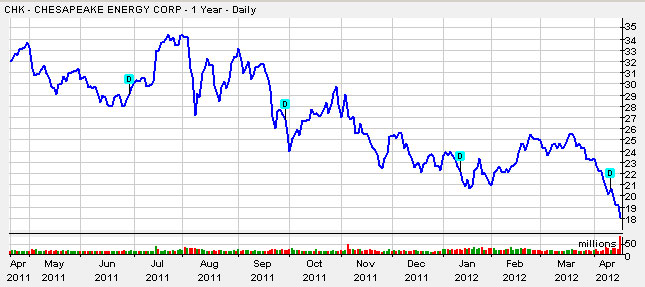
News that companies issue fall into categories. First, there’s the normal news. We sold more. Earnings are up. We sold less because the economy is no good. Earnings are down. The sort of thing that affects every company.
Then there’s the other news. Abnormal stuff. Strange shenanigans. CEO weirding.
I live in New York. Our town has cockroaches. They’re not popular. When you see one, you kill it. Three days later his brother appears. You kill him. Four days later his sister appears. They keep on coming.
Stocks that make abnormal, bad news keep making it. One week. Than another. These companies are called Cockroack Stocks. Once the cockroaches start, they keep on coming. WorldCom and Enron were classic cockroach stocks. Such cockroach They should be sold short.
Chesapeake is being doubly hit – CEO weirding and plummeting natural gas prices.
Reuters ran this story late yesterday:
Chesapeake shares tumble on CEO loan worries
(Reuters) – Shares of Chesapeake Energy Corp (CHK.N) dropped more than 5 percent on Wednesday and one investor called for the company to “clean up” its leadership after a Reuters report that Chief Executive Aubrey McClendon borrowed as much as $1.1 billion against his stake in thousands of company wells.
Those loans, taken out over the past three years, were previously undisclosed to shareholders, analysts and academics said, and raised worries about the potential for conflict of interest. McClendon and the company insist there is no conflict.
Jittery investors pushed the company’s shares down more than 10 percent to a low of $17.17, the lowest level since July 2009, before they rebounded to close down 5.5 percent at $18.06.
Trading in the company, the nation’s second-largest natural gas producer behind Exxon Mobil Corp (XOM.N), was heavy, with 93.2 million shares changing hands. That was the highest level since October 10, 2008, the end of a week when McClendon was forced by margin calls to sell more than 31 million shares in the company.
“Chesapeake is one of the leaders in this (sector), but his business ethics are out of the Wild West,” said David Dreman, chairman of Dreman Value Management LLP, which owns about 1 million shares of the company.
Dreman said the report of the new loans rekindled fears that had surfaced in 2008 around McClendon’s stock sales.
“I think the company has to be more professional,” Dreman said. “I think that the whole management and the board of directors has to be cleaned up. We’re obviously very unhappy with the situation as it is now.”
Rolling Stone blog wrote this:
‘World’s Biggest Fracker’ Pockets $1 Billion in Shady Deal
by Jeff Goodell
In March, I wrote a long article about the fracking boom for Rolling Stone, focusing on Chesapeake Energy, whose CEO, Aubrey McClendon proudly boasted to me, “We’re the biggest frackers in the world.” The story raised questions about the financial underpinnings of the company and suggested that today’s natural gas boom is likely to be a short-lived euphoria driven by new drilling technology and corporate greed.
Well, this morning Reuters hit with an important story revealing that the financial shenanigans at Chesapeake are even more complicated than anyone knew. And, as always, McClendon is right in the middle of it.
Reuters reports:
McClendon has borrowed as much as $1.1 billion in the last three years by pledging his stake in the company’s oil and natural gas wells as collateral, documents reviewed by Reuters show.
The loans were made through three companies controlled by McClendon that list Chesapeake’s headquarters as their address. The money is being used to help finance what could be a lucrative perk of his job – the opportunity to buy into the very same well stakes that he is using as collateral for the borrowings.
The story caused Chesapeake’s stock to tank as much as 10 percent during the day and made it one of the most actively traded stocks on Wall Street. Let me unpack this a little and explain why this is a big deal.
The first thing you need to know is that McClendon has a long history of financial recklessness. In October of 2008, McClendon had to liquidate nearly his entire holding of Chesapeake stock — worth some $552 million — to meet a margin call on personal investments. The move caused Chesapeake’s stock to tank, losing 39% of its value virtually overnight.
The second thing you need to know is that McClendon has long treated Chesapeake as his own personal piggy bank. One example: in 1993, the company’s board (who are all McClendon’s buddies) set up an unusual perk for the CEO, known as the Founder Well Participation Program, which essentially gives him the right to buy a 2.5% share in every well that Chesapeake drills. McClendon has to pay proportionate part of the well’s operating expenses, but when – if – the well starts producing, he gets 2.5% of the revenue. This is sweet deal, one that essentially allows him to siphon money out of the ground (McClendon claims it aligns his interests with the interests of the company) “I don’t know any other gas or oil company that gives the CEO as share of production,” Phil Weiss, an oil analyst at Argus Research told me. “If it works so well for stockholders, why don’t other companies do it?”
Today, Reuters revealed that during the last three years McClendon has borrowed more than a billion dollars in order to pay the operating expenses of the wells that he participates in. For collateral, he has used his ownership in the wells – that is, the future production of the gas and oil. So he is essentially using the promise of buried gas and oil to finance the drilling of the wells, for which he will receive future royalties.
O.K., that’s unorthodox enough. But a billion dollars in loans to cover operating expenses for his tiny share of Chesapeake’s wells? If the company’s wells are performing so well, why does McClendon need to borrow a billion dollars to cover operating expenses? Maybe he’s broke. Or maybe, as some analysts have suggested, the wells aren’t performing as well as the company would like you to think they are.
But it gets worse. McClendon arranged the financing of some of these loans through EIG Global Energy Partners, a global equity firm that also finances deals for Chesapeake. The potential for conflict of interest is obvious; you can imagine a quiet quid pro quo where McClendon gets cheap terms on his personal loan and EIG gets a piece of one of Chesapeake’s billion-dollar financing deals. I’m not suggesting McClendon or EIG made such an arrangement. I’m suggesting that it’s possible to imagine it happening.
And then there is the issue of disclosure. You would think that when the CEO of a publicly-traded company takes out a billion dollars worth of loans against company assets, it would be disclosed in the company’s Securities and Exchange Commission filing. Henry Hood, the general counsel for Chesapeake (who also happens to be an old college buddy of McClendon’s) told Reuters that indeed it is, buried deep down in the fine print, and that the company’s disclosures are “fully compliant all legal and regulatory requirements.” But if that’s true, it was news to the shareholders Reuters interviewed.
In the coming days, financial journalists are going to have a lot of fun following up on this story. Among the questions worth asking:
1. If Chesapeake plays this fast and loose with disclosure on McClendon’s loans, why should we not assume they are also playing fast and loose with disclosure about chemicals that are injected underground during fracking operations or the disposal of polluted flow-back water?
2. Where is the Securities and Exchange Commission on this? How is that the CEO of a publicly traded company can take a billion dollars in loans, use the wells as collateral, and not disclose it in any significant way to shareholders? Does the name Bernie Ebbers mean anything to anyone these days?
3. How long are Chesapeake’s stockholders going to tolerate a CEO whose first priority is to pocket billions for himself, rather than maximize profits for shareholders? As Frances McKenna, who writes about the accounting industry for Forbes put it, the company’s response to questions about McClendon’s secret billion dollar loans “is not only disingenuous, it’s borderline delusional.” One Wall Street analyst I talked to today was even more blunt: “Long term, it is in the best interests of shareholders for someone else to be running the company.”
4. How close to bankruptcy is Chesapeake? The company already projects a $10 billion revenue shortfall this year, thanks in part to rock-bottom natural gas prices (caused, in part, by over-drilling in the rush to cash in on the fracking boom). But the company’s complex accounting methods make it almost impossible for analysts and stockholders to determine what the risks really are. The fact that the CEO is taking out billion-dollar loans and not openly disclosing them only furthers the perception that everything is not as it appears at Chesapeake — that the company is Enron with drilling rigs. I mean, Enron might have been a bunch of crooks, but when they went down, at least they didn’t leave a legacy of toxic drinking water and industrial wastelands.
Late last night, the Wall Street Journal posted:
For Chesapeake’s CEO, a Complex Web of Loans
Firms controlled by Aubrey McClendon, the high-profile founder and chief executive of Chesapeake Energy Corp., were in debt to a private equity group for as much as $1.4 billion while Chesapeake was negotiating with the same firm to sell it hundreds of millions of dollars of assets.
According to documents reviewed by The Wall Street Journal and a person familiar with the matter, an entity created by Mr. McClendon received a loan of up to $1 billion from an affiliate of EIG Global Energy Partners last November, on top of an earlier loan of $375 million. The November loan was to Jamestown Resources LLC, which lists Mr. McClendon as president and shares an address with Chesapeake in Oklahoma City, Okla.
Earlier in November, EIG bought $500 million in Chesapeake assets and in December led a group of private firms that bought an additional $750 million, the company announced at the time. Earlier this month, EIG was again part of a private-equity group that purchased a stake in a Chesapeake subsidiary for $1.25 billion.
Mr. McClendon used loans from EIG to pay for his participation in a controversial company program that gives him the right to benefit from every oil and gas well Chesapeake drills, but requires him to contribute to the well costs, according to people familiar with the matter. Chesapeake, the second-largest gas producer in the U.S., has had to raise billions of dollars recently as the price of gas has plunged because there is a glut of the fuel.
The existence of the loans was first reported last month by the Pittsburgh Post-Gazette and then on Wednesday by Reuters.
News of the loans, and the fact that they were made by a private-equity firm that was also doing deals with Chesapeake, has raised concerns with shareholders about how well the company is monitoring and disclosing the financial activities of Mr. McClendon.
“This sounds like a major conflict of interest,” says Michael Passoff, chief executive of Proxy Impact, which advises institutions on shareholder votes.
Mr. McClendon didn’t respond to questions from The Wall Street Journal, but the company says there was no conflict of interest. Mr. McClendon didn’t participate in the company’s negotiations with EIG, though he signed off on the transactions, the company said.
Chesapeake also said it didn’t have to disclose details of loans. “He had separate counsel negotiating the terms of his own financing transactions,” Henry Hood, the company’s general counsel, said in a statement, adding that the board was aware of Mr. McClendon’s companies’ transactions.
Members of Chesapeake’s board declined to comment, didn’t return calls seeking comment or, in one case, couldn’t be reached.
Chesapeake’s shares have fallen 43.5% in the last year, including a 5.5% drop Wednesday to $18.06. The stock peaked in June 2008 at just under $70 a share. The company has been struggling with natural gas prices that have sunk to their lowest level in a decade, down 55% in the last year, and says it has cut back its gas-drilling to shift its rigs to more profitable oil fields.
Mr. McClendon’s limited liability companies obtained loans of up to $1.375 billion from EIG and a predecessor firm, TCW Asset Management Co., starting in 2010, according to public records filed in Texas and Pennsylvania. The financing package was modified in November 2011, and a mortgage was amended earlier this year to include more properties. Mr. McClendon pledged as collateral his minority interests in thousands of wells that Chesapeake drills.
Chesapeake says Mr. McClendon’s right to purchase a 2.5% interest in every well the company drills helps align his interests with shareholders. In late 2008 the company awarded him $75 million to invest in the program.
But the program has ballooned. In 1994, the first full year of the “Founders Well Participation Program,” the company drilled only 18 wells. Today, the company is the most active driller in the U.S., operating twice as many land rigs as Exxon Mobil Corp., its nearest competitor, and drilling more than 1,000 wells a year.
Mr. McClendon paid $242 million in 2010 to cover his costs of drilling those wells, according to company filings with securities regulators.
As the cost of participating has grown, Mr. McClendon turned to private equity groups to help cover his payments, with his 2.5% interest in the Chesapeake wells serving as collateral. EIG, in a meeting with the New Mexico State Investment Council in February 2011 and first cited by Reuters, said it collected all his revenue from the wells until it achieved a 13% annualized return, then takes 42% of the profit. The other 58% belongs to Mr. McClendon. The remaining 97.5% of revenue from the wells remains with Chesapeake and any partners it may have.
Chesapeake’s sale of assets in the Utica Shale to EIG last November are part of its continuing effort to raise at least $10 billion to fund its drilling program and pay down debt.
Mark Hanson, an analyst for Morningstar, said he thought that one deal, in which Chesapeake sold Utica acreage to EIG, was an expensive way to secure financing, but thought it made sense because the field was unproven.
But informed of Mr. McClendon’s private deal with EIG, he said he would have some doubts about whether there was a quid pro quo.
This isn’t the first time Mr. McClendon has attracted attention for his finances. Last November, as part of a settlement with shareholders, he agreed to buy back, with interest, a collection of 500 antique maps he sold to Chesapeake in 2008 for $12.1 million.
In October 2008, Mr. McClendon had to sell most of his 5.8% stake in the company after a falling stock price led to margin calls. Today he owns less than 1% of the company’s shares.
Analysts and investors have criticized Chesapeake’s compensation practices, which before this year weren’t based on set performance metrics. Last year, 58% of votes cast favored Chesapeake’s executive pay practices. Mr. McClendon was re-elected with 78% of the vote, down from the more than 96% support he received in 2008.
Renewed controversy over Mr. McClendon could widen shareholder support for efforts to make it easier for major investors to nominate independent directors to the board. New York City’s five employee pension funds are pushing a so-called “proxy access” resolution at this year’s annual meeting, expected in June.
Shareholders “need directors who will protect our interests, not those of a self-interested CEO,” said Michael Garland, executive director for corporate governance for New York City Comptroller John Liu, who oversees the pension funds. “It’s the latest example of a board that has repeatedly shown itself incapable of exercising independent oversight.”
Where goes Apple?
From Goldman Sachs:
Apple (AAPL) today had its estimates boosted and price target raised to $750 by Goldman Sachs (GS), as the firm believes that iPhone and iPad sales should continue to increase. A buy rating was issued.
From Minyanville:
Apple (AAPL) might disappoint on Mac sales in next week’s earnings call, according to Gene Munster, an analyst at Piper Jaffray. Munster says that, based on data from NPD, we can expect that Mac sales in the first quarter will be 5% higher than the year before, Apple Insider reports. Apple-watchers are expecting a 14% increase. The analyst chalks this up to the fact that Apple hasn’t made any major changes to the Mac lineup in over a year. This means that would-be buyers are merely waiting to avoid the risk of obsolescence, as All Things D’s Walt Mossberg advises both Mac and PC buyers to do. Some would-be buyers are waiting for the next generation to come out, presumably with Intel’s (INTC) latest Ivy Bridge processors, which will start shipping next week. Munster predicts that a hardware upgrade in the next quarter will send sales way up. I think it will make me jealous.
From Business Insider:
The Next iPhone Will Be The Biggest Smartphone Release Of All Time. Click here.
From British Airways:
The airline is now using iPads loaded with movies, games and music in business class as its entertainment system. A friend who just flew in from London said the iPads had many new wonderful movies he wanted to see. He loved using the one he was issued by the stewardess.
The neat thing about the iPad is the huge and expanding number of applications creative people are finding for them.
Apple dropped $1.36, or 0.22% yesterday.
Unemployed kids needing some shekels? Try starting a local knife sharpening business. The Newton household will be your first customer.
Dumb. Dumb. Dumb.
A real estate agent sends me note: “Buy this hot property.”
I call this morning. I say, I’ll visit today.
She responds, The property “won’t be ready” until next week.
I throw her sales pitch out. Why did she send it out?
Making cell phone calls overseas is ultra-pricey. See today’s Wall Street Journal.
Absolute favorite recent New Yorker cartoon. If you’ve watched Ted Conference videos, you’ll now why this cartoon is hiysterical.
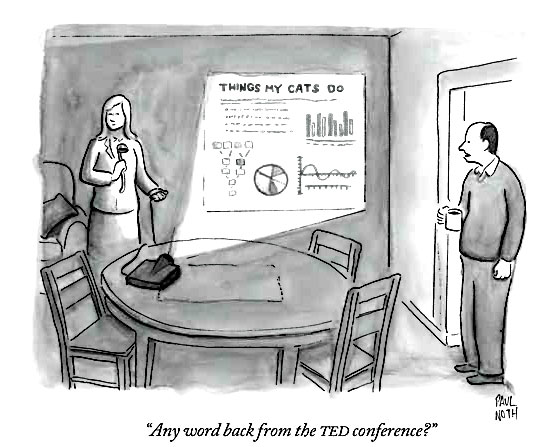
Watch some real Ted presentations here.
Yet another Borowitz Report. The last one I published annoyed every “conservative” and their uncle. Lighten up, please. The author Andy Borowitz is a comedian. He pokes fun at things that are funny. I think he’s funny. Here’s his latest posting:
North Korea Expelled from Axis of Evil
Ahmadinejad Cites `Lack of Evil’
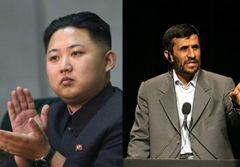
PYONGYANG (The Borowitz Report) – Just hours after an embarrassing launch of a rocket that crashed to the ground in a little over a minute, North Korea suffered another blow to its prestige as it was expelled from the Axis of Evil.
The decision was announced by the presiding Chairman of the Axis of Evil, Iranian President Mahmoud Ahmadinejad, who cited as the reason for the expulsion North Korea’s evident “lack of evil.”
“There are a lot of evil countries out there, Iran for one, who are trying to terrify the world by developing nuclear weapons,” he said. “When North Korea launches a so-called `rocket’ and it goes about twenty feet before blowing up, that just makes it harder for the rest of us.”
A spokesman for the erstwhile evil nation objected strongly to Mr. Ahmadinejad’s statement, saying it was “totally unfair to judge how evil a country is based on one crappy rocket.”
For a rogue nation that prides itself on threatening the world community, membership in the Axis of Evil is considered essential, which makes North Korea’s expulsion from the group a particularly damaging setback.
“The rocket thing is hurting our credibility, evil-wise, no question about it,” one aide to North Korean President Kim Jong-un said today. “This afternoon we tried to threaten Japan and it went straight to voicemail.”
In a possible sign of newly reduced ambitions, North Korea today hurled a roll of toilet paper over the border at South Korea.
Mr. Ahmadinejad offered no comment about the latest incident on the Korean Peninsula, other than to say, “Really, the whole thing is kind of sad.”

Harry Newton who discovered the superherdyne stabilizer in wife Susan’s TV remote had gone on the fritz, much to her annoyance. Problem solved with my technical brilliance and two new AA batteries. Susan is happy.

If you care about the facts with respect to Chesapeake, see –
http://www.chk.com/Reuters/Pag…
Mr. McClendon is losing his own money in a commodity investment where that commodity is declining in price. He's the guy getting screwed, not the company. He has always been a very aggressive investor, and he built a huge firm from scratch. He's the primary reason that there is a shale gas glut. His company found it! The warm winter helped as well.
It may make him poorer, but is that a basis to judge him as bad?
I've owned the stock on and off and have followed it for several years. The participation interest has been around for years, and I've been aware of it. It's no secret. If the institutional investor quoted didn't know about it, then shame on him for not doing his work. He's just pissed that CHK has been TOO successful in finding nat gas!
As to the fracking nonsense, shale rock is an aquaclude – water can't go through it. The allegations that drilling and injecting water 6000 feet down into non-porous rock will greatly affect groundwater in the top 100 feet is rather overblown.
Regarding North Korea being expelled from the “Axis of Evil”, the media is reporting that Dr. Evil himself is going on the record as stating, “The little bastards had it coming, because they couldn't get their rocket up. And if that Kim Jong-un were to shave his head I would make him “Mini Me II”.
Spelling: Superheterodyne
The only reason I know is I had to go look it up myself.But seriously, Harry. In your own words: “Never fall in love with an idea, a business or a property. Love is for your family.” Dump that AAPL before it gaps one day after hours and you bitch about your losses for the next two years.
“This afternoon we tried to threaten Japan and it went straight to voicemail.”
Love it!