The world gorged on debt. The debt spiked asset values — from housing to office buildings, to companies. The debt funded generous payouts for pensions and social benefits. When it all fell apart in 2008, social benefits became unaffordable and asset values plummeted. And \, with rare exceptions, they have not come back.
Since 2008, we’ve been “deleveraging.” This means everything has slowed down and, largely, stayed down. I worry about the second half of this year. Parts of Europe are in recession and suffering huge unemployment — in some countries worse than in America in the Great Depression
As everyone knows I’m not sanguine about coming months in the market. Exhibit one, a story by MarketWatch last night on Cisco’s results:
Cisco shares slide on weak outlook
CEO Chambers points to “cautious IT spending environment”
SAN FRANCISCO (MarketWatch) – Shares of Cisco Systems slid in after-hours trading on Wednesday after the technology giant issued a weaker-than-expected outlook for the current quarter, as Chief Executive John Chambers pointed a “cautious” spending environment.
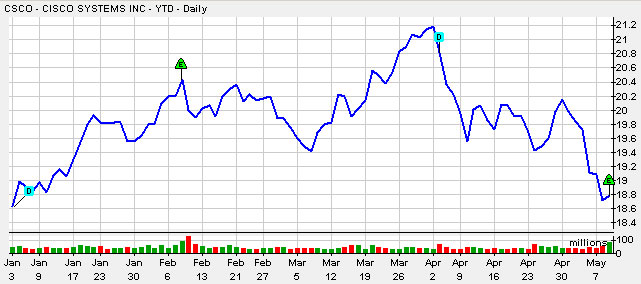
Cisco (CSCO) were down more than 8% in after-hours trading – the stock has gained only 4% since the first of the year.
For its third fiscal quarter ended April 28, Cisco posted profit of $2.2 billion, or 40 cents a share, compared with a profit of $1.8 billion, or 33 cents a share, for the year-earlier period. Adjusted profit was 48 cents a share.
Revenue was $11.6 billion, up from $10.9 billion.
Analysts were expecting a profit of 47 cents a share, on revenue of $11.6 billion, according to a consensus survey by FactSet Research.
For the current quarter, Cisco said it expects sales to rise to 2% to 5% year-over-year, and adjusted profit in the range of 44 cents to 46 cents a share. Analysts were expecting sales to rise 7% year-over-year, and an adjusted profit of 49 cents a share.
“We are still in an uncertain environment economically,” Chambers said on a conference call, specifically citing areas of concern such as Europe, the public sector market and “conservative” information technology spending.
Stocks pared their losses after signs that Greece will receive its latest bailout package, though investors remained concerned about the future of the euro zone’s peripheral countries. Brendan Conway has details on The News Hub.
“Europe and customer conservativism have gotten worse,” he noted.
The disappointing forecast from Cisco, which dominates the networking gear market, appeared to affect the shares of other players in that space. Shares of Juniper Networks JNPR +0.42% and Brocade Communications BRCD +1.18% were each trading down by more than 3% in after-hours trades.
Asked by an analyst if the “slowness” the company was seeing in the market was a short-term problem, Chambers responded, “I would say you’re going to see exactly what our customers said, which is very slow painful progress.”
This is my chart. It doesn’t reflect the 8% drop last night after hours. This morning pre-market, CISCO is trading at$17.27.
And here from Spain is a depressing story of over-leveraging and over-spending:
In Spain, a Debt Crisis Built on Corporate Borrowing
By LANDON THOMAS Jr. of the New York Times
LONDON – In a country with one of the highest levels of company debt in the world, few businesses in Spain shoulder as big a burden as Grupo A.C.S., the global construction giant whose debt woes have become a mirror image of Spain’s own increasingly severe financial struggle.
Saddled with a 9 billion euro ($11.7 billion) debt pile that is twice the size of the company’s shrinking market value, A.C.S. is in the midst of a frantic campaign to sell off assets, pay down debt and further distance itself from a Spanish economy caught in a spiral of austerity and deflation.
The Spanish government’s harsh budget cuts and their depressive effect on the economy have prompted foreign investors to sell Spanish stocks and bonds in droves. On Tuesday, Spanish stocks plunged 2.8 percent and the government’s 10-year bond yields spiked to 6 percent as Spain moved to bail out its ailing banks, and uncertainty over Greece loomed.
But economists now say that one of the greatest threats to Spain could well be the snarl of debt choking off the growth prospects of A.C.S. and other highly indebted Spanish corporations. And they warn that as these companies cut back on investments and shed assets as well as jobs, the result could be a Japan-style lost decade of stagnation.
An important metric in the euro zone debt crisis has been government debt as a percentage of the total economic output, and Spain has a relatively low ratio of 70 percent, compared with 165 percent for Greece and 120 percent for Italy.
But according to a recent report by McKinsey on global debt, Spain’s nonfinancial private sector debt is 134 percent of gross domestic product, higher than any major economy in the world with the exception of Ireland, where the figures are skewed by the outsize presence of foreign multinationals. Factoring in bank, household and government obligations, the total figure rises to 363 percent of G.D.P., trailing only Japan at 512 percent and Britain at 507 percent.
“The problem in Spain is not government debt, it’s private sector debt,” said Jonathan Tepper of Variant Perception, a London-based research boutique with a specialty in Spain. “A.C.S. perfectly captures this problem.”
Under the stewardship of its ambitious chairman, Florentino Pérez, A.C.S., like many other corporations in Spain during the recent boom, gorged on cheap debt, seeking to diversify by buying large equity stakes in companies in Spain and elsewhere.
In a bull market, this web of cross-holdings held in special-purpose vehicles and financed by bank loans can sustain a vast corporate appetite. But when the assets backing these debts plunge and the banks call in their loans, the opposite can occur.
“It is a really bad time for these companies,” said Mauro Guillen, an expert on Spanish multinational companies at the Wharton School of the University of Pennsylvania. “The government is no longer investing in infrastructure, the municipalities are no longer paying their bills and the companies are in constant need of refinancing from their banks. So they have to unload their positions to raise cash.”
With 28 billion euros in revenue, A.C.S., or Actividades de Construcción y Servicios, is one of the largest building services companies in the world. Its projects range from building subway stations in Manhattan and managing toll roads in Florida, to collecting waste in France and building wind farms in Brazil.
But for the growing legion of investors who have been betting against the company by selling its shares short, A.C.S.’s still significant exposure to Spain’s ailing construction industry and austerity-hobbled municipalities feeds their bearish outlook.
Credit Suisse, in a recent report, warned that 48 percent of the company’s cash flow comes from various Spain-related infrastructure projects. Tellingly, the bank said, 70 percent of that income depends on austerity-bound government entities.
More than anything, though, it is the 6 billion euros in debt that A.C.S. has used to buy a controlling stake of the German construction company Hochtief, and a similar but now thwarted move to take over Iberdrola, the Spanish utilities giant, that is at the heart of investor concerns.
“The debt of this company has gone out of control,” said Javier Suarez, a utilities analysts at Nomura in Madrid.
The decline of its shares has accelerated in recent weeks – the price is down 40 percent for the year and fell 27 percent in April alone – as it became clear that the more Iberdrola fell, because of concerns about regulatory pressures and its own high debt, the worse A.C.S.’s financial position became.
Bowing to pressure from banks and investors, A.C.S. reversed course on its Iberdrola strategy last month and sold a 3.6 percent chunk of its stake at a loss, bringing down its position in the company to just under 15 percent.
“Spanish corporates and households are paying down debt massively,” said Richard C. Koo, an economist at the Nomura Research Institute in Tokyo who has been warning for some time now that Europe is entering the same type of balance sheet recession that plagued Japan in the 1990s.
Indeed, he and others argue that it is this relentless private sector downsizing in Spain – by individuals weighed down by mortgages and corporations tethered to their boom-time loans – that threatens to make the Spanish economic collapse semipermanent as opposed to cyclical.
Jobs are lost, companies have stopped investing and assets have plunged, from house prices to the stock market, which is already down 18 percent this year, the worst among major merging and developed markets – all compounded by the government’s own austerity drive.
In many ways, A.C.S. is a product of its chairman, Mr. Pérez, who, after Emilio Botin of Santander Bank, is perhaps the most commanding business figure in Spain, in large part because of his position as president of the soccer club Real Madrid.
Trained as an engineer, he gave up a career in politics in 1983 to buy into a bankrupt construction firm and then presided over a succession of mergers that culminated in the formation of A.C.S. in 1997.
Just as he has used debt to accelerate his company’s remarkable growth, he has borrowed heavily to sign prominent Real Madrid players – from the British star David Beckham to the current Portuguese sensation, Cristiano Ronaldo.
Mr. Pérez, who owns 13 percent of A.C.S. (worth about 550 million euros and down 56 percent over the last year), is known for his austere personal tastes. He does not drink nor does he often vary the color of his blue suit and shirt.
While soccer-mad Spain may excuse Mr. Pérez for piling an estimated 500 million euros of debt on the team, investors in a public company tend to be less forgiving, especially as A.C.S., unlike Real, must publicly account for its rising debt levels.
A.C.S. remains profitable. It earned 962 million euros last year and many of its diverse overseas operations are thriving, especially those in fast-growing markets like Latin America.
An A.C.S. spokesman said Mr. Pérez and other executives were not available for interviews.
But in comments to analysts in March while reporting 2011 results, Mr. Pérez emphasized the importance of speeding up asset sales to further reduce the company’s debt burden, and he pointed to the company’s 66 billion euros in backlogged business as a sign of its strength.
Its most vigorous supporter is Southeastern Asset Management, a value-based investment company based in Memphis that owns 7.5 percent of A.C.S., making it the company’s fifth-largest shareholder.
Southeastern’s main international fund was down 20 percent last year, largely because A.C.S., the fund’s second-largest holding, put it among the worst-performing mutual funds in its category as ranked by Morningstar, the mutual fund tracker.
In its most recent letter to investors, Southeastern took pains to justify its significant exposure, writing that A.C.S. “sells for approximately half of our valuation because the market oversimplifies this as a Spanish business with optically high leverage.”
But in a global marketplace that has become obsessed with debt, be it sovereign, household or corporate, optics can count for a lot, especially when they are backed by numbers that are all too real.
This book is just out. It tells the right story of the consequences of deleveraging on slowing growth:

The analysis makes sense. Sadly, Shilling falls down when he comes to answering the question, “What should I as an investor do now?” Here’s what Shilling recommends for you and I to own:
1. Treasurys and other high-quality bonds.
2. Income producing securities.
3. Food and other consumer staples.
4. Small luxuries.
5. The U.S. dollar.
6. Investment advisers and financial planners (??).
7. Factory built housing and rental apartments.
8. Health care.
9. Productivity enhancers.
10. North American energy.
Totally tasteless photograph. One benefit of being married to a Muslim wife is that, when you change wives, you don’t have to change the photo on your desk.


Harry Newton who wonders bought more AGNC yesterday and is eyeing his few remaining equities with trepidation. My muni bonds — bulk of my portfolio– continue to do well, holding up and paying their nice tax-free dividends.
