There are four ways to protect yourself from this present and upcoming awful spring/summer market:
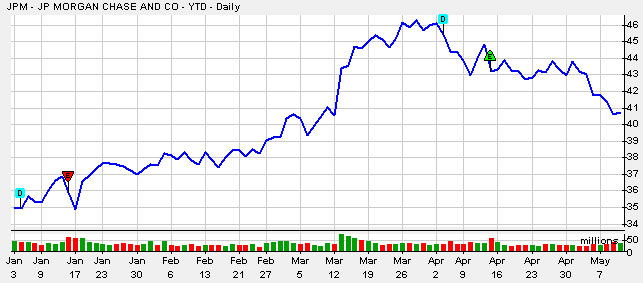
+ Sell short opportunistically. That means sell short when opportunities emerge, e.g. J.P. Morgan (see below), gold, RadioShack and the list I published two days ago — Panera Bread, Caterpillar, Chipotle, Yahoo, Amazon, Sears and US Steel. Don’t short all of these. Pick which ones you like least. Look for stocks with a big European exposure, like Ford. Be prepared to cover quickly if the short goes against you.
+ Buy dividend paying stocks, like the mortgage REITs — AGNC, NLY, MITT. They continue to do well. The fed will not raise rates for years. I also have a big portfolio of muni bonds — not one of which has failed to pay a dividend and not one of which has lost value in the past five years. Thank you Todd.
+ Play opportunities as they come along. Which means get some Facebook on the IPO. Sell your allocation once it trades.
+ Play opportunities quickly. Stay heavily in cash. Don’t buy stocks that don’t pay decent dividends. That’s called “speculation” and that’s far too hard in today’s awful market.
Give me one reason that Jamie Dimon shouldn’t be in jail, or at least lose his job? Measured by assets, J.P.Morgan is the largest U.S. bank. Measured by reputation, Jamie Dimon, its CEO, has walked on water right through the financial crisis of the past five years. Last night the bank reported $2 billion-plus “trading” (also called gambling) losses. Read the events, courtesy the Wall Street Journal:
Tracking the Trading.
+ April 5: The Wall Street Journal reports a trader at J.P. Morgan known in the market as the ‘London Whale’ made large bets on credit derivatives. J.P. Morgan says his unit is meant to ‘hedge structural risks.’
+ April 10: WSJ reports the J.P. Morgan trader had stopped making trades.
+ April 13: J.P. Morgan reports first-quarter earnings. CFO Doug Braunstein says the bank is ‘very comfortable’ with the unit’s positions. CEO James Dimon calls media coverage on the matter a ‘tempest in the teapot.’
+ May 10: J.P. Morgan says it has taken $2 billion in losses so far. Mr. Dimon calls the strategy ‘flawed, complex, poorly reviewed, poorly executed and poorly monitored.’ Among the things he says he should have paid more attention to, Mr. Dimon deadpans: ‘newspapers.’
Now ask yourself how can Jamie Dimon call the matter a “tempest in the teapot” and less than a month later report $2 billion plus of losses and, this morning their stock will be down at least 8%. That’s called lying. That’s called defrauding shareholders — at least in my book. Questions:
+ What is the bank doing gambling on derivatives, anyway?
+ Am I correct? They gambled on European bonds doing better? I thought that’s what brought MF Global down?
+ How can Jamie Dimon take this whole thing so flippantly? For one, he lied, he failed manage the bank and his shareholders are about to lose billions.
While I hate seeing arrogance get hoisted on its own petard (the lesson here), I’m pleased that I have recommended to my readers to stay away from banks. I now believe J.P. Morgan has become a Cockroach stock and should be shorted. This continuing “trading” story will produce lots of little cockroaches in coming weeks and hammer JPM. Its stock has a long way to fall.
Long-term Facebook has no appeal. Short-term, the market is hungry for it and the IPO should do well. Do not buy after it begins trading. Here’s the Economist on Facebook:
Valuing Facebook
Zuckerberg’s rocket, ready for lift-off
Despite the hype as it prepares to launch its IPO, the giant social network still has plenty to prove
OUTSIDE Facebook’s vast new headquarters in Silicon Valley is a huge sign with an image of a hand on it giving a thumbs-up sign. A tiny digital version of the same hand sits on millions of websites and invites Facebook’s 900m or so users to click on it to share content they have found with their pals. Now Facebook is hoping to get another big thumbs-up when it stages its eagerly awaited initial public offering (IPO) of 12% of its equity on America’s NASDAQ stockmarket on May 18th. Assuming all goes according to plan, the flotation will be the largest yet undertaken by an internet company.
On a roadshow across America to promote the listing this week, Mark Zuckerberg, Facebook’s 27-year-old boss, and other executives were treated like rock stars. Long queues snaked out of hotels where they were holding meetings, as investors lined up to hang on their every word. Hordes of photographers rushed to take pictures of Mr Zuckerberg, in his trademark hoodie, as he and his colleagues were whisked off to waiting limousines.
This frenzy is further proof, if any were needed, that Facebook has become a global internet idol. Facebulls reckon the flotation, which could raise almost $12 billion (with about half going to shareholders selling up), will help transform the social network into a web powerhouse in the same way that Google used the riches from its 2004 IPO to spread its tentacles across the web. And they confidently predict that Facebook’s shares will start trading well above the range of $28-35 that the firm has set for them-a range that would value Facebook at $77 billion-96 billion.
Some financiers think it could command an even bigger price. If Facebook’s valuation were to hit $100 billion, it would put the company roughly on a par with, say, Amazon and give it a market capitalisation greater than those of Dell and Hewlett-Packard combined. One analyst even dismissed Facebook’s suggested pricing as “pretty silly”, pointing out that its shares were changing hands at $44 on at least one secondary market before trading in them was suspended ahead of the IPO.
However, there are good reasons for caution. Several high-profile internet firms that went public last year, including Zynga, a social-gaming company, and Groupon, a coupon-peddler, have seen their shares fall below their IPO prices and stay there (see chart 1). Even seasoned investors find it hard to resist a lemming-like rush to grab stakes in high-profile web firms. “When it comes to consumer-internet companies, enthusiasm often overwhelms pragmatism on offering day,” notes Lise Buyer of Class V Group, an IPO advisory firm.
Facebook is admittedly in a different league to the likes of Zynga and Groupon. Its size gives it access to mountains of data and to economies of scale that others cannot match. It can also tap into a wide range of moneymaking opportunities. Last year the company made most of its $3.7 billion of revenue from online display advertising. But it also takes a slice of the sales of digital tractors, swords and other virtual goods in games run by Zynga and others that use Facebook’s platform to reach customers. This business generated $557m for the social network last year.
Such sums of money are impressive given that Facebook was only launched in the same year that Google went public. But the network’s rise also raises several important questions that investors would do well to ponder. The first of these is whether Facebook can become a part of the fabric of a more social web, rather than simply a destination on it. Within five years, Mr Zuckerberg sees all kinds of applications being linked to Facebook in one way or another. But to achieve this goal, the network must convince users to stick with it. The brief history of social networking is littered with examples of former high-flyers, such as Friendster and MySpace, whose fortunes faded after users dumped them in droves when they were no longer considered cool-even though this meant abandoning the content they had built up there.
Alert to this risk, Facebook has been rolling out new features such as Timeline, which encourages users to load their life histories onto the social network, to bind them in more tightly. So far, this approach appears to be working. Facebook trumpets that it had 901m average monthly users in the first quarter of 2012. And 526m, or 58% of them, used the service daily in March, up from 55% last year. This matters not least because frequent users are the most likely to click on ads and to splash out on virtual crops and other gaming paraphernalia.
Next there is the question of whether Facebook can adapt fast enough to the brave new world of mobile computing. The jury is still out on this. The firm has almost 500m mobile users, but its mobile apps are clunky and reflect the fact that its roots lie in the personal-computer era. To help cure this weakness, Facebook recently splashed out $1 billion on Instagram, a fast-growing mobile photo-sharing service, and it may use some of its post-IPO riches to snap up other mobile outfits. But until it can develop a more robust mobile platform of its own, it is likely to remain vulnerable to a disruptive challenger.
Facebook has little advertising on its mobile site, so its revenues could be hit if many more people access it on their phones. Investors will thus need to ponder whether its mainly computer-based ad business justifies such a lofty valuation.
Facebook fans among admen rave about the network’s ability to deliver a vast audience and to aim ads at specific groups of people using its mountain of data on them. “Facebook is probably the single most powerful platform out there right now for targeting consumers,” says Dick Reed of Just Media, a media-planning agency.
Perhaps, but the company has yet to demonstrate it can translate this power into a bold new social-advertising model. In recent months, Facebook has expanded one of its innovative ad formats, “sponsored stories”, which allows brands to pump puff-pieces into the “news feeds” of the brands’ Facebook fans and their friends. Yet when it surveyed 21 executives in America who were running ads on Facebook, ITG Investment Research found that almost half had no intention of increasing their spending on it this year.
Steve Weinstein of ITG says that many advertisers still prefer to place traditional direct-response ads on the network, even though Facebookers generally are too busy chatting to their friends to click on these. Perhaps Facebook needs to work harder to educate advertisers about how best to use its platform. It will also need to find ways to aim its ads even more effectively without irritating or creeping-out its users, who have grown wary of its intentions after various privacy debacles.
Facebook’s recent figures raise other red flags. Its ad revenues were lower in the first quarter of this year than in the final one of 2011. Facebook has blamed this dip on seasonality, which is an excuse one expects to hear from a grizzled industry stalwart, not a young web revolutionary. Worryingly, the company has also seen a slowing of growth in average revenue per user, though this is still above 6% a year (see chart 2). To boost it the firm will need to find more creative ways of making money from its expanding user base without driving up its costs, which have soared as it pumps money into new data centres and other infrastructure to support its growth.
The obvious way for Facebook to boost revenue is to keep inventing clever ways to advertise on its network. But it also intends to explore a host of other areas, from payments to “social commerce” (eg, online stores to turn Facebookers’ “likes” into purchases), either by itself or through applications run on Facebook’s platform by other firms which pay to reach its audience. Such initiatives may in theory bring in billions of dollars of extra revenue. But until there are clearer signs that they will, a valuation towards the lower end of Facebook’s own pricing range seems reasonable.
Investors who buy shares in the IPO will also have to accept that Mr Zuckerberg will continue to control more than 50% of the voting rights. “One person owning so much of a potential blue-chip company is more or less unheard of,” says Debarshi Nandy, a professor at Brandeis International Business School. Other tech firms, such as Google, have flourished under the tight control of small groups of founders, and Mr Zuckerberg shows every sign of maturing into an exceptional technology leader. But if something were to go badly wrong at Facebook in future, its shareholders will be able to do little more than give him a big thumbs down.
Reality will reign in Europe, eventually. The process of getting to it will be painful. I’ve become more positive on Europe. That’s a long-term view. Not a short-term view. Europe continue to hurt our markets and our companies for the remainder of 2012. Here’s an excellent piece from the Wall Street Journal:
The European Revolt Against Reality
What will it be: “Mitterrand for All” or “Schröder Does Europe”?
Forget for a moment François Hollande, who sent Nicolas Sarkozy packing on Sunday. Set aside, too, the triumph of the radical left and the neo-Nazis in Greece who together captured one-third of the vote.
Look instead at Europe’s real mess: the sickly state of the EU-15, the core of the Union, most of which today uses the euro: Austria, Belgium, Denmark, Finland, France, Germany, Greece, Ireland, Italy, the Netherlands, Luxembourg, Portugal, Spain, Sweden and the United Kingdom.
In the 1970s, their average growth clocked in at 3.2%, in the 80s at 2.5%, in the ’90s at 2.2%-and in the ’00s, 1.2%. Yes, the 2008 crash was bad for everybody, but Europe is still heading down. This year, growth is likely to end up at an anemic 1%.
Europe has been falling back for decades, and this is the source of all its trouble. Yesterday’s economic wonderland, with its ever growing list of benefits and privileges, is losing it. While the U.S. share of global GDP has held steady at around 26% for two generations, the EU-15’s share has dropped to 26% from almost 35% in 1970.
Back to Dark Sunday’s elections. You might have thought that the French and Greek parties would have hyped themselves as saviors: Anoint us, and we shall lead ye from debt and decline. Wrong. The winners were those who yelled: “Stop the world, we want to get off!” Cursed be the market, blessed be the all-providing state.
Markets ended Mitterrands agenda within two years. The new Socialist President won’t have that long.
This is the message of those 52% who voted for Mr. Hollande in France. In the campaign, he had targeted “financial markets” as the enemy of the French social model, while offering to tax, protect and provide. No talk of the real reason those evil markets and their ratings agencies downgraded France: The national debt has surged to 90% of GDP, from 35% in 1990.
In Greece, the big winner was the Coalition of the Radical Left, or Syriza, which won nearly 17% of votes-almost four times its take in the 2009 elections. Together, the far left and far right have overwhelmed a government that had pledged to slash spending and cut into the bloated state sector. The pro-reform coalition of the moderate right and left has lost its parliamentary majority and may have to go into new elections in a few weeks. Hence, the “Nightmare of Anarchy,” as Greek daily Ta Nea headlined its post-mortem on Tuesday.
Meanwhile, unemployment now averages close to 11% in the euro zone. The odd-man-out in this drama of decay is Germany. Joblessness, which stood at five million only a few years ago, has dropped to less than three million. The public budget deficit is heading toward zero. Why this Teutonic miracle? Germany had cleaned house before the crash struck.
Go back nine years, when Social Democratic Chancellor Gerhard Schröder launched his “Agenda 2010.” He declared to the Bundestag: “We shall reduce social benefits, promote individual responsibility and demand more from each and all.” True to his word, he loosened up labor markets, cut payroll, personal and corporate taxes, and enacted a “workfare” program that egged the unemployed off the dole. Angela Merkel is now reaping what her predecessor sowed-efforts for which he lost his job.
Today, elsewhere in Europe, leaders’ attempts to change their economies’ bad old ways have not met with political boons. Since 2008, a dozen euro-zone governments have fallen like the House of Lehman. Yet what is the alternative but to pursue the reforms? Where would the cash come from, when Germany is the last man standing among the large countries? Perhaps Europe is still rich enough to keep Greece on the dole indefinitely. But it does not have the resources to put France, Italy or Spain on euro-welfare.
Which brings us back to the new French president, who in 1981 was a young Elysée staffer when François Mitterrand enacted the very program Mr. Hollande has been hawking: buy now, pay later, tax forever. Two years later Mitterrand’s Socialist Party was drubbed in local elections, Saul turned into Paul and Mitterrand started preaching discipline and markets. This time, the Socialist president won’t even get his first 100 days.
For one thing, Mrs. Merkel will not relent. She will not allow Mr. Hollande to loosen the debt brakes enshrined in the EU’s fiscal pact by inserting the kind of “growth” Mr. Hollande wants-a euphemism for spending Europe into insolvency. She knows that the euro, indeed the EU, is at stake-and that neither will be saved by Keynes-to-the-max.
“Growth” à la Mr. Hollande will not heal but feed Europe’s disease. The country needs labor liberalizations, with youth unemployment topping 22%. The French job market tells a simple, sordid tale: high wages and lifetime job security are great for insiders and deadly for newcomers.
If core Europe does not regain competitiveness now, it will sink and fall apart. So what will it be: “Mitterrand for All” or “Schröder Does Europe”?
Watch the new French president in the coming weeks. My bet is that he will take a page out of “Casablanca” and sputter: “I am shocked, shocked to find out about the mess Mr. Sarkozy has left.” Then he will blame Mrs. Merkel’s brutishness for forcing him to deliver a “blood, toil, tears and sweat” speech in which he breaks all his campaign promises.
And if he doesn’t yield to reality? The markets will speak.
Mr. Joffe is editor of Die Zeit in Hamburg, a senior fellow of the Freeman-Spogli Institute for International Studies and a fellow at the Hoover Institution, both at Stanford University in California.
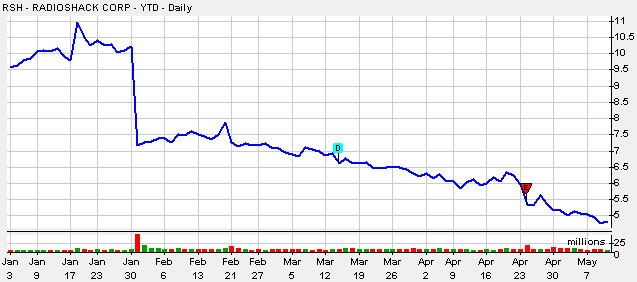
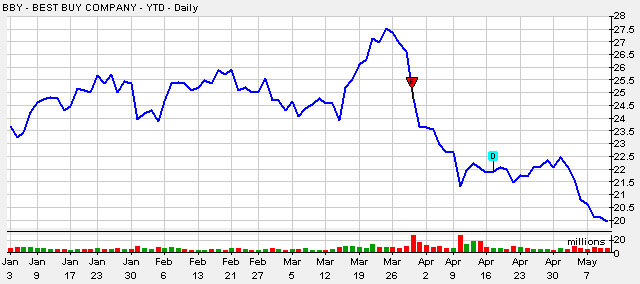
My amazing day. Yesterday I bought a TV from Best Buy. I “showroomed.” Which means I checked the price at Amazon. It was actually cheaper at Best Buy. A first! I also bought some batteries from Radio Shack. They were also on sale.
Irrespective of my huge purchases, neither company has any reason to exist and their stock prices are incresingly reflecting that:
More money saving tips:
+ Try Room77.com instead of Priceline.com.
+ Your bank manager will refund its excessive charges if you ask. Today I’m asking JP Morgan to refund the $34 bounced check charge they hit me with on a charity bank account I stupidly have with them. In the old days they would have called and said “Mr. Newton, you must have made a mistake…” These days they’re more interested in fees.
The Saturday Shabbath Service. At the regular Saturday morning service, the rabbi announced that he was planning to leave for a larger congregation that would pay him more.
There is a hush within the congregation. No one wants him to leave because he is so popular.
Fred Silverstein, who owns several car dealerships in Newton and Brookline, stands up and proclaims “If the rabbi stays, I will provide him with a new Cadillac every year and his wife with a Honda mini-van to transport their children!”
The congregation sighs in appreciation and applauds.
Saul Cohen, a successful businessman and lawyer, stands and says, “If the rabbi will stay on here, I’ll personally double his salary and establish a foundation to guarantee a free college education for his children!”
More sighs and loud applause.
Estelle Rubin, age 88, stands and announces with a smile, “If the rabbi stays, I will give him sex!”
There is total silence.
The rabbi, blushing, asks her: “Mrs. Rubin, you’re a wonderful and holy lady. Whatever possessed you to say that?”
Estelle’s 90-year old husband, Abe, is now trying to hide, holding his forehead with the palm of his hand and shaking his head from side to side, while his wife replies:
“Well, I just asked my husband how we could help, and he said, “Screw the rabbi.”

Harry Newton is annoyed as his brain’s inadequacy. For one, his hayfever allergies have almost disappeared. Is that because he switched to Allegra-D? Or is that because the pollen has gone away? Or is that because God has answered his prayers? What can I learn — if anything for August 24, when the hayfever season starts all over again.

Harry – stop the nonsense. You should be on MSNBC shouting from the rooftops about Wall St and the big banks. It is irresponsible and unfounded of you to headline “give me one reason Jamie Dimon shouldn’t be in jail”. First of all it is not a crime to mismanage. Second at the time of Dimon's statement April13 that it was a “tempest in a teapot” the positions held by JP Morgan were only slightly underwater. Since you are such a self proclaimed market maven you certainly know that global markets unraveled terribly since April 13 with much carnage taking place last week of April and all of May. So when he made that statement the losses were significantly smaller. You cant go to jail for that. While shareholders are down 10% today, depositor’s money was never at risk, and JP Morgan will still be profitable. While I can not defend poor management and lack of oversight calling for jail as if some crime had been committed is irresponsible on your part. Stocks (and bonds) blow up everyday. Get over it. Take a look deep inside the management of NLY and AGNC if you want to see guys with a shady past.
Losing the money on a bad decision is not the problem. Lying about it is.
Harry – the position turned bad after he said it was a tempest in a teapot. At the time of that statement the position was probably only a bit underwater or perhaps not at all. When global markets got slammed post French and Greek elections is when the position got hammered and it is what is responsible for $2billion loss. On April 13 it was not a $2billion loss- it was smaller and not worthy of headline news. So Dimon was not lying at the time of his statement. You should be ashamed of yourself. Jamie Dimon is a standup guy with great skills and is also a wonderful family man. calling for him to go to jail is despicable on your part. You should get your facts right before going viral with your inaccurate and damaging proclamations.
You should prove you know someone is lying before you call for him to go to jail. What proof to you have that on April 13 JP Morgan had a $2billion loss? What proof do you have that Jamie Dimon was lying? If losses at the time were say only $10million or $50 million that in fact would be insignificant in the grand scheme of JPM.
Spent the last two days listening to economist at a conference. Three key remarks: 1- borrow as much as you can because these rates and thirty year mortgages are slated to be a thing of the past. 2- buy real estate (not commercial) now because the residential cycle is ready to climb. 3- 2014 will be a mild recession but ALL forecasts for 2028-33 of for an awful, dramatic recessionary environment, quite possibly bordering on a depression
Here's what the economist should have said: 1) The world economy is about to slide down again as the European Union finally begins to unravel. 2) Housing prices will fall another 10-15 percent by the beginning of 2013. 3) U.S. will try another round of quantitative easing to stop the collapse but there will be general economic malaise/doldrums until about 2019. 4) If a Republican president gets in and taxes are cut for the rich, expect replace the phrase “Great Recession” with “Second Great Depression.”
He said the market (equities) will recede under a Republican president and stay flat (short term) under Obama. The larger issue, mounting debt, requires tax increases AND substantial cuts in spending. Anything other than implementing cuts and tax increases will fail to accomplish anything other than polarizing us more.