Favorite weekend cover:
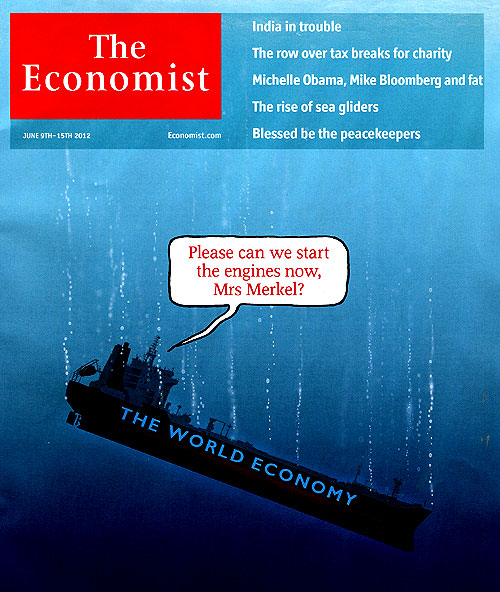
Here are some of the Economist’s words:
TO THE lifeboats!” That is the stark message bond markets are sending about the global economy. Investors are rushing to buy sovereign bonds in America, Germany and a dwindling number of other “safe” economies. When people are prepared to pay the German government for the privilege of holding its two-year paper, and are willing to lend America’s government funds for a decade for a nominal yield of less than 1.5%, they either expect years of stagnation and deflation or are terrified of imminent disaster. Whichever it is, something is very wrong with the world economy.
That something is a combination of faltering growth and a rising risk of financial catastrophe. Economies are weakening across the globe. The recessions in the euro zone’s periphery are deepening. Three consecutive months of feeble jobs figures suggest America’s recovery may be in trouble (see article). And the biggest emerging markets seem to have hit a wall. Brazil’s GDP is growing more slowly than Japan’s. India is a mess (see article). Even China’s slowdown is intensifying. A global recovery that falters so soon after the previous recession points towards widespread Japan-style stagnation.
But that looks like a good outcome when set beside the growing danger of a fracturing of the euro. The European Union, the world’s biggest economic area, could plunge into a spiral of bank busts, defaults and depression-a financial calamity to dwarf the mayhem unleashed by the bankruptcy of Lehman Brothers in 2008. The possibility of a Greek exit from the euro after its election on June 17th, the deterioration of Spain’s banking sector and the rapid disintegration of Europe’s cross-border capital flows have all increased this danger (see article). And this time it will be harder to counter. In 2008 central bankers and politicians worked together to prevent a depression. Today the politicians are all squabbling. And even though the technocrats at the central banks could (and should) do more, they have less ammunition at their disposal.
Nobody wants to test these various disaster scenarios. It is now up to Europe’s politicians to deal finally and firmly with the euro. If they come up with a credible solution, it does not guarantee a smooth ride for the world economy; but not coming up with a solution guarantees an economic tragedy. To an astonishing degree, the fate of the world economy depends on Germany’s chancellor, Angela Merkel (see article).
In one way it seems unfair to pick on Mrs Merkel. Politicians everywhere are failing to act-from Delhi, where reform has stalled, to Washington, where partisan paralysis threatens a lethal combination of tax increases and spending cuts at the end of the year. Within Europe, as Germans never cease to point out, investors are not worried about Mrs Merkel’s prudent government, whose predecessor restructured the economy painfully ten years ago; the problem is a loss of confidence in less well-run, unreformed countries.
But do not get too sympathetic. To begin with, past virtue counts for little at the moment: if the euro collapses, then Germany will suffer hugely. The downgrading of some of its banks this week was a portent of that. Moreover, the undoubted mistakes in Greece, Ireland, Portugal, Italy, Spain and the other debtor countries have been compounded over the past three years by errors in Europe’s creditor countries. The overwhelming focus on austerity; the succession of half-baked rescue plans; the refusal to lay out a clear path for the fiscal and banking integration that is needed for the single currency to survive: these too are reasons why the euro is so close to catastrophe. And since Germany has largely determined this response, most of the blame belongs in Berlin.
Outside Germany, a consensus has developed on what Mrs Merkel must do to preserve the single currency. It includes shifting from austerity to a far greater focus on economic growth; complementing the single currency with a banking union (with euro-wide deposit insurance, bank oversight and joint means for the recapitalisation or resolution of failing banks); and embracing a limited form of debt mutualisation to create a joint safe asset and allow peripheral economies the room gradually to reduce their debt burdens. This is the refrain from Washington, Beijing, London and indeed most of the capitals of the euro zone. Why hasn’t the continent’s canniest politician sprung into action?
Her critics cite timidity-and they are right on one count. Mrs Merkel has still never really explained to the German people that they face a choice between a repugnant idea (bailing out their undeserving peers) and a ruinous reality (the end of the euro). One reason why so many Germans oppose debt mutualisation is because they (wrongly) imagine the euro could survive without it. Yet Mrs Merkel also has a braver twin-headed strategy. She believes, first, that her demands for austerity and her refusal to bail out her peers are the only ways to bring reform in Europe; and, second, that if disaster really strikes, Germany could act quickly to save the day.
The first gamble can certainly claim some successes, notably the removal of Silvio Berlusconi in Italy and the passage, across southern Europe, of reforms that would recently have seemed unthinkable. But the costs of this strategy are rising fast. The recessions spawned by excessive austerity are rendering it self-defeating. Across much of Europe debt burdens are rising, along with the appeal of political extremes. The uncertainty caused by the muddle-through approach is draining investors’ confidence and increasing the risk of a euro disaster.
As for Germany’s idea that it could all be saved at the last minute, by, for instance, the European Central Bank (ECB) flooding a country with liquidity, that looks risky. Were Spain to see a full-scale bank run, even an emboldened Mrs Merkel might not be able to stop it. If Greece falls out, yes, the German public would be more convinced that sinners would be punished; but, as this newspaper has argued before, a “Grexit” would cause carnage in Greece and contagion around Europe. Throughout this crisis, Mrs Merkel has refused to come up with a plan bold enough to stun the markets into submission, in the same way that America’s TARP programme did.
In short, even if her strategy has paid some dividends, its cost has been ruinous and it has run its course. She needs to lay out a clear plan for the single currency, at the latest by the European summit on June 28th, earlier if Greece’s election spreads panic. It must be specific enough to dispel all doubt about Germany’s commitment to saving the euro. And it must include immediate downpayments on deeper integration, such as a pledge to use joint funds to recapitalise Spanish banks.
This would risk losing her support at home. Yet with these risks comes the possibility of rapid reward. Once Germany’s commitment to greater integration is clear, the ECB would have the room to act more robustly-both to buy many more sovereign bonds and to provide a bigger backstop for banks. With the fear of calamity diminished, a vicious cycle would become virtuous as investors’ confidence recovered.
The world economy would still have to grapple with ineptitude elsewhere and with weak growth. But it would have taken a giant step back from disaster. Mrs Merkel, it’s up to you.
You can read the full leader (that’s what the Economist calls its editorials) here.
Apple’s big developer conference this week should add a few dollars to its share price. There’ll be news of an upgraded OS (operating system). Apple doesn’t make the fuss (nor create the inconveniences) Microsoft does, but its upgrades are useful and important.
Falling in love and out of love. He comes with a super idea. I fall in love. I’m ready to write a check. This is the greatest thing since sliced bread. Then he does something stupid. One little thing. Questions suddenly pop into my brain. If he can be this stupid …what about other things? Erstwhile things I ignored pop up.
When I worked with my salespeople, I told them the two biggest mistakes they could make were:
1. Talking too much. The prospect is set to buy and they keep talking positive features — some of which the customer doesn’t like.
2. Not grabbing the order when the customer is ready to buy. Delay will kill enthusiasm faster than anything else.
People like to buy.
My investment banker/venture capital guy cautions me, “Never fall in love. Your chances of being disappointed are too high.”
Good news: there’s an explosion of startups today. Oodles of new tech companies to invest in. When God closes a door, he always opens a window.
Nuts for bow ties. My friends like me in my borrowed bow tie. I went to buy one. You can buy a bow tie for $3 and one for $155. Some are tied. Others you have to tie yourself. YouTube has a video. Click here. This is my favorite bow tie I could find on line.
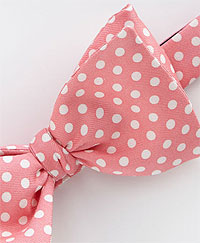
It’s silk and costs $49.50 from here. I’m mulling this extravagance.
Facebook redeemed. The broker who “sold” my 100 shares of Facebook at $38 on the first day is rewriting the ticket to show that he sold it at $40. Which goes to prove that the squeaky wheel (i.e. me) gets the most attention.
Have no fears: I don’t intend to spend all the $200 at once. There’ll be rainy day?
Amazon has a big sale on SSDs (solid state drives). SSDs are the best way to speed up your laptop or desktop computer.
Look carefully. Friday morning, Central Park. On the left is a lone piper practicing his bag pipes.

His name is James Felder. He’ll play at your wedding (or funeral) for $200 to $300. But only in New York City since he doesn’t drive. He’s good. I heard him. Email him — HSStudios@aol.com.
The French Open goes to Nadal. Novak made a double fault on championship point. Can you imagine how he feels? That’s nerves bailing. Sad for him.

Harry Newton who is thankful to Facebook for broadcasting his birthday and soliciting zillions of “Happy Birthday” wishes from friends near and far. Ditto for the huge number of comments on the weekend’s blog. Thank you to everyone.
The BIG lesson on getting old is urgency. Do it now. Don’t delay.
+If you want to take that trip you always wanted, do it.
+ If you want to be an entrepreneur, don’t work for da man, i.e. a big company. Do it now.
+ If you feel confident about buying long (or selling short) that stock, do it now.
Nothing moves faster than the watch on your wrist, the clock on your desk or (most likely) the clock on your cell phone.
The second big lesson is prioritize. Each day, figure the Five Most Important Things to Accomplish, and do them. Put the hardest one at the top. Do it. You’ll feel on a high for the rest of your day. Excellent way to start your day.

Hi Harry.
Love the sight. However, you inexlicable insoucciance towards showing a more robust model portfolio with gains, losses, and performance histor disappoint me. That is the only way to guage your recommendations.
I've listed the portolio on several occasions. But it's actually boring, since much of it doesn't change — e.g. muni bonds and mortgage REITs.
What, Harry's 70? When did he get so much older than me!
Henry have you ever had the Ambulatory Plebectomy done on the varicose leg veins?
Joe say no is involved in Dgit
No.
Happy Belated 70th Harry !
Wishes for many more !
Robert Karr
Arlington, Texas
thank you.