Yesterday the market began strongly, then skidded and went negative — as Europe did its usual damage.
The general consensus: Europe is bandaiding its problems, not fixing them. After Spain comes Italy and on it goes. Wait for France….
The New York Times editorialized this morning (my emphasis):
Now, Spain
Two weeks after Prime Minister Mariano Rajoy of Spain vowed “there will be no Spanish banking rescue,” and after days of delay in which Mr. Rajoy pressed European officials for sounder rescue terms, Spain has now joined Greece, Ireland and Portugal as the latest bailout recipient. Catastrophe averted? Hardly.
Bailouts – this one is worth up to $125 billion – are supposed to help restore investor confidence. But investors have clearly figured out what too many European politicians are still denying: serial bailouts, piecemeal plans and one-size-fits-all austerity are not a solution.
On Monday, Spanish and Italian borrowing costs spiked after Mr. Rajoy, the day before, had lamely tried to downplay the new bailout – calling it a line of credit – while Mario Monti, Italy’s prime minister, publicly warned of a “permanent risk of contagion.”
And the next potential calamity is just days away. On Sunday, Greek voters will go to the polls to choose a new government and, by implication, whether to stay in the euro zone. A disorderly Greek exit (it is hard to imagine an orderly one) could threaten bank stability throughout the euro zone. Some analysts are warning it could provoke a Lehman Brothers-like global financial seizure.
Spain urgently needed the bailout, and it may turn out to be a better package than the others. The Spanish government will be able to use the money for the sole purpose of recapitalizing its banks, avoiding the onerous and counterproductive austerity conditions imposed on Greece, Ireland and Portugal.
The looser terms were presented as a reward of sorts for Madrid’s voluntary fiscal stringency over the past several months. We hope that it also means that German and other European officials are beginning to figure out that the relentless austerity they have demanded has been a failure. Fiscal contraction has deepened recession in Europe’s struggling economies, making them less able to repay their debts. It has also led to social and political upheaval, with Greece as Exhibit No. 1.
Spain’s troubles are rooted not in profligate government borrowing but in the bursting of a housing bubble that has devastated banks that lent too much, too recklessly, for too long. The bailout correctly gives the European Union the authority to monitor the bailed-out banks and a greater voice in structural reforms, including loosening the tight links between local politicians and local banks.
But Spain is not out of the woods. The aid will add to the country’s debt load, making it harder for the government to repay its existing debt while delivering basic services. A subsequent bailout to shore up the government is probably unavoidable.
Which brings us back to the main issue. With every stopgap solution to the euro-zone debt crisis, the gaps have gotten larger and the stops have gotten shorter.
Europe’s leaders – especially Chancellor Angela Merkel of Germany – need a new playbook. Previous austerity pacts must be softened; if it is politically impossible to refer to that process as a “renegotiation,” then call it something else, as long as new agreements allow for growth measures to address high unemployment.
At a meeting scheduled for later this month, Europe’s leaders must also accelerate the process of institutional integration, beginning with the Continent’s banking system, including euro-zone-wide deposit insurance, bank supervision and joint plans for managing bank failures.
If Europe can’t take those first steps, then it would be folly to believe that leaders will ever agree on fiscal and political unity, without which the euro will not make it.
Personally, I have no idea if the Euro will or won’t make it. Nor whether Europe’s politicians will ever find the gumption to do what’s necessary to save the Euro.
Nor do I know what the short-term and long-term costs of breaking the Euro apart will be. All I know is that I do not want my investments oriented to Europe. It’s contagion. Every indecision leaks to more market volatility, which is not good for my wallet or my psyche.
The New York Times also ran pieces by Andrew Ross Sorkin, “Why the Bailout in Spain won’t work.” Click here. And a piece by Joe Nocera How Not to Solve a Crisis. Click here
What a wonderful world. Please watch this commercial for BBC One. It’s stunning, classy, and truly wonderful. Click here.
AGNC declares dividend. The latest quarterly dividend is $1.25. That gives AGNC a dividend yield of 16%, which is better than a slap in the belly with a cold fish.
The stock has been on a tear recently:
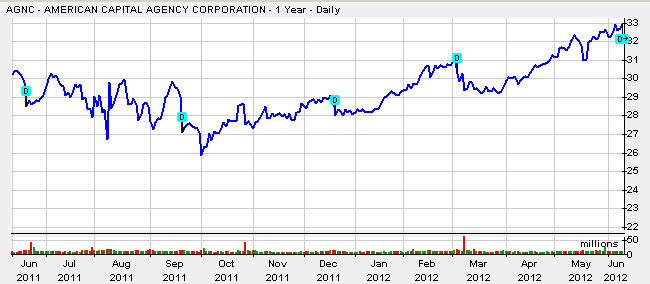
The little blue dots are dividend payouts. The last two are $1.25 each. The previous three on this chart were $1.40. Despite the lower dividend, AGNC has risen strongly. It’s also one of my largest positions.
Apple. Some Good. Some Bad. My rich friend rushed out and spent $3800 on a new MacPro he doesn’t need. Apple has lots of crazies who buy its new stuff — whatever it announces. I’m not one of them. I didn’t buy the new iPad. I won’t buy the new MacBook Pro, since I have a perfectly fine old one in the closet sitting unused. I am waitingfor the new iPhone 5.
Apple dropped the price of three models of its lightweight MacBook Air by 6% to 8%. There are many people who think Apple is presently a great bargain:
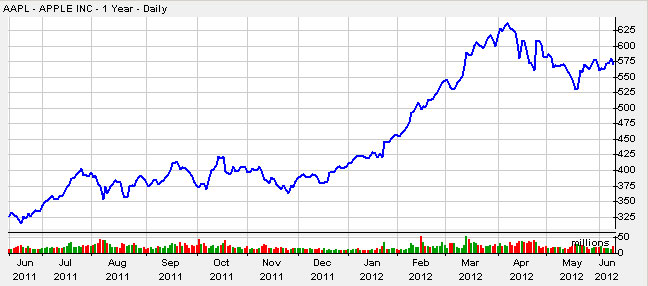
There are others who believe that without Steve, it’s ultimately doomed. Its P/E is presently 13.9%. Which looks reasonable for today’s desultory stockmarket. That’s above Microsoft and Cisco.
for more on Apple’s announcements, click here.
Why I don’t buy…
+ Mining stocks. They’re always in a cycle. When prices go up, they open mines, pump more oil, increase supply. In turn, that drives down prices. Then they close mines, pump less oil, decrease supply. Right now oil is dropping because the Saudis are pumping like crazy. They fear the explosion in cheap natural gas in the U.S. and hence even lower oil prices. I can predict this stuff. But I can’t time it. Hence I stay out.
+ Biotech stocks. The FDA gives irrationality a whole meaning. Some years it wants to protect us more and save us less. Some years it likes new biotech formulations. Some years it doesn’t. It’s a political animal that no one can predict. And then there are patent expirations and Obamacare. I have enough problems trying to predict when Rosie (our dog) will go outside, and not on the nice white rug — the giant wee-wee pad in our living room (at least in her tiny mind).

Rosie yesterday. Loveable, cute, and untrained. Oih.
New, fast cameras.I love my Canon G10, though its shutter is slow. I love my new Nikon D7000, though it’s heavy. I keep looking for the perfect, powerful, tiny, portable camera. Canon has a new G1X with a huge image processor. But the G1X is too big and clunky. Leica has a new V-LUX-40 and an allegedly fast shutter. Sony has a newRX-100 — small, and with a beautiful fast lens. But it’s not out yet. I think we’ll see some more this summer. I’m holding off, for now.
AT&T cellphone sucks.That’s a polite term. It has the distinction of never working when I need it — unless I’m on Wi-Fi.
Refrigerant. Freon. The stuff airconditioners work on. Here’s the story; All air conditioners use something. If your AC starts pumping only warm air, you likely don’t have enough freon. That means cars, central HVACs, window units, wine cellar coolers, etc. . Some cars will run ten years without topping up their freon. Some will go a couple of years. You can’t tell. You can’t even top up some ACs. Our wine cooler lost its refrigerant. We had to buy a new one, because it can’t be topped up. Our Mercedes lost its freon, but could be topped up. Sadly, topping up is not something normal people like you and I can do with the tools in our basement.
Good idea to get the man in and top up your central HVACs and clean the outside condensers — before it gets too sinking hot.
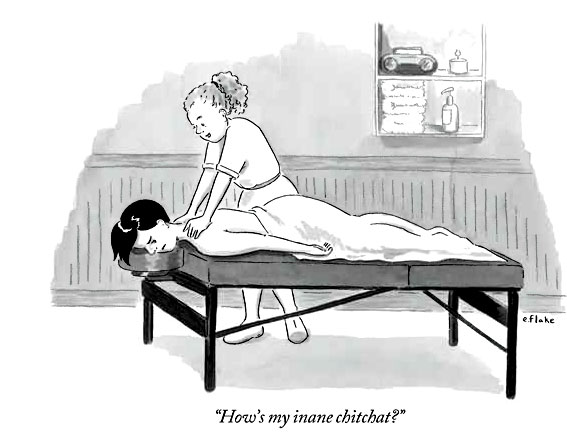
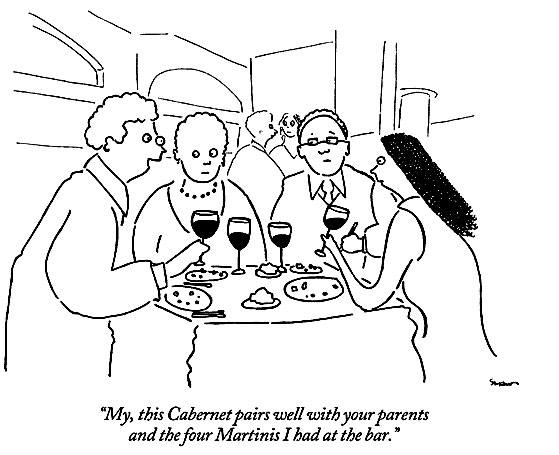
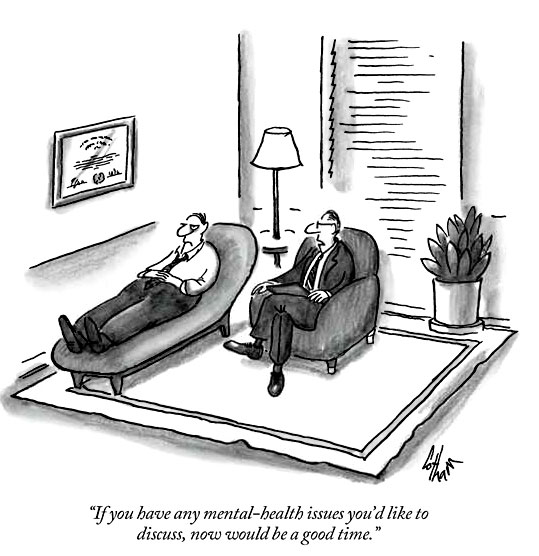
This week’s favorite New Yorker cartoons:

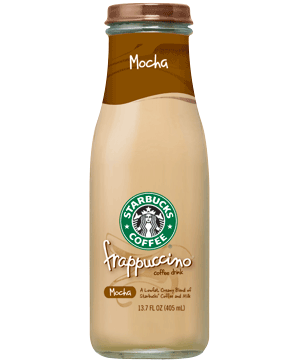
Harry Newton who is hooked on Starbucks frappuccino Mocha
and Pepperidge Farms Jewish Rye bread doused with Philadelphia cream cheese.

Pepperidge Farms Jewish Rye is my fave, too. Roll any filling in it, or grill it with swiss, tomato, bacon. The thinner slice is perfect for everything. A must have, at all times! BTW: Happy Bday.
Remember, if an AC system needs topping up, it is leaking in some way. Make sure you get it fixed as well as topped up.
Coolant doesn't just disappear, it has to get out somehow.
Harry…Starbucks coffee is now grown in China from very “natural” fertilizer…I neither ear nor drink anything grown in China…been there…seen that! Especially avoid any type of fish or shrimp grown in China or other Far Eastern countries…waters of rivers and nearby seas are heavily polluted…even worse than their air. Get a Tassimo “one cup” coffee maker for great coffee drinks…pour them over ice and add your own creamers and sweeteners.
OK, Harry. For years I've read your daily “Looking for the Pefect Investment” column and suddenly, after not finding an answer, only terrors, ghosts, goblins and lurking monsters (i.e., your normal Wall Street news for last 12 years) I realized I knew the answer. Get born to rich parents and voila!, no more worries. If too late, get adopted by Warren Buffett or one of his peers. Again, voila, no worries. Sure beats trying to outguess the market. No?
Given that you have experienced quite a few dental issues in recent years, I think you should be careful about the frequency with which you consume the frappuccino for the sake of your teeth…here's the ingredient list: Brewed Starbucks® Coffee (Water, Coffee), Reduced Fat Milk, Sugar, Cocoa, Pectin, Ascorbic Acid. I don't know what the pH is, or why it contains ascorbic acid, but I would definitely place it in the occassional treat category versus dietary staple.
Hi Harry,
The link you provided to the BBC One commercial is not working.
Thank you. I fixed.it. It's working now.
and it IS great!