More reasons not to own any of our major banks. They’ve all become cockroach stocks.
Remember yesterday’s article about how the banks conspired to defraud municipalities of billions? Now comes news of a conspiracy to rig Libor (the key interest rate) and defraud borrowers. From today’s Wall Street Journal an incredible article:
Barclays Settles Rates Probe
LONDON-Barclays PLC said it will pay £290 million ($453.6 million) to settle a long-running probe by U.S. and U.K. regulators into allegations that traders at the bank manipulated interbank lending rates.
The U.K. bank is the first major financial institution to settle with regulators following a sprawling interest-rate probe in North America, Europe and Asia that has led to a score of individuals being fired or suspended by major U.S. and European banks and leading brokers. No banks or individuals have been charged with wrongdoing.
Barclays said in a statement Wednesday that it had settled with the U.K.’s Financial Services Authority, the U.S. Commodity Futures Trading Commission and the U.S. Department of Justice’s fraud section. It also said Chief Executive Robert Diamond and three other top executives-Chris Lucas, Jerry del Missier and Rich Ricci-will forgo their annual bonuses for 2012.
Mr. Diamond’s total compensation for 2011 came to around £15 million.
“The events which gave rise to today’s resolutions relate to past actions which fell well short of the standards to which Barclays aspires in the conduct of its business,” Mr. Diamond said. “When we identified those issues, we took prompt action to fix them and cooperated extensively and proactively with the authorities…I am sorry that some people acted in a manner not consistent with our culture and values.”
The $200 million fine levied by the CFTC is the biggest financial penalty ever imposed by that regulator. The U.K.’s FSA also slapped the bank with a record £59.5 million fine, and the DOJ fined the bank $160 million.
The Libor, or London interbank offered rate benchmark, at the center of the probe is used to price home and auto loans, corporate debt and derivatives totaling more than $350 trillion. Libor is calculated by Thomson Reuters under the auspices of the British Bankers’ Association and is based on data submitted daily by a 16-bank panel. The benchmark measures the rates at which major banks borrow from each other. The other major benchmark probed, the Euro Interbank Offered Rate or Euribor, is set by a panel of 43 banks.
Banks that have disclosed they are being investigated include Citigroup Inc., Deutsche Bank AG, HSBC Holdings PLC, J.P. Morgan Chase & Co. and Royal Bank of Scotland Group PLC. Swiss bank UBS AG has said it has been granted partial immunity by certain regulators, including the Justice Department, in return for cooperating with the probe.
As part of the investigation, officials are trying to determine whether some banks deliberately tried to skew Libor by submitting inaccurate data during the financial crisis. One possibility being probed is whether banks mutually agreed to hold down their rates to avoid appearing as though they were borrowing at high costs. Another key question was whether interest-rate derivative traders in the banks colluded with those who submit the data to set the rate to boost profits. U.K and U.S regulators stopped short of stating that Barclays successfully fixed the benchmark.
The CFTC said there were two areas of unlawful conduct by Barclays. The first concerned senior management, the regulator said. In late 2007, as banks came under pressure in the early rumblings of the financial crisis, Barclays managers didn’t want the bank to be seen to be paying high rates to borrow, it said. After discussions “among high levels of management” within the bank, an order was sent to keep Barclays’ submissions to U.S. dollar Libor at an artificially low level, the CFTC said.
“Barclays Libor submitters were told not to submit [quotes for U.S. Libor] at levels where Barclays was ‘sticking its head above the parapet,'” the CFTC said. “Multiple” senior managers at the bank were involved, according to a CFTC official. People familiar with the matter say the majority of Barclays employees involved in the alleged manipulation have left the bank.
The CFTC also said Barclays traders in New York, London and Tokyo attempted to manipulate Libor to help their derivatives trading positions. Traders made unlawful requests to the bank’s rate submitters “routinely, and sometimes daily” from at least mid-2005 to at least the fall of 2007, the CFTC said. The requests were frequently accepted by the bank’s rate submitters, according to the CFTC. It quoted emails such as “always happy to help” and “Done…for you big boy.”
A CFTC official described its $200 million penalty in a telephone call with reporters Wednesday as “an appropriate and just result.” CFTC officials declined to discuss why no individuals were charged as part of the enforcement action.
The FSA said Barclays’ traders sought to profit from the bank’s trading positions and sought to influence other banks setting the benchmark.
“Making submissions to try to benefit trading positions is wholly unacceptable. This was possible because Barclays failed to ensure it had proper controls in place,” the U.K. regulator said. “Barclays’ behavior threatened the integrity of the rates with the risk of serious harm to other market participants.”
The settlement is the latest blow to the credibility of the Libor benchmark. The British Banker’s Association said in March that a steering group made up of several major banks, including Barclays, will be asked to consider codes of conduct as part of a wide-ranging review of the methods used to set Libor.
The BBA’s review, which is the second in four years, is considering the financial instruments included in defining the benchmark in an effort to ensure the daily rates submitted by the banks are accurate. A result is expected in the coming months.
In a statement Wednesday, the BBA said that the regulators’ findings had “extremely serious implications which need to be carefully considered.”
Jamie Dimon is a banking genius. That’s the prevailing wisdom. When news of his huge trading loss came out, it tarnished his reputation. and his stock fell. But his super strong reputation prevailed and the stock bounced back. I argued that JPMorgan was now a Cockroach Stock. There were two reasons:
1. JPMorgan hadn’t closed his $2 billion trade. That smelled. When I am losing money, I sell the stock, instantly, if not sooner. There was something fishy about not closing a losing trade. and not being very clear on how big the loss was going to be.
2. To this day, we still don’t know what the JPMorgan trade was. This is how today’s New York Times described it:
In its most basic form, the losing trade, made by the bank’s chief investment office in London, was an intricate position that included a bullish bet on an index of investment-grade corporate debt. That was later combined with a bearish wager on high-yield securities.
The article went on to explain:
The chief investment office – which invests excess deposits for the bank and was created to hedge interest rate risk – brought in more than $4 billion in profits in the last three years, accounting for roughly 10 percent of the bank’s profit during that period.
In testimony before the House Financial Services Committee last week, Mr. Dimon said that the London unit had “embarked on a complex strategy” that exposed the bank to greater risks even though it had been intended to minimize them.
Anyway, the loss has escalated to $9 billion or so. And Jamie Dimon has major egg on his face. I believe JPM will fall today on this latest cockroach news.
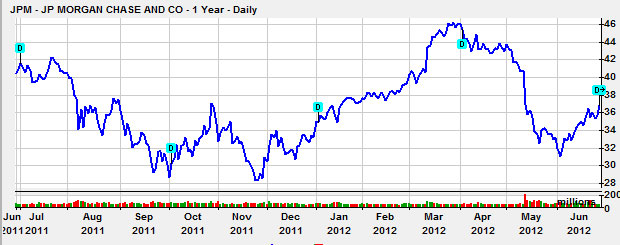
But I’m not shorting it. It should be a good short, even after this latest news. But Mr Dimon is a charmer. An awful lot of people believe he walks on water. No one does.
You can read about how Jamie’s loss may reach $9 billion here.
Harry, should I buy BHP? asked Lucas.
Yesterday I nibbled at BHP. It has fallen dramatically:
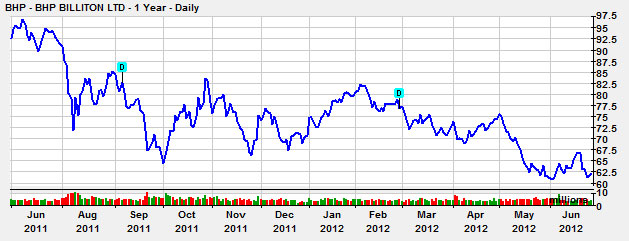
While I hate catching falling knives, BHP has allen to a yield of 3.54% and the Australian dollar was recovering handsomely, and, and, and.
But Lucas, you (or anyone else) should not own BHP — without doing your own homework and being prepared to watch it like a hawk. If it drops 6%, I’m out. And I won’t have time to email you.
In the old days, when I accepted recommendations from self-proclaimed stockmarket genii (plural of genius) I always lost money. These days I politely say “thank you,” do my research and inevitably pass.
Everyone is crazy. Everyone has their own ideas that work for them, but usually not for you.
From the latest Richard Russell newsletter:
“Never invest in anything that eats or needs repainting.” Billy Rose.
Don’t laugh — the bird flu is destroying the ostrich-farm business in Africa.
Reading, but not buying. I get almost as much pleasure from reading about the thing I want to buy, than actually buying it. My latest “read” is all about the Sony Cyber-shot DSC RX-100 ultra-talented pocket size camera:
1. Huge sensor, about four times larger than my favorite Canon G10. This results in super-clear images.
2. f1.8 lens at maximum aperture. In contrast, the Canon G series widest is f2.8.
3. Very light — around half the weight of the G10. Fits in your shirt pocket.
4. It probably has no shutter lag. Though I don’t know for sure.
5. Great looking:


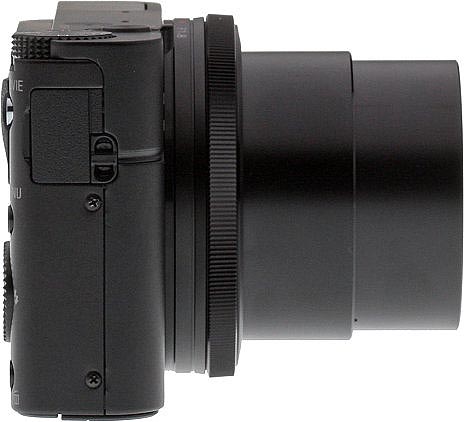
Fortunately the $650 suggested list camera isn’t available yet. But you can read about it here and salivate.

Harry Newton who constantly marvels at the service he gets from Amazon. Fast delivery. Great prices And they always have what I want. Why Google when you have Amazon. In mid-June I bought a 256 gig SSD from them for about $260. It got delivered and signed for my someone our building doesn’t know. I emailed Amazon yesterday with my sorry story. They immediately sent me another one by overnight shipping. No questions. No fuss. No bother. That’s great service. They have me as a customer-for-life (which I actually already was).
When I was in business, I initiated a policy called “The Escalating Happiness Project.” If one of our customers complained about something, we’d make it good and say “Sorry.” A few days later, we’d send them a gift, apologizing again. Then we’d keep sending them gifts until they finally called us, admitting defeat. They forgave us. They loved us. They would be a customer-for-life.
The only thing wrong with my brilliant program was that it actually gave us an incentive to mess up the customer’s order. By making it well and sending all those presents, we achieved a stronger, happier customer. We resisted the temptation.

Chief Justice John Roberts is a liberal……….congratulations Harry.
Harry, 2 quick questions: 1. Where does all the FINES money go ? Is there a public accounting for it ? and 2. Gee If I had only known about the Happiness Project, Is it too late to complain ?