Dividends, bonds, an inviolate 8% stop loss rule and lots of cash have protected me and kept my portfolio up despite the weakness in the stockmarket of the last two months.
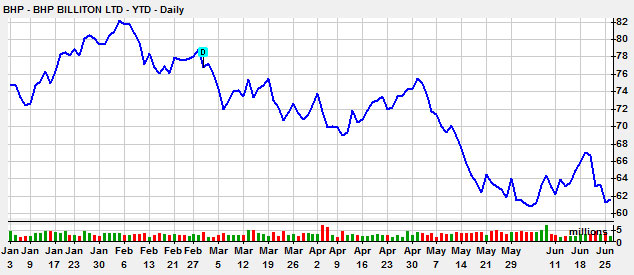
Several readers believe now is the same perfect time to get back into the market as March 2009 was. For a flyer, try a favorite of mine — BHP. Its P/E is 7.24 and its yield is 3.57%. It’s heavily dependent on good times in China., however.
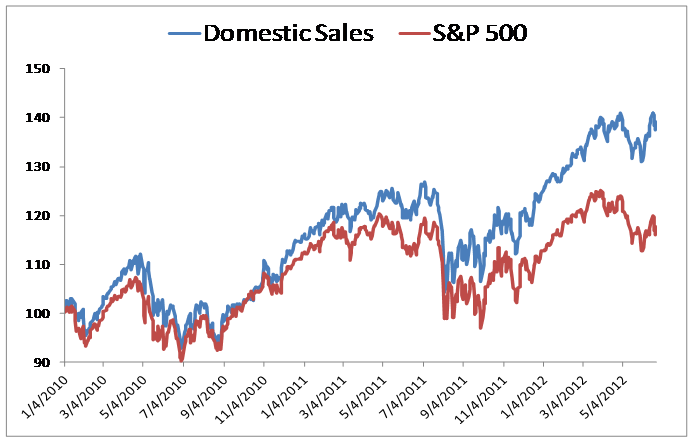
Stocks with less exposure to Europe and Asia are doing better than those with overseas exposure. This chart came from a research firm called BTIG, which wrote:
The chart (rebased to 100 at the beginning of 2010) compares the S&P 500 to a BTIG custom, market cap weighted basket of U.S. companies that generate virtually all if not entirely all of their revenues from the United States. Names such as UNH, NUE, COG and PAYX are in the basket and as the chart plainly illustrates, companies that are thought of as insulated from global issues have begun to meaningfully outperform. Investors are truly “coming home.” For that reason, heeding the debate in the aforementioned paragraph could be crucial for maintaining, or obtaining, portfolio outperformance.
Real estate returns, sort of. In the good old days (like 2005) the real estate syndicators bought overpriced commercial property, knowing they could sell the property at even higher prices a year or two later. Their optimism was giddy. They borrowed short-term, caring not one wit for for the terms of the loan because they planned on selling so quickly. Then 2008 came, the big tenants left, rents plunged, the loans came due, the owners couldn’t make the bank payments and the banks took the properties. They syndicators and their investors lost money bigtime.
These days the syndicators freely admit they have no idea when the next big real estate bust will come — except that it will come. Their present strategy is hence:
1. Longer duration loans. Ten years is best. that will last through at least one boom and bust cycle.
2. Higher equity investment. These days I hear Loan To Value (LTV) ratios of commonly 62%, compared to 75% to 80% in the good old days.
3. Invest only in properties that have a solid, almost stabilized income stream, with hopefully some opportunity to improve the place a bit and up the value.
3. Interest coverage should be at least two times. In other words, you should have twice as much money left over after the expenses of running the property in order to pay the bank.
4. No more funds.
Lessons from the following hedge fund story:
1. Give your money to someone else and kiss it Good Bye.
2. Nothing last forever. No run of good luck nor good judgment lasts forever.
3. The reason you gave your money to the genius last year is not what your genius is doing this year.
4.. Chasing last year’s hot idea or, worse, hot manager, is a really dumb idea.
5. Goldman Sachs always gets preferred. You get screwed.
6 Telecommunications “opportunities” and stocks usually suck (especially if you don’t know anything about telecom, i.e. you’re a hedge fund manager).
This story is from this morning’s New York Times:
S.E.C. Said to Be Poised to Sue Fund Manager
His wireless dreams all but dashed, billions of dollars lost and investors swearing him off, Philip A. Falcone has been a colorful exhibit of how quickly fortunes can turn in the hedge fund world.
Adding to Mr. Falcone’s mounting woes, the Securities and Exchange Commission is expected to sue the money manager as soon as this week, planning to accuse him of taking a personal loan from his hedge fund, Harbinger Capital Partners, and of giving preferential treatment to Goldman Sachs, according to a person briefed on the matter Tuesday.
The decision to pursue an enforcement action follows a battle of months between the pugnacious hedge fund manager and regulators. It also punctuates a staggering fall for one of Wall Street’s most closely watched investors and personalities. The S.E.C. may accuse Mr. Falcone of market manipulation in the purchase of bonds in MAXX Holdings, a maker of bathroom fixtures, according to the person.
Mr. Falcone, who grew up in a small Minnesota town and made billions of dollars betting against the subprime mortgage market, said on Tuesday that he planned to fight “vigorously” the allegations against him.
“Any allegations by the S.E.C. of improprieties by Mr. Falcone or Harbinger are neither supported by the facts or the law,” Mr. Falcone’s lawyer, Matthew S. Dontzin, said in a statement.
The agency first flagged Mr. Falcone’s actions last December, when they served him and his hedge fund with a so-called Wells notice, an indication that a regulatory action was likely.
The case stems from the period around the financial crisis, when hedge funds, Harbinger included, were reeling from losses. In late 2008, Mr. Falcone elected to suspend or limit withdrawals from his biggest funds, saying it was necessary to preserve all investors’ rights. Investors, however, were irate.
Then, shortly after, Mr. Falcone is said to have given permission to Goldman, a major investor, to withdraw money in a way that others could not. The arrangement, according to the person briefed on the matter, was permitted in the fund’s documents; the exact nature of the government’s contention is not clear.
Later in 2009, Mr. Falcone also took a $113 million loan from one of his hedge funds to pay a personal tax bill, again at a time when investors were not afforded the same right. Mr. Falcone has said that his lawyers at Sidley Austin approved the transaction and drafted a legal opinion in support of it. He also has said that he paid back the loan with interest.
Over the last few months, Mr. Falcone and his lawyers have talked to the S.E.C. over a potential settlement. But the meetings proved fruitless. Bloomberg News earlier reported that the agency was preparing a lawsuit.
While the regulatory crackdown is a setback for Mr. Falcone, it pales in comparison with the bankruptcy of the crown jewel of his empire, LightSquared. The company was to provide wireless broadband service to compete with the likes of Verizon and AT&T by selling chunks of data wholesale to independent providers.
But as other investments Mr. Falcone held began to wane, and as his investors began to flee, the size of the LightSquared gamble began to take up a bigger and bigger portion of his portfolio. Having angered investors and summoned the scrutiny of regulators, the company also became increasingly important to his fate as a hedge fund manager.
Those high-flying wireless ambitions came crashing down around him earlier this year, when the Federal Communications Commission pulled the plug on his venture. The agency, which had initially supported Mr. Falcone’s plans to build the 4G network, promptly reversed course after an adviser determined it would interfere with GPS signals.
Since then, Mr. Falcone’s LightSquared has filed for bankruptcy, and creditors have been jockeying for control as Mr. Falcone struggles to remain in charge of his operation. As he has in most other challenging situations in the last two years, Mr. Falcone has vowed to fight the F.C.C. ruling to retain the rights to build his wireless network.
It has been a big comedown for Mr. Falcone, whose expensive habits have been the talk of New York society since he exploded onto the scene with his subprime bet. Mr. Falcone purchased the Upper East Side mansion of former Penthouse publisher Bob Guccione for $49 million, and a mountaintop villa in St. Barts.
Investors flocked, attracted by the next hedge fund star. At its apex in 2008, Harbinger held about $26 billion in assets. But after big investment losses and large withdrawals, there are indications that Mr. Falcone has just a few billion left, if that, a big chunk of it his own money.
Now, go back and read my four lessons above.
Recommended reading:I forgot to add the link to Matt Taibbi piece yesterday. It’s below.
+ The Scam Wall Street Learned From the Mafia. How America’s biggest banks took part in a nationwide bid-rigging conspiracy – until they were caught on tape. This is the story of how Wall Street ripped municipalities off for billions. As the piece by Matt Taibbi explains (in the piece I excerpted yesterday)
…These three Wall Street wiseguys spent the past decade taking part in a breathtakingly broad scheme to skim billions of dollars from the coffers of cities and small towns across America. The banks achieved this gigantic rip-off by secretly colluding to rig the public bids on municipal bonds, a business worth $3.7 trillion. By conspiring to lower the interest rates that towns earn on these investments, the banks systematically stole from schools, hospitals, libraries and nursing homes – from “virtually every state, district and territory in the United States,” according to one settlement. And they did it so cleverly that the victims never even knew they were being -cheated. No thumbs were broken, and nobody ended up in a landfill in New Jersey, but money disappeared, lots and lots of it, and its manner of disappearance had a familiar name: organized crime.
Here’s a new excerpt (one for today). this stuff is truly amazing.
To grasp the full insanity of these revelations, one must step back and consider all this information together: the bribes, yes, but also the industrywide, anti-competitive bid-rigging scheme. It turns into a kind of unbroken Möbius strip of corruption – the banks pay middlemen to rig auctions, the middlemen bribe politicians to win business, then the politicians choose the middlemen to run the auctions, leading right back to the banks bribing the middlemen to rig the bids.
When we allow Wall Street to continually raid the public cookie jar, we’re not just enriching a bunch of petty executives (Wolmark’s income in 2008, two years after he was busted in the FBI raid, was $2,464,210.18) – we’re effectively creating an alternate government, one in which money lifted from the taxpayer’s pocket through mob-style schemes turns into a kind of permanent shadow tax, used to maintain the corruption and keep the thieves in place. And that cuts right to the heart of what this case is all about. Wall Street is tired of making money by competing for business and weathering the vagaries of the market. What it wants instead is something more like the deal the government has – regularly collecting guaranteed taxes. What’s crazy is that in order to justify that dream of regular, monopolistic tribute, they’ve begun to see themselves as a type of shadow government, watching out for the rest of us. Amazingly enough, this even became a defense at trial.
You can (and should read) the entire piece. Click here.
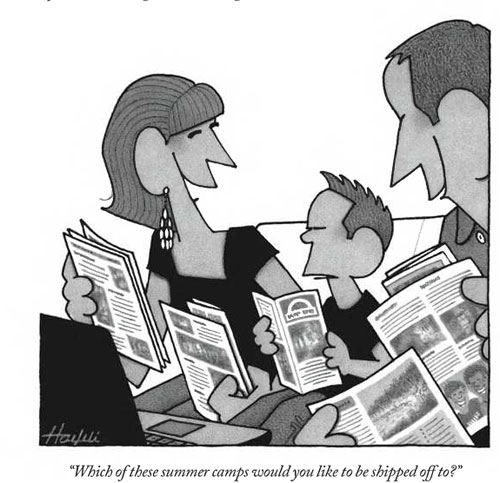
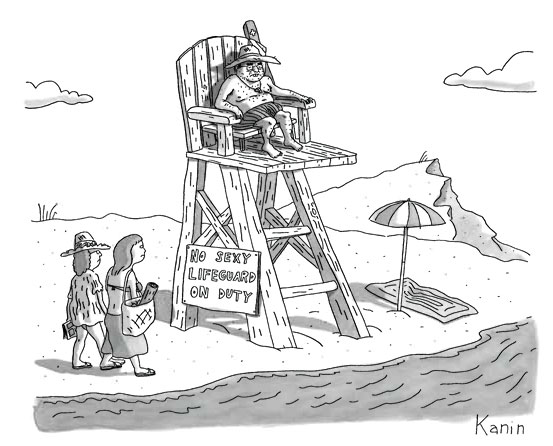
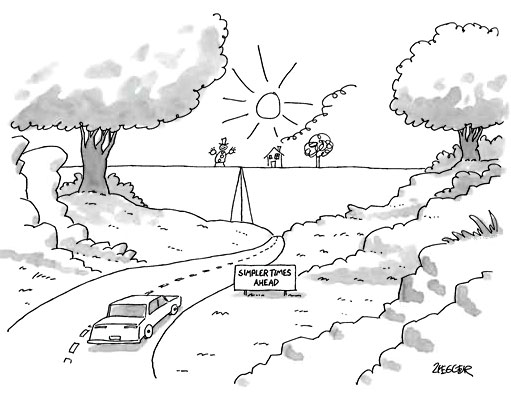
Three recent great New Yorker cartoons.
Wimbledon tennis continues today. It’s on ESPN, ESNPN2 and The Tennis channel. Federer is destroying some poor Italian as I write this. Watching tennis (and especially Federer) is more interesting (and rewarding) than listening to Henry Blodgett tell on BubblieVision whether Facebook is overpriced or not. (It is.)

Harry Newton who loves coming home to a note from the IRS telling Susan that they never received her 2010 return. So, today, for the third time, I shall print out a copy of our joint return and mail it to them. Such a pleasure. Despite this nonsense, I’m really happy to be back in New York. Irish TV sucks. It rains too much. It’s short of interesting tourist sites. And it’s very very expensive. Maybe I’m just a Manhattan snob?

Such an interesting post. Those graphs are so informative and I am glad to see this info. Some interesting cartoons you have published.
Harry, has there been a single year in the past half decade that you haven't had to resubmit your tax forms? There's gotta be someone messing with you. Did you piss off someone from the IRS really bad at one time?
I don't believe so.
Matt Taibbi is a hack. His stuff is garbage.
Sadly, not true. Matt Taibbi is among the top five most accomplished financial writers in the U.S. today.
Oh, by the way, Fred789, you have been very critical of my recommendations. Yet you have not responded to my request for your own recommendations.
More B.S. from you. You never asked, and I HAVE given recommendations on here. Earlier this year I recommended Microsoft (up 18% YTD) JP Morgan (OK, a little bad luck here, but it'll do well in the long run) and i'm also high on BTU – energy stocks are out of favor, it's down over 50% YTD, but in five years it has a chance to return a tremendous profit.
I also like junk bond funds at Vanguard & Fidelity. Also, for the long run Berkshire Hathaway, A or B. There's a built in discount because ppl are afraid the stock will drop when Buffett goes, but the young guys who will replace him are sharp as knives. BRK is also well positioned in manufacturing, which will come back just find soon.
Also, for the long haul, Emerging markets funds, but you have to stay invested for 10-20 years.
I've bought up all the farmland I can get, and I think now is a decent time to buy a house in the U.S. If I hear Suze Orman recommend renting for young people one more time, I may throw a brick at the TV set.
And, Taibbi is a poor writer.
“Nobody knows when the next great real estate crash will come – except that ti will come.” Of course it'll come, only very likely not within any of our lifetimes. Before the 2006 crash, the last big real estate crash was 1923.
Also, Harry, this continual patting yourself on the back for being in cash must stop. You're a crusty old fool, and for your readers in their 40s, 50s and even 60s, cash loses them money to inflation every year. Consumer sentiment is EXTREMELY low, yet gas and housing prices are moving in the right direction. It's also an election year. Even a complete doofus like you should know all this adds up to a good chance the market will be 10 to 20% higher in 6 to 12 months.
What motivates you to write this nasty stuff? Where are your recommendations?
He's your resident troll, Harry. Consider it a compliment as most trolls just do drive by's — but you get one that visits each and every day.
actually the previous real estate crash was at the end of the 1980s. i know this because the studio apartment i bought for less than 25K was selling for more than 60K just a year earlier.
Hi, Harry. When you send those returns, do you use Certified Mail?
Absolutely. And I have receipts to prove it. It does me no good. They still keep requesting copies — to be sent to a different IRS office…..
Everyone should read Matt Taibbi's pieces. He is the only reporter that gets to that the heart of it all in a way that the ordinary person can identify with.
Yes. And he puts the time and thought in. Some of his pieces require weeks and weeks of research and thinking.