Apple is edging back. RIMM continues to fall. Nice short. AGNC, MITT and NLY are doing well, especially AGNC. It’s hard to see what can hurt the mortgage REITs in this continuing low interest rate world. My muni bond funds NUV and VWALX are holding in nicely, also. ED is also doing nicely.
My real estate syndications are stabilizing, as new tenants are found at lower rents. this requires time, patience and skills. They exist — but rarely among institutional holders. Therein lies a continuing opportunity.
I don’t have any new, brilliant ideas — except to keep away from big industrials with heavy exposure overseas.
Your children, and the hollowing of the American workforce. Jobs are lost short-term because of recessions. Jobs are lost long-term because of technology (new smarter computers) and outsourcing (shipping the jobs to China). Today’s big unemployment is among younger people — especially among younger people with few skills. There are jobs available , but employers report finding a dearth of people with the skills they need. Education is the only solution — formal and informal. I am writing this not for us, but for our children. The rest comes from a piece in the New York Times:
The issue of the disappearing middle is not new, but credible economists have added a more threatening twist to the argument: the possibility that a well-functioning, efficient modern market economy, driven by exponential growth in the rate of technological innovation, can simultaneously produce economic growth and eliminate millions of middle-class jobs.
Michael Spence, a professor at N.Y.U.’s Stern School of Business, and David Autor, an economist at M.I.T., have argued that this “hollowing out” process is a result of twin upheavals: globalization and the hyper-acceleration of technological progress.
Just two weeks ago at the Aspen Ideas Festival, Alan Krueger, Chairman of the Council of Economic Advisers, stressed this theme:
If you look at the decade before the recession, the U.S. economy was not creating enough jobs, particularly not enough middle class jobs, and we were losing manufacturing jobs at an alarming rate even before the recession. And I would also put together, combined with those two problems, the polarization of the U.S. job market, the fact that we are getting more and more people at the very top and the very bottom and the middle has been shrinking.
McAfee has graphically illustrated the key findings that worry him and Brynjolfsson. The red line in the figure below, the employment to population ratio, tracks the ratio of the number of people working to the total number of working-age men and women in the United States.
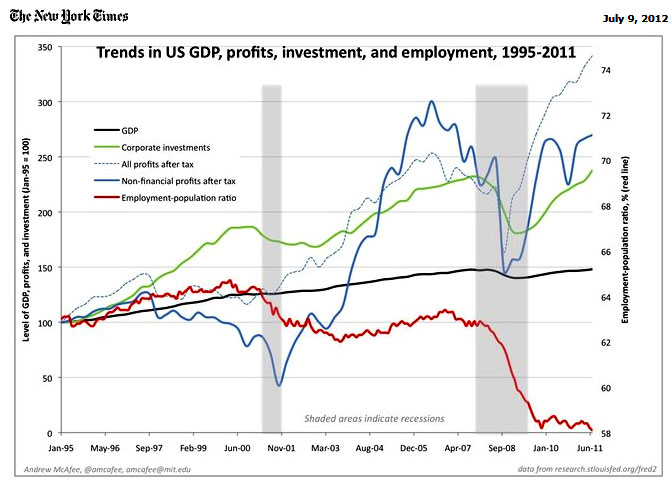
On his blog, McAfee explains the graphic:
Since the Great Recession officially ended in June of 2009 G.D.P., equipment investment, and total corporate profits have rebounded, and are now at their all-time highs. The employment ratio, meanwhile, has only shrunk and is now at its lowest level since the early 1980s when women had not yet entered the workforce in significant numbers. So current labor force woes are not because the economy isn’t growing, and they’re not because companies aren’t making money or spending money on equipment. They’re because these trends have become increasingly decoupled from hiring – from needing more human workers. As computers race ahead, acquiring more and more skills in pattern matching, communication, perception, and so on, I expect that this decoupling will continue, and maybe even accelerate.
You can read the entire piece here.
The greatest iPhone feature is iMaps.You don’t need a separate GPS. The iPhone works fine. This is the app Maps:

Touch the left bottom arrow and little blue arrow will appear in the center of the screen showing where you are. Touch the bottom right page-turning button and you will get his screen:

Touch the button that shows Show Traffic and your previous screen will show red and green lines on the streets (as they do above) showing the traffic. It’s magical.
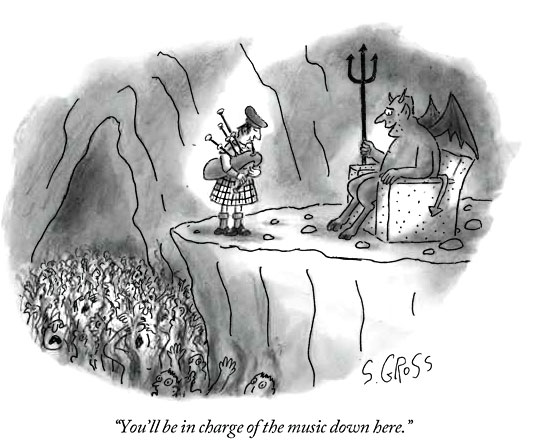
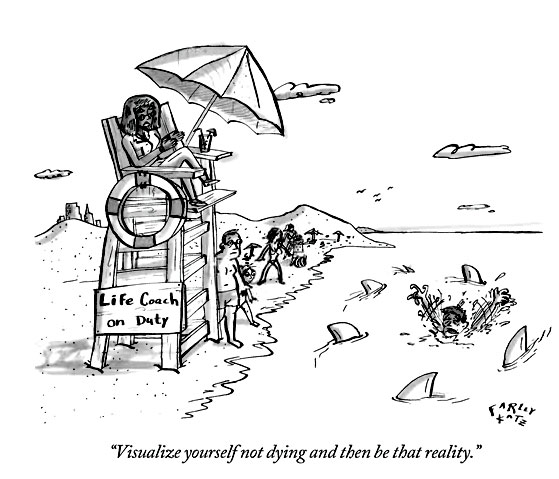
Favorite recent New Yorker cartooons.


Harry Newton who constantly marvels at that wonderful phenomenon called Gotchas. Item: I walk into local pharmacy and ask for a refill on the prescription they have on file. “Sorry, Harry, refills expire in 12 months.” You gotta be kidding? Nope, apparently that’s the law. Go figure.
Moral of this story. Get your refills now and store them in your refrigerator, where they’ll survive nicely.

On the contrary, as a value investor with a long term horizon, I find companies with overseas exposure to be on sale now. Also, the WMT and BRK-B shares I recommended in this space a while back are now at decade highs and yearly highs, respectively. We're looking for a short term, mild pullback in the coming weeks, which will give Harry and other the other perma-bears who follow him one more chance to buy into the market before a dramatic pre-election rise in Nov and Dec.
One of the biggest problem with younger folks and employment, rather than technology and off-shoring, is a lack of needed skills. Today we falsely believe that “everyone” should go to college, despite something like half never graduating (often with hugh debt) and many getting soft degrees because it's easier leaving more time for horsing around. And worse, we've dropped from our government/union driven public high schools craft and trade training – great jobs available at decent wages and no college debt. Many here don't even finish high school, particularly those most in need of schooling. In Germany, ninety some percent finish high school and a third (or is it two third's?) go on the good paying craft jobs, rather than college. Decisions have consequences, even for teenagers.
Respectfully, Pahowley, the craft/trade training is a contributing factor to the increased unemployment because such training is a relatively short term solution. With craft/trade training, a person will be able to make a living using those skill but what happens when technology disrupts it or when the person in China with the same skills can do it for a much lower pay? Even though the craft/trade training does help people get employed using those skills, it has a relatively short useful life. However, a broader college education makes acquiring focused training much easier and quicker compared to the length of time it takes a skilled laborer who tries to acquire another skill to replace his now useless one. In today's world, college education choices in the STEM fields (Science, Technology, Engineering, and Mathematics) are proving to give the best return on the tuition investment. I have a niece who graduated with an engineering degree (BS) just a couple of months ago who has landed a six figure salary along with tuition reimbursement benefit for her graduate studies. A friend she grew up with went for the trade/skills training and went to work a couple of years ago for a decent living wage and was laid off after working for just over a year. She just now finished another skill/trade training program is looking for a job. So, while better than nothing, the skill/trade training is a short term solution.
Are you suggesting refilling before you are near the end of your current prescription?
As in, are you suggesting that hoarding of medicine is prudent? You wouldn't be the first person to suggest medicines will be the first supply disruption coming.
Both.
Harry,
Check out the app, WAZE. It is a free gps app that can be updated in real time as to traffic, road hazards, etc. by folks on the app as they are driving. It even shows you other cars on the road that are on the app at the time and you can ping them. It does raise the concern of texting while driving though which is illegal in my state, NC. But, if others add real time information, I benefit from the verbal notices by WAZE as I am driving.
Richard