First, buying stocks is a gamble you have only one control over — you can sell when things go awry. That is unless you’re away and not paying attention.
There is no such thing any longer as “buy and hold.” Index funds spread the risk, but not when everything goes awry, as it has with increasing frequency in recent years.
Buying stocks is gambling. Nobody has ever done consistently well picking stocks long-term. Everyone screws up at some time. And usually screws up big-time.
Note to file: Warren Buffett is a great stock picker, but a much better company picker and manager. He has control over his investments And that makes a huge difference. If I buy shares in Verizon, I can email its boss, Ivan Seidenberg, but he will never do anything, despite my brilliant suggestions on his teleom business (which I actually know something about).
All that said, it is reasonable to buy stocks on several conditions:
+ First, never listen to anyone without thoroughly researching yourself. Most times, don’t bother with the research. Their recommendation will be garbage. Are you listening, Mark? RIMM isn’t the $18 to $20 you thought it would be when some moron bought the company. It closed last night at $6.995.
+ Second, don’t put the bulk of your money in stocks — no matter what Warren Buffett says. As you get older you need income and security. Bonds provide that.
+ Third, never borrow money to buy (or sell) stocks. (Or for that matter, never borrow any money.)
+ Fourth, if you buy stocks long or sell them short, buy them as you see opportunities. Don’t buy a bundle all at once. That’s stupid.
+ Fifth, watch them every day. Sign up for Google Alerts on each of your stocks. If any one is going awry, sell instantly, if not sooner.
+ Sixth, as Todd says, “if in doubt, stay out.” Out is cash. Cash is as good as money. Maybe better.
+ Seventh you can beat the market, but only if you work at managing your emotions. Which means things like not falling in love with stocks, listening to your rich friends, or going crazy when a stock or two turn against you.
Stock investing is a game. Learn it. You can have fun. That said, there are five types of stocks:
1. Stocks whose products you love. Apple. Good to buy them before the world figures it out.
2. Stocks whose products you love and whose products are getting huge amount of favorable press, in the financial press, on the blogs, in the technical trade press, wherever. Apple, LuluLemon and Crocs are examples of these.
3. Stocks whose products are influenced heavily by forces you can’t predict — like government decisions. For example biotech stocks which await approval — one day — from the FDA. Coal stocks that just got told by the EPA that they must reduce their emissions. Which means, in simple language, use less coal. PCI fell yesterday. Great short. See yesterday’s column.
4. Stocks which are huge, unwieldy companies and will never move up fast. But they will move down fast.
2. Stocks whose products and prospects you hate. Nokia is on the skids. Go into a Radio Shack store. There’s nothing to buy. Goldman Sachs…read below.
Desperation reincarnate. Goldman Sachs is becoming a commercial bank for rich people and corporations, says today’s Wall Street Journal. Why am I sceptical? As an unhappy Goldman private wealth client, I’m probably one of thousands. Goldman has treated me and my meager investments with them miserably. I’ve been shunted from one Goldman adviser to another and finally I’ve ended up with a call center in Albany, New York. Goldman once made a “capital call” on my private equity fund investment — not to finance our companies’ expansion or to buy new companies for investment, but solely to pay their fees, which they had trouble collecting because they didn’t cash in the fund and couldn’t sell anything. They’ve never allocated me one share in any hot (or cold) IPO they were doing. In fact, they told me pointedly I’d get some “next time” if I gave them more brokerage revenue and ALL my net investible wealth.
The Journal says “Goldman is now starting to collect their cash (i.e. my cash) in the form of deposits and make loans to them (i.e. people like me) for homes, art, boats and the like.” Now think about this for a moment. They’re lending to rich people to buy more stuff they don’t need and clearly can’t afford. If the rich need to borrow money to buy art, they clearly can’t afford the art. Since when was art a good investment?
to my tiny brain, this whole Goldman move smacks of acute desperation — and one they’re going to take seriously anyway.
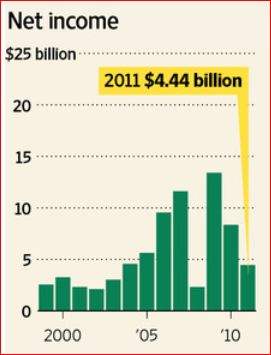
Said their CEO, Lloyd Blankfein, in today’s Journal, Goldman has no plans to open retail branches, build a network of automated teller machines, pitch credit cards or “give away toasters,” Mr. Blankfein said.
Please Mr Blankfein, as a Goldman client, I could actually do with a new toaster. Maybe the first positive thing they ever did for me.
I wish I had sold GS short earlier. I know I’ve about my distaste for this stock many times. GS is clearly going nowhere fast.
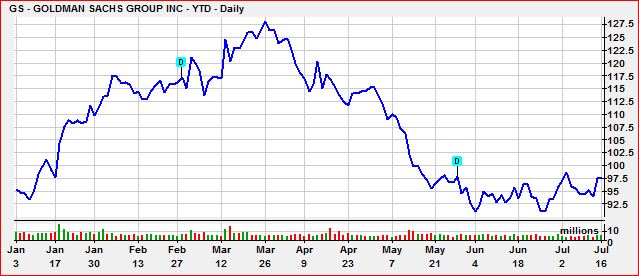
I thnk it’s time for a small short. Unless Lloyd calls me today and offers me that toaster. Ha!
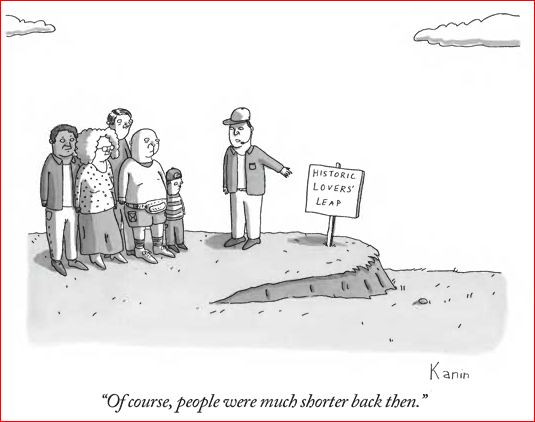
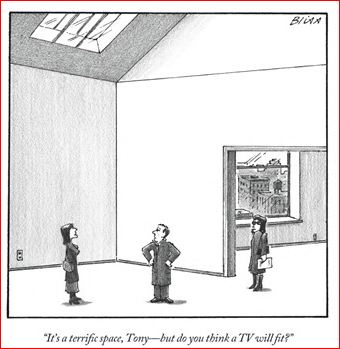
Favorite latest New Yorker cartoons:

This column is late (and unfinished) because my crummy Fairpoint DSL service crashed just before 9. I’m on emergency backup. Please bear with me… YUCH. YUCH. YUCH.
I’ll catch up tomorrow when I’m back in New York this afternoon using Verizon FiOS which is more reliable.

Harry,
Sorry, the link didn't appear on the above comment. Here it is: http://www.thrivemovement.com
The whole “Thrive Movement” is amazingly preposterous, but it's so slickly preposterous that I'm almost willing to bet that its a disinformation conspiracy in itself, designed to lead us away from recognizing real problems and finding real solutions. It smells of “false flag” activism, like the “social welfare” political organizations founded by rich loonies.
As for the wonderous technology cited, small amount of energy can possibly be extracted from the vacuum via the Casimir force, but even if large amounts of power could somehow be extracted from the space-time continuum, it would lead to bizarre space-time anomalies occurring randomly in space and time. Imagine if something like the Bermuda Triangle could appear momentarily in your kitchen or backyard, and appearing days, months or years before or after you turn on your mystery energy machine. You don't get something for nothing in physics (at least not for very long 🙂 ), no matter how screwy and contrived the physics.
And who is this 'Dr. D. H. DeVore' who falls for this bosh and is promulgating it on (of all places) Harry Newton's web site. Is he or she really a spammer hired by the thrive folks to set up back links to http://www.thrivemovement.com to boost its organic ranging on Google? Inquiring minds want to know, Herr Doctor.
Harry,
This link may be the most important information of the century and surely explains why big government is really the most clandestine financial machine ever conceived. This intro is by the heir to the Proctor & Gamble fortune, Forrest Gamble, who has elected to uncover the hidden realities of organized financial dominance by the financial community controlling literally 60 trillion dollars……..utilizing a seperate set of books. Listen to Forrest and then click on the link that explains this ruse……you won't be able to sleep!
Dr. D. H. De Vore
“Nobody has ever done consistently well picking stocks over the long term.” This is easily the stupidest sentence ever written. There are people who have accumulated MASSIVE AMOUNTS of wealth from picking stocks over the long term.
Re: your condemnation of coal as an investment: Harry, perhaps this would be a good time to respond to published accounts that you favored high tech and dot.com stocks in late 2001 or thereabouts? Do I have the wrong Newton? I may, I'm not sure. Correct me if I'm wrong. I'm asking: are you the Harry Newton who favored Dot coms in 2001 or thereabouts as a great investment? I read the Buffett book”Snowball” and there's a passage seeming to indicate as much. But as I said, it may be a different newton and my recollection may be inaccurate.
Mr. Newton,
Ivan retired a year ago, but I understand your point.
Fairpoint can certainly use your suggestions!