“There’s oodles of money on the sidelines. It probably won’t come into the market until it’s another 10% to 15%,” said a favorite broker this morning.
I suspect he’s right. But when they do, will that signal a turndown?
Keeping reading. Today’s column is major fun.
Thoughts on the iPad. With all my profits on Apple’s stock, I can easily afford a new iPad.
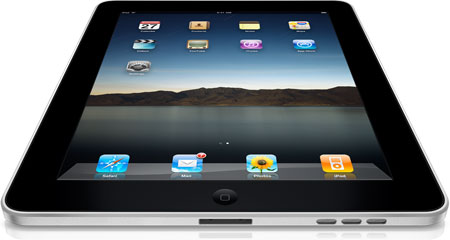
I went to the local Apple store yesterday to see one. I didn’t buy one. There’s no room in my life for another half-way gadget. The thing is not a laptop. It lacks a decent keyboard. It lacks all the useful computer plugs — like an SD slot and a USB port. Basically, it’s a book reader with limited battery life, but much faster page-turning than the Kindle or the Nook.
I carry around enough gadgets — a BlackBerry, my Canon G10 camera, an iTouch (for music and pod casting) and my trusty ThinkPad X200 (soon to be upgraded to an X201) laptop. I love reading books on my ThinkPad. I just don’t see where the iPad fits in for me. Given all that, I think the iPad might make a great computer for older people who simply want email, photoviewing, some Internet browsing and maybe reading an occasional e-book. There are also lots of neat apps for organizing your life, like To Do Lists, etc. Keeping the thing charged may be an issue.
You do not want to see this movie. Unless you’re really sick, enjoy murder, sick sex, rape, mutilation and general mayhem.

A business partner recommended it. My wife liked it. She’d read the book.
The cockroaches at Goldman Sachs. They’re coming out of the woodwork.

From today’s Wall Street Journal:
A Goldman Sachs Group Inc. director tipped off a hedge-fund billionaire about a $5 billion investment in Goldman by Warren Buffett’s Berkshire Hathaway before a public announcement of the deal at the height of the 2008 financial crisis, a person close to the situation says.
Read here. P.S. They didn’t tip me off. Drat!
The Bond Market Will Never Be the Same After Goldman: This is from Michael Lewis, author of the excellent book (which you should read) “The Big Short.” This article was published yesterday on. Bloomberg
If you happen to be sitting on the Goldman Sachs bond-trading floor life must feel horribly unfair.
You did nothing worse than live by the ethical assumptions of your market — any money-making event short of obviously illegal is admirable — and now your own grandfather thinks you’re some kind of monster. Your world feels upside down: What was right is now wrong; what was good is now bad; what once felt like winning now feels like losing.
You are probably wondering: What next? What will the angry rabble — all those ordinary people who can never really understand your business — now demand that you explain to them, so they can disapprove of you all over again?
A few possibilities:
No. 1 — Full knowledge of the inner workings of your proprietary trading desk.
In particular: the moment-to-moment dealings of your correlations traders from late 2004 (when they first exploited American International Group’s idiotic willingness to sell cheap insurance on pools of subprime mortgage loans) until the end of 2007, when they would have taken most of their profits from the total collapse of the subprime bond markets.
Your bosses claim to have lost almost $100 million on the Abacus trade for which your firm is being sued. This seems, to put it mildly, disingenuous. In March 2007, the time of this particular Abacus trade, your prop traders were already short the subprime market. Would they really have taken a naked long position in a deal you helped to construct precisely so that it would fail without offsetting in some other way on their books?
Ritual Sacrifice
Sadly, it will not suffice to offer up Fabrice Tourre as a ritual sacrifice. No one is going to accept a then 27-year-old Frenchman, whose job was apparently to keep sweet the patsies on the other end of your trades, as the world’s authority on your trading positions.
His name isn’t even on the top of the list of Goldman traders listed on the $2 billion Abacus deal for which you are being sued. The name on top of that document is Jonathan Egol. Egol appears to have been the bond trader at the center of your Abacus program. The same Jonathan Egol who told fellow traders in 2006 — a year before this transaction — that the subprime market was doomed.
The public eventually will ask: Who is Jonathan Egol and what exactly was his game?
No. 2 — A far better understanding of your relations with the inaptly named “CDO manager.”
Clearly Clueless
In this case the manager was ACA Management, but there were other CDO managers at least as pliable as ACA. The SEC suit charges you with using ACA as a shill: the end investors in your CDO assumed that it was ACA’s job to figure out whether the bonds inside the CDO were intelligent investments.
But ACA quite clearly had no idea what it was doing — and you quite clearly understood that.
The telling details here are the e-mails between your French salesman and ACA, in which ACA feels it needs to understand exactly what John Paulson’s interest are in this new CDO. Paulson, who had done a great deal of analysis on the underlying bonds, was of course picking the ones he wanted to see inside the CDO. (Hard to understand why it didn’t disturb you that he was even in the room, by the way, but that’s another conversation.)
The SEC accuses you of lying to ACA, by suggesting Paulson was a long investor in the deal when he was in fact selling the deal short.
Good From Bad
But what’s interesting here is what you appear to take for granted: that ACA has no talent for evaluating the bonds picked by Paulson. After all, if ACA was doing its job it wouldn’t have cared one way or the other what Paulson (then a little-known hedge fund manager) was up to. ACA would have known which bonds were good and which were bad, and picked the good ones.
In their anxiety about Paulson’s motives we can all glimpse their incompetence. They want to know that Paulson has an interest in picking the good ones because they themselves have no clue which ones they are.
But if a CDO manager had no independent ability to select the bonds inside a CDO what, please explain to us, was his financial function? Why did you select ACA to manage your deal?
No. 3 — A far better sense of why, and when, you ceased completely to concern yourself with the consequences of your actions.
The masses will be curious to know, for instance, how you became blinded to the very simple difference between right and wrong. The more moralistic among them will ask the question mainly to fuel their own outrage; the more tactical will ask the question because they sense that the financial system doesn’t function unless you have the incentive to think in these terms – – and you clearly do not.
Soul-Changing
What begins as an effort to change your business may well end up as an attempt to change your soul.
Among the many likely consequences of the SEC’s decision to sue Goldman Sachs for fraud is a social upheaval in the bond markets.
Indeed, the social effects of the SEC’s action will almost certainly be greater than the narrow legal ones. Just as there was a time when people could smoke on airplanes, or drive drunk without guilt, there was a time when a Wall Street bond trader could work with a short seller to create a bond to fail, trick and bribe the ratings companies into blessing the bond, then sell the bond to a slow-witted German without having to worry if anyone would ever know, or care, what he’d just done.
That just changed.
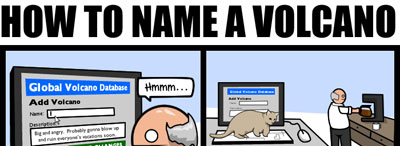
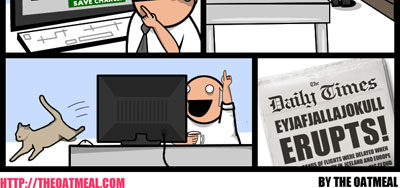
Spectacular photos of the Iceland volcano, whatever its name.

The photos are from Boston.com Click here. How the volcano got its name:
There are poor kids who need education and sports. There are charities that help them. We went to an event last night. There were lots of goodies to buy, especially weird handbags:

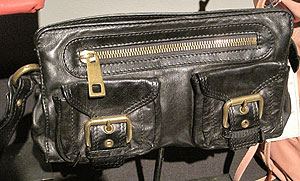
Women must love these bags. The bigger the better. They were carrying them:
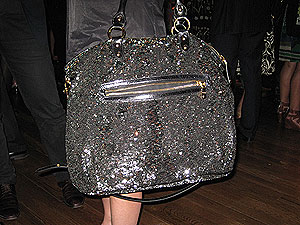
And when they got too heavy, they laid them down.
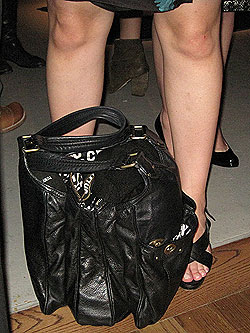
Which then got me interested in legs and shoes:
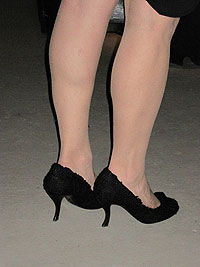
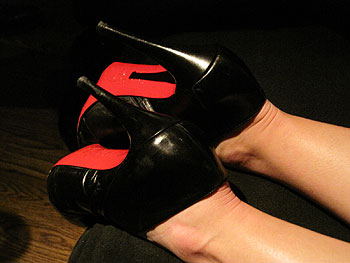
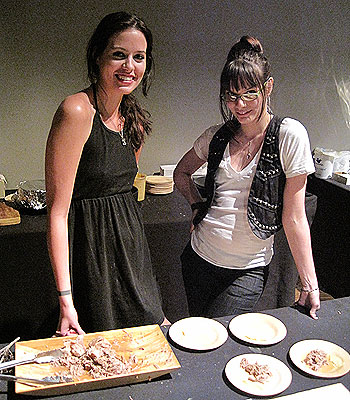
The best part of the show was the food. Someone brilliant (Callie Siegel?) conned a bunch of restaurants into giving out free food (and business cards) to all the attendees. These two servers were especially cute.
Yesterday was glorious. The Cherry Blossoms lost some blossoms in a quick thunderstorm, but still look pretty great on Roosevelt Island — an island in the middle of the East River.

This is the 59th Street Bridge of Simon and Garunkel fame.

The ship was actually called the Newtown Creek. A closeup:

Most impressive was walking on a path of newly fallen blossoms.

Who cares about investing when God makes free profits like these?

Harry Newton, who spends much of each day trying to amuse himself (since that distracts him from focusing on dumb investments). Yesterday amusing myself included 2 1/2 hours of tennis, half an hour of walking in the cherry blossoms and one hour studying the “dynamics” of charity events — pretty girls and ugly handbags.

Many of my friends have the iPhone and are visibly tingling at the thought of owning an iPad – everyone, except me, still bound by my Verizon contract. I expect to see Steve Jobs on a future episode of the tv series “V”, as an alien ambassador, handing out iBalls full of blue energy.
Love, love, love the pix of cherry blossoms! Ode to spring – and life!
Ten hour battery life on the iPad, Harry. And that's with WiFi on! And personally, I love the keyboard. I am going to guess that you don't carry an iPhone. Users of the iPhone instantly transfer love to the iPad. In contrast, the changes revealed by the “lost” iPhone are not compelling enough to cause me to pay for an upgrade.
There is no such thing as money on the sidelines, unless its buried in your back yard.
Money in money markets is also not in MMs, as its being utilized by someone else in some kind of trade.
IOW, to take your money out of your MM, someone else has to unwind their position.
Mish Shedlock has a couple of really good and in depth articles explaining this.
“Money on the sidelines just itching to dive into the market” is purely broker marketing to lure in more money.
IOW, YOU are the money on the sidelines.
Money on the sidelines is money in money market funds and in bank CDs. Money on the sidelines is broker talk. You're 100% right. I guess I was looking for a way to say I felt optimistic about equities.
>>Basically, it’s a book reader<<
The iPAD is MUCH more than that: It's a web browser, email appliance, magazine reader, newspaper reader, music player, photo displayer, game player, data organizer, and probably much more that I haven't discovered yet.
Some neighbors came to visit for my birthday last week. I passed around the iPad that had a slideshow of some block parties from years ago, with appropriate music. It was much better than a photo album, pikle of pics, electronic photo frame, iPod touch, or netbook.
The on-screen keyboard works fine, and unlike the keyboard on the Kindle, no space is wasted when you're not typing. I have not felt deprived by the lack of a USB port or SD slot, and battery life is more than long enough.
I've had mine for 10 days, and have already decided to give my netbook to my sister.
The iPad is too big to hang from a beltclip, but it can easily fit into a briefcase, and onto the tray-table on a plane.
The more people like iPads — for whatever their reasons — the more my Apple stock rises. Frankly, I think the next BIG push on Apple's stock will be the new iPhone coming out in coming weeks. That phone will have major improvements.
More analysis on Goldman:
http://www.ritholtz.com/blog/2010/04/10-things-…
This piece is interesting. Worth reading. It's called Ten Things You Don’t Know (or were misinformed by the Media) About the GS Case. It's by Barry Ritholtz nd his Big Picture blog