There are two reasons stocks fall in price. First, because their earnings (outlook or actuality) falls. Second, because weird, non-earnings-related, bad things emerge about them. I call these cockroach events. They resemble cockroach behavior. When one strange, bad event happens, another and another and another are likely to happen — just like you can never get rid of cockroaches when one appears in your kitchen.
Goldman Sachs looks more and more like cockroach stock. First, there was the news that it helped Greece hide its irresponsible borrowings. and thus get Greece into the mess it is today. There was the news of the SEC civil fraud case. Then there was the news that one Goldman insider told a hedge fund manager Goldman client that Warren Buffett had effectively saved the company by investing $5 billion in Goldman — before the Buffett investment was public. This enabled the hedgie to buy shares before they rose on the news.
Governments Go After Insider Trading
A Goldman Sachs Group Inc. director tipped off a hedge-fund billionaire about a $5 billion investment in Goldman by Warren Buffett’s Berkshire Hathaway Inc. before a public announcement of the deal at the height of the 2008 financial crisis, a person close to the situation says.
The revelation marks a significant turn in the government’s case against Raj Rajaratnam, the hedge-fund titan at the center of the largest insider-trading case in a generation. Mr. Buffett’s investment in Goldman in September 2008 was a watershed moment in the financial crisis. One of the world’s savviest investors, Mr. Buffett helped allay fears about the instability of the financial system by backing America’s leading investment bank.
The new disclosure stems from a government examination into whether the Goldman director, Rajat Gupta, gave inside information to Mr. Rajaratnam. In a court filing March 22, the government alleged that Mr. Rajaratnam or “co-conspirators” traded on non-public information about Goldman. In a filing last week, the government provided more details about the information it alleges Mr. Rajaratnam received, including advance notice about the Buffett transaction with Goldman.
And this weekend there’s news that senior Goldman employees, knowing about the unannounced SEC fraud case — but knowing it was coming — sold their shares. A huge amount of them. From the Wall Street Journal:
Insiders Sold Shares As SEC Probed Firm
Five senior executives of Goldman Sachs Group Inc., including the firm’s co-general counsel, sold $65.4 million worth of stock after the firm received notice of possible fraud charges, which later drove its stock down 13%.
Sales by three of the five Goldman insiders occurred at prices higher than the stock’s current level. The stock sales by co-general counsel Esta Stecher, vice chairmen Michael Evans and Michael Sherwood, principal accounting officer Sarah Smith and board member John Bryan occurred between October 2009 and February 2010. It was the most active spate of insider selling in three years, according to InsiderScore.com in Princeton, N.J., which tracks and analyzes purchases and sales of stocks by top executives and directors.
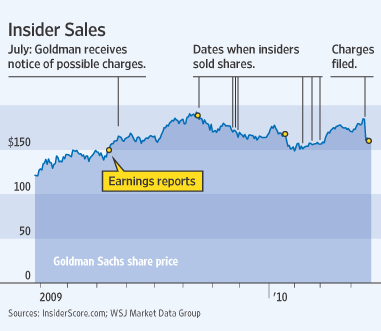
Goldman received notice of the possible charges last July, but didn’t publicly disclose that fact, later explaining that it didn’t consider such a notice material information investors would have needed to value the stock. A week ago, on April 16, the Securities and Exchange Commission filed civil-fraud charges against Goldman for failing to disclose that a short seller, Paulson & Co., participated in selection of assets in a pool tied to subprime mortgages.
This week, beginning on Wednesday, Senator Carl Levin who heads something called the Permanent Subcommittee on Investigations will hold hearings on Wall Street and Financial Crises. Several Goldman executives including Fabrice Touree and Lloyd Blankfein will appear. To get us all juiced up for the hearings, the subcommittee released several emails be appearing. His committee has released a bunch of emails, one relating to Goldman’s attempted manipulaton of the press and some relating to its alleged losses. You can read them here.
Goldman itself is helping the cockroaches multiply by opening its month and saying supremely stupid things. Like it’s doing “God’s work.” It should not be commenting publicly on a pending law suit. Whether that suit succeeds or not is for the courts to decide. It should not be decided in the press. Goldman should also not be telling the world that it lost money on subprime mortgages . First, that information is not relevant to the case. Second, what’s the point of making your company look stupid? Is Goldman really in the business of losing money?
I believe we’ll see more cockroaches this week — what with the Senate hearings and the press’s obsession with chasing Goldman stories. I suspect that many of Goldman’s customers are increasingly upset with the company, and are looking to flee the company and leak stories to the press about their mistreatment and losses. How would you feel if Goldman called your competitor up and gave them insider information but didn’t call you. Frankly, as a Goldman client, I don’t expect to be fed insider information. But it annoys me that others were. Hence they made money when I didn’t.
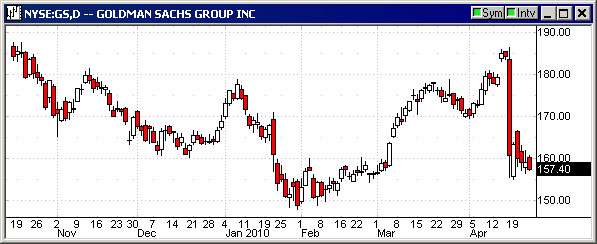
There are a hundred ways to play this. You can simply short the stock. You can buy puts on GS. The July $160 puts are trading just about $12. Goldman’s stock would have to fall to $148 for that put to begin to be in the money. That’s about 6% below where it is now — about the level of its late-January low:
David Letterman did a wonderful piece on Goldman Sachs’ Top Ten Excuses. You can see it on YouTube.
The paucity of investment ideas. Grantham is one of the great investors of all time. In this interview he worried about the U.S. stockmarket, emerging markets and commodities (fullly priced). He favors — of all things — global brand companies, like Coco Cola, which have lagged the recent uptick.

Click for Interview with Jeremy Grantham
The story that has Washington’s attention today. From today’s Washington Post:
The national debt and Washington’s deficit of will
By Joel Achenbach, Sunday, April 25, 2010
Bill Gross is used to buying bonds in multibillion-dollar batches. But when it comes to U.S. Treasury bills, he’s getting nervous. Gross, a founder of the investment giant Pimco, is so concerned about America’s national debt that he has started unloading some of his holdings of U.S. government bonds in favor of bonds from such countries as Germany, Canada and France.
Gross is a bottom-line kind of guy; he doesn’t seem to care if the debt is the fault of Republicans or Democrats, the Bush tax cuts or the Obama stimulus. He’s simply worried that Washington’s habit of spending today the money it hopes to collect tomorrow is getting worse and worse. It even has elements of a Ponzi scheme, Gross told me.
“In order to pay the interest and the bill when it comes due, we’ll simply have to issue more IOUs. That, to me, is Ponzi-like,” Gross said. “It’s a game that can never be finished.”
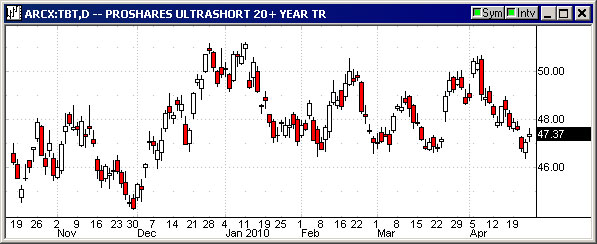
The “smart” money is playing this game by buying TBT. So far, it hasn’t done much.
Buying something today. A couch. A computer. Whatever. Figure on delays longer than you get promised. Factories aren’t getting bank financing. Hence many can’t afford inventory. Thus, your orders are made when you place them. And sometimes take much, much longer than in previous years.
Joy in logic.
Fisherman ONE: How’d you do?
Fisherman TWO: I caught a fish that was so big, it took two men to carry the photograph.
The man is waiting for his seat while others were seated. He grows annoyed.
But, maitre d, he says, I have reservations.
“Frankly, sir, if I were going to eat here I’d have reservations, also.”
Two people are walking in New York’s Central Park.
A bird shits on one.
“Shouldn’t you go for a kleenex?”
“No. By the time I get back with the Kleenex, the bird will be miles away.”

Harry Newton, who marvels at how low interest rates propel us to focus on risky bets. Listen to Grantham talk about the next bubble.

In a post today, Barry Ritholtz uses the Cockroach analogy as well. On Goldman:
“So where does this ongoing saga eventually lead? For us the cliché “there is never just one cockroach” applies.”
http://www.ritholtz.com/blog/2010/04/the-paulso…
Harry:
I think our entire economy is a nest of cockroaches. As Grantham states, it has been aided and abetted by a Fed that is more willing to speculate than render sound policy.
Time honored investment guidelines and ethics are for old people out of the loop.
Now we change the rules for big banks (no mark to market for them) lend them billions and guarantee them the nanny state entitlements of riskless trades (spreads on Treasuries, etc.) corporations are more and more efficient — translation don't need employees, only consumers — true employment rate rising, and “beat by a penny investment metrics”, that is to say, we no longer care about revenue growth over a longer trend, just whether diddled profits “beat” last go round with their dumbed down estimates.
Meanwhile, having outsourced too many manufacturing jobs due to “optimization and efficiency”, we still con the public into taking on more debt with Cash for Clunkers, Cash for Houses and Cash for Appliances. And how many real estate related jobs do we need now, realtors, contractors, title companies, etc., how many car manufacturing jobs, how many full service brokerage and financial institution jobs? When we get back to the boom years of say 2004 -2007, then I'm sure all those people will be called up immediately.
Somehow, you remain an optimist that things are getting better. But NYC is not really the real world, so I wonder if your thinking is influenced. “Fly over country”, AKA, the USA, is not doing so well. Even “the other coast” aka California is looking bad — with the exception of Hollywood and its ilk.
And as jobs disappear, now we're paying people (incentivizing) people not to work (extended unemployment) as people “strategically” walk away from mortgages that were doomed from the get go, and go out and spend the sudden “cash flow bump” (you are a BAD person if you have cash, and are appropriately punished for same!).
And not all are walk aways, many are simply stopping paying the mortgages and living in the house and assuming their “new jobs” as caretakers for potentially abandoned properties.
And why not, the municipalities where these events are happening cannot deal with the abandoned properties, the banks don't want them (that nasty “Mark to Market” thingy may raise its ugly head — Hello FDIC) and so on, as more and more parts of the economy and country hear that sucking sound as the swirling gets closer to the drain.
Bankruptcy and foreclosures are at or near all time highs, I believe, and that's the FULL bankruptcy — no assets, no way to pay just walk away. I'm reading that some credit card companies are almost literally waiting out side the court house to award new “low, low, low rate freedom cards” to the newly bankrupt, so they can “get back on their feet as consumers.”
Meanwhile, let's Party On as long as the fun house economy rocks!
Got some Raid?