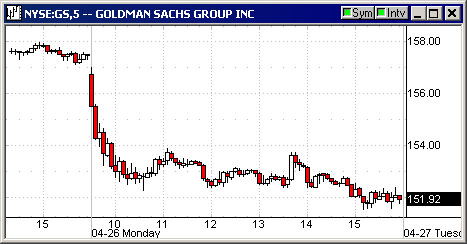
Yesterday’s “action” in Goldman. Predictably down. (See yesterday’s “Should we short Goldman?” column.)
More cockroaches at Goldman:
Beleaguered banking giant Goldman Sachs has lost much of the edge it had over competitors due to the recent government charges and is a stock investors should avoid, analyst Meredith Whitney told CNBC.

After a year of outpacing its rivals, Goldman faces a future in which its brand has been tainted and it will lose business to small competitors, said Whitney, who doesn’t have a “buy” rating on Goldman or any of the other big banks.
Financials are up 16 percent in 2010 but have taken a beating in the last 10 days since the Goldman charges exploded onto the market.
“They’re going to lose market share and small players will gain market share,” said Whitney, CEO of Meredith Whitney Advisory Group. “The momentum has clearly been taken away from Goldman.”
The company’s stock should trade around book value, Whitney added, which would place the price just above $120. Goldman’s stock currently trades at 1.26 times book value, according to Thomson Reuters.
Goldman finds itself facing charges that it withheld information from investors regarding a package of securities that were backed by subprime mortgages. The government alleges that Goldman didn’t tell investor that an investor who believed the mortgages would fail helped suggest securities for the collateralized debt obligation.
Even if Goldman is exonerated of the charges, the damage has been done, Whitney said.
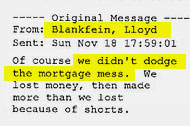
A neat email:
The Senate Investigation begins today.
The best investing piece I’ve read a while. Read carefully. The author has done super well with his investments in energy storage.
Common Sense in Energy Storage Investing by John Petersen
In the wake of last fall’s initial public offering by A123 Systems (AONE) I wrote a four part series on battery investing for beginners. Over the last six months, changes in the storage sector have been coming at a fast and furious pace and many of my recent blogs have focused on technical minutiae rather than the stock market. They’ve led to heated debate with die hard EV advocates who don’t understand the difference between technical and economic reality and religious belief, but I’m not sure how useful they’ve been for investors who see the potential in energy storage and want to understand how to position their portfolios to capitalize on the opportunities.
Since my new followers outnumber old friends and critics by a wide margin, and that points to a surge of interest among mainstream investors, I’ve decided to back up and try to refocus my attention on the fundamental forces that are shaping the energy storage sector.
Economic fundamentals
Everybody hates the inexorable upward spiral in oil prices and we all have a favorite scapegoat to blame. For some it’s evil oil companies and ruthless speculators, for others it’s grasping and corrupt foreign governments and for others still it’s the eco-religious who’ve consecrated promising oil and gas exploration frontiers as shrines to their green goddess. My favorite explanation comes from a classic December 20, 1973 column by the late Art Buchwald who laid the blame squarely at the feet of the Harvard Business School:
“Almost every sheik now in charge of oil policy for his country was trained at Harvard. Everything they learned there they have put into practice to the detriment of the Free World. The Harvard Business School taught the sons of Arab potentates how to sell oil, raise prices and demand outrageous profits for the black gold they have in the ground. Had these same sons been sent to the University of Alabama, Oklahoma or Texas, they would now be involved in developing football teams instead of putting the screws to everyone.”
In the end, there’s only one fact that matters. The world’s appetite for oil has grown faster than the ability to produce it and immutable laws of supply and demand have had their way with prices. Everything else is a sideshow. The scary news is that oil prices have nowhere to go but up and the only way to avoid the financial pain at the pump is to accept individual responsibility and become more efficient. Ultimately, higher oil prices will be the cure for high oil prices.
Oil prices are foremost in our collective consciousness because we all buy petroleum in minimally processed form on a weekly basis. While the changes are less obvious, prices for every major commodity have been following a relentless upward trend for decades, with no signs of moderation. In other words, the world’s appetite for everything is growing faster than the ability to produce anything. We’re careening toward a commodity cliff at 180 miles an hour and nobody seems to notice because we can’t take our eyes off the gas gauge. The problem isn’t just peak oil; it’s peak everything.
I’d love to tell you that things are going to get better, but they’re not. We live on a planet where six billion poor live in squalor and deprivation while 500 million of us enjoy relatively comfortable lives. As long as the poor didn’t know that there was more to life than mere subsistence, they neither contributed to nor demanded from the global economy.
For better or worse, the information and communications technology revolution gave half of them cell phones so the cat’s out of the bag and the existence of a better life is no longer a secret. For the first time in history, we live in a world where more than half of the population knows that a better life exists and they all want a small slice of the economic pie. Human nature being what it is, their first natural response will be to work harder and compete for a place at the global economic table. If that doesn’t work, their second natural response is likely to be far less pleasant.
The challenge of our age is not changing our carbon footprint because every ton of coal we don’t burn in developed countries will be burned somewhere else. The same holds true for oil and natural gas. The inconvenient truth is that global consumption of these energy resources will continue apace no matter what we do and if anthropogenic global warming is more than the latest in a long-string of frightening but profitable alarmist theories, it’s already too late to change the future and humanity will have to do what it’s done since the dawn of time – adapt.
In the final analysis, our only challenge is finding relevant scale solutions to critical shortages of water, food, energy and every imaginable commodity. Whether we like it or not, the days of plenty have already passed and we must turn our attention to eliminating waste now, because if we don’t make room at the table for six billion new mouths, the only possible outcomes are catastrophic conflict and horrific environmental devastation.
Last week I described cleantech as “an ethical system based on the responsible application of technology to optimize the use of natural resources and increase the well-being of the six billion people that live on this planet.” It all boils down to using every available resource for its highest and best purpose; and that’s where storage becomes a critical enabling technology. It can reduce waste in transportation by capturing braking energy for immediate reuse. It can reduce waste in wind and solar power by smoothing out inherent variability. It can reduce waste in the power grid by smoothing out load fluctuations and potentially shifting power from when it’s produced to when it’s needed. In short, storage is the beating heart of cleantech and an investment mega-trend that will probably outlive us all. Storage is not, however, a silver bullet that can solve all of humanity’s problems.
Technical fundamentals
The last forty years have been a time of mind-boggling progress in information and communications technology. As a result, everybody knows next years’ products will be more powerful and cheaper than last years’ products. We’ve all gotten used to the idea that Apple (AAPL) can launch iPad in April and sell millions by the end of the year. We’ve also come to expect that new products will be immediately successful and highly profitable. Unfortunately, none of the factors that drove the information and communications revolution have any bearing on energy storage, or for that matter, cleantech in general.
The fundamental technical difference is that the laws of physics ruled our last industrial revolution. Those laws gave innovators the ability to improve performance through miniaturization and double capacity every 18 to 24 months. With minor exceptions, the laws of chemistry rule energy storage. Those laws are less flexible to begin with, and they’re subject to absolute natural limits. In a Moore’s Law world, the performance progression is 1, 2, 4, 8, 16, and each new generation of products needs fewer high-cost material inputs than its predecessor. In the world of chemistry, the progression is 50%, 75%, 87.5%, 93.75%, and each generation of products requires more high-cost material inputs than its predecessor. In a Moore’s Law world, the time between generations is falling, but in the world of chemistry a generational change takes seven to ten years and the time lags are increasing.
The bottom line for investors is that energy storage is subject to a different set of rules and while progress is inevitable, it will be very time consuming and very expensive. Over 90% of the advances announced by research scientists will be too expensive or complex to successfully bridge the gulf between science and a manufactured product. The 10% that can bridge the gap will typically require a decade of product development and industrial engineering. As a result, most advances will be modest incremental improvements and while disruptive changes are always possible, they’ll usually arise from the combination of new materials with established chemistries. Where our last industrial revolution soared on the wings of eagles, the cleantech revolution will be a long hard slog through an alligator infested swamp.
Emergence of Storage as a Discrete Sector
There is little in life more boring than a battery. In fact, the only time most of us even think about our batteries is when they need to be charged or replaced. It’s a classic love hate relationship. We want them, we need them and we know in our hearts that they’re going to fail just when we need them the most. Is it any wonder that the modifier most frequently used with the word battery is ‘damned?’
Until a few years ago there were two principal types of batteries that were used for widely divergent applications and didn’t face much in the way of crossover competition. Lead-acid batteries started cars, provided uninterruptible power for critical infrastructure and provided traction power for golf carts, forklifts, wheelchairs and the oddball electric car. Advanced batteries like NiCd, NiMH and lithium-ion powered portable electronics and power tools.
Energy storage entered a new epoch in 1999 when Toyota (TM) introduced a radical product named the Prius, a hybrid electric vehicle, or HEV, that captures some of the energy normally lost in braking, stores it in a battery, and then uses the stored energy to boost the next acceleration cycle. Over the last decade the Prius has earned a sterling reputation as the most fuel-efficient car in the fleet. In the process Toyota became the undisputed King of Hybrid Hill and built an intellectual property fortress that made life almost impossible for automakers that wanted to compete, but couldn’t bear the humiliation of licensing Toyota’s technology. So instead of innovating, the laggards went back to the scrapheap of automotive history, resurrected the inherently flawed concept of a battery powered electric vehicle and then excused their lack of imagination with the tired promise that “this time it’s different.” Experience tells me that this time is never that different.
While Toyota was making impressive progress in transportation, a second and equally important change was occurring in wind and solar power. After 25 years on the fringe, these clean power technologies finally reached an inflection point where they promised nameplate cost parity with conventional power sources within a few years. The only fly in the ointment was that the sun doesn’t always shine and the wind doesn’t always blow, which limits the usefulness of these variable power sources in countries that expect 99.9999% reliability in the electric grid. Despite the nameplate cost parity claims, the reality is that wind and solar are intermittent and a generator that provides variable power for part of the day isn’t equivalent to a conventional plant that provides stable power 24/7. In the end, the best way to maximize the value and reliability of wind and solar is to couple them with cost-effective storage to smooth out the variability and shift power from when it’s generated to when it’s needed.
A third evolutionary driver that has emerged over the last few years is the recognition that our current power grid isn’t up to the challenges of the future and it will need to be upgraded to a smarter, more stable and more efficient system over the next couple of decades. While there are only a few grid-scale applications that make economic sense in today’s environment, big changes are afoot and the prize to companies that can deliver cheap utility scale energy storage systems is immense.
The rapidly escalating demand for energy storage in cleantech applications created a huge problem for battery manufacturers because none of the technologies we relied on in the last century were good enough or cheap enough. Lead-acid batteries had always been the dominant technology for large-scale storage systems, but they didn’t have the durability and cycle-life needed for the new applications. Similarly, advanced batteries were great when it came to durability and cycle-life in portable electronics, but they were designed to store a few watt-hours of energy for devices that would be replaced every couple of years, not mega-watt hours for an industry that thinks in terms of decades.
For several years, battery manufacturers worldwide have been working feverishly to upgrade their products to meet the new demands. While they’re all making progress, energy storage is not a horse race and there will never be a single winner. Instead there will be a broad range of technologies serving a broad range of needs and every company that brings a cost-effective product to market will have more business than it can handle.
Cheap vs. Cool
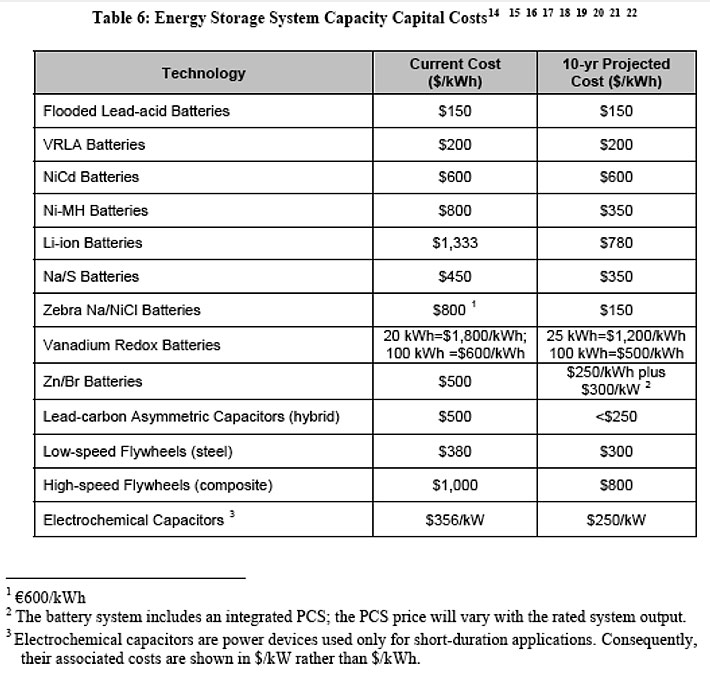
There are two basic kinds of energy storage products: cool devices like NiMH batteries, lithium-ion batteries, high-speed flywheels and supercapacitors that promise extraordinary performance and are objectively expensive; and simpler devices like lead-acid batteries, flow batteries, sodium nickel chloride batteries and low-speed flywheels that make less dramatic claims and are far cheaper. My favorite source of cost data on energy storage technologies is a July 2008 report from the Solar Energy Grid Integration Systems – Energy Storage (SEGIS-ES) program at Sandia National Laboratories. While critics often suggest that the Sandia numbers should be ignored because they’re not as optimistic as forward looking statements and stories in the mainstream media, I believe the Sandia estimates are less prone to puffery and unbridled optimism.
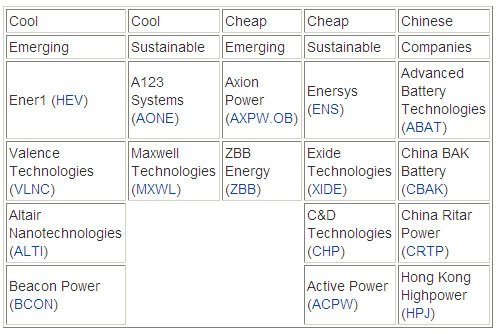
There are three basic types of pure-play energy storage investments: established manufacturers with sustainable business models, entrepreneurial companies that are developing new technologies, and Chinese companies that have listed their shares in the U.S. but won’t be players in America’s domestic battery industry. To allow for fundamental differences among their technologies and business models, I’ve segregated the universe of publicly held pure play energy storage companies into five classes as follows:
Since I started writing on this topic, my basic premise has been that market expectations for companies with objectively cool technologies are too optimistic while market expectations for companies with objectively cheap technologies are too pessimistic. That premise led me to believe that over time the cheap technology companies would outperform the cool technology companies. The following graph tracks the composite market performance of my tracking categories from November 14, 2008 through March 31, 2010.
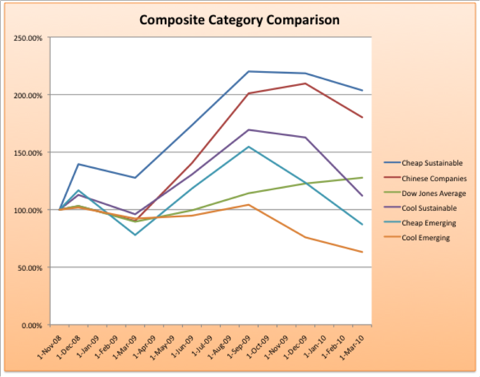
The past is never a guarantee of the future, but my basic premise seems to be holding up pretty well.
Disclosure: Author is a former director of Axion Power International (AXPW.OB) and holds a substantial long position in its common stock.
About the author: John L. Petersen, Esq. is a U.S. lawyer based in Switzerland who works as a partner in the law firm of Fefer Petersen & Cie (http://www.ipo-law.com) and represents North American, European and Asian clients, principally in the energy and alternative energy sectors. This article comes from SeekingAlpha. Petersen has written many pieces on this area. His articles are archived here.
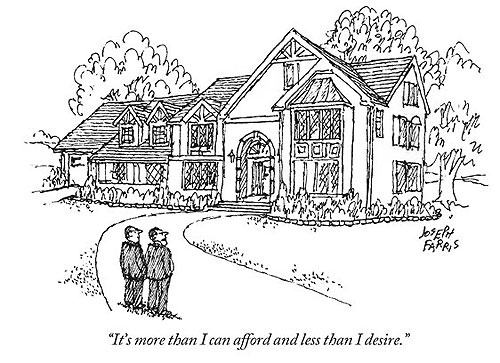
Favorite recent New Yorker cartoons.


Harry Newton, who is bemused by some of the words. Sample from the latest Economist, “The SEC also claims that IKB, a German state bank with a seemingly inexhaustible capacity for self-harm, was not told of Paulson’s role in helping pick the mortgages, a role the SEC argues was material.”

Hi Harry,
I have a question: Do you get permission and pay a fee for running the New Yorker cartoons? I'll tell you why I ask:
I own a small steel fabricating company in the midwest, and recently I took the liberty of putting one of Sid Harris's cartoons (from the New Yorker) on the backpage of our 4 page monthly newsletter.
It was a perfect cartoon for us. It showed (and you may remember it) a couple guys gazing at a small shopping center, a cluster of homes and apartments, and a steel mill right in the center, and the comment was something like, “This ought to work out pretty well…”
Well, guess what? A couple of weeks ago, I got a letter from a guy who apparently polices the wholle world looking for guys like me. He's demanding $200 for the privilege I took with Sid's carfoon. He won't budge either. If I don't pay up, he threatens he'll sue.
Now I know I'm in the wrong, but wouldn't you think they'd be less harsh…After all, the monthly magazine isn't for sale, it's a relationship-building project…
No, no, they won't buy any of it. They say I'm depriving Sid of his livlihood.
I do feel badly about doing something that is definitely against the law. It just seems sort of funny that the big New Yorker happens to clamp down on a guy in the midwest, like I'm really up to no good.
Anyway, what do you do? Do you come up with $200 everytime you have a cartoon in your blog?
Thanks for any advice.
Best,
Bob Wolff, Owner & President
Sachs Steel & Supply Corp.
Send him the $200 and be thankful he didn't ask for more.
“I’d love to tell you that things are going to get better, but they’re not. We live on a planet where six billion poor live in squalor and deprivation while 500 million of us enjoy relatively comfortable lives. As long as the poor didn’t know that there was more to life than mere subsistence, they neither contributed to nor demanded from the global economy.”
-Never trust anyone who bellows such B.S. It is not factual and is only the rumblings of a corrupt socialist who is high on their own musings.
Really? With all due respect A.R., when was the last time you visited another country? Please, don't include any trips to Canada. Ever been to a village in China, India, or in any one of the countries in Africa and South America? What about any big city in Russia or any of the other countries that were part of the former U.S.S.R.? What you see when you are a tourist in any country is not a true reflection of how life is lived by the average person of that country, including our own. Not sure why you thought the author was a “corrupt socialist” as he was merely stating the fact that there are a lot of people in the world – billions of them – who are now aware of things that they never knew before, thanks to the advances and availability of technology enabling better communications and allowing them to see how “the other half” live. As a result, they want to live the way we do, which the author clearly states will lead to even more demand and consumption of energy – which is also a fact. What is socialist about that? I respectfully suggest that you turn off your TV (you sound like a FOX fan) get your passport renewed and travel the world, learn, and open your eyes. You will be amazed with what you will learn and even start to appreciate many things you never even paid attention to. Most importantly, for all the problems that we deal with and the constant nagging by the media and the politicians that the U.S.A. is going to hell-in-a-handbasket, we live in the best country in the world and that America is still the true Land of Opportunity, bar none!