Every so often I delve into why I’m earning so little on cash. And I despair. But so is everyone else. Our desperation is doing exactly what it did the last few times the Fed lowered interest rates to practically nothing — it fueled a speculative boom. This time the boom is stocks. The good news is this boom is being supported (for now) by improving corporate earnings — e.g. this morning’s news from Procter & Gamble.
The message the Fed is giving us all: throw caution to the wind; dump all your cash into common stocks. Yesterday the Fed reaffirmed its anti-saver interest policy once again, with these words:
Information received since the Federal Open Market Committee met in March suggests that economic activity has continued to strengthen and that the labor market is beginning to improve. Growth in household spending has picked up recently but remains constrained by high unemployment, modest income growth, lower housing wealth, and tight credit. Business spending on equipment and software has risen significantly; however, investment in nonresidential structures is declining and employers remain reluctant to add to payrolls. Housing starts have edged up but remain at a depressed level. While bank lending continues to contract, financial market conditions remain supportive of economic growth. Although the pace of economic recovery is likely to be moderate for a time, the Committee anticipates a gradual return to higher levels of resource utilization in a context of price stability.
With substantial resource slack continuing to restrain cost pressures and longer-term inflation expectations stable, inflation is likely to be subdued for some time.
The Committee will maintain the target range for the federal funds rate at 0 to 1/4 percent and continues to anticipate that economic conditions, including low rates of resource utilization, subdued inflation trends, and stable inflation expectations, are likely to warrant exceptionally low levels of the federal funds rate for an extended period…
Experience tells us 100% allocation to common stocks is a recipe for disaster, especially at my age (67). So yesterday I went in search of the perfect cash vehicle. I’ve done this exercise for several years now. Increasingly I walk away from the day feeling totally miserable. But I have learned two important things:
First, the Fed reduces its rates. And the banks follow slowly, as reflected in this chart of rates being paid for saving at banks:
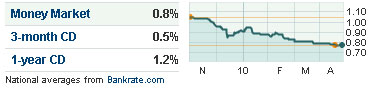
Second, “the big fear” that bond prices will fall when interest rates rise has been a gigantic bugaboo — at least in the last five years. Every time I buy a bond or invest in a bond fund, I’m warned that value of my bonds will fall when interest rates rise –as they must soon. But they never do. Meantime, I’m losing money by not “tweaking” my cash a little better. For example yesterday, I discovered that My Vanguard New York Tax exempt money market fund was now paying the grand sum of 0.15%. A better deal would something like the Vanguard Limited-Term Tax-Exempt Fund Investor Shares (VMLTX) which invested in short-term muni bonds, is exempt from Federal (but not local) and pays 1.42%. The warnings about capital loss are somewhat moot, however. Check out this chart of the fund from the last ten years. Notice that it’s fluctuated within a fairly narrow range over the past ten years, taking its time to make its move:
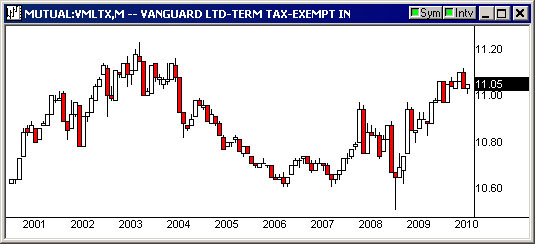
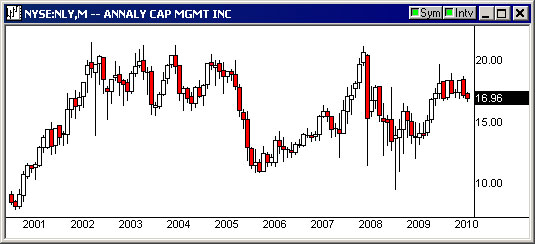
Vanguard says the 10-year return on this fund has been 3.91%. Free of Federal tax, that’s not bad. This doesn’t go anywhere near NLY’s present 15.33% dividend yield but it’s also fluctuated more widely over the past ten years:
The lessons are:
1. You need to look at your cash and cash equivalents regularly. Suddenly you can be earning nothing. And they don’t tell you “we’ve just dropped our rates, again.”
2. You don’t have to despair and dump everything into equities.
3. You should think of a broad allocation of your “cash” investments. While less safe than bank CDs, bond funds appear to be ultra-safe — now the Fed is maintaining its anti-saver, pro-bank policy.
4. You should keep looking. Muni bonds, for example, aren’t traded like stocks. You can’t look up their prices. A bond appears. It’s cheap. You have 5 minutes to make up your mind. (At least that’s all Todd gives me.) Then it disappears. Someone else bought it. That’s it. No more. Not like the stockmarket. You’re left stunned. You buy it. Hopefully, you did good. My bonds have done wonderfully in recent years. Thank you Todd.
Solid state drives improve. They’re not dropping in price. But they are improving in performance. MaximumPC magazine reviewed the major drives and liked two drives the best — the OWC Mercury Extreme Enterprise and the OCZ Vertex LE. Both these are only 100 GB which is a bit small for my taste. The magazine also liked the $330 Corsair Nova V128, an updated version of the one I use (see the right hand column). This drive is bigger at 128 GB. As I’ve said before, a solid state drive (SSD) will speed your PC or laptop up faster than any tweeking you can do to the software and crapware on your hard drive.
The future of bicycles? Acccording to Engadget, this Lexus bicycle has apparently been quietly making the rounds since the last year’s Tokyo Motor Show.
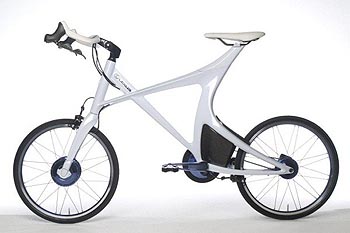
While it’s still just a concept, it does exist in prototype form, and packs a 240-watt electric motor that’s powered by a 25.9-volt lithium battery pack, which promises to give you a little extra push when you’re tired of pedaling. Being a Lexus, it also follows the “L-finesse” design language, and it relies on the same principles of the Lexus Hybrid Drive system to recharge the battery through regenerative braking. Unfortunately, Lexus says it doesn’t have any plans to put the bike into production.
Salt is not good for you. Richard Russell of the Dow Theory (investment) Letters writes:
Now it can be told. I’ve been warning my subscribers about the dangers of too much salt. Go through your local super-market and read the labels. Almost everything is loaded with sodium. It’s almost criminal. Soup is one of the worst offenders as are frozen dinners. A feature article on the front page of today’s USA Today tells the story. “Known as a silent killer, it’s part of the way we live.”
“More than half of Americans have either high blood pressure or pre-hypertension,” says cardiologist Clyde Yancy, President of the American Heart Association and medical director at the Baylor Heart and Vascular Institute of Dallas.
Americans now consume an average of about 3,400 milligrams of sodium a day or about 1 1/2 teaspoons, government data show. Men consume more than women. But most adults – including those with high blood pressure, African-Americans, the middle-aged and the elderly – should consume no more that 1,500 milligrams a day, according to the dietary guidelines from the U.S. Department of Agriculture. Others should consume less that a teaspoon, the guideline say.
And yet it’s virtually impossible to limit yourself to such amounts if you often eat processed foods, prepared foods or restaurant fare, including fast food. Most Americans’ sodium intake comes from those sources, not the salt shaker on the table. Some restaurant entrees have 2,000 milligrams or more in one dish. Fast-food burgers can have more that 1,000 milligrams. Many soups are chock-full of sodium. So are many spaghetti sauces, broths, lunch meats, salad dressings, cheeses, crackers and frozen foods.
“You can’t see it,” Yancy says. “You can’t even taste it because you are so accustomed to it. If you want the freedom to make healthy choices, you are limited by today’s foods. That’s a problem.”
There are several theories for why sodium increases blood pressure, Yancy says, “but the most obvious one is that it makes us retain fluids, and that retention elevates blood pressure,” which injures blood vessels and leads to heart disease and stroke. “It’s a connect-the-dots phenomenon.”
There are many punchlines here.
A doctor says to his patient, “I have bad news and worse news”.
“Oh dear, what’s the bad news?” asks the patient.
The doctor replies, “You only have 24 hours to live.”
“That’s terrible”, said the patient. “How can the news possibly be worse?”
The doctor replies, “I’ve been trying to contact you since yesterday.”
The joke that got the White House in trouble.
A Taliban militant gets lost and is wandering around the desert looking for water. He finally arrives at a store run by a Jew and asks for water.
The Jewish vendor tells him he doesn’t have any water but can gladly sell him a tie. The Taliban begins to curse and yell at the Jewish storeowner. The Jew, unmoved, offers the rude militant an idea: Beyond the hill, there is a restaurant; they can sell you water.
The Taliban keeps cursing and finally leaves toward the hill. An hour later he’s back at the tie store. He walks in and tells the merchant: “Your brother tells me I need a tie to get into the restaurant.”

Harry Newton, who looks at today’s blue skies and feels wonderful. Tomorrow we look at debt. Until then, avoid it.

About salt: We eat health food, very low salt, and had to eat dinner at a Thai restaurant two evenings in a row recently (suddenly out of town). My four year old son, who usually sleeps peacefully, kicked like a colt for hours while he slept. My calves twitched, too. What a disgusting feeling. Anybody who has “restless legs syndrome” and eats EVER at a restaurant or processed food is contributing to their own disease IMHO.
I credit an electric bike for helping me drop from being obese to simply being overweight. Isn't it a contradiction to say I got more exercise when I used an electric bike? Not at all!
This isn't just a two wheeled motorized vehicle, this is still a bicycle — with pedals. You won't just sit there, you'll pedal. And the more often I pedaled, the better shape I got in — and then found I was using the electric assist less and less.
And after a whiie I found myself using the bike to replace car trips. Why? It can be quicker, for one. The electric assist DOES get you there faster than pedaling alone. Accelerating from a stop sign? Pedal hard but hit the electric throttle to get through the intersection as quickly as the cars do. That makes it safer too!
Climbing a hill? Hit the juice — especially when you prefer not to be covered in sweat when you reach your destination.
These things have a future — regardless of the price of a gallon of gas.