The chart tells the damage cockroaches have wreaked.
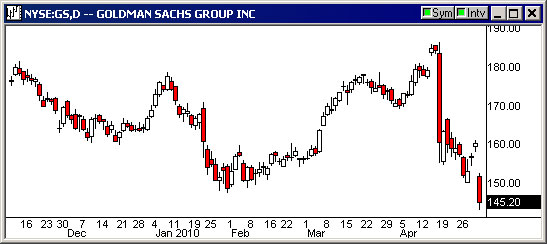
There are two reasons stocks fall in price. First, because their earnings (outlook or actuality) fall. Second, because weird, non-earnings-related, bad things happen to, and emerge about them. I call these cockroach events. They resemble cockroach behavior. When one strange, bad event happens, another, another and another are likely to happen — just like you can never get rid of cockroaches when one appears in your kitchen. (Living in New York for 41 years makes me a certified expert on cockroach behavior.)
On April 26, I wrote that Goldman Sachs looks more and more like cockroach stock and you ought to short it or buy puts against it. Had you, your trade would now be nicely profitable. It’s worth listing the cockroach events (and wondering what the next ones will be):
+ First, there was the news that it helped Greece hide its irresponsible borrowings. and thus get Greece into the mess it is today.
+ There was the news of the SEC civil fraud case.
+ There was the news that one Goldman insider told a hedge fund manager Goldman client that Warren Buffett had effectively saved the company by investing $5 billion in Goldman — before the Buffett investment was public. This enabled the hedge fund manager (Raj Rajaratnam) to buy shares before they rose on the news.
+ Then there’s the news that some senior Goldman employees, knowing about the unannounced SEC fraud case — but knowing it was coming — sold $65.4 million worth of stock after the firm received notice of possible fraud charges, which later drove its stock down 13%.
+ And now late last week there were rumors that the Government was preparing a criminal fraud case against Goldman.
Is Goldman still a cockroach stock? I believe so. But I wouldn’t make a big bet on it at this point. Personally, I had shorted Goldman and on Friday, after it plummeted, I covered.
What could possibly further emerge on Goldman? Frankly, I have no idea, just as I had no idea of rumors on criminal fraud cases . But, as a taste, here’s Matt Taibbi’s latest Goldman hate article — from the latest issue of Rolling Stone:
The Feds vs. Goldman
The government’s case against Goldman Sachs barely begins to target the depths of Wall Street’s criminal sleaze.
On the day the Securities and Exchange Commission filed suit against Goldman Sachs for securities fraud, shares in the company plunged 12.8 percent, closing at $160.70. The market, it seemed, was finally passing judgment on a decade of high-stakes Wall Street scammery that left America threatening Nigeria, Indonesia and Belarus on the list of the world’s most corrupt economies.
A few days later, Goldman announced its first-quarter numbers. Profits were up 91 percent, to a staggering $3.4 billion.
Compensation and bonuses soared to $5.5 billion, up from $4.7 billion in the first quarter of 2009. Battered in the press, Goldman was raking up on the bottom line. So investors once again leapt into Goldman’s arms, pushing the stock as high as $166.50, not far from where it was even before news of the SEC suit broke.
Goldman isn’t dead – far from it. But this new SEC suit officially places it at the center of a raging national discussion about the hopelessly fucked state of American business ethics. As a halting, first-step attempt at financial regulatory reform makes its way toward a vote in the Senate, the government has finally thrown open the door and let a few of the rottener skeletons tumble out.
On the surface, the failure-to-disclose rap being leveled at Goldman feels like a niggling technicality, the Wall Street equivalent of a tax-evasion charge against Al Capone. The bank will try and – who knows – might even succeed in defending itself in a court of law against these charges. But in the court of public opinion it was doomed the instant the SEC decided to put this ghastly black comedy of a fraud case on the street for everyone to see. Just as Pittsburgh Steeler Ben Roethlisberger will never recover from the image of him (allegedly) waving his dick at a scared 20-year-old coed in the darkened hallway of a Georgia nightclub, Goldman may never bounce back from the SEC’s brutal blow-by-blow account of how the bank conspired with a hedge-fund magnate to bend one gullible business partner after another over the edge of the subprime housing market.
Read the story that started it all, “The Great American Bubble Machine,” and find out why Matt Taibbi called Goldman Sachs “a great vampire squid wrapped around the face of humanity.”
Here’s the CliffsNotes version of the scandal: Back in 2007, Harvard-educated hedge-fund whiz John Paulson (no relation to then-Treasury secretary and former Goldman chief Hank Paulson) smartly decided the housing boom was a mirage. So he asked Goldman to put together a multibillion-dollar basket of crappy subprime investments that he could bet against. The bank gladly complied, taking a $15 million fee to do the deal and letting Paulson choose some of the toxic mortgages in the portfolio, which would come to be called Abacus.
What Paulson jammed into Abacus was mortgages lent to borrowers with low credit ratings, and mortgages from states like Florida, Arizona, Nevada and California that had recently seen wild home-price spikes. In metaphorical terms, Paulson was choosing, as sexual partners for future visitors to the Goldman bordello, a gang of IV drug users, Haitians and hemophiliacs, then buying life-insurance policies on the whole orgy. Goldman then turned around and sold this poisonous stuff to its customers as good, healthy investments.
Where Goldman broke the rules, according to the SEC, was in failing to disclose to its customers – in particular a German bank called IKB and a Dutch bank called ABN-AMRO – the full nature of Paulson’s involvement with the deal. Neither investor knew that the portfolio they were buying into had essentially been put together by a financial arsonist who was rooting for it all to blow up.
Goldman even kept its own collateral manager – a well-known and respectable company called ACA – in the dark. The bank hired the firm to approve the bad mortgages being selected by Paulson, but never bothered to tell ACA that Paulson was actually betting against the deal. ACA thought Paulson was long, when actually he was short. That led to the awful comedy of ACA staffers holding meeting after meeting with Goldman and Paulson, and continually coming away confused as to why their supposedly canny financial partners kept kicking any decent mortgage out of the deal. In one ACA internal e-mail, the company wonders aloud why Paulson excluded mortgages issued by Wells Fargo – a bank that traditionally created high-quality mortgages. “Did [they] give a reason why they kicked out all the Wells deals?” the quizzical e-mail reads.
The climactic scene of this absurd vaudeville came on February 2nd, 2007, when Goldman vice president Fabrice Tourre – a French-born slimeball who would be the only Goldman individual named in the suit – showed up with Paulson & Co. at ACA’s New York offices. At this meeting, both Paulson’s people and Tourre presumably pretended, for the benefit of their sucker partner ACA, that they were putting together a deal they actually believed in. One has to imagine Tourre and the Paulson contingent overacting with Shatnerian intensity to convince the numbskull ACA guys that they really, really thought subprime mortgages lent out to exurban Floridians with shit credit scores were awesome investments. During the meeting, Tourre sent a damning e-mail to another Goldman staffer: “I am at this aca paulson meeting, this is surreal.”
Tourre would brag in other e-mails that while the housing market was about to blow up, his fabulous French self would be left standing in a pile of money when it was all over. “More and more leverage in the system,” he wrote. “The whole building is about to collapse anytime now. . . . Only potential survivor, the fabulous Fab . . . standing in the middle of all these complex, highly leveraged, exotic trades he created!”
Get more political muckraking from Matt Taibbi on his blog, Taibblog.
These flighty Tourre e-mails boasting of cashing in on a disaster and chuckling over the “surreal” experience of power-lying right in the face of a business partner are Goldman’s very own Ben Roethlisberger drunken dick-waving moment. It is hard to imagine any company from now on doing business with Goldman and not picturing its fruitcake executives text-boasting to each other about the pleasures of screwing over their own clients.
Goldman has issued three denials with regard to the SEC charges. The first was a very curt “this is all bullshit” press release, issued on the day the complaint came out, in which it called the charges “completely unfounded in law.”
Then, after their PR people had a few minutes to think about things, Goldman issued a second release claiming that it lost $90 million on the deal, and therefore couldn’t have been doing anything wrong. While this may be true – and we only have their word for it that it is – who the hell cares? What Goldman is being accused of is lying to its clients. How much money they did or didn’t make is totally irrelevant. In fact, if Goldman really did lose money knowing what they knew about this deal, all that proves is that they’re morons as well as sleazebags.
The third press release paved the way for the inevitable deployment of the Dr. Richard Kimble/one-armed-man defense – i.e., that Fabrice Tourre did it all, acting alone. “Goldman Sachs would never condone one of its employees misleading anyone,” the release insisted. “Were there ever to emerge credible evidence that such behavior indeed occurred here, we would be the first to condemn it and to take all appropriate actions.”
So within the space of a few days, Goldman issued three different explanations, which progressed from (a) we absolutely, positively didn’t do it, to (b) if we did do it, we didn’t make any money doing it, and finally on to (c) if somebody did it, it was only that French cat Tourre, and here’s his head if you want it. These guys couldn’t find the truth if it was sitting in their lap playing the ukulele, and that’s the basic problem that the entire financial-services sector – an industry that requires trust and confidence to thrive – is struggling to overcome.
Just under a year ago, when we published “The Great American Bubble Machine” [RS 1082/1083], accusing Goldman of betting against its clients at the end of the housing boom, virtually the entire smugtocracy of sneering Wall Street cognoscenti scoffed at the notion that the Street’s leading investment bank could be guilty of such a thing. Attracting particular derision were the comments of one of my sources, a prominent hedge-fund chief, who said that when Goldman shorted the subprime-mortgage market at the same time it was selling subprime-backed products to its customers, the bait-and-switch maneuver constituted “the heart of securities fraud.”
CNBC’s house blowhard, Charlie Gasparino, laughed at the “securities fraud” line, saying, “Try proving that one.” The Atlantic’s online Randian cyber-shill, Megan McArdle, said Rolling Stone had “absurdly” accused Goldman of committing a crime, arguing that “Goldman’s customers for CDOs are not little grannies who think a bond coupon is what you use to buy denture glue.” Former Wall Street Journal reporter Heidi Moore hilariously pointed out that Goldman wasn’t the only one betting against the housing market, citing the short-selling success of – you guessed it – John Paulson as evidence that Goldman shouldn’t be singled out.
The truth is that what Goldman is alleged to have done in this SEC case is even worse than what all these assholes laughed at us for talking about last year.
Prior to the “Bubble Machine” piece, I had heard rumors that Goldman had gone out and intentionally scared up toxic mortgages and swaps in order to get short of them with sucker bookies like AIG. But – and this seems funny in retrospect – I foolishly dismissed those tales as being too conspiratorial. I thought it was bad enough that Goldman was shorting the subprime market even as it was selling toxic subprime-backed securities to chumps on the open market. The notion that the bank would actually go out and create big balls of crap that would be designed to fail seemed too nuts even for my tastes.
In the year since – and this, to me, is the main lesson from the SEC case against Goldman – the public has quickly come to accept that when it comes to the once-great institutions of modern Wall Street, literally no deal that makes money is too low to be contemplated.
The nearly identical case involving a Merrill Lynch mortgage deal called Norma now making its way through the courts is just one example. There is more fraud out there, and everyone knows it: front-running, manipulation of the commodities markets, trading ahead of interest-rate moves, hidden losses, Enron-esque accounting, Ponzi schemes in the precious-metals markets, you name it. We gave these people nearly a trillion bailout dollars, and no one knows what service they actually provide beyond fraud, gross self-indulgence and the occasional transparently insincere public apology.
The Goldman case emerges as a symbol of all this brokenness, of a climate in which all financial actors are now supposed to expect to be burned and cheated, even by their own bankers, as a matter of course. (As part of its defense, Goldman pointed out that IKB is a “sophisticated CDO market participant” – translation: too fucking bad for them if they trusted us.) It would be nice to think that the SEC suit is aimed at this twisted worldview as much as at the actual offense. Some observers believe the case against Goldman was timed to pressure Wall Street into acquiescing to Sen. Chris Dodd’s loophole-ridden financial-reform bill, which probably won’t do much to prevent cases like the Abacus fiasco. Or maybe it’s just pure politics – Democrats dropping the proverbial horse’s head in Goldman’s bed to get their fig-leaf financial-reform effort passed in time for the midterm elections.
Whatever the long-range motives, the immediate effect of the lawsuit is to put Wall Street’s crazy fraud ethos on trial in the court of public opinion. For now, at the end of the first quarter, Goldman and most of the other big banks are still winning that case. But the second quarter might be a different story.
THE FIRST JEWISH PRESIDENT of the United States calls his mother in Queens and invites her to come down for Thanksgiving.
She says, “I’d like to, but it’s so much trouble … I mean, I have to get a cab to the airport, and I hate waiting on Queens Blvd …”
He replies, “Mom! I’m the President! You won’t need a cab – I’ll send a limousine for you!”
His mother replies, “I know, but then I’ll have to get my ticket at the airport, and try to get a seat on the plane, and I hate to sit in the middle … it’s just too much trouble.”
He replies, “Mom! I’m the President of the United States! I’ll send Air Force One for you – it’s my private jet!”
To which she replies, “Oh, well, but then when we land, I’ll to carry my luggage through the airport, and try to get a cab … it’s really too much trouble.”
He replies, “Mom!! I’m the President! I’ll send a helicopter for you! You won’t have to lift a finger.”
She answers, “Yes, that’s nice … but, you know, I still need a hotel room, and the rooms are so expensive, and I really don’t like the rooms…”
Exasperated, he answers, “Mom! I’m the President! You’ll stay at the White House!”
She responds, “Well … all right … I guess I’ll come.”
The next day, she’s on the phone with her friend Betty:
Betty: “Hello, Sylvia … so what’s new?”
Sylvia: “I’m visiting my son for Thanksgiving!”
Betty: “The doctor?”
Sylvia: “No … the other one”

Harry Newton, who spent a fascinating morning listening to the CNBC interview with Warren Buffett. He really is a one smart fellow. One day he calls derivatives “financial weapons of mass destruction.” Then we find out that his Berkshire Hathaway has $63 billion of derivatives, ranging from hedging contracts to underwriting bets against muni and other bonds. And we find out that Buffett’s home state senator, Ben Nelson, is the only Democratic senator who has publicly stated that derivatives shouldn’t be regulated. But then Buffett is Nelson’s biggest campaign donor and Nelson owns shares in Berkshire Hathaway. Funny conflicted world we live in.

Dear Harry,
Please let us know your comments after watching the “Enron” and the “Goldman Sachs, the musical” on Broadway. (Hopefully you don't feel like watching cockroaches crawling on the stages). Thanks. 🙂
KS
Hi Harry,
From spotlighting the foibles of human behavior to a simple joke your site always gives me a laugh.
Today it is your discussion of cockroaches – the financial sort.
Right next to your column is an ad for Terminix.
If only there was a Terminix for financial cockroaches.
Too funny.
It's “Boomer” reality time. Like, “What! You're shocked?” Casablanca for an aging generation. Maybe it's a good thing to come to one's senses only late in life. It certainly wouldn't be healthy growing up bitter, dark, distrustful, and crippled by unvarnished truth. But then what do I know?