There’s a huge explosion in startups, with many doing extraordinarily well. I believe everyone should own a specs — startups and spec biotechs (like IRWD) and spec miners. (See at the bottom.)
The New York Times has a cover story this morning on “Sudden Rise in Home Demand Takes Builders by Surprise.” It starts:
SACRAMENTO – After six years of waiting on the sidelines, newly eager home buyers across the country are discovering that there are not enough houses for sale to accommodate the recent flush of demand.
“In my 27 years I’ve never seen inventories this low,” said Kurt K. Colgan, a broker with Lyon Real Estate in the Sacramento metropolitan area, where the share of homes on the market has plummeted by one of the largest amounts in the nation. “I’ve also never seen a market turn so quickly.”
The housing turnaround seems to have caught almost everyone in the business by surprise. As desirable as the long-awaited improvement may be, the unusually low level of homes for sale is creating widespread problems for buyers and sellers alike, leading to bidding wars and bubblelike price jumps in places that not long ago were suffering from major declines. In the Sacramento area, where the housing bust took an especially heavy toll, the median sales price has surged 15 percent over the last year, according to Zillow.
Nationwide, sales prices rose 7.3 percent over the course of 2012, according to the Standard & Poor’s Case-Shiller index, ranging from a slight decline in New York to a surge of 23 percent in Phoenix. Tracking more closely with the national trend were cities like Dallas, up 6.5 percent; Tampa, which rose 7.2 percent; and Denver, which gained 8.5 percent.
In many areas, builders are scrambling to ramp up production but face delays because of the difficulty of finding construction workers and in obtaining permits from suddenly overwhelmed local authorities. At the same time, homeowners – many of them lifted above water for the first time in years – often remain reluctant to sell, either because they want to wait and see how much further prices will climb or because they are afraid of being displaced in the sudden buying frenzy.
“You see a home go for sale and within a couple days there are three, four, six offers,” said Carrie Miskawi, a mother of three young children who has been looking for a new home for the last six months with Mr. Colgan’s help. She and her husband have decided not to put their current home on the market because they fear it will be snatched up before they have a chance to bid successfully on a new one.
“It’s kind of a Catch-22,” Mr. Colgan said. As long as large numbers of people are hesitant to put their own homes on the market because so few other homes are available, he said, there won’t be many homes available.
Across the country, the raw number of homes for sale is at its lowest level since 1999, according to the National Association of Realtors. In the Sacramento metro area, home listings were down 60 percent in January from a year earlier, compared with 23 percent for the country over all, according to Zillow.
Inventories have been whittled down largely because new construction ground to a standstill for several years. Investors large and small have also scooped up most of the backlog of foreclosures and short sales; about 40 percent of all homes bought in Sacramento County over the last year were purchased by owners who currently live at a different address, according to county records and title data provided by the Fidelity National Title Insurance Company.
But steady job growth has put more people back to work, and families that put off moving because they couldn’t afford it are finally ready to do so. “Distressed” sales are down and conventional sales are up.
Extraordinarily low mortgage rates don’t hurt, either.
Yesterday I said I liked Lennar and Toll. I still do, though they went up a little after my column. (Heh. I can affect the market. — No way, Harry. You live in fantasy.)
Profit dropped 31% at FedEx and the stock got hammered — nearly 7% down yesterday:
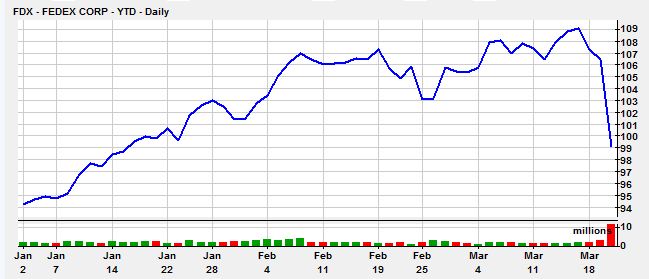
Businesses are steering away from FedEx’s unbelievably pricey express air services and going for its much cheaper ground services. I recently sent an overnight package with them and was horrified when I got the bill — $42. And I thought UPS was pricey. I suspect FedEx may cut its overnight prices, work more deals with its bigger shippers and get itself on a growth trajectory quickly. After all it’s not the economy that’s doing badly, It’s something FedEx management can solve. Watch this stock today and tomorrow. Pick it up if it becomes a little cheaper.
Capitalism, Steven Pearlstein, and Morality. This came from Dean Baker at a place called cepr, the Center for Economic and Policy Research. I did the bolding. There’s a lesson here. See below.
The Washington Post had a major column by Steve Pearlstein on the front page of its Outlook section headlined, “Is Capitalism Moral?” The piece notes the sharp upward redistribution of income over the last three decades and asks whether we should just being willing to accept market outcomes.
Of course this question is absurd on its face. The upward redistribution of the last three decades was the result of deliberate government policies designed to redistribute income upward; it was not the natural workings of the market.
For example, trade policy was quite explicitly intended to place segments of the U.S. workforce in direct competition with low paid workers in Mexico, China and other developing countries. The predicted and actual result of this policy has been to push down the wages the bottom 50-70 percent of the workforce to the benefit of those at the top.
This was hardly the free market. We could have adopted trade policies that were designed to put doctors, lawyers and other highly paid professionals in direct competition with their much lower paid counterparts in the developing world. If we had done this, doctors in the U.S. might be earning closer to $100,000 a year rather than the current average of more than $250,000 annually. This would transfer more than $100 billion annually to the rest of the country in the form of lower health care costs.
The government also strengthened and lengthened the periods of monopoly protection provided by both patents and copyrights. This has hugely increased the amount of rents being paid to high-end earners, the pharmaceutical industry and the entertainment industry at the expense of everyone else.
The government has also helped management against labor by having laws that asymmetrically punish workers and management. If workers have a strike that is ruled illegal, the case can immediately go into court and the leaders of the strike can be thrown in jail. By contrast, when management breaks the law to prevent workers from organizing, the case goes to the National Labor Relations Board, where it can be dragged out for months or even years. Management will almost never face imprisonment as a result of its lawbreaking.
In the last three decades the government has allowed banks to merge and grow large enough so that they enjoy an implicit guarantee from the government. This guarantee provides a subsidy to the big banks that has been estimated to be as large as $80 billion a year. The financial sector also enjoys a special low tax status in that it is exempted from many of the taxes (most importantly state sales taxes) that affect other industries. This is also an implicit subsidy.
Even the state of the macro economy is a policy decision, not a market decision. The fact that almost 8.0 percent of our workforce is unemployed is the result of a policy decision that put a greater emphasis on limiting deficits and debt than maintaining full employment. (There is no natural market level of government surpluses/deficits. Whatever the government does is a policy decision — sorry natural market lovers.) The decision to put a higher priority on deficit reduction than maintaining employment levels also redistributes income upward. The people who are unemployed are disproportionately at the lower end of the income ladder. Also, high rates of unemployment put downward pressure on the wages of the bottom half of the workforce even if they are employed.
The massive upward redistribution of the last three decades has been the result of these and other deliberate policies that had the goal of redistributing income upward. It was not the result of free market capitalism. …
The real message here is: make sure you, your children and your grandchildren are not at the bottom of the rung. And the only cure for that is education. Oodles of formal education and at home. For the full post, click here.

Harry Newton who eyeing these long-shot Canadian specs: Alpha Minerals and Forum Uranium. For more Google “Stockhouse Alpha Minerals.”

It’s undoubtedly exciting for the NYTimes and its readers to see the housing market is rising. But with medium and lower cost house prices down 50% and more in places like Sacremento, Phoenix and Florida, from their tops a few years ago, they still have a long way to go. And millions of underwater homes are yet to enter the market. And a lot of these buyers are home flippers, rather than mom and dad getting a place for the kids to grow up in.
Harry,
Capitalism is the only moral economic method known to us other than a benevelant dictator. But it only works well when the government doesn’t put roadblocks in the way. Instead of moving everyone up the scale and giving them a chance for prosperity, as of late we have been trying to pull down the top tier so everyone is more “equal”. The result of this is higher unempolyment, a lower standard of living for everyone – especially the middle class, and more dependence on government. This downward spiral is bankrupting America.
Well said, and all too true.
Did you miss the point (or ignore it) of the section Harry bolded?