Three people died, and another 150+ were injured by two explosions at the finish line of the Boston Marathon yesterday. One of the dead was 8-years old. Many of the injured lost their legs — a result the bomb maker/s seemed to want. President Obama said those responsible will “feel the full weight of justice”. The FBI will hold a press conference at 9:30 a.m. ET. For horrifying images from the Boston Marathon explosions, click here.
Stratfor, the intelligence service, send this out late last night:
Unanswered Questions After the Boston Marathon Blasts
Two deadly blasts disrupted the Boston Marathon today. The people of Boston have been terrorized and are panicked. International media are seeking information and inadvertently magnifying and spreading fear, while federal, state and metropolitan authorities are working to secure the city, treat the wounded, investigate the scene and hunt down the perpetrator(s).
With the attack over, everyone is left waiting for answers. Why was the marathon attacked? Who conducted the attack? What was the motive? In some attacks, the answers come quickly, as with the July 7, 2005, London transit bombings. In other cases, it can take years before those answers appear, as with the 1996 Olympic Park bombing in Atlanta.
The attack venue will greatly aid the search for answers. The heavy presence of people and media that presumably drew the attacker to target the Boston Marathon may prove to be the perpetrator’s undoing if someone captured a photo of them delivering the devices. Indeed, there are reports that a man was photographed carrying multiple backpacks near the scene of the attack — although at a major marathon the sight of a person carrying multiple backpacks or gear bags to friends at the finish line is not unusual.
At first look, the devices used in the attack appear to have been rudimentary explosive devices constructed with a common homemade explosive mixture. In other words, virtually anyone could have constructed them using readily available items. Although made of common items, it appears the bombmaker intended the devices to cause maximum casualties by adding shrapnel to multiple devices planted at a heavily congested event.
Still, investigators will painstakingly search the crime scene for evidence that could help identify the bombmaker. They will look for fragments of the device that they can use to potentially trace their origin. They will also be looking for evidence that could identify the bombmaker, such as fingerprints, fiber evidence and traces of DNA. If reports of multiple undetonated devices being located are true — and they may not be, since in the wake of a blast everything tends to look like an improvised explosive device — then the undetonated devices will provide a treasure trove of forensic evidence for the investigators to work with.
While any number of actors could have conducted this attack based on the simplicity of the devices, it took some degree of planning to create and place multiple devices. Many different types of groups have used multiple devices in terrorist attacks, so that fact alone does not help identify the culprits. But if there were multiple unexploded devices recovered from different areas in Boston in addition to the two that did detonate, this would indicate that more than one person carried out the attacks, meaning an organized group was involved rather than a lone wolf. Multiple unexploded devices could suggest some sort of tactical incompetence presented by the attackers. Long race venues such as the Boston Marathon also spread out security resources over large areas, likely allowing the attackers to more easily plant multiple devices throughout the city without being detected.
The identity of the perpetrator(s) will be critical to determining the U.S. reaction to the attack. A domestic group, or even a grassroots group without direct external connections, would cause a different reaction than if the attacker or attackers have direct connections to a foreign terrorist group like al Qaeda or one of its regional franchises.
But we will have to wait for that answer.
Daughter Claire and son-in-law Ted live in Boston. They’re OK. Thank God. Ted will be working from home today because his office is near the blast site. That area is closed today.
Gold’s buying opportunity(?). If the price falls, BubbleVision always heralds:

Here’s gold over the last year:
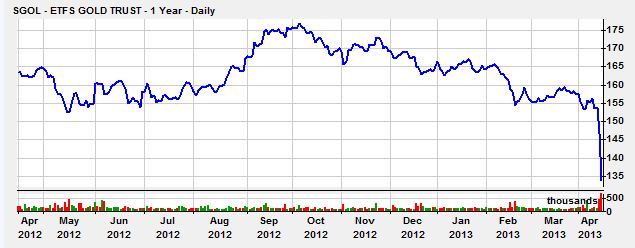
So, is it a buying opportunity? My philosophy is that catching a falling knife makes absolutely no sense. What we have here is a classic falling knife.
Gold is clearly no longer the “hedge” it once was. Where’s it going now? Commodities guru Jim Rogers told Business Insider he thinks gold is going to as low as $1200. It’s presently about $1,383. His four reasons:
1. India – The country hiked its gold import tax rate by 50% to 6% at the start of the year. This has curbed gold demand. (India is a huge gold consumer, especially for weddings.)
2. Chartists – Technical analysts that have warned that gold prices will continue to fall.
3. Cyprus – “Ms. Merkel is seeking re-election so she has told Cyprus and others that they should sell some of their gold to pay their debts. The Germans are tired of bailing people out and she needs to be tough.” (I’m guessing other European countries in trouble are also selling their gold.)
4. Bitcoins – “The collapse of Bitcoin since most of them also own gold.”
For those of us who have no idea what a Bitcoin is, the Economist explains:
BITCOIN, the world’s “first decentralised digital currency”, was launched in 2009 by a mysterious person (or persons) known only by the pseudonym Satoshi Nakamoto. It has been in the news this week as the value of an individual Bitcoin, which was just $20 at the beginning of February, hit record highs above $250, before falling abruptly to below $150 on April 11th. What exactly is Bitcoin, and how does it work?
Unlike traditional currencies, which are issued by central banks, Bitcoin has no central monetary authority. Instead it is underpinned by a peer-to-peer computer network made up of its users’ machines, akin to the networks that underpin BitTorrent, a file-sharing system, and Skype, an audio, video and chat service. Bitcoins are mathematically generated as the computers in this network execute difficult number-crunching tasks, a procedure known as Bitcoin “mining”. The mathematics of the Bitcoin system were set up so that it becomes progressively more difficult to “mine” Bitcoins over time, and the total number that can ever be mined is limited to around 21m. There is therefore no way for a central bank to issue a flood of new Bitcoins and devalue those already in circulation.
The entire network is used to monitor and verify both the creation of new Bitcoins through mining, and the transfer of Bitcoins between users. A log is collectively maintained of all transactions, with every new transaction broadcast across the Bitcoin network. Participating machines communicate to create and agree on updates to the official log. This process, which is computationally intensive, is in fact the process used to mine Bitcoins: roughly every 10 minutes, a user whose updates to the log have been approved by the network is awarded a fixed number (currently 25) of new Bitcoins. This has prompted Bitcoin fans to build powerful computers, or even to hijack other people’s computers, for use in Bitcoin mining.
Bitcoins (or fractions of Bitcoins known as satoshis) can be bought and sold in return for traditional currency on several exchanges, and can also be directly transferred across the internet from one user to another using appropriate software. This makes Bitcoin a potentially attractive currency in which to settle international transactions, without messing around with bank charges or exchange rates. Some internet services (such as web hosting and online gambling) can be paid for using Bitcoin. The complexity and opacity of the system means it also appeals to those with more nefarious purposes in mind, such as money laundering or paying for illegal drugs. But most people will be reluctant to adopt Bitcoin while the software required to use it remains so complex, and the value of an individual Bitcoin is so volatile. Just as BitTorrent was not the first file-sharing service and Skype was not the first voice-over-internet service, it may be that Bitcoin will be a pioneer in the field of virtual currencies, but will be overshadowed by an easier-to-use rival.
I don’t own any Bitcoins. My investment “logic” has always been if you don’t understand, stay away. I don’t understand. Bitcoin which surged to over $260 last week has now fallen to $57.
PSY’s latest video. Not as good as the original. But OK. Hit the bottom right hand button to play it in full HD, full screen. Most impressive.
Achievements (?) recognized. North Korean generals dressed in their finest. For a country that hasn’t been to war since 1954, what are the medals for?

How to bet on the horses.
A gambler was at the horse races playing the ponies and all but losing his shirt.
He noticed a Priest step out onto the track and blessed the forehead of one of the horses lining up for the 4th race.
Lo and behold, that horse – a very long shot – won the race.
Next race, as the horses lined up, the Priest stepped onto the track. Sure enough, he blessed one of the horses.
The gambler made a beeline for a betting window and placed a small bet on the horse. Again, even though it was another long shot, the horse won the race.
He collected his winnings, and anxiously waited to see which horse the Priest would bless next.
He bet big on it, and it won. As the races continued the Priest kept blessing long shots, and each one ended up winning.
The gambler was elated. He made a quick dash to the ATM, withdrew all his savings, and awaited for the Priest’s blessing that would tell him which horse to bet on ..
True to his pattern, the Priest stepped onto the track for the last race and blessed the forehead of an old nag that was the longest shot of the day.
This time the priest blessed the eyes, ears, and hooves of the old nag. The gambler knew he had a winner and bet every cent he owned on the old nag.
He watched dumbfounded as the old nag came in last. In a state of shock, he went to the track area where the Priest was.
Confronting Him, he demanded, ‘Father! What happened? All day long you blessed horses and they all won. Then in the last race, the horse you blessed lost by a mile. Now, thanks to you I’ve lost every cent of my savings!’.
The Priest nodded wisely and with sympathy.
‘Son,’ he said, ‘that’s the problem with you Protestants, you can’t tell the difference between a simple blessing and last rites.’

Harry Newton who sees a little good news: Housing starts are up. Goldman Sachs and Blackrock (BX) beat earnings expectations. I’m still long on APO, BX, CG and KKR. And I really like Pinnacle Foods (PF) — the only stock I own that actually rose yesterday.
You need to read these two pieces:
+ Corzine Blasted in MF Global Autopsy. Article in the Wall Street Journal. The bankruptcy trustee says clearly that John Corzine deserves much of the blame for the disaster. Click here.
+ Amazon’s letter to shareholders should inspire every company in America, from Business Insider. Click here.

The photo showing Korean generals bedecked in their metallic finest opens the possibility that a giant magnet could be the answer to N Korea’s recent posturing
Has anyone else broached the theory that the Boston Mar. attacks were caused by Wall Street traders who missed the rally anxious to knock the stock market down to a lower level that they can buy into? Remember: Wall Street banks have morals every bit as low as those of any terrorist organization. Far fetched? Maybe, but let’s not rule it out. When it comes to Wall Street, its guilty until proven innocent.