Today’s incredibly boring message:
+ We don’t know where this is going.
+ Panic will eat you alive.
+ Watch your stops. They have probably not kicked in for most of your stocks.
+ Hug the kids. Kiss the spouse.
+ Walk tall.
+ Remember the message: “Life is good.”
The story:
Last ten days:
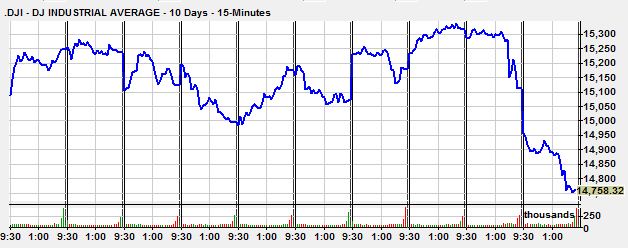
The year so far:
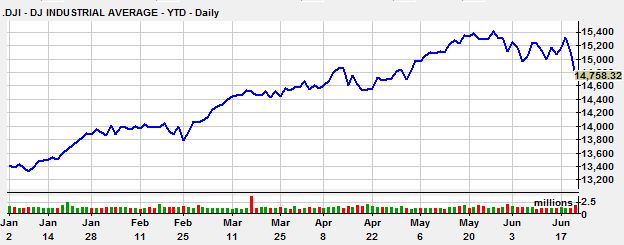
Yesterday I wrote:
The Fed says the economy is doing awfully. It pumps $85 billion a month in. The stockmarket booms.
The Fed says the economy is doing better and the stockmarket crashes (like yesterday).
Go figure.
Yesterday was awful.But other days have been awful too in this rumor-rife, but, on balance rising market.
Nothing the Fed said or didn’t say yesterday has changed my mind about being substantially invested in equities.
This morning European markets bounced back a little. I’m guessing ours will too. Here’s today’s “big summary piece” from the New York Times. They have more reporting resources than I do. But they also are as confused as I am. I bet the writer owns few shares and is not personally affected by these gyrations. He’s also desperate for a story, viz: he ended his article with a quote from Goldman Sachs’ chief economist, who’s about as conflicted in what he says publicly as you can get.
June 20, 2013
Two Economies in Turmoil, for Different Reasons
By BINYAMIN APPELBAUM
WASHINGTON – The Federal Reserve chairman, Ben S. Bernanke, meant to deliver two dollops of good news on Wednesday: the economy is doing better, and the Fed is determined to keep it that way. He announced that the Fed would extend one part of its stimulus campaign, suggested that it might extend another part, and offered new details about the timing.
Yet his primary audience, the investors whose decisions spread Fed policy through the economy, responded as if the news had been grim. The Standard & Poor’s 500-stock index took its worst two-day dive since November 2011 and has lost 5 percent of its value in the last month. Wells Fargo, the nation’s largest mortgage lender, raised its advertised rate on 30-year loans to 4.5 percent from 3.9 percent in the same period.
The call-and-response underscores the complexity of the Fed’s task as it seeks to do more to help the economy, but not too much.
Fed officials increasingly are convinced that they are finally doing enough to stimulate the economy – not just the steps already taken, but the plans they have detailed for the next several years. That is why they felt comfortable suggesting that they could begin before the end of the year to scale back their purchases of government securities. But some critics see clear evidence in the persistence of high unemployment and low inflation that the Fed should do even more. And many others are simply nervous.
“People aren’t sure that the economy is well enough for the Fed to pull back,” said Paul Christopher, chief international strategist at Wells Fargo Advisors. “The market is signaling to the Fed that we don’t trust your assessment of the economy; we don’t trust your assessment of inflation.”
On Wednesday, Mr. Bernanke sought to underscore that the Fed still planned to stimulate the economy on a big scale over the next few years. The central bank continues to hold short-term interest rates near zero, and Mr. Bernanke said it might maintain that policy for longer than previously expected. The Fed has amassed more than $3 trillion in Treasury securities and mortgage-backed securities, and Mr. Bernanke said that it no longer intended to sell the mortgage bonds as the economy improved.
Yet public attention focused almost entirely on the least potent part of the Fed’s stimulus effort, its pledge to expand its holdings of mortgage bonds and Treasuries to increase job growth.
Those purchases will continue for now, but Mr. Bernanke for the first time sketched a timeline for winding them down, beginning this year and ending next summer, as long as growth keeps pace with the Fed’s expectations. Specifically, he said that the Fed expected the unemployment rate to decline to 7 percent by next summer, from 7.6 percent in May.
Many investors responded as if Mr. Bernanke had said only that the Fed soon intended to reduce its bond purchases.
This was a good demonstration of the difference between probably and certainly. While the timeline generally corresponded to investors’ expectations, Mr. Bernanke’s remarks made it official. And his repeated insistence that investors should focus instead on the evolution of economic data worked about as well as telling people not to think about purple kangaroos.
“If you draw the conclusion that I’ve just said that our policies, that our purchases will end in the middle of next year, you’ve drawn the wrong conclusion, because our purchases are tied to what happens in the economy,” Mr. Bernanke said in one response to a question at a news conference on Wednesday.
Some analysts and economists said the reaction was particularly striking because the Fed seemed more committed than ever to its stimulus campaign.
“They are getting very close to where I would have had them be two or three years ago,” said Joseph E. Gagnon, a former Fed economist and architect of the first round of asset purchases who is now a senior fellow at the Peterson Institute for International Economics. “I find it odd, and probably the chairman is surprised and unhappy with the market reaction, too.”
The Fed declined on Thursday to comment on the market reaction to Mr. Bernanke’s remarks. But he expressed himself clearly during the news conference on the negative market response since his last public appearance in May. “Well, we were a little puzzled by that,” he said.
He also acknowledged that the Fed might need to respond if the market’s reaction persisted. “It’s important to understand that our policies are economic-dependent,” he said. “And in particular, if financial conditions move in a way that makes this economic scenario unlikely, for example, then that would be a reason for us to adjust our policy.”
Some analysts said that would not be necessary, arguing that the market would soon settle down.
Others, however, saw legitimate reasons for concern.
The Fed has made the unemployment rate the measuring stick for its stimulus effort. It doubled down on Wednesday by saying that it would buy bonds until the rate fell to 7 percent.
But the unemployment rate so far has fallen almost entirely because people have stopped looking for work. The share of adults with jobs, known as the employment-to-population ratio, has barely changed over the last three years. In past recoveries, declining unemployment has encouraged people to re-enter the labor market, but some economists argue that that will not begin to happen until the rate falls well below 7 percent.
“Why is monetary policy linked to unemployment rate as opposed to employment-to-population ratio?” Amir Sufi, an economist at the University of Chicago, wrote on Twitter. “Seems bonkers. Does anyone seriously think labor market is improving dramatically?”
Jan Hatzius, chief economist at Goldman Sachs, wrote in an e-mail that he doubted the Fed’s current plans would be sufficient. “I am much less sanguine under our forecasts for the economy,” he wrote, “and to a somewhat lesser degree even under theirs.”
How birth control really works. From my friends in Australia.
After having their 11th child, an Irish couple decided that that was enough, as they couldn’t afford a larger bed. So the husband went to his doctor and told him that he and his wife didn’t want to have any more children …..
The doctor told him there was a procedure called a vasectomy that would fix the problem but it was expensive. A less costly alternative was to go home, get a large firecracker, light it, put it in a beer can, then hold the can up to his ear and count to 10.
The husband said to the doctor, “B’Jayzus, I may not be the smartest fella in the world, but I don’t see how putting a firework in a beer can next to my ear is going to help me with my problem.”
“Trust me, it will do the job”, said the doctor.
So the man went home, lit a cracker and put it in a beer can. He held the can up to his ear and began to count:
“1, 2, 3, 4,5…….” at which point he paused, and placed the beer can between his legs so he could continue counting on his other hand.
This procedure also works in New Zealand , Tasmania , parts of Liverpool, Southern USA , and some areas near Gympie, Queensland.

Harry Newton who eyes resarch done by Men’s Journal. “We tested scores of LED bulbs in a residential setting. These three models offered the best combo of price and light quality:”
+ Best for general use. Cree 60W warm white. $13. Home Depot.
+ Best for accent lighting. Cree 40 W soft white LED. $10. Home Depot.
+ Best for indoor floods. Philips 13 W BR30 Soft white dimmable flood. $25 on Amazon.
Get some exercise and plenty of rest this weekend.

More attention should be paid to the hell Bernanke has unleashed on seniors living in fixed income CDs, etc. Confused 90-yr-olds forced into the scary stock market for the first time. Others living on a couple hundred thousand in savings on .025 percent interest. While I benefited greatly through equity gains, I find Bernanke an abhorrent and repellent man for ignoring our elderly retirees and rewarding borrowers and investors at all cost for too long.