Today stocks are plummeting overseas. They’ll probably plummet here, too. No one knows why. You can guess. But the reality is virtually all stocks are going down. What do you do?
This could be temporary blip. Or it could be the beginning of a big decline — a la 2008. No one knows.
There’s only one thing to do: Watch your stops. What are you comfortable with? 8%, 10%, 15%?
I’m comfortable with 8%. I’m watching each stock I own. If it hits 8%, I sell.
The worst thing you can now is to panic and sell everything — also called “going to cash.”
Now they’re cheaper, is this the time to pick up “bargains”?
The best time to pick up bargains is when your favorite stock drops for reasons that have nothing to do with its intrinsic earning ability.
But when all stocks are cratering as they did on Thursday and Friday (and may or may not d0 today), there’s zero reason to gamble and try to catch falling knives.
This is the time to be vigilant, not panicked.
The phrase “Wait. Be a little late. Then accelerate.” comes from my favorite tennis coach David Glackin, who’s teaching me a killer backhand.
The ratings agencies lie, cheat and steal. There’s no other conclusion from the the most recent crash in which the ratings agencies rated garbage securities as AAA, helping the banks (their clients) sell the garbage to unsuspecting investors. When it all went bad, trillions of dollar were lost, and the world’s economies were put at risk — some still are. Think Southern Europe. Matt Taibbi of the Rolling Stone published a piece in the latest issue that pretty well details it all. Some excerpts:
The Last Mystery of the Financial Crisis
It’s long been suspected that ratings agencies like Moody’s and Standard & Poor’s helped trigger the meltdown. A new trove of embarrassing documents shows how they did it. Thanks to a mountain of evidence gathered for a pair of major lawsuits by the San Diego-based law firm Robbins Geller Rudman & Dowd, documents that for the most part have never been seen by the general public, we now know that the nation’s two top ratings companies, Moody’s and S&P, have for many years been shameless tools for the banks, willing to give just about anything a high rating in exchange for cash….
Ratings agencies are the glue that ostensibly holds the entire financial industry together. These gigantic companies – also known as Nationally Recognized Statistical Rating Organizations, or NRSROs – have teams of examiners who analyze companies, cities, towns, countries, mortgage borrowers, anybody or anything that takes on debt or creates an investment vehicle.
Their primary function is to help define what’s safe to buy, and what isn’t. A triple-A rating is to the financial world what the USDA seal of approval is to a meat-eater, or virginity is to a Catholic. It’s supposed to be sacrosanct, inviolable: According to Moody’s own reports, AAA investments “should survive the equivalent of the U.S. Great Depression.”
It’s not a stretch to say the whole financial industry revolves around the compass point of the absolutely safe AAA rating. But the financial crisis happened because AAA ratings stopped being something that had to be earned and turned into something that could be paid for….
Given all of this, why would top analysts from both Moody’s and Standard & Poor’s rate such a massive deal like Cheyne without any science to back it up? The answer was simple: money. In the old days, ratings agencies lived on subscriptions sold to investors, meaning they were compensated — indirectly, incidentally — by the people buying the financial products.
But over time, that model morphed into the current “issuer pays” model, in which a company like Moody’s or Standard & Poor’s is paid directly by the “issuer” – i.e., the company that is actually making the financial product.
For Cheyne, for instance, the agencies were paid in the area of $1 million to $1.5 million to rate the deal by Morgan Stanley, the very company with an interest in getting a high rating. It’s the ultimate in negative incentives, and was and continues to be a major impediment to honest analysis on Wall Street. Michigan Sen. Carl Levin, one of the few lawmakers to focus on reforming the ratings agencies after the crash, put it this way: “It’s like one of the parties in court paying the judge’s salary.”
Thanks to this model, ratings-agency business soared during the bubble era. A Senate report found that fees for the “Big Three” doubled between 2002 and 2007, from $3 billion to $6 billion. Fees for rating mortgage-backed securities at both Moody’s and S&P nearly quadrupled.
So there were powerful incentives to whitewash deals like Cheyne. The eventual president of Moody’s, Brian Clarkson, actually copped to this awful truth in writing, in a 2004 internal e-mail. “To put it bluntly,” he wrote, “the issuer could take its business elsewhere unless the rating agency provides a higher rating.” …
Fortunately for the bank and the hedge fund, these subprime SIVs were a relatively new kind of investment product, so the ratings agencies had little to go on in the area of historical data to measure these products. One might think this would make the ratings agencies more conservative. In fact, caution in the face of the unknown was supposed to be a core value for these companies. As Moody’s put it, “Triple-A structures should not be highly dependent on untestable assumptions.”…
Rhinebridge, cheyne and a hell of a lot of other subprime investments ultimately blew to smithereens, taking with them vast amounts of cash — 40 percent of the world’s wealth was wiped out in the aftermath of the mortgage bubble, according to some estimates. 2008 was to the American economy what 9/11 was to national security. Yet while 9/11 prompted the U.S. government to tear up half the Constitution in the name of public safety, after 2008, authorities went in the other direction. If you can imagine a post-9/11 scenario where there were no metal detectors at airports and people could walk on carrying chain saws and meat cleavers, you get a rough idea of what was done to reform the ratings process.
Specifically, very little was done to change the way AAA ratings are created – the “issuer pays” model still exists, and the “Big Three” retain roughly the same market share. An effort by Minnesota Sen. Al Franken to change the compensation model through a new approach under which agencies would be assigned to rate new issues through a government agency passed overwhelmingly in the Senate, but in the House it was relegated to a study by the SEC – which released its findings last year, calling for?.?.?. more study. “The conflict of interest still exists in the exact same way,” says a frustrated Franken.
For the full article, which you should read, click here.
Alice in Cell Phone wonderland. She’d have a ball. What I’ve recently learned:
+ All of us are overpaying for cell phone service. We all got sucked in by the “cheapness” of a cellphone with a two-year contract. We’d ALL be better off buying an unlocked phone — e..g. an iPhone 5 for $650 — and buying service from any number of providers.
+ The word “unlocked” means anything you want it to mean. Some phones are “unlocked” and will work overseas with a SIM card bought locally. That phone may not work in the U.S. It all depends who unlocked it. If AT&T “unlocked” it, it probably won’t work in the U.S. — except on AT&T.
+ Don’t ever buy an “unlocked” cell phone on eBay. The only unlocked phone to buy is the iPhone 5. Buy it directly from Apple.
+ Most U.S. phones will work overseas — including Verizon’s. If you take your U.S. buy the $5 package that will drop your per minute rate from totally outrageous to semi-outrageous — 99 cents a minute. Turn off data roaming. On the iPhone 5, that’s Settings/General/Cellular/Cellular Data OFF. Remember the fellow who downloaded a movie in Europe; Cost: $15,000.
+ Best deal: Take an unlocked phone and buy a local prepaid GSM SIM card at any local convenience store. Get them to install the card and get it working. Do your email on WiFi at your hotel — or someplace it’s free.
+ Unsubscribe from as many email lists as you can before you leave. You do not want spam in Europe.
We’re leaving on Thursday for Italy. Hence my obsession with this stuff.
I’m fascinated with the Middle East in general and Syria in particular.
+ The Trap of Loyalty from this weekend’s New York Times Magazines explains all about the Alawites and their mishmash of a fascinating religion. Click here.
+ When we announced we’d send arms to the rebels, it wasn’t clear which rebels, nor what we hope to accomplish. Read more.
Favorite recent New Yorker cartoons.
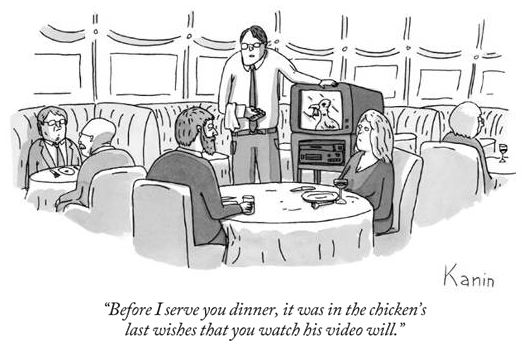
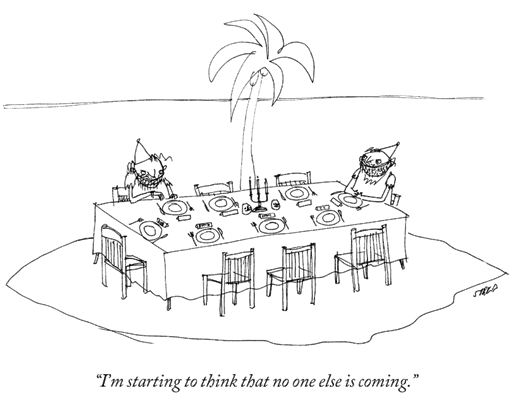
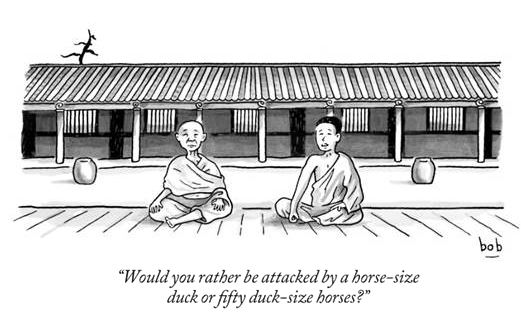

Harry Newton who did something really naughty: He fed Rosie corn. She loved it. This morning she threw it all up, undigested — in the middle of our bed. Giving corn to Rosie is not a good idea. Susan is not happy. Bad Harry.

If you check back you will see that in the past few years the markets have rallied in the last few days of June and into July. Maybe this year also.
I’m guessing David Glackin has not coached any Wimbledon winners. “Wait, be a little late” is bad advice for tennis or investing. “A little late” in investing will usually translate to interminable waiting, which is why almost all investors missed the run up post 2008-09.
We’re not talking about coaching Wimbledon winners. We’re talking about fixing my backhand which I hit too early. What are you doing in today’s blood bath?
Nothing, except moving a tiny bit out of bond funds. (I’ve already moved much out.) If equities fall another couple of percent after their already 1.7 percent drop on Monday, I’ll start nibbling at oversold stocks.
I too am going to Europe. How do I turn off your notices?