This morning I listened to CNBC’s discussion on The New Normal –what Pimco’s calling it. New debt financing old debt. More recovery in the U.S. Good news from China. Weakness in Europe and in the Euro.
The big guest was Ken Rogoff, Harvard professor and author of a new book “This Time is Different — Eight Centuries of Financial Folly.”

In its early days as a nation state, Rogoff reports, France defaulted eight times on its sovereign debt. And that was before it joined the EU.
I quickly read the introduction on Amazon and my fast conclusion is: We’ve been here before. With one difference. In the old days countries defaulted. Now they get bailed out with other people’s debt. Spain bailed out Greece. This won’t work long-term. We’ll have more financial crises in the next few years. Hence, gold appeals.
Biotech is actually picking up steam. Finally. Two things I know about biotech: First, it takes a huge amount of time and money (and a big, bumpy frustrating road) to get a drug or a product approved by the FDA. Figure ten years. Second, when it does get approved, the sky’s the limit on valuation. From millions to billions overnight.
I’ve owned Ziopharm Oncology for eons. It’s finally started to move:
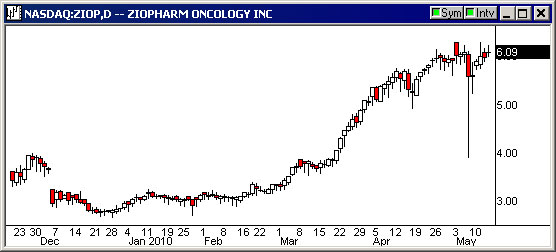
On the basis of a couple of phase III trials, some analysts say it will be $10 soon. I pray daily.
My friend Freddie Golino likes Radient Pharmaceuticals. Says Freddie, “It may get FDA approval for a general cancer screening kit by year’s end.”
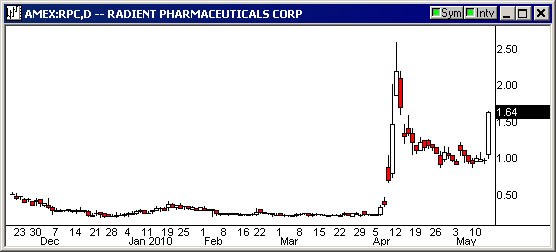
A recent paid financial news story reads:
Goldman Small Cap Research Initiates Coverage of Radient Pharmaceuticals Corporation
BALTIMORE, May 13, 2010 (GlobeNewswire via COMTEX) — Goldman Small Cap Research, a stock market research firm focused on the small cap and micro cap sectors, has initiated research coverage of Radient Pharmaceuticals Corporation (RPC 1.64, +0.66, +67.36%) , a leading early stage cancer/oncology in-vitro diagnostic test kits provider.
Radient has won FDA approval for its lead product as a post-surgery colorectal cancer monitoring test and is the only approved product abroad for lung cancer detection and monitoring and as a general cancer screen. By year-end, Radient will submit an application for approval as a general cancer screen with the FDA, which would markedly expand its current billion dollar market opportunity. As part of its diagnostics focus, Radient is in the midst of monetizing non-core assets and business lines through divestitures and out-licensing.
In the Goldman Opportunity Research report on the Company, analyst Rob Goldman outlines milestone events that he believes will serve as catalysts for the Company’s shares.
“We view Radient as a stock that offers great value and potential for its existing operations, hidden but soon-to-be monetized value in its non-core assets, and home run potential with its next-gen product, should it be awarded FDA approval. A steady stream of news and events prior to FDA submission should serve as catalysts for the stock.”
To view a summary of the report or download the report in its entirety, please visit www.goldmanresearch.com.
About Goldman Small Cap Research: Led by former Piper Jaffray analyst and mutual fund manager Rob Goldman, Goldman Small Cap Research produces stock market research reports. The Firm produces research via two formats: Goldman Select Research and Goldman Opportunity Research. The Select product reflects the Firm’s internally generated stock ideas while the Opportunity product reflects sponsored research reports. While performance is tracked separately, the same coverage criteria are utilized in determining coverage of all stocks in both research formats.
A Goldman Small Cap Research report is not intended as an offering, recommendation, or a solicitation of an offer to buy or sell the securities mentioned or discussed. Please read the report’s full disclosures and analyst background on our website before investing. Neither Goldman Small Cap Research nor its parent is a registered investment adviser or broker-dealer. To download our research or for more information, visit www.goldmanresearch.com.
About Radient Pharmaceuticals Corporation: Radient Pharmaceuticals Corporation (RPC 1.64, +0.66, +67.36%) is an integrated In-Vitro Diagnostic (IVD) company devoted to the research, development, manufacturing, and marketing of diagnostic products. Radient’s primary focus is on the early stage cancer/oncology diagnostic segment, with its lead product, Onko-Sure(TM). For more information, visit www.radient-pharma.com
Radient’s marketing capitalization is $48 million. Ziopharm’s is $254 million. They could both go a lot higher IF their products actually work and actually get approved. Biotech is a gamble, but I also know:
1. Big pharma desperately needs new product.
2. Big pharma will pay bit for new product.
3. Biotech is back in fashion.
I’ve always considered biotech for my grandchildren. Bit, since I don’t have any of them, I’m thinking of the kids as they hit middle-age.
The disaster that is Intel. I sold my Intel stock this week in disgust. I can’t believe this company. It’s sitting on over $10 billion in idle cash yet it can’t deliver product and won’t build factories to build that product. I have been waiting for eons for an Intel 17 powered Lenovo ThinkPad X201. Lenovo has no i7s processors. I write by snail mail to Paul Otellini, Intel CEO. He actually emails me: He’ll check, he says. But that was days ago. Meantime, while he’s checking, Computerworld publishes this:
IDG News Service – A shortage of the latest Intel laptop PC microprocessors worsened in April, but the chip giant says it will meet demand by the end of this quarter.
The shortfall comes at a bad time for PC vendors because laptops have been selling briskly so far this year, and analysts say the shortage has likely caused some companies to delay the rollout of new models.
The shortage involves the same chips analysts and companies fretted about last month, Intel’s Arrandale laptop microprocessors, including some Core i3 and Core i5 chips.
“We saw the full force of the Intel Arrandale shortage [in April],” said U.S. chip distributor Converge, in a monthly research report. …
Intel’s Arrandale processors are designed so PC vendors can create slimmer laptops. They come in a two-chip package that includes an Arrandale processing core made using 32-nm production technology and a graphics processor made using 45nm technology.
Some companies have adapted to the shortage by using older Intel laptop chips in their devices, but one executive who asked not to be named, said that’s a losing strategy. “People always want the latest technology. They will make sure they’re getting the newest chips, or they won’t buy the laptop,” he said. …
Global PC shipments surged 24.2% in the first three months of this year, with both desktop and laptop shipments beating forecasts, according to IDC. The market researcher predicts PC shipments will grow by more than 15% this year.
All this demand would have been great for my Intel stock, had Intel got its act together. My friend, the analyst, writes me, “They had $10 billion of cash on their balance sheet and were making money even at the trough. They simply didn’t invest in enough capacity. Everyone made the same mistake. They had a chance to be leaders. Leading is hard.”
Paul, my new laptop ain’t cheap. I’m paying nearly $2,000 it. Your chip costs $332, according to your web site. So sell me or sell Lenovo just one little i7 microprocessor.
Why piss off a long-time customer?
Dedicated to Paul Otellini, Intel CEO, from the New Yorker:
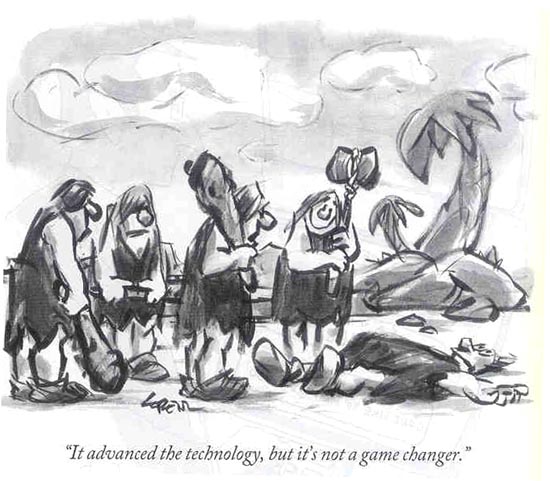
Paul, your chip is not a game changer. My present Intel-powered ThinkPad X200 works just fine. But my new ThinkPad X201 powered by your new Intel i7-620 processor will be a lot faster — if you can ever deliver.
My daughter wonders about her marriage. Claire emails me, “And let’s be honest, its amazing Ted and I have lasted this long without this amazing piece of technology!”


Harry Newton, who continues to like gold.

Firms like Goldman issue “research” that is paid for by the company being researched. Some would call them pr shills. Typically, they choose names that evoke one of the first-string big guys. Another that I've seen calls themselves J M Dutton (think Hutton.) …If only my name were Stanley Morgan.
BTW, love your blog.
Is Apple having the same i5/i7 processor problem with their new computers/notebooks?
I don't know if Apple is having the same problem, though I suspect not. It is a far better managed company than either Inel or Lenovo. When industry turned down in 2008/2009, many companies got ultra-scared, sat on their hands and did nothing. They feared the end of the world was at hand.It wasn't.. When demand came back they lacked the production and management capacity to deal with it. Hence, I'm sitting here awaiting some kind fellow in Intel or Lenovo to find one i7 processor and sell me my new laptop. The upshot of today's column (I'm writing this nearly 12 hours after I published the column) is absolutely nothing. Lenovo's salespeople are on permanent voice mail. And Mr. Paul Otellini no longer replies to his emails. This is a sad day for American and Chinese industry — Lenovo is owned by the chinese by populated by a bunch of scared American middle-managers..