We had our regular investment club meeting yesterday. Items:
+ Despite the recent stockmarket runup, there’s still oodles of money on the sidelines and and oodles of skeptics.
+ Opportunities in real estate and new company startups are coming out of the woodwork. Finding them means aggressively pursuing sources. And then deciding very quickly. The good stuff is snapped up unbelievably quickly these days.
+ Management is key. Some is awful. Some is great. Yo must walk from bad management. Use my old motto: When in doubt, stay out. And if you don’t control it — which you won’t — don’t put more in than you can afford to lose.
+ Running your own business is still the ONLY way to go. There are plenty of people around to help, including a growing number of support groups aimed at CEOs.
No one knows it the markets are overpriced. Everyone agrees with Buffett. Someone are overpriced. Some aren’t. It’s your choice.
New hot IPOs coming this morning include FireEye and Rocket Fuel. One recent really hot IPO was BenefitFocus (BNFT). It’s already doubled.
Why you shouldn’t put money into money market funds. I wrote about this yesterday. Here’s more proof. Click here.
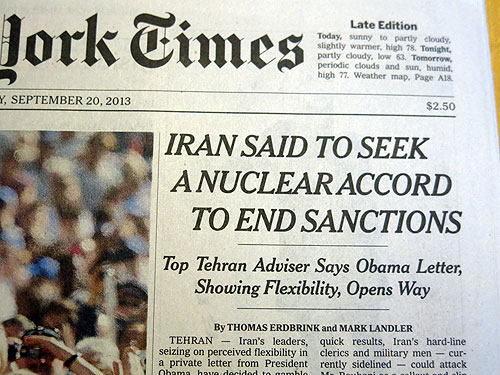
My God. another country we may not have to bomb. Our sanctions are working. the good news from the middle east continues to flow. today’s Times:
The buzz has turn in Apple’s favor. The new iPhones 5S and 5C go on sale this morning. There are large lines outside Apple stores. I’ll pop by the upper west side store at lunchtime and (hopefully) pick up a black iPhone 5S with 32 gigs of memory. It will cost me over $800 (with tax). I’ll play with it this weekend and report on my personal feelings Android vs Apple. My initial feelings:
+ iPhones need fewer clicks to get done what you want. On the other hand, you have more options with Android.
+ Apple’s App Store has more stuff than Android’s does. But generally you’ll find what you want (and use) on either.
+ The issue is less which phone, and which carrier? Sadly, the most expensive — Verizon — is still the best for widespread high-speed Internet coverage.
+ The most useful feature (at least in my book) is a high-speed Hot Spot. Use your cell phone to provide Internet access to your laptop. The newer phones all that the Hot Spot. But there are issues. For example, T-Mobile’s coverage is only strong inside cities. Outside, it often relies on AT&T for “roaming.” But it won’t provide you a Hot Spot when you’re roaming, since AT&T charges T-Mobile a hefty fee.
Famed tech writer I, Cringely has an interesting piece on where Apple might be going. Hint: it’s pretty positive for Apple:
The Innovator’s Dilemma, a 1997 book by Harvard professor Clayton Christensen, made the point that successful companies can lose their way when they pay too much attention to legacy products and not enough attention to new stuff. They are making so much money they either don’t see a competitor rising up or are too complacent to feel threatened. In either case the incumbent generally loses and the upstart (usually one of many) generally wins. The best way for successful companies to avoid this problem is by inventing the future before their competitors do.
We see this pattern over and over in high tech. Remember Lotus? Remember Word Perfect? Remember Borland? And it’s not just in software. Remember IBM sticking too long with the 80286 processor? Remember the Osbourne Executive?
Microsoft certainly faces this dilemma today, having nothing with which to replace Windows and Office. Some say Apple, too, is living now on the wrong side of the innovation curve, but I don’t think so. I think Cupertino has a plan.
When Apple announced its iPhone 5c and 5s mobile phones I alluded to having an idea of some broader strategy Cupertino had in mind for the devices, especially the iPhone 5S. Here are the clues I am working from:
1) Tim Cook was clear to claim the iPhone 5S had a “workstation-class 64-bit processor.”
2) iWork is now free on all new iOS devices.
3) iOS 7 has, for the first time, support for not just Bluetooth keyboards but Bluetooth mice as well.
4) There’s a new Apple TV of some sort coming anytime now.
Here’s what I think is happening. At the very moment when Apple critics are writing-off the company as a three- or four- or five-hit wonder, Apple is embracing the fact that desktop computers only represent about 15 percent of its income, making Apple clearly a mobile technology company. As such, it is more important for Apple to expand its mobile offerings than its desktops. So Apple in a sense is about to make the Macintosh deliberately obsolete.
This doesn’t mean Apple is going out of the Mac business. Why would they drop a hardware platform that still delivers industry-leading profit margins? But a growing emphasis from here on out will be the role of iOS on the desktop.
I see the iPhone 5S and whatever follows as logical desktop replacements. They, and phones like them, will be the death of the PC.
Jump forward in time to a year from today. Here’s what I expect we’ll see. Go to your desk at work and, using Bluetooth and AirPlay, the iPhone 5S or 6 in your pocket will automatically link to your keyboard, mouse, and display. Processing and storage will be in your pocket and, to some extent, in the cloud. Your desktop will require only a generic display, keyboard, mouse, and some sort of AirPlay device, possibly an Apple TV that looks a lot like a Google ChromeCast.
That’s what I have running in the picture on this page, only with my iPhone 5 and iOS 7. A year from now I expect the apps will detect and fill the larger screen. And that Mac-in-your-pocket will have not only iWork installed, but also Microsoft Office, which Microsoft will be forced to finally release for iOS. Apple making iWork free on new devices — devices powerful enough for this desktop gambit — guarantees that Microsoft will comply.
Go home and take your work with you. Go on the road and it is there, too. IT costs will drop for businesses as desktop PCs are replaced. Having a desktop at home will cost in the $200 range, bringing costs for home IT down, too.
Why would Apple do this? Well for one thing if they don’t Google will. For that matter Google will, anyway, so Apple has some incentive to get this in the market pronto.
There are other reasons why Apple would do this. For one thing it is much more likely to hurt the PC market than the Mac market, since pocket desktop performance probably won’t be there for Apple’s core graphics and video markets. Mac sales might actually increase as sales are grabbed from faltering Windows vendors.
But in the end it doesn’t really matter to Apple what happens to the Mac since they are a phone company now. And by embracing their phone-i-ness, Apple will be giving its mobile business a huge boost. Want an iPhone desktop? That will require a new phone, probably sooner than you would otherwise have upgraded. If you are thinking of this new phone as your total computing environment, albeit backed-up to the cloud, you’ll be inclined to spend more on that phone, opting for the maximum configuration. Apple makes a higher profit on maxed-out iPhones than on base phones. And instead of upgrading your desktop every 2-3 years, you’ll now be doing it every 1-2 years.
But wait, there’s more! This desktop gambit completely bypasses Wintel. There’s no pro-Windows bias in the phone market. If anything there’s an anti-Windows bias, so Apple will be playing to its strength. This will be a huge blow to Microsoft, Windows, and Office, yet Redmond will lean into it in an attempt to save Office. Either that or die.
This is a chance for Apple to reinvent the desktop exactly as they reinvented the music player, the mobile phone, and the tablet. For those who say Apple can’t do it again, Apple is already doing it again.
Ironically, for all the stories I’ve been reading about the death of the desktop, this strategy I am laying-out guarantees a desktop resurgence of sorts — only one that won’t help Dell or HP a bit.
Now take this idea one step further. There’s an opportunity here for Apple to promote yet another hardware platform — a mobile interface to go with that iPhone. This is a device I seriously considered doing myself for Android a couple years ago but the performance just wasn’t yet there.
You see for all the advantages of having a desktop in your pocket, we really prefer larger displays and even keyboards to do actual work. Tablets have their place, but that place is not everywhere. Commodity desktop peripherals are easy to provide at work and home but much more difficult on the road. Use an iPad to give a bigger screen to your iPhone? That doesn’t make sense. So I expect Apple to build for road warriors a new class of devices that have the display, keyboard and trackpad of a notebook but without the CPU, memory or storage. Call it a MacBook Vacuum, because it’s a MacBook Air without the air.
More likely, since it’s an iOS device, Apple will call this gizmo an iSomething. It will be impossibly strong and light — under a pound — the battery will last for days, and it ought to cost $199 for 11-inch and $249 for 13-inch, but Apple being Apple they’ll charge $249 and $349.
What I’m predicting, then, is an Apple resurgence. But let’s understand something here: this is yet another product class that Apple will dominate for awhile then eventually lose. It’s a 3-5 year play just like the iPod, iPhone, and iPad. Google and Amazon will be in hot pursuit, each more willing than Apple to pay to play. Cupertino will have yet another dilemma a few years from now and possibly another revolution to foment after this one if they can think of something new. They’ll need it. Still I see happy days ahead for Apple with iOS 7 and the legacy of Steve Jobs preserved for now.
Apple is the cover story on this weekend’s BusinessWeek:

Textile manufacturing is returning to the U.S. From today’s heartwarming New York Times story (click here)
Mr. Winthrop says American manufacturing has several advantages over outsourcing. Transportation costs are a fraction of what they are overseas. Turnaround time is quicker. Most striking, labor costs — the reason all these companies fled in the first place — aren’t that much higher than overseas because the factories that survived the outsourcing wave have largely turned to automation and are employing far fewer workers.

Harry Newton who’s enjoying having his only sister in town. She’s healthy, and happily married for 41 years. Her husband is a hoot. We’ve done the tourist thing in New York in recent days: Walking. Here’s Central Park taken from Central Park South, late yesterday afternoon.


White clouds have a black lining and black clouds have a silver lining. “because the factories that survived the outsourcing wave have largely turned to automation and are employing far fewer workers.” Dandy, but that also gives us the “jobless recovery.” The same high fuel prices that are hobbling the US economy are responsible for raising the transportation costs to China. Chinese jobs move to the US, so China can no longer afford to buy US bonds. You can not do “Just One Thing.”
Mr. Newton:
Many thanks. I appreciate the Innovation education this morning!!!